

Introduction: When Convenience Meets Clinical Reality
Benign prostatic hyperplasia (BPH) and erectile dysfunction (ED) are not merely age-associated inconveniences; they represent a complex intersection of vascular, neurological, hormonal, and psychological processes. As men age, these two conditions increasingly coexist, often reinforcing each other in ways that significantly impair quality of life. What complicates management further is not a lack of effective pharmacological options, but rather the challenge of maintaining long-term adherence to therapy.
Modern urology has made notable progress by introducing fixed-dose combinations (FDCs) that target multiple mechanisms simultaneously. Among these, the combination of tadalafil 5 mg and tamsulosin 0.4 mg represents a rational pharmacologic union: one improves smooth muscle relaxation via phosphodiesterase type 5 inhibition, while the other reduces bladder outlet resistance through α₁-adrenergic blockade.
Yet clinical effectiveness is not determined solely by pharmacodynamics. Real-world outcomes depend heavily on whether patients continue therapy long enough to experience its benefits. Persistence, not prescription, is often the true therapeutic challenge.
This article explores treatment persistence with a fixed-dose combination of tadalafil and tamsulosin, examining why patients discontinue therapy, who is most at risk of doing so, and what clinicians can learn to improve long-term outcomes.
The Clinical Logic Behind Combining Tadalafil and Tamsulosin
Lower urinary tract symptoms (LUTS) and erectile dysfunction frequently coexist because they share overlapping pathophysiological pathways. Pelvic ischemia, endothelial dysfunction, autonomic hyperactivity, and nitric oxide dysregulation form a common biological backdrop. Treating these conditions in isolation may relieve symptoms partially but often fails to address the broader dysfunction.
Tamsulosin acts primarily by reducing smooth muscle tone in the prostate and bladder neck, thereby improving urinary flow and relieving voiding symptoms. Tadalafil, by enhancing nitric oxide–mediated vasodilation, improves erectile function and contributes modestly to lower urinary tract symptom relief.
When combined, these agents theoretically offer complementary benefits: improved voiding, enhanced sexual function, and potentially better patient satisfaction. Fixed-dose combinations further simplify therapy by reducing pill burden—an especially relevant advantage in older men frequently managing multiple comorbidities.
However, pharmacological elegance does not guarantee real-world success. Adherence depends not only on efficacy but on tolerability, expectations, and patient experience.
Understanding Treatment Persistence: More Than Just Compliance
Persistence refers to the duration of time a patient continues prescribed therapy. Unlike adherence—which reflects how well dosing instructions are followed—persistence captures whether treatment is sustained at all.
In real-world settings, persistence often declines rapidly, especially when medications are used for chronic, non–life-threatening conditions. Symptoms fluctuate, expectations rise, and side effects—even mild ones—become disproportionate in the patient’s decision-making process.
In the context of fixed-dose tadalafil–tamsulosin therapy, persistence becomes a particularly valuable outcome measure because the treatment is intended for long-term use, not episodic relief. Evaluating persistence therefore offers insight into the true clinical utility of the combination.
Real-World Persistence: What the Evidence Shows
In a real-world observational setting involving men with coexisting LUTS and ED, approximately half of the patients discontinued fixed-dose tadalafil–tamsulosin therapy within six months. While this figure may appear discouraging, it reflects a realistic clinical landscape rather than an artificial trial environment.
Persistence declined progressively over time. The steepest drop occurred within the first three months, suggesting that early experiences—particularly side effects and perceived efficacy—play a decisive role in determining long-term continuation.
Interestingly, age emerged as a significant predictor. Younger patients were more likely to discontinue therapy, while older individuals demonstrated greater persistence. This finding challenges the common assumption that younger patients are more tolerant or adaptable and suggests that expectations may be higher and patience lower among younger men.
Equally important was prior treatment exposure. Patients previously familiar with alpha-blockers or phosphodiesterase inhibitors were significantly more likely to continue therapy than treatment-naïve individuals. Experience appears to foster tolerance—not merely physiologically, but psychologically.
Why Patients Stop: Beyond the Prescription Pad
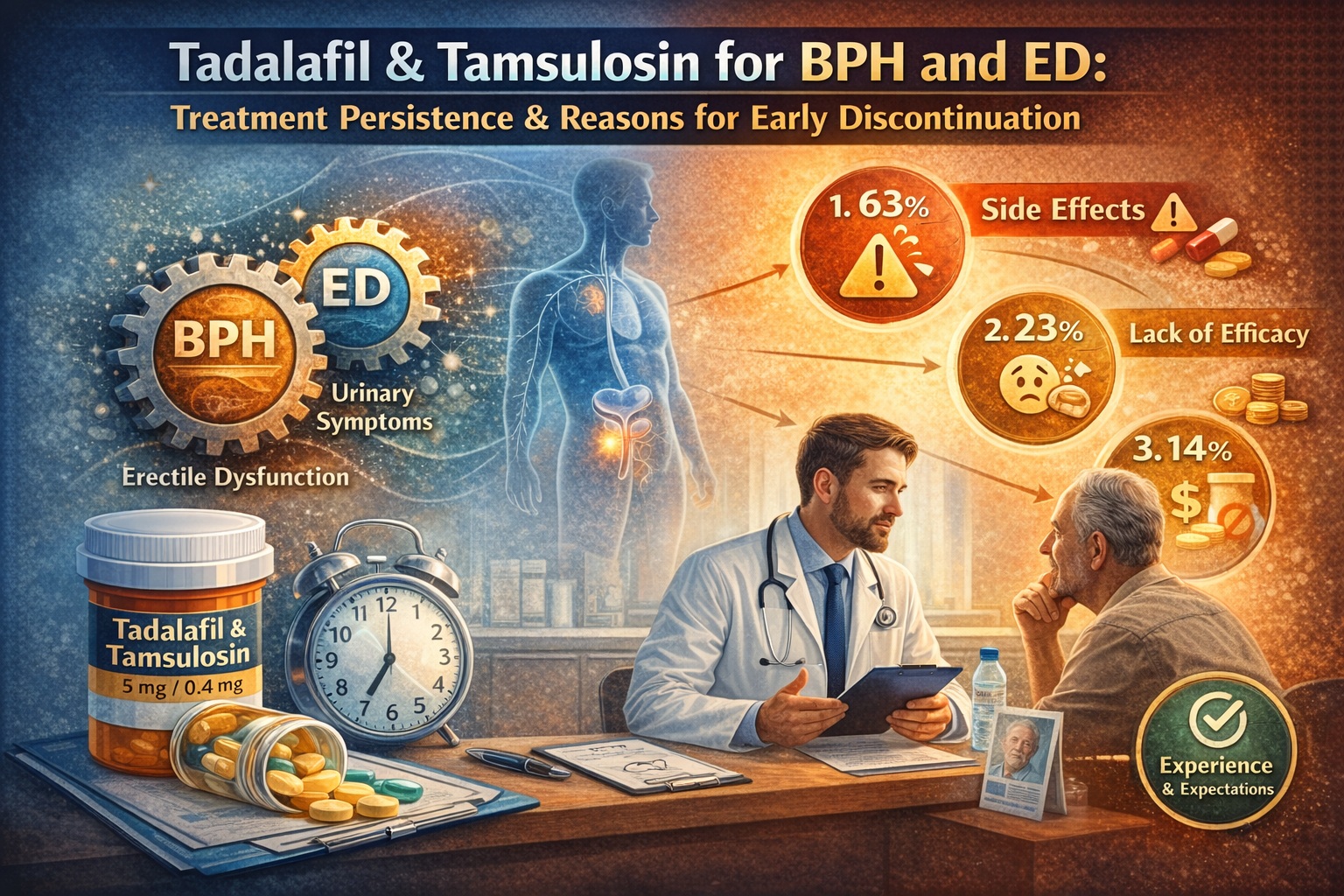
The most common reason for discontinuation was adverse effects. While most side effects were mild and non–life-threatening, their subjective impact was substantial.
Ejaculatory dysfunction emerged as the leading cause of discontinuation. Although often underappreciated in clinical conversations, changes in ejaculation can be distressing and identity-altering for patients. For many men, especially those who remain sexually active, this side effect outweighs improvements in urinary symptoms.
Other reported adverse effects included dizziness, headache, nasal congestion, and orthostatic symptoms. These effects, while generally transient, may erode patient confidence during the early phase of treatment.
Perceived lack of efficacy was the second most common reason for discontinuation. Notably, this perception was not always aligned with objective symptom improvement. This discrepancy highlights the psychological dimension of treatment response: patients may abandon therapy not because it fails, but because it fails to meet expectations quickly enough.
Cost and inconvenience played smaller but still relevant roles, particularly in healthcare systems where medication expenses are borne by the patient.
The Role of Patient Expectations and Prior Experience
One of the most clinically instructive findings is the difference between treatment-naïve and treatment-experienced patients. Those with prior exposure to alpha-blockers or PDE5 inhibitors were significantly more likely to persist with combination therapy.
This suggests that familiarity breeds tolerance—not complacency, but understanding. Patients who have already navigated mild side effects or gradual symptom improvement are less likely to misinterpret early discomfort as treatment failure.
In contrast, treatment-naïve patients may approach therapy with unrealistic expectations, anticipating rapid and complete symptom resolution. When this does not occur, disappointment can override rational appraisal of benefit.
This highlights a crucial yet often overlooked therapeutic intervention: education.
The Clinician’s Role: Framing Expectations and Enhancing Persistence
Physicians play a decisive role in shaping treatment outcomes long before the first pill is taken. Effective counseling can recalibrate expectations, normalize early side effects, and frame therapy as a process rather than an instant solution.
Explaining that urinary and sexual symptoms often improve gradually—and sometimes independently—helps prevent premature discontinuation. Discussing potential side effects openly, rather than defensively, builds trust and resilience.
Moreover, identifying patients likely to struggle with persistence allows clinicians to individualize therapy. Younger patients or those new to pharmacologic treatment may benefit from closer follow-up, dose titration, or even initial monotherapy before transitioning to combination treatment.
In this context, the fixed-dose combination should not be viewed as universally appropriate, but rather as a strategic option for selected patients.
Clinical Implications and Broader Perspectives
The findings surrounding tadalafil–tamsulosin persistence reflect a broader truth in modern medicine: efficacy without adherence is functionally meaningless.
As healthcare systems increasingly emphasize real-world outcomes, understanding behavioral and experiential factors becomes as important as understanding molecular mechanisms. The success of a therapy is no longer defined solely by its performance in randomized trials, but by its survivability in daily life.
This perspective invites a more nuanced approach to guideline-based care—one that recognizes patient individuality, acknowledges inconvenience as a legitimate barrier, and values shared decision-making.
Conclusion: Optimizing Therapy Beyond Pharmacology
Fixed-dose tadalafil–tamsulosin therapy offers a rational and effective option for men with concomitant LUTS and erectile dysfunction. However, its real-world effectiveness is constrained by treatment persistence, which is shaped less by pharmacology and more by human experience.
Patients who are older, treatment-experienced, and well-informed are more likely to benefit from this therapy. Conversely, younger or treatment-naïve individuals may require additional support, counseling, or alternative strategies.
Ultimately, the success of combination therapy lies not only in its molecular synergy, but in its alignment with patient expectations, tolerability, and daily life.
Medicine advances not just through better drugs, but through better understanding of the people who take them.
Frequently Asked Questions (FAQ)
1. Why do many patients stop tadalafil–tamsulosin therapy early?
Most patients discontinue due to side effects—particularly ejaculatory changes—or because they feel the treatment is not effective quickly enough.
2. Are younger patients less suitable for fixed-dose combination therapy?
Not necessarily, but younger patients tend to discontinue earlier, often due to higher expectations or greater sensitivity to sexual side effects.
3. How can clinicians improve treatment persistence?
By selecting appropriate candidates, setting realistic expectations, explaining side effects clearly, and providing early follow-up and reassurance.
