

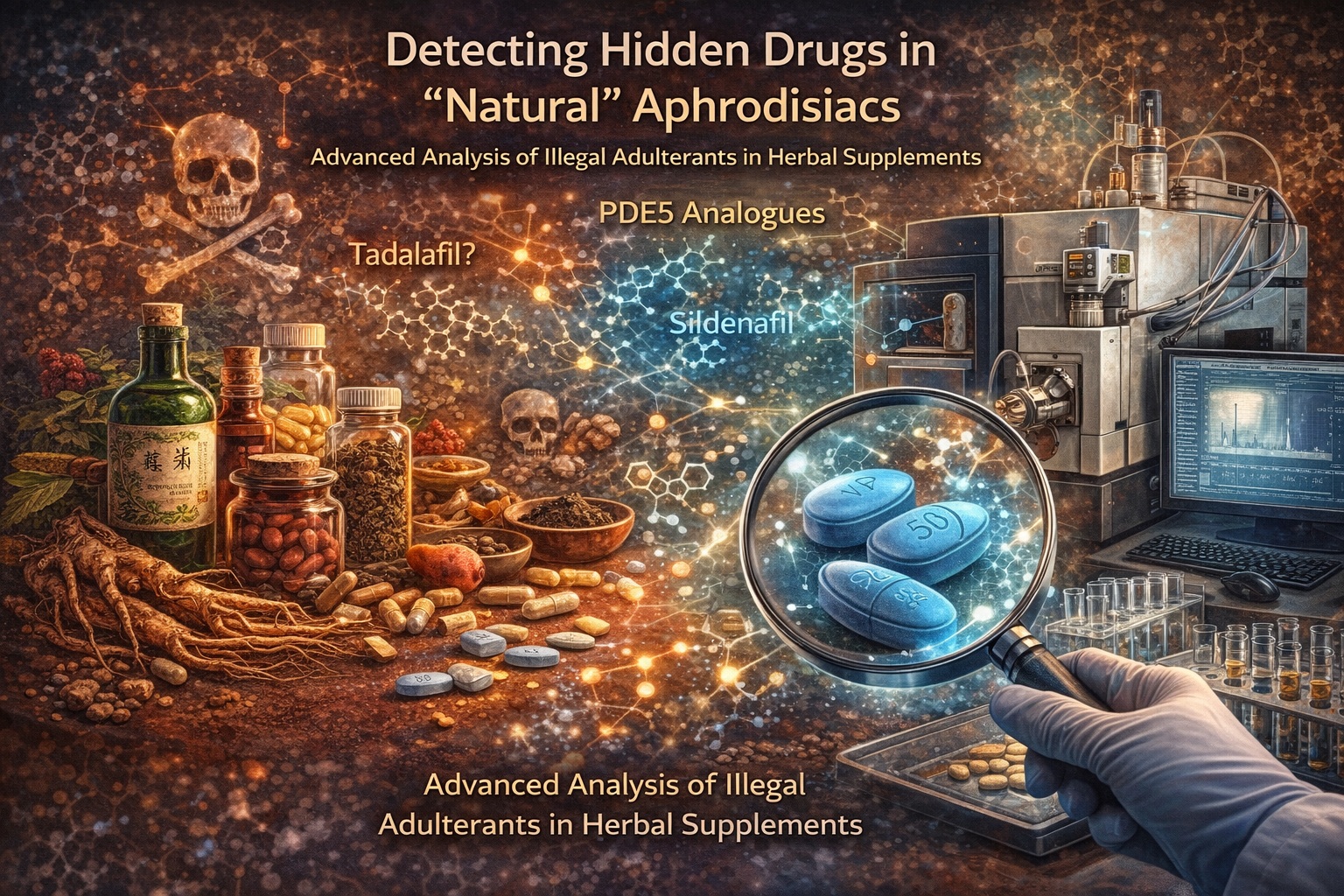
Introduction: When “Herbal” Is Not What It Seems
The global market for sexual enhancement products has expanded dramatically over the past two decades. Dietary supplements, herbal mixtures, and traditional medicines are widely marketed as “natural” alternatives to prescription drugs for erectile dysfunction. For many consumers, the appeal is obvious: perceived safety, ease of access, and the promise of improved sexual performance without medical consultation.
Unfortunately, this perception often diverges sharply from reality. A growing body of analytical evidence demonstrates that many of these products are deliberately adulterated with synthetic pharmaceutical compounds, most commonly analogues of phosphodiesterase type-5 (PDE5) inhibitors such as tadalafil. These substances are frequently undeclared, structurally modified, and sometimes poorly characterized, posing significant risks to consumers.
From a regulatory perspective, the challenge is formidable. Manufacturers may alter molecular structures slightly to evade detection, creating new compounds that retain pharmacological activity while escaping conventional screening methods. This practice has given rise to a complex and evolving landscape of illegal adulterants.
To address this problem, modern analytical chemistry has turned to powerful technologies capable of identifying multiple compounds simultaneously with high sensitivity and specificity. Among these, ultrahigh-performance liquid chromatography coupled with quadrupole time-of-flight mass spectrometry (UHPLC–QTOF-MS) has emerged as a gold standard.
This article explores the scientific principles behind this technology, its application in detecting adulterated aphrodisiac products, and the broader implications for public health and clinical practice. In doing so, it reveals a striking reality: the line between “natural supplement” and “pharmaceutical product” is often far thinner than consumers realize.
The Rise of Adulterated Aphrodisiacs: A Public Health Concern
The adulteration of health products is not a new phenomenon, but it has become particularly prevalent in the market for sexual enhancement supplements. Products marketed as herbal remedies often contain undisclosed active ingredients designed to mimic the effects of prescription medications.
The most commonly identified adulterants are PDE5 inhibitors or their structural analogues. These compounds act by enhancing nitric oxide signaling and increasing blood flow to the corpus cavernosum, thereby facilitating erection. While effective when prescribed appropriately, their unsupervised use can pose significant risks.
Manufacturers may include these compounds for a simple reason: they work. A product that produces noticeable physiological effects is more likely to generate repeat customers. However, this approach transforms a “natural” supplement into an unregulated pharmaceutical product.
The situation becomes more concerning when modified analogues are used. These compounds may differ slightly from known drugs such as tadalafil but retain similar pharmacological activity. Because their safety profiles are unknown, their use introduces additional uncertainty and risk.
Common characteristics of adulterated products include:
- Undeclared synthetic PDE5 inhibitors or analogues
- Structurally modified compounds designed to evade detection
- Variable and unpredictable dosing
- Lack of quality control and regulatory oversight
For clinicians, this creates a diagnostic challenge. Patients presenting with adverse effects may not disclose supplement use, or may believe that “natural” products cannot cause harm.
Tadalafil and Its Analogues: The Pharmacological Backbone of Adulteration
Among PDE5 inhibitors, tadalafil is particularly attractive to manufacturers of adulterated products. Its long half-life and sustained pharmacological activity make it highly effective in enhancing erectile function.
Tadalafil works by inhibiting the degradation of cyclic guanosine monophosphate (cGMP), thereby prolonging smooth muscle relaxation in penile tissue. The resulting increase in blood flow produces the desired erectile response.
From a chemical standpoint, tadalafil’s structure provides a versatile template for modification. Small changes to functional groups can produce analogues with similar activity but altered molecular signatures.
These analogues may retain the desired pharmacological effect while evading detection by routine analytical methods. However, even minor structural changes can significantly alter pharmacokinetics, metabolism, and toxicity.
In some cases, these compounds may exhibit unexpected side effects or drug interactions, particularly when taken alongside other medications such as nitrates or antihypertensives.
The presence of tadalafil analogues in unregulated products therefore represents a dual risk: pharmacological potency without medical supervision, and chemical uncertainty without safety data.
Analytical Challenges: Detecting the Undetectable
Identifying adulterated compounds in complex matrices such as herbal supplements is a technically demanding task. These products often contain a mixture of plant extracts, excipients, and multiple active ingredients.
Traditional analytical methods may struggle to detect unknown or modified compounds. Targeted approaches require prior knowledge of the substance being tested, which is not always available in cases of novel adulterants.
Furthermore, the structural diversity of PDE5 analogues complicates detection. Small modifications can significantly alter chromatographic behavior and mass spectral signatures.
This challenge necessitates analytical techniques capable of:
- Detecting multiple compounds simultaneously
- Identifying unknown substances based on molecular structure
- Providing high sensitivity and specificity
- Operating efficiently in complex sample matrices
UHPLC–QTOF-MS meets these requirements and has become a cornerstone of modern analytical toxicology.
UHPLC–QTOF-MS: A Powerful Tool for Comprehensive Screening
Ultrahigh-performance liquid chromatography (UHPLC) separates compounds based on their chemical properties, allowing individual components of a mixture to be analyzed sequentially. Compared with traditional HPLC, UHPLC offers improved resolution, faster analysis times, and greater sensitivity.
When coupled with quadrupole time-of-flight mass spectrometry (QTOF-MS), the system gains the ability to measure the mass-to-charge ratio of ions with exceptional accuracy. This enables precise identification of molecular structures.
The combination of these technologies allows for simultaneous detection of multiple adulterants, including both known and unknown compounds. High-resolution mass spectrometry provides detailed information about molecular composition, enabling researchers to identify even novel analogues.
In practical terms, the analytical workflow involves extracting compounds from a sample, separating them using UHPLC, and analyzing their mass spectra using QTOF-MS. The resulting data can be compared with reference libraries or used to infer structural characteristics.
One of the most significant advantages of this approach is its non-targeted capability. Unlike traditional methods, UHPLC–QTOF-MS can detect compounds that were not specifically anticipated.
This feature is particularly valuable in the detection of emerging adulterants, where new compounds appear regularly.
Simultaneous Detection of Multiple Adulterants
Recent analytical studies have demonstrated the ability of UHPLC–QTOF-MS to identify more than 20 different adulterants within a single analysis. These include both established PDE5 inhibitors and newly synthesized analogues.
The method allows for rapid screening of commercial products, providing comprehensive data on their chemical composition. This capability is essential for regulatory agencies tasked with monitoring product safety.
In addition to identifying known compounds, the technique can detect unexpected peaks corresponding to previously uncharacterized substances. Further analysis can then be performed to elucidate their structure.
The efficiency of simultaneous detection offers several advantages:
- Reduced analysis time compared with sequential testing
- Improved detection of complex mixtures
- Enhanced ability to identify multiple adulterants in a single product
This comprehensive approach reflects the evolving nature of the problem. As manufacturers continue to modify chemical structures, analytical methods must remain adaptable and robust.
Clinical and Regulatory Implications
The widespread presence of adulterated aphrodisiac products has significant implications for both clinical practice and public health.
From a clinical perspective, physicians should remain vigilant when evaluating patients with unexplained symptoms. Adverse effects such as hypotension, visual disturbances, or cardiovascular events may be linked to undisclosed PDE5 inhibitor exposure.
Patients should be encouraged to disclose supplement use, and clinicians should maintain a high index of suspicion when encountering atypical presentations.
Regulatory agencies face the challenge of monitoring a rapidly evolving market. The development of advanced analytical techniques such as UHPLC–QTOF-MS provides a powerful tool for identifying unsafe products and protecting consumers.
However, enforcement remains complex. Products may be distributed through online platforms, international markets, and informal supply chains, making regulation difficult.
Public education is therefore essential. Consumers must understand that “natural” does not guarantee safety, particularly in a market where pharmacological adulteration is widespread.
Conclusion: Bridging Chemistry, Medicine, and Public Safety
The detection of illegal adulterants in aphrodisiac products represents a convergence of analytical chemistry, pharmacology, and public health.
Technologies such as UHPLC–QTOF-MS have transformed our ability to identify complex mixtures of compounds, revealing a hidden layer of pharmacology within supposedly natural products.
The frequent presence of tadalafil and its analogues underscores a critical reality: many supplements are, in effect, unregulated pharmaceuticals.
For clinicians, researchers, and regulators, the challenge is not only to detect these substances but also to communicate their risks effectively.
Ultimately, the goal is to ensure that patients receive safe, effective, and transparent treatment—whether through prescription medications or regulated health products.
Because in medicine, as in chemistry, what you cannot see can still have very real effects.
FAQ
Why are PDE5 inhibitors like tadalafil found in “natural” supplements?
Manufacturers add these compounds to produce noticeable effects, improving product appeal. However, they often do so without disclosure, making the products unsafe and unregulated.
What makes UHPLC–QTOF-MS effective for detecting adulterants?
This technology combines high-resolution separation with precise mass analysis, allowing simultaneous detection of multiple known and unknown compounds in complex mixtures.
Are tadalafil analogues dangerous?
Yes. While they may have similar effects to tadalafil, their safety profiles are often unknown. Structural modifications can alter metabolism and increase the risk of adverse effects.
