

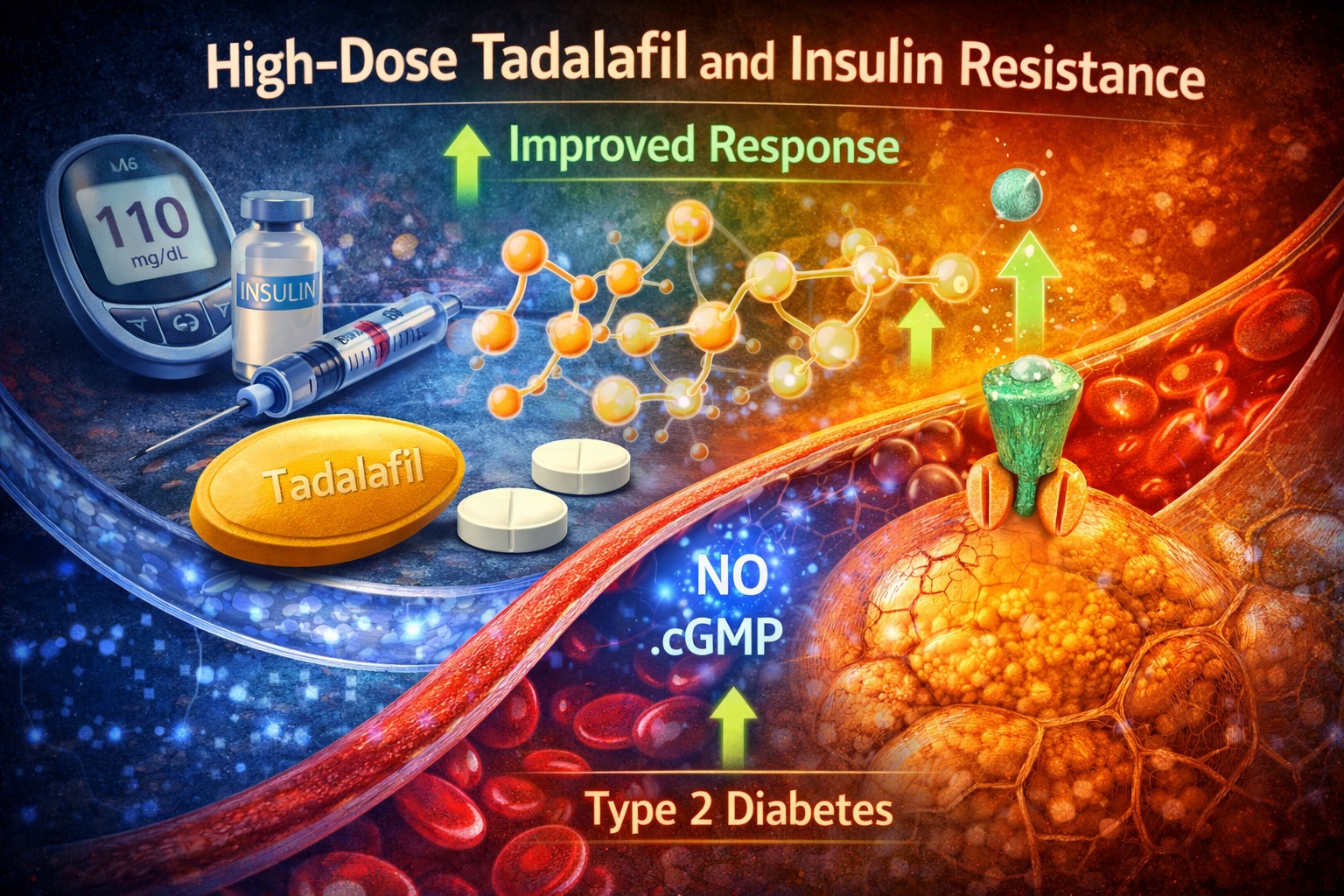
Introduction: When a Familiar Drug Enters Unfamiliar Territory
In clinical medicine, certain drugs become so closely associated with a single indication that their broader potential is often overlooked. Tadalafil, a well-established phosphodiesterase type-5 (PDE5) inhibitor, is one such example. Known primarily for its role in treating erectile dysfunction and pulmonary arterial hypertension, tadalafil has quietly attracted attention in a very different domain: metabolic disease.
Type 2 diabetes mellitus is a global health challenge characterized by insulin resistance, chronic inflammation, and progressive vascular dysfunction. While the primary focus of treatment has traditionally been glycemic control, it has become increasingly clear that improving vascular and endothelial function plays a critical role in long-term outcomes.
The MAKROTAD study represents an intriguing step in this direction. By investigating the feasibility and metabolic effects of high-dose tadalafil in patients with well-controlled type 2 diabetes, researchers have explored whether modulation of the nitric oxide–cGMP pathway can influence insulin sensitivity.
At first glance, the connection may seem unexpected. Yet upon closer examination, it becomes almost inevitable. After all, insulin resistance is not merely a metabolic problem—it is also a vascular one.
This article examines the rationale, methodology, and implications of high-dose tadalafil therapy in metabolic disease. It explores how a drug designed to improve blood flow might also influence glucose metabolism, and what this means for the future of integrated cardiometabolic care.
Insulin Resistance: A Vascular and Metabolic Intersection
Insulin resistance is a defining feature of type 2 diabetes. It occurs when peripheral tissues—particularly skeletal muscle, adipose tissue, and liver—fail to respond effectively to insulin, leading to impaired glucose uptake and elevated blood glucose levels.
Traditionally, insulin resistance has been viewed through a metabolic lens. However, growing evidence highlights the importance of vascular factors in its pathogenesis. Adequate blood flow is essential for delivering insulin and glucose to target tissues. When microvascular function is impaired, insulin delivery becomes inefficient.
Endothelial dysfunction plays a central role in this process. Reduced nitric oxide availability leads to impaired vasodilation, limiting capillary recruitment in skeletal muscle. As a result, glucose uptake is compromised even when insulin levels are adequate.
This vascular component of insulin resistance suggests that therapies targeting endothelial function may improve metabolic outcomes. Enhancing nitric oxide signaling could increase tissue perfusion and facilitate insulin action.
Thus, the intersection between vascular biology and metabolic disease provides a compelling rationale for exploring PDE5 inhibitors as potential modulators of insulin sensitivity.
Tadalafil and the Nitric Oxide–cGMP Axis
Tadalafil exerts its effects by inhibiting PDE5, thereby increasing intracellular levels of cyclic guanosine monophosphate (cGMP). This enhances nitric oxide–mediated vasodilation and improves blood flow.
In erectile tissue, this mechanism is well understood. However, PDE5 is also expressed in other tissues, including vascular smooth muscle throughout the body. This raises the possibility that tadalafil’s effects extend beyond localized vascular beds.
By improving endothelial function and increasing microvascular perfusion, tadalafil may enhance the delivery of insulin and glucose to peripheral tissues. This effect could theoretically improve insulin sensitivity.
Moreover, cGMP signaling influences intracellular metabolic pathways. It has been implicated in mitochondrial function, oxidative stress regulation, and inflammatory responses—all of which are relevant to insulin resistance.
The long half-life of tadalafil makes it particularly suitable for sustained modulation of these pathways. Unlike shorter-acting PDE5 inhibitors, tadalafil provides continuous pharmacological activity, which may be necessary for influencing metabolic processes.
In this context, tadalafil transitions from a drug that improves acute vascular responses to one that may reshape chronic metabolic physiology.
The MAKROTAD Study: Design and Scientific Intent
The MAKROTAD study was designed as a single-centre, double-blind, randomized, placebo-controlled, cross-over phase 2 trial—a structure that reflects both scientific rigor and exploratory intent.
Participants included patients with well-controlled type 2 diabetes. This selection is noteworthy, as it isolates insulin resistance from confounding factors such as uncontrolled hyperglycemia.
The cross-over design allowed each participant to serve as their own control. Patients received high-dose tadalafil during one phase and placebo during another, with a washout period in between.
This approach enhances statistical power and reduces variability, making it particularly suitable for early-phase studies exploring subtle metabolic effects.
The primary objective was to assess the feasibility and metabolic impact of high-dose tadalafil, with a focus on insulin resistance and related parameters.
By combining rigorous methodology with a targeted research question, the study aimed to provide meaningful insights into a novel therapeutic application.
Clinical Findings: Subtle Signals in Complex Physiology
The results of the MAKROTAD study highlight both the promise and the complexity of targeting insulin resistance through vascular mechanisms.
High-dose tadalafil was generally well tolerated, confirming the feasibility of this approach in patients with type 2 diabetes. Safety is a critical consideration, particularly when exploring off-label or novel therapeutic applications.
In terms of metabolic outcomes, the effects were nuanced. While some parameters suggested improvement in insulin sensitivity, the changes were not uniformly dramatic. This is not surprising, given the multifactorial nature of insulin resistance.
It is important to recognize that metabolic processes operate within complex networks. A single intervention may produce modest effects that become clinically meaningful only when combined with other therapies.
The study’s findings therefore should not be interpreted as definitive proof of efficacy, but rather as evidence supporting further investigation.
In clinical research, subtle signals often precede major breakthroughs.
Interpreting the Results: What Do They Really Mean?
The MAKROTAD study invites careful interpretation. Its findings suggest that tadalafil may influence metabolic pathways, but they also highlight the limitations of targeting a single mechanism in a complex disease.
Insulin resistance is influenced by numerous factors, including inflammation, adiposity, mitochondrial function, and genetic predisposition. Improving endothelial function addresses only one component of this multifaceted condition.
However, this does not diminish the significance of the findings. Instead, it places them within a broader therapeutic context. Tadalafil may serve as an adjunctive therapy, complementing existing treatments rather than replacing them.
The study also underscores the importance of patient selection. Individuals with preserved vascular responsiveness may benefit more from PDE5 inhibition than those with advanced endothelial dysfunction.
Ultimately, the results highlight a key principle of modern medicine: effective treatment often requires multi-targeted strategies.
Clinical Implications: Expanding the Role of Tadalafil
The potential metabolic effects of tadalafil raise important questions for clinical practice. Could PDE5 inhibitors play a role in managing insulin resistance? Should they be considered in patients with both erectile dysfunction and diabetes?
At present, the answers remain tentative. While the evidence is intriguing, it is not yet sufficient to support routine use of tadalafil for metabolic indications.
However, the concept itself is compelling. Many patients with type 2 diabetes also experience erectile dysfunction, making tadalafil a common part of their treatment regimen.
If the drug offers additional metabolic benefits, it could provide a dual therapeutic effect—improving both vascular and metabolic health.
This possibility aligns with the broader trend toward integrated cardiometabolic care, where treatments address multiple aspects of disease simultaneously.
Future Directions: From Hypothesis to Clinical Practice
The findings of the MAKROTAD study open the door to further research. Larger trials will be needed to confirm the metabolic effects of tadalafil and to identify patient populations most likely to benefit.
Future studies may explore combination therapies, integrating PDE5 inhibitors with established antidiabetic agents. Such approaches could amplify therapeutic effects and address multiple pathways simultaneously.
Advances in biomarker analysis may also help identify responders and non-responders, enabling more personalized treatment strategies.
As our understanding of the interplay between vascular function and metabolism continues to evolve, drugs like tadalafil may find new roles beyond their original indications.
In medicine, as in science, the most interesting discoveries often occur at the boundaries between disciplines.
Conclusion: A Familiar Drug, A New Perspective
The exploration of high-dose tadalafil in type 2 diabetes represents a shift in how we think about pharmacology. It challenges the notion that drugs are confined to a single therapeutic domain.
By targeting the nitric oxide–cGMP pathway, tadalafil influences both vascular and metabolic processes. While its primary role remains in treating erectile dysfunction and pulmonary hypertension, its potential applications may extend further.
The MAKROTAD study does not provide definitive answers, but it raises important questions—and in science, that is often the first step toward progress.
For clinicians, the message is clear: remain open to new possibilities, but grounded in evidence. For researchers, the challenge is to build upon these findings and translate them into meaningful clinical outcomes.
And for tadalafil, the journey continues—from a specialist drug to a potential player in the broader landscape of metabolic medicine.
FAQ
Can tadalafil improve insulin resistance?
Some research suggests that tadalafil may have modest effects on insulin sensitivity by improving endothelial function and blood flow, but more studies are needed to confirm this.
Is high-dose tadalafil safe for diabetic patients?
In controlled clinical settings, high-dose tadalafil has been shown to be generally well tolerated. However, its use should always be guided by a physician.
Should tadalafil be used to treat diabetes?
No. Tadalafil is not currently approved for treating diabetes. Its potential metabolic effects are still under investigation and should not replace standard antidiabetic therapies.
