

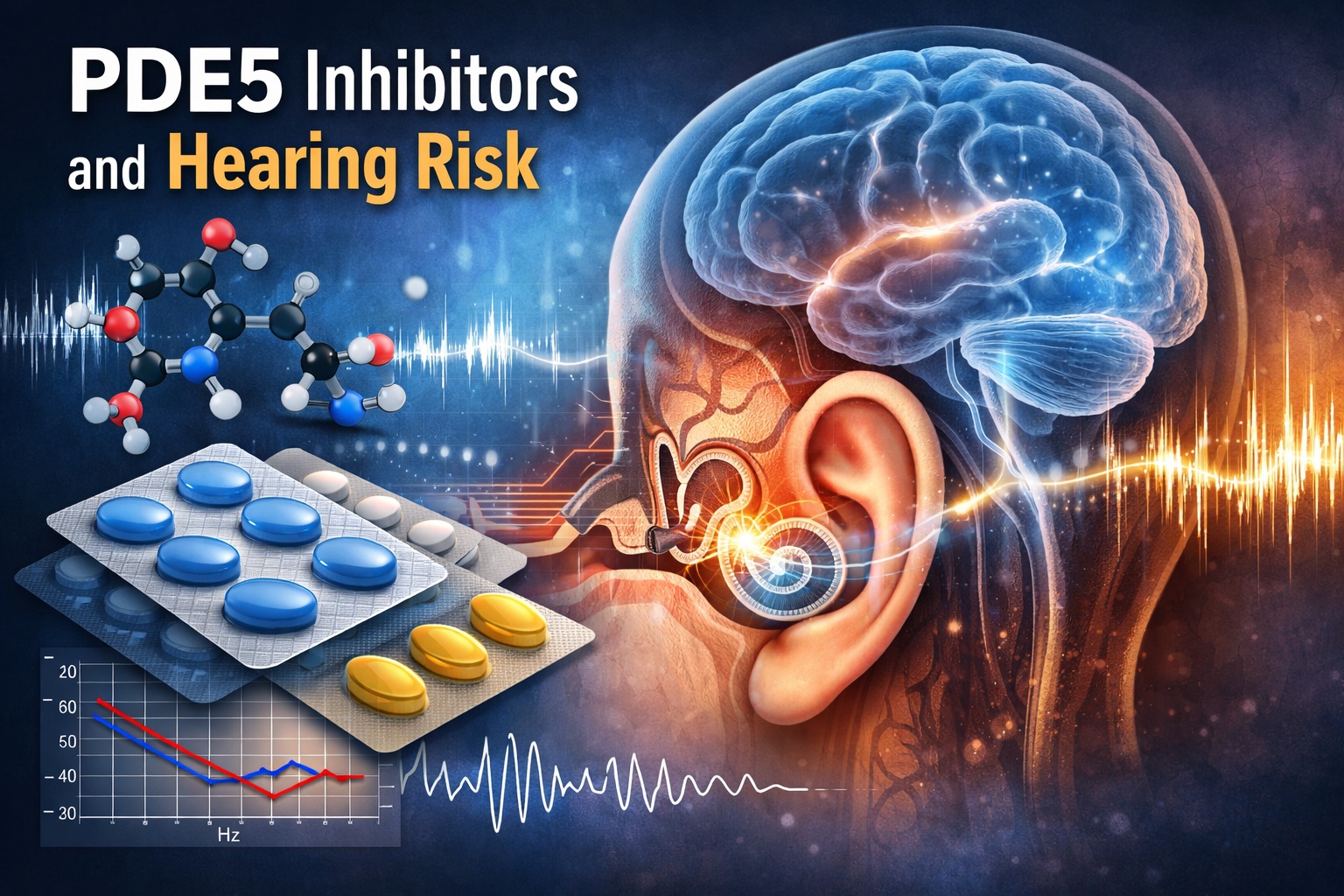
Introduction: When a Vascular Drug Reaches the Inner Ear
Phosphodiesterase type 5 inhibitors (PDE5 inhibitors) have long secured their place in clinical practice. Originally developed as vasodilators, they are now widely prescribed for erectile dysfunction, pulmonary hypertension, and even selected cardiovascular conditions. Their pharmacological profile is well understood, their efficacy proven, and their safety—at least in conventional terms—considered acceptable.
Yet medicine has a habit of revealing its subtleties only after widespread adoption. As PDE5 inhibitors such as sildenafil, vardenafil, and tadalafil became increasingly accessible, clinicians began to notice a pattern that was difficult to ignore: reports of hearing disturbances, sometimes sudden, sometimes progressive, and often unexplained.
The study under discussion introduces a more structured exploration of this issue, focusing on extended high-frequency hearing—a domain often overlooked in routine clinical assessments. Its findings suggest that the relationship between PDE5 inhibitors and auditory function may be more complex than previously assumed .
This article examines that relationship in depth, moving beyond anecdotal reports to a more nuanced understanding of potential ototoxicity, its mechanisms, and its clinical implications.
Pharmacological Context: A Drug Class with Expanding Influence
PDE5 inhibitors function by enhancing nitric oxide (NO)-mediated vasodilation through inhibition of cyclic guanosine monophosphate (cGMP) degradation. This mechanism, elegant in its simplicity, has made these drugs indispensable in conditions characterized by impaired vascular flow.
However, the NO–cGMP pathway is not confined to penile vasculature or pulmonary arteries. It is also integral to the physiology of the inner ear, particularly within the cochlea. The cochlea is a metabolically active structure, reliant on finely regulated blood flow and cellular signaling to maintain auditory function.
This overlap creates a theoretical framework for both benefit and harm. On one hand, improved microcirculation could support cochlear health. On the other, dysregulation of NO signaling may disrupt delicate cellular processes, particularly within the hair cells and supporting structures.
Tadalafil, with its longer half-life and sustained systemic activity, introduces an additional variable. While advantageous in many clinical contexts, prolonged exposure may amplify subtle physiological effects—beneficial or otherwise—within sensitive tissues such as the inner ear.
Ototoxicity: A Silent and Often Irreversible Complication
Ototoxicity refers to drug-induced damage to the structures of the inner ear, leading to hearing loss, tinnitus, or balance disturbances. Unlike many adverse drug reactions, ototoxicity is frequently irreversible, making early detection and prevention paramount.
Historically, ototoxicity has been associated with well-known drug classes such as aminoglycoside antibiotics, chemotherapeutic agents, and loop diuretics. PDE5 inhibitors have not traditionally been included in this category, largely due to limited direct evidence.
However, case reports and observational studies have begun to challenge this assumption. Instances of sudden sensorineural hearing loss following PDE5 inhibitor use have been documented, though causality remains difficult to establish. The absence of baseline auditory data in many of these cases further complicates interpretation.
The current study addresses this gap by employing a structured, pre- and post-exposure design, allowing for a more objective assessment of hearing changes associated with PDE5 inhibitor use .
Methodological Insight: Why Extended High-Frequency Audiometry Matters
Traditional hearing assessments typically evaluate frequencies between 250 Hz and 8000 Hz. While sufficient for detecting clinically significant hearing loss, this range may fail to capture early or subtle cochlear damage.
Extended high-frequency audiometry (EHFA), by contrast, examines frequencies up to 20,000 Hz. These higher frequencies are often the first to be affected by ototoxic agents, making EHFA a sensitive tool for early detection.
In the study, participants underwent EHFA before and after PDE5 inhibitor exposure, with results analyzed across multiple frequency bands. This approach allowed for a more granular assessment of auditory function and minimized the risk of overlooking early changes.
The use of EHFA represents a methodological advancement over earlier studies, many of which relied on subjective reports or less sensitive diagnostic tools. It provides a more reliable foundation for evaluating the true impact of PDE5 inhibitors on hearing.
Clinical Findings: A Pattern That Cannot Be Ignored
The study’s results are both intriguing and concerning. Individuals using PDE5 inhibitors demonstrated significantly poorer hearing thresholds compared to controls—not only after medication but even before exposure .
This finding suggests that the population using these drugs may already be predisposed to auditory dysfunction. Erectile dysfunction, the primary indication for PDE5 inhibitors, is itself associated with vascular and metabolic conditions that could impact cochlear health.
More importantly, the study observed further deterioration in hearing thresholds following drug administration. While the changes were not uniformly dramatic, they were consistent enough to warrant attention.
Interestingly, within-group comparisons did not reveal statistically significant differences between pre- and post-medication thresholds. This may reflect the short follow-up period rather than the absence of effect. Ototoxicity, particularly when mediated by subtle biochemical pathways, may require longer exposure to manifest fully.
Mechanistic Considerations: The Role of Nitric Oxide in the Cochlea
The potential ototoxic effects of PDE5 inhibitors are closely linked to their influence on the nitric oxide pathway. Within the cochlea, NO plays a complex role, contributing to both protective and potentially harmful processes.
At physiological levels, NO supports cochlear blood flow and cellular function. However, excessive NO production may lead to oxidative stress, disrupting cellular integrity and impairing signal transmission.
Experimental studies suggest that PDE5 inhibitors may alter NO dynamics within the cochlea, potentially affecting gap junctions in supporting cells such as Deiters’ cells. These structures are essential for maintaining ionic balance and facilitating auditory transduction.
The result is a delicate balance. Too little NO impairs perfusion; too much may damage cellular structures. PDE5 inhibitors, by modulating this pathway, may inadvertently tip the balance in susceptible individuals.
Clinical Interpretation: Association, Causation, and Caution
One of the most challenging aspects of this research is distinguishing between association and causation. The observed hearing impairment in PDE5 inhibitor users may reflect underlying health conditions rather than direct drug effects.
Nevertheless, the consistency of findings across multiple studies—including reports of sudden hearing loss and changes in otoacoustic emissions—suggests that the drugs themselves may play a contributory role.
From a clinical perspective, this uncertainty necessitates caution. While the benefits of PDE5 inhibitors are well established, their potential risks—particularly in less obvious domains such as hearing—must be considered.
It would be premature to classify these drugs as definitively ototoxic. However, it would be equally imprudent to dismiss the growing body of evidence suggesting otherwise.
Implications for Practice: Monitoring What We Cannot Easily Reverse
The most practical takeaway from current evidence is the need for vigilance. Hearing loss, once established, is often permanent. Early detection, therefore, becomes the cornerstone of prevention.
Clinicians prescribing PDE5 inhibitors should consider baseline auditory assessments, particularly in patients with existing risk factors for hearing loss. Follow-up evaluations, ideally using sensitive methods such as EHFA, may help identify early changes.
Patients, too, should be informed—though not alarmed. Awareness of potential auditory symptoms, including tinnitus or changes in hearing sensitivity, can facilitate timely intervention.
The goal is not to restrict access to effective medications but to use them responsibly, with a full understanding of their potential effects.
Conclusion: A Subtle Signal in a Widely Used Therapy
PDE5 inhibitors have transformed the management of several conditions, offering effective and convenient treatment options for millions of patients worldwide. Their benefits are undeniable, their mechanisms well characterized.
Yet, as this study demonstrates, their effects may extend beyond intended targets. The inner ear, with its intricate physiology and limited regenerative capacity, may represent an unintended site of action.
The evidence for ototoxicity is not yet definitive, but it is compelling enough to warrant further investigation. Larger, long-term studies will be essential to clarify the relationship and guide clinical practice.
In the meantime, a balanced approach is required—one that acknowledges both the benefits and the potential risks of these widely used drugs. Even tadalafil, often praised for its pharmacokinetic advantages, must be considered within this broader context.
Medicine, after all, is rarely about absolutes. It is about probabilities, patterns, and the careful interpretation of emerging evidence.
FAQ: Key Questions About PDE5 Inhibitors and Hearing
1. Can PDE5 inhibitors cause hearing loss?
There is growing evidence suggesting a possible association, but causality has not been definitively established.
2. Why is extended high-frequency audiometry important?
It detects early cochlear damage that may not be visible in standard hearing tests.
3. Is tadalafil safer for hearing than other PDE5 inhibitors?
There is no clear evidence that tadalafil is safer; its longer half-life may even prolong exposure effects.
4. Should patients stop taking PDE5 inhibitors due to hearing concerns?
Not necessarily. Patients should consult their physician and consider monitoring rather than discontinuation.
5. What symptoms should patients watch for?
Sudden hearing loss, tinnitus, or a feeling of fullness in the ear should prompt immediate medical evaluation.
