

Introduction: When Pharmacology Meets Formulation Science
Tadalafil has established itself as one of the most effective and widely used phosphodiesterase type-5 (PDE5) inhibitors in modern medicine. Its long half-life, predictable pharmacokinetics, and clinical versatility make it a preferred option for treating erectile dysfunction and pulmonary arterial hypertension. Yet even a well-established drug can be limited—not by its pharmacodynamics, but by how it is delivered.
One of the fundamental challenges with tadalafil lies in its poor aqueous solubility. Like many lipophilic drugs, it struggles to dissolve efficiently in the gastrointestinal environment, which can limit its absorption and delay its onset of action. For a medication often associated with time-sensitive expectations, this is not a trivial issue.
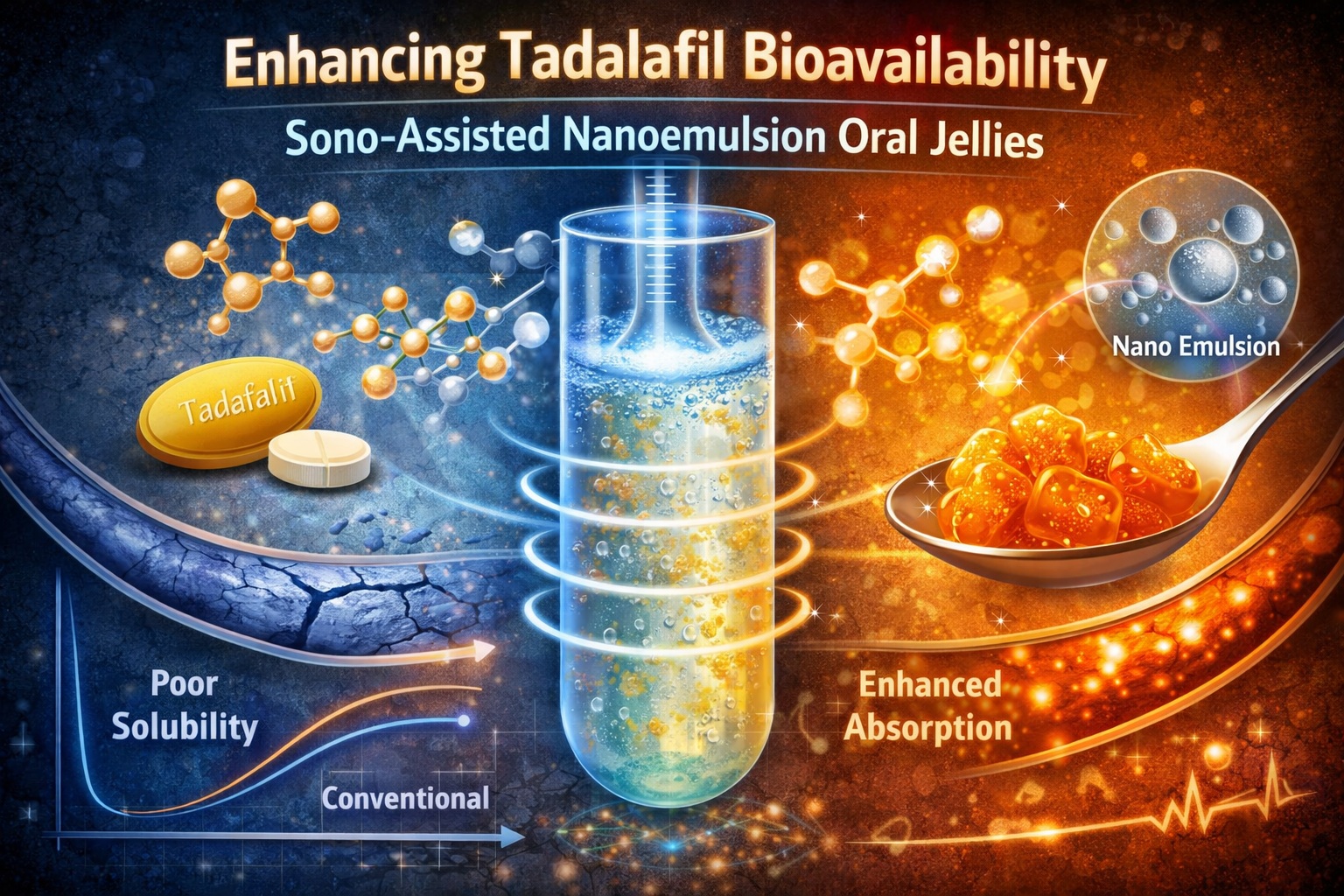
Pharmaceutical scientists have therefore turned their attention to formulation strategies capable of enhancing tadalafil’s bioavailability. Among the most promising innovations is the development of nanoemulsion-based oral jellies, particularly those produced using sonication techniques.
This approach does more than improve solubility—it redefines how the drug is presented to the body. By reducing particle size to the nanoscale and embedding the drug within a structured delivery system, researchers aim to enhance absorption, improve stability, and offer a more patient-friendly dosage form.
In this article, we explore the science behind nanoemulsion-based tadalafil delivery, the role of sono-assisted formulation, and the optimization strategies that make such systems viable. The story is one of engineering precision applied to pharmacology—and a reminder that sometimes, how a drug is delivered matters just as much as what it does.
Tadalafil and the Challenge of Bioavailability
Tadalafil’s pharmacological success is well established, but its physicochemical properties present inherent challenges. The drug is highly lipophilic, with limited solubility in aqueous environments such as the gastrointestinal tract.
This low solubility translates into variable and sometimes suboptimal absorption. After oral administration, only a portion of the administered dose is absorbed efficiently, while the remainder may pass through the system without contributing to therapeutic effect.
In clinical terms, this can manifest as delayed onset of action or variability in patient response. While tadalafil’s long half-life compensates for some of these limitations, improving its bioavailability remains a desirable goal.
Traditional formulation approaches, such as tablets and capsules, offer limited flexibility in addressing these issues. The drug’s dissolution rate is constrained by its physicochemical properties, and increasing the dose is not always a practical or safe solution.
This challenge has driven the exploration of advanced delivery systems designed to enhance solubility and absorption at a fundamental level.
Nanoemulsions: Small Droplets, Big Impact
Nanoemulsions are colloidal systems consisting of oil, water, and surfactants, with droplet sizes typically ranging from 20 to 200 nanometers. At this scale, the surface area of the dispersed phase increases dramatically, enhancing interaction with biological membranes.
For lipophilic drugs such as tadalafil, nanoemulsions offer several advantages. The drug can be dissolved within the oil phase, effectively bypassing the need for dissolution in the aqueous environment of the gastrointestinal tract.
The small droplet size facilitates rapid absorption, as nanoparticles can more easily penetrate mucosal barriers and interact with epithelial cells. This leads to improved bioavailability and potentially faster onset of action.
Additionally, nanoemulsions can enhance drug stability by protecting the active compound from degradation. The structured environment of the emulsion shields the drug from external factors such as pH variations and enzymatic activity.
In practical terms, nanoemulsions transform tadalafil from a poorly soluble compound into a readily absorbable system, optimizing its pharmacokinetic profile.
Sono-Assisted Formulation: Precision Through Energy
Creating stable nanoemulsions requires precise control over droplet size and distribution. One of the most effective methods for achieving this is sonication, a process that uses ultrasonic energy to break down larger droplets into nanoscale particles.
During sonication, high-frequency sound waves generate microscopic cavitation bubbles within the liquid. When these bubbles collapse, they produce intense localized energy, effectively fragmenting oil droplets into smaller units.
This process allows for the formation of highly uniform nanoemulsions with narrow size distributions. Uniformity is critical, as it ensures consistent drug delivery and predictable pharmacokinetics.
Sono-assisted formulation also offers practical advantages. It is relatively simple, scalable, and capable of producing stable emulsions without excessive use of surfactants.
From a formulation perspective, sonication provides a level of precision that traditional mixing techniques cannot achieve. It allows researchers to fine-tune particle size, optimize stability, and enhance the overall performance of the delivery system.
Oral Jellies: A Patient-Centric Dosage Form
While nanoemulsions address pharmacokinetic challenges, the choice of dosage form introduces an additional dimension: patient experience. Oral jellies represent a novel and increasingly popular alternative to conventional tablets and capsules.
These formulations offer several practical advantages. They are easy to swallow, require no water, and are particularly suitable for patients with dysphagia or those who prefer non-solid dosage forms.
In the context of tadalafil, oral jellies provide a convenient and discreet mode of administration. Their semi-solid consistency allows for rapid disintegration and release of the active compound.
Moreover, oral jellies can enhance patient adherence. A dosage form that is pleasant and easy to use is more likely to be taken consistently—a factor that is often underestimated in clinical practice.
By combining nanoemulsion technology with oral jelly formulations, researchers create a system that is both pharmacologically efficient and patient-friendly.
Optimization Through Box–Behnken Design
Developing an effective nanoemulsion-based formulation requires careful optimization of multiple variables. These include oil concentration, surfactant levels, sonication time, and other formulation parameters.
To achieve this, researchers employ statistical experimental designs such as the Box–Behnken design. This method allows for systematic evaluation of multiple variables and their interactions, reducing the number of experiments required.
Through this approach, optimal conditions can be identified for achieving desired outcomes such as minimal droplet size, high stability, and maximum drug loading.
The use of such statistical models reflects the increasing sophistication of pharmaceutical development. Formulation is no longer a matter of trial and error—it is a data-driven process guided by predictive modeling.
In the case of tadalafil nanoemulsions, Box–Behnken optimization ensures that the final product meets both pharmacokinetic and practical requirements.
Pharmacokinetic and Performance Advantages
The integration of nanoemulsion technology, sonication, and optimized formulation yields significant improvements in tadalafil’s performance.
Studies demonstrate enhanced dissolution rates, improved absorption, and increased bioavailability compared with conventional formulations. These improvements translate into more consistent therapeutic effects and potentially faster onset of action.
In addition to pharmacokinetic benefits, the formulation exhibits favorable stability characteristics. The nanoemulsion remains stable over time, maintaining its structure and performance under various conditions.
These advantages highlight the potential of advanced formulation strategies to overcome limitations inherent in traditional drug delivery systems.
Clinical and Future Implications
The development of nanoemulsion-based tadalafil oral jellies represents more than a technical achievement—it reflects a broader trend in medicine toward personalized and optimized drug delivery.
For patients, this innovation offers improved convenience, faster action, and potentially better therapeutic outcomes. For clinicians, it provides an additional tool for tailoring treatment to individual needs.
Looking ahead, similar approaches may be applied to other poorly soluble drugs, expanding the impact of nanoemulsion technology across multiple therapeutic areas.
The integration of nanotechnology, advanced formulation techniques, and patient-centered design marks a new era in pharmacotherapy—one in which effectiveness and usability go hand in hand.
Conclusion: Redefining Drug Delivery for Modern Medicine
The evolution of tadalafil from a conventional tablet to a nanoemulsion-based oral jelly illustrates the transformative power of pharmaceutical innovation.
By addressing fundamental challenges such as solubility and absorption, researchers have enhanced the drug’s performance while improving the patient experience.
This dual achievement underscores a key principle: the success of a medication depends not only on its pharmacological action but also on how effectively it reaches its target.
In the case of tadalafil, the journey from molecule to medicine continues—guided by science, refined by technology, and ultimately shaped by the needs of patients.
FAQ
Why is tadalafil’s bioavailability limited in traditional formulations?
Tadalafil is poorly soluble in water, which limits its dissolution and absorption in the gastrointestinal tract. This can lead to variability in therapeutic response.
How do nanoemulsions improve drug absorption?
Nanoemulsions reduce particle size and increase surface area, allowing the drug to be absorbed more efficiently through biological membranes.
What are the advantages of oral jelly formulations?
Oral jellies are easy to swallow, require no water, and improve patient compliance while enabling rapid drug release and absorption.
