

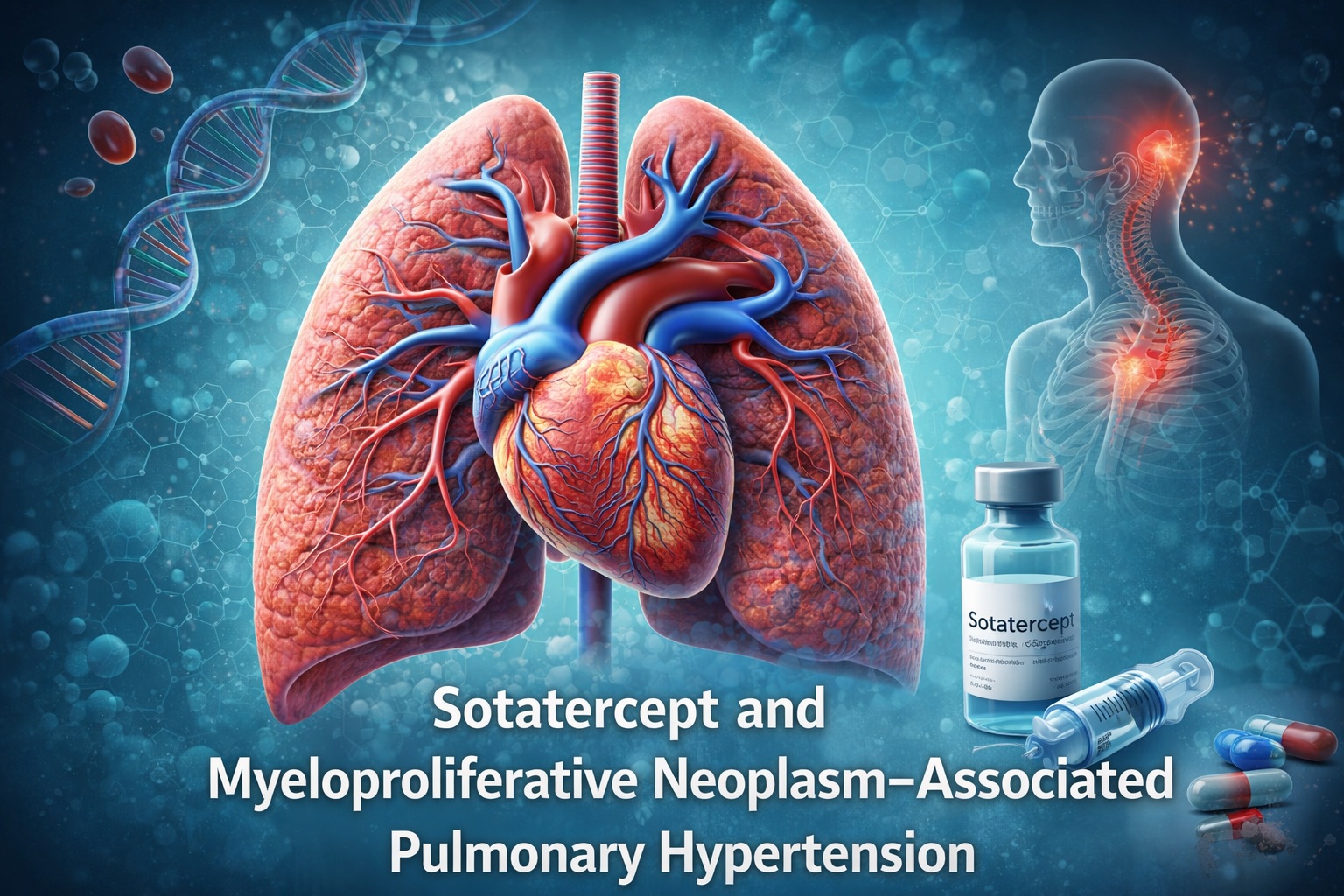
Introduction: A Disease at the Intersection of Hematology and Cardiology
Pulmonary hypertension (PH) associated with myeloproliferative neoplasms (MPNs) occupies a uniquely complex space in modern medicine. It is neither purely vascular nor exclusively hematologic; instead, it represents a convergence of proliferative signaling, hemodynamic stress, and systemic disease. Classified within Group 5 PH—conditions with multifactorial or unclear mechanisms—MPN-associated PH challenges traditional diagnostic and therapeutic frameworks.
The clinical burden is substantial. Patients with MPN who develop PH experience dramatically reduced survival compared to those without pulmonary vascular involvement. Five-year survival rates may fall as low as 34%, a stark contrast to the relatively favorable prognosis of isolated MPN . This disparity underscores a central problem: while we understand much about each disease independently, their intersection remains insufficiently explored.
Recent clinical observations, however, are beginning to reshape this narrative. The emergence of sotatercept, a novel activin signaling inhibitor, introduces not just another therapeutic option, but a fundamentally different mechanism of action. Unlike conventional pulmonary vasodilators—including agents such as tadalafil—sotatercept targets the underlying vascular remodeling process rather than simply modulating tone. The implications are profound.
Pathophysiology: Why MPN-Associated Pulmonary Hypertension Is Different
The pathophysiology of MPN-associated PH is layered, dynamic, and frequently misunderstood. At its core lies clonal hematopoiesis, driven by mutations such as JAK2 or CALR, which promote proliferative and inflammatory signaling. These molecular disturbances extend beyond the bone marrow, influencing vascular biology in ways that are only beginning to be elucidated.
Pulmonary vascular remodeling in this context is not merely a passive consequence of increased blood viscosity or thrombosis. Instead, it reflects active endothelial dysfunction and smooth muscle proliferation, mediated by pathways such as STAT3 and activin signaling. These pathways overlap with those implicated in pulmonary arterial hypertension (PAH), suggesting a shared biological substrate despite different clinical classifications .
Compounding this complexity is the heterogeneity of hemodynamic presentations. Patients may exhibit:
- Precapillary PH resembling classical PAH
- Postcapillary PH driven by heart failure
- Combined pre- and postcapillary phenotypes
This variability complicates treatment decisions. A therapy effective in one hemodynamic profile may be ineffective—or even harmful—in another. It is precisely this unpredictability that has historically limited progress in this field.
Diagnostic Challenges: When One Disease Masks Another
Diagnosing MPN-associated PH requires both technical precision and clinical suspicion. Right heart catheterization remains the gold standard, confirming elevated pulmonary artery pressures and characterizing the hemodynamic profile. However, the interpretation of these findings is rarely straightforward.
The first challenge lies in differentiation. Many patients with MPN have coexisting conditions—heart failure, thromboembolic disease, or anemia—that can independently contribute to elevated pulmonary pressures. Disentangling these overlapping mechanisms is essential but often difficult.
The second challenge is temporal evolution. As illustrated in clinical cases, patients may initially present with postcapillary PH, only to later demonstrate a precapillary component. This shift reflects the dynamic nature of the disease and underscores the need for repeated assessment.
Finally, there is the issue of under-recognition. Cultural and systemic barriers may delay evaluation, particularly when symptoms such as dyspnea are attributed to more familiar diagnoses. By the time PH is identified, significant vascular remodeling may already be established.
Traditional Therapies: The Limits of Vasodilation
Historically, treatment of PH has relied heavily on pulmonary vasodilators. PDE5 inhibitors, such as tadalafil, are among the most commonly used agents. By enhancing nitric oxide signaling, they reduce pulmonary vascular resistance and improve symptoms in many patients with PAH.
However, their role in MPN-associated PH is far less clear. The fundamental issue is that vasodilation addresses only one aspect of the disease. It does not reverse vascular remodeling, nor does it modify the underlying proliferative signaling.
Clinical observations reinforce this limitation. In one case, tadalafil was associated with worsening symptoms and increased cardiac output, contributing to high-output heart failure . In another, initial improvement was followed by rapid deterioration, highlighting the transient and sometimes unpredictable nature of its effects.
These findings do not invalidate the use of PDE5 inhibitors but rather place them in context. They are tools—useful in specific scenarios but insufficient as standalone solutions in complex, multifactorial disease.
Sotatercept: A Mechanistic Shift in Treatment Strategy
Sotatercept represents a departure from conventional paradigms. Rather than acting as a vasodilator, it targets the activin signaling pathway, which plays a central role in vascular proliferation and remodeling.
Mechanistically, sotatercept binds to activins and growth differentiation factors, restoring balance between pro-proliferative and anti-proliferative signals. This rebalancing has downstream effects on endothelial function, smooth muscle proliferation, and overall vascular architecture.
Importantly, sotatercept does not increase cardiac output—a feature that may be particularly advantageous in MPN-associated PH, where high-output states are already a concern . This distinguishes it from many traditional therapies and aligns its effects more closely with the underlying pathophysiology.
Additionally, sotatercept has hematologic benefits. By modulating SMAD signaling, it can improve anemia—a common complication in MPN. This dual action, targeting both vascular and hematologic components, is both elegant and clinically relevant.
Clinical Evidence: Lessons from Real-World Cases
The clinical cases presented in the source study provide compelling, albeit preliminary, evidence of sotatercept’s potential. In both patients, initiation of sotatercept led to rapid and sustained improvements in pulmonary hemodynamics, functional status, and laboratory markers.
In the first case, pulmonary artery pressures decreased within days, with near normalization observed over several months. This was accompanied by improved renal function, reduced NT-proBNP levels, and increased hemoglobin . Notably, hospital admissions for heart failure ceased following treatment.
The second case demonstrated a similar trajectory. Despite limited response to tadalafil and persistent cardiorenal syndrome, sotatercept produced sustained reductions in pulmonary pressures and significant clinical improvement.
The figure on page 3 of the PDF vividly illustrates these changes, showing measurable improvements in right ventricular function and hemodynamic parameters before and after treatment. The contrast is striking and suggests more than symptomatic relief—it points toward disease modification.
Mechanisms of Benefit: Beyond Hemodynamics
The rapid onset of action observed with sotatercept raises important mechanistic questions. Traditional models of vascular remodeling would predict a slower response, yet improvements were evident within days.
Several hypotheses may explain this phenomenon. One possibility is that sotatercept directly modulates vascular tone through signaling pathways that have not yet been fully characterized. Another is that early changes reflect improved endothelial function, with structural remodeling occurring over a longer timeframe.
The hematologic effects of sotatercept may also contribute. By correcting anemia, the drug reduces compensatory high-output states, thereby alleviating hemodynamic stress. However, this alone does not fully account for the magnitude of pulmonary pressure reduction.
Most compelling is the hypothesis that sotatercept targets the core pathobiology of MPN-associated PH. By interrupting pro-proliferative signaling, it may halt—or even reverse—the progression of vascular disease. If confirmed, this would represent a paradigm shift in treatment.
Clinical Implications: Rethinking Treatment Algorithms
The introduction of sotatercept necessitates a re-evaluation of current treatment strategies. Rather than relying solely on hemodynamic classification, clinicians may need to consider underlying molecular mechanisms when selecting therapy.
This approach aligns with broader trends in medicine, where targeted therapies are increasingly tailored to specific biological pathways. In the context of MPN-associated PH, this means moving beyond symptom control toward disease modification.
However, several questions remain. The optimal timing of sotatercept initiation is unclear, as is its role in combination therapy. Additionally, long-term safety and efficacy data are still emerging.
Despite these uncertainties, the early results are encouraging. For a condition historically characterized by limited options and poor outcomes, sotatercept offers a glimpse of a more hopeful future.
Conclusion: From Complexity to Opportunity
MPN-associated pulmonary hypertension exemplifies the challenges of modern medicine: complex pathophysiology, overlapping disease processes, and limited evidence to guide treatment. Yet it also highlights the potential of targeted therapy to transform outcomes.
Sotatercept, by addressing the underlying biology rather than merely its consequences, represents a significant step forward. Its ability to improve hemodynamics, functional status, and hematologic parameters suggests a multifaceted benefit that extends beyond traditional therapies.
At the same time, the experience with tadalafil serves as a reminder that not all effective drugs are universally applicable. Context matters, and understanding the nuances of each patient’s disease is essential.
In the end, the story of sotatercept is not just about a new drug. It is about a new way of thinking—one that embraces complexity, leverages biology, and dares to challenge established paradigms.
FAQ: Practical Questions Clinicians Often Ask
1. What makes sotatercept different from traditional PH therapies?
Unlike vasodilators, sotatercept targets the activin signaling pathway, addressing vascular remodeling rather than just reducing resistance.
2. Can tadalafil still be used in MPN-associated PH?
Yes, but with caution. Its effects may be limited or even counterproductive in certain hemodynamic profiles, particularly in high-output states.
3. How quickly does sotatercept work?
Clinical observations suggest that improvements in pulmonary pressures can occur within days, although full benefits develop over months.
4. Does sotatercept treat the underlying MPN?
It does not cure MPN but may improve associated anemia and modulate disease-related signaling pathways.
5. Is sotatercept currently approved for this indication?
It is approved for Group 1 PAH. Its use in MPN-associated PH is investigational and requires further study.
