

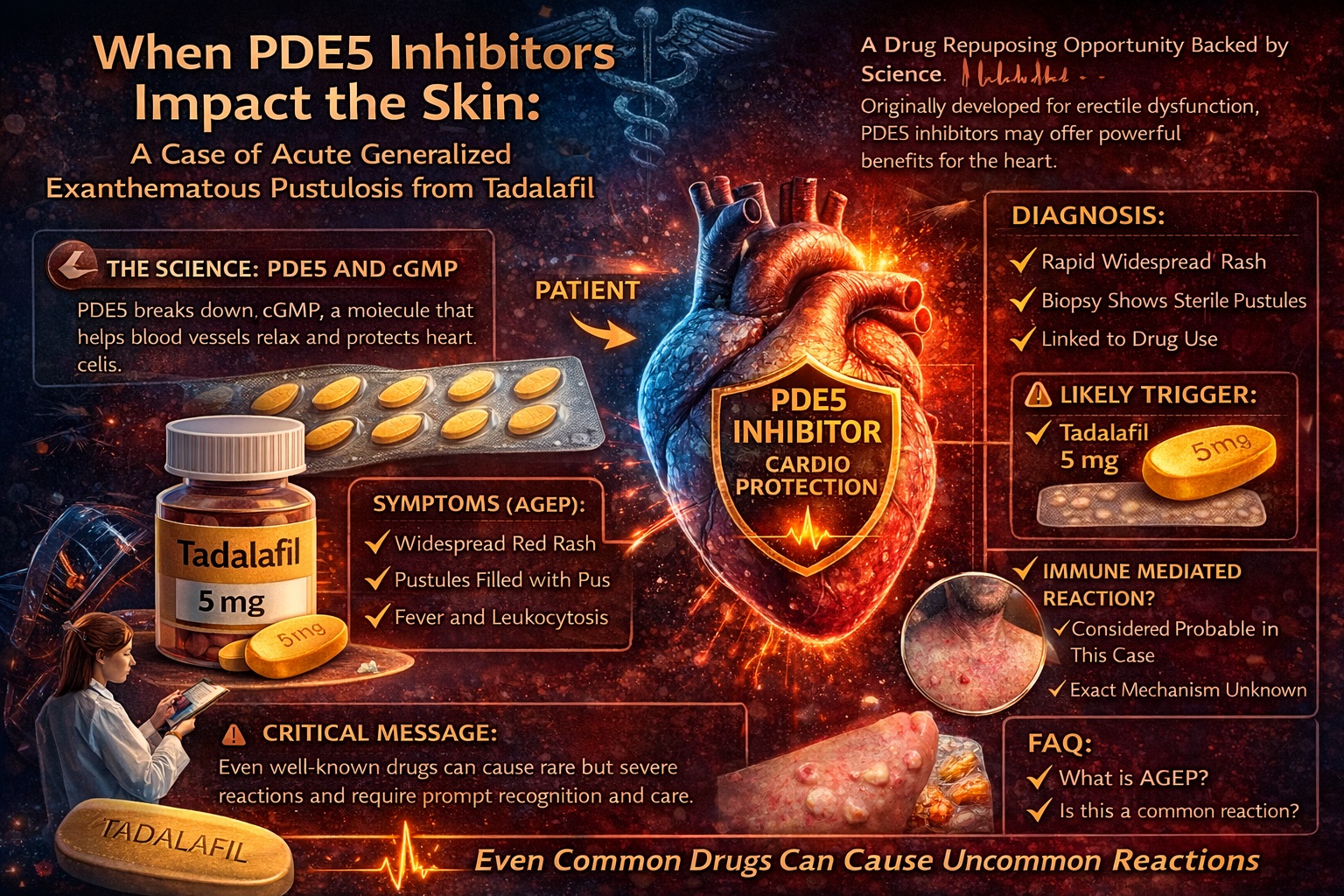
Introduction: The Predictable Drug with an Unpredictable Reaction
In clinical medicine, familiarity often breeds confidence. Drugs that are widely prescribed, well studied, and generally safe—such as tadalafil—tend to inspire a sense of predictability. Physicians know what to expect: efficacy, a defined safety profile, and manageable adverse effects.
And yet, medicine has a habit of humbling certainty.
The case report presents an unusual and previously undocumented adverse reaction: acute generalized exanthematous pustulosis (AGEP) associated with tadalafil use. This finding is more than a curiosity. It challenges assumptions, expands the known safety profile of a widely used drug, and reminds clinicians that even familiar therapies can behave in unfamiliar ways.
Tadalafil, best known for its role in erectile dysfunction, now enters a more complex narrative—one that includes dermatology, immunology, and pharmacovigilance. This article explores that narrative in depth, translating a single case into broader clinical insight.
Understanding AGEP: A Rare but Dramatic Dermatological Emergency
Acute generalized exanthematous pustulosis (AGEP) is an uncommon but distinctive cutaneous adverse drug reaction. It is characterized by the rapid onset of numerous sterile pustules on a background of erythematous skin, often accompanied by fever and systemic symptoms.
Clinically, AGEP can appear alarming. The eruption is sudden, widespread, and visually striking. Patients may present with diffuse redness, edema, and hundreds—sometimes thousands—of small, non-follicular pustules.
From a pathological standpoint, AGEP is considered a severe cutaneous adverse reaction (SCAR), although it typically follows a more benign course than conditions such as Stevens–Johnson syndrome. Histologically, it is defined by spongiform subcorneal pustules and a dermal infiltrate rich in neutrophils and eosinophils .
The condition is most commonly associated with antibiotics and antiepileptic drugs. Its association with tadalafil, as described in this case, represents a novel and clinically significant observation.
The Case: A Timeline of Unexpected Events
The patient described in the report was a 40-year-old man with no significant medical history. His presentation began with what might initially seem like a benign complaint: a pruritic rash.
However, the progression was rapid. Within days, the rash evolved into a widespread eruption involving the trunk, extremities, and face. Fever developed, and the clinical picture became more concerning.
Initially, the patient denied recent medication use—a detail that delayed diagnosis. Only upon further evaluation did he disclose starting tadalafil five days prior to symptom onset .
Physical examination revealed classic features of AGEP: numerous small, sterile pustules on erythematous skin, with sparing of mucous membranes. Laboratory findings showed leukocytosis with neutrophilic predominance, consistent with an inflammatory response.
The diagnosis was confirmed by skin biopsy, which demonstrated hallmark histological features. Using the EUROSCAR scoring system, the patient achieved a score of 10—indicating a definitive diagnosis.
This sequence highlights a critical point: accurate diagnosis depends not only on clinical observation, but on careful history-taking.
Pathophysiology: When the Immune System Overreacts
The exact mechanism of AGEP remains incompletely understood, but it is widely accepted to be an immune-mediated hypersensitivity reaction.
In most cases, AGEP is thought to involve T-cell activation leading to the release of cytokines such as interleukin-8. This, in turn, recruits neutrophils to the skin, resulting in the formation of sterile pustules.
The involvement of eosinophils, as observed in the biopsy, further supports a hypersensitivity mechanism. This aligns with the broader category of drug-induced immune reactions, where the body misidentifies a pharmacological agent as a threat.
In the context of tadalafil, this mechanism is particularly intriguing. The drug is not typically associated with strong immunogenicity. Its known adverse effects are largely related to vasodilation rather than immune activation.
And yet, this case suggests that under certain conditions, tadalafil may trigger an exaggerated immune response.
Why this occurs in some individuals and not others remains an open question.
Tadalafil and Cutaneous Reactions: Expanding the Safety Profile
Tadalafil is widely regarded as a safe medication, with a well-characterized side effect profile. Common adverse effects include headache, dyspepsia, and back pain—symptoms that are predictable and generally mild.
Cutaneous reactions are less common but not unheard of. Reported manifestations include urticaria, angioedema, fixed drug eruptions, and, in rare cases, Stevens–Johnson syndrome .
However, prior to this report, AGEP had not been associated with tadalafil in the medical literature. This makes the case particularly noteworthy.
The drug’s pharmacokinetics may play a role. With a half-life of approximately 17.5 hours, tadalafil exerts prolonged systemic effects, potentially increasing the duration of antigen exposure.
Additionally, its widespread use increases the likelihood of detecting rare adverse events. As the number of users grows, so does the probability of encountering unusual reactions.
In this sense, the emergence of new safety signals is not surprising—it is inevitable.
Diagnosis: The Art of Recognizing the Uncommon
Diagnosing AGEP requires a combination of clinical suspicion, laboratory evaluation, and histopathological confirmation.
Key diagnostic features include:
- Rapid onset of pustular eruption
- Fever and systemic symptoms
- Neutrophilic leukocytosis
- Characteristic biopsy findings
The EUROSCAR scoring system provides a structured approach, assigning points based on clinical and histological criteria. A high score confirms the diagnosis.
In this case, the score of 10 left little room for doubt .
Equally important is the identification of the causative agent. The Naranjo scale, used to assess drug-related adverse events, yielded a score of 5—indicating a probable association between tadalafil and AGEP.
This structured approach transforms a diagnostic challenge into a manageable process.
Management: Simple Steps, Significant Outcomes
The management of AGEP is, in principle, straightforward: identify and discontinue the offending drug.
In this case, cessation of tadalafil was followed by the initiation of oral prednisolone at a dose of 40 mg daily. The patient was managed on an outpatient basis, reflecting the typically self-limited nature of AGEP.
Clinical improvement was rapid. Within days, pustules began to resolve, and desquamation followed. Complete resolution occurred within two weeks .
This favorable outcome underscores an important principle: early recognition and intervention can prevent complications.
It also highlights the resilience of the skin—an organ capable of dramatic recovery when the underlying insult is removed.
Clinical Implications: Awareness as a Preventive Tool
The significance of this case extends beyond a single patient. It has broader implications for clinical practice.
First, it emphasizes the importance of considering all medications—prescribed or otherwise—in the differential diagnosis of cutaneous eruptions. Patients may not always disclose drug use, particularly for conditions such as erectile dysfunction.
Second, it expands the known safety profile of tadalafil. While the drug remains safe for the vast majority of patients, clinicians should be aware of rare but serious reactions.
Third, it reinforces the value of pharmacovigilance. Case reports, though limited in scope, play a critical role in identifying new adverse effects.
In medicine, awareness is often the first—and most effective—line of defense.
Limitations and Unanswered Questions
As with all case reports, this study has limitations.
A single case cannot establish causality definitively. While the temporal relationship and scoring systems suggest a probable association, further cases are needed to confirm the link.
The underlying mechanism also remains unclear. Why tadalafil triggered AGEP in this patient is unknown, and may involve genetic or immunological factors.
Additionally, the absence of prior reports raises the question of underrecognition. It is possible that similar cases have occurred but were not documented.
These uncertainties highlight the need for continued research and reporting.
Conclusion: A Reminder of Medicine’s Complexity
The case of tadalafil-induced AGEP serves as a powerful reminder of medicine’s complexity.
A drug known for its predictability revealed an unexpected side. A common therapy produced a rare reaction. A familiar clinical tool required a broader perspective.
And yet, the outcome was positive—thanks to timely recognition and appropriate management.
For clinicians, the lesson is clear: remain vigilant, remain curious, and never assume that a well-known drug has nothing new to teach.
Because in medicine, even the most familiar stories can take unexpected turns.
FAQ: Practical Questions About Tadalafil and Cutaneous Reactions
1. Can tadalafil cause skin reactions?
Yes, although rare. Reported reactions include urticaria, angioedema, and, in this case, AGEP.
2. What is AGEP?
A rare drug-induced skin condition characterized by rapid onset of sterile pustules, fever, and inflammation.
3. How quickly do symptoms appear?
Typically within a few days of starting the offending drug—in this case, five days.
4. Is AGEP dangerous?
It can appear severe but usually resolves with prompt treatment and drug discontinuation.
5. Should tadalafil be avoided after such a reaction?
Yes. Re-exposure to the drug should be avoided to prevent recurrence.
