

Introduction: Safety Beyond the Label
Phosphodiesterase type 5 inhibitors (PDE5Is) have revolutionized the treatment of erectile dysfunction. Sildenafil, tadalafil, vardenafil, and avanafil are now firmly established as first-line therapies, widely prescribed and generally well tolerated. Yet, as with any pharmacological intervention used at scale, safety is not defined solely by clinical trials—it evolves in real-world use.
Postmarketing surveillance provides a different perspective. It captures what randomized trials often cannot: rare adverse events, unexpected patterns, and the influence of comorbidities and human behavior. The study analyzed here uses the FDA Adverse Event Reporting System (FAERS) to examine over a decade of real-world data, offering a comprehensive view of safety signals associated with PDE5 inhibitors .
The findings are nuanced. PDE5 inhibitors remain safe for most patients, but certain adverse events—some rare, some clinically significant—require careful attention. The message is not alarmist, but it is clear: safety is not static, and vigilance is part of good medicine.
PDE5 Inhibitors: Widely Used, Broadly Trusted
Erectile dysfunction affects tens of millions of men globally, with prevalence increasing steadily with age. In the United States alone, up to 50 million men are affected, and hundreds of thousands of new cases emerge annually .
PDE5 inhibitors dominate this therapeutic space. They account for approximately 75% of all ED treatments and are increasingly used not only for medical indications but also recreationally. This widespread use amplifies the importance of understanding their safety profile.
From a pharmacological standpoint, these drugs share a common mechanism: inhibition of PDE5, leading to increased levels of cyclic guanosine monophosphate (cGMP) and enhanced nitric oxide–mediated vasodilation.
Tadalafil, in particular, stands out for its long half-life and extended duration of action. This pharmacokinetic advantage makes it a preferred option for many patients—but also necessitates careful consideration of prolonged exposure.
When millions of patients use the same class of drugs, even rare events become clinically relevant.
The FAERS Database: A Window into Real-World Risk
The FAERS database is one of the most important tools for postmarketing pharmacovigilance. It collects voluntary reports of adverse events from healthcare professionals, patients, and manufacturers.
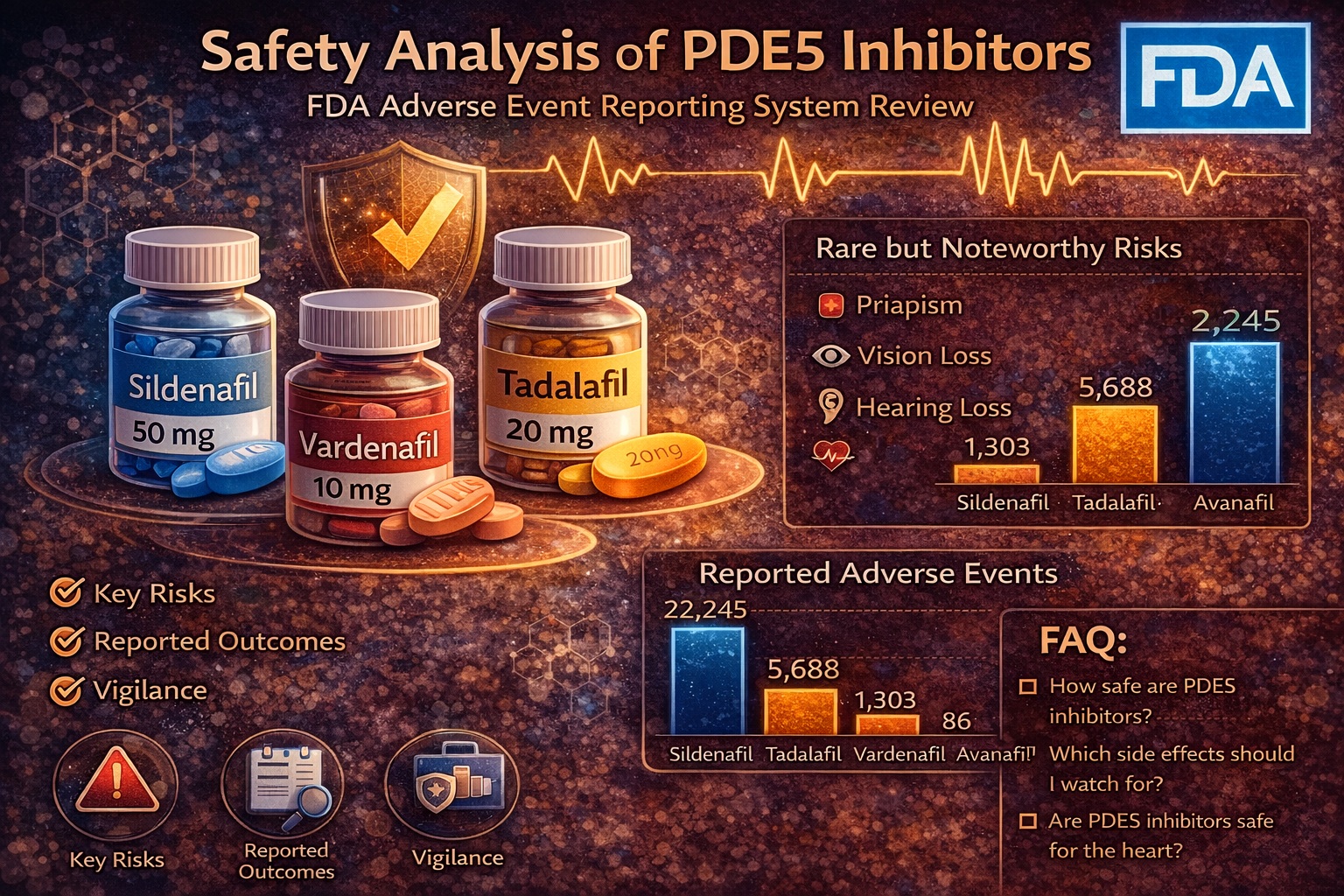
Between 2010 and 2021, a total of 29,236 adverse events associated with PDE5 inhibitors were reported . This dataset provides a rich source of information on safety patterns that may not emerge in controlled trials.
Unlike clinical studies, FAERS captures real-world variability. Patients may have multiple comorbidities, take concomitant medications, and use drugs in ways not anticipated by prescribing guidelines.
However, this strength is also a limitation. Reporting is voluntary, data may be incomplete, and causality cannot be definitively established. The FAERS database identifies signals, not proof.
In pharmacovigilance, signals are the beginning of the conversation—not the conclusion.
Common Adverse Events: Familiar but Informative
The most frequently reported adverse event across all PDE5 inhibitors was “drug ineffective,” accounting for 24.3% of reports . While not traditionally considered a safety issue, it reflects an important clinical reality: patient expectations are not always met.
Other commonly reported adverse events include:
- Cardiovascular events
- Headache and migraine
- Back pain and fatigue
- Dizziness and flushing
These findings align with known side effect profiles. Headache, for example, is a well-established consequence of vasodilation. Back pain, particularly associated with tadalafil, is thought to result from effects on skeletal muscle.
Interestingly, melanoma was among the most reported events for both sildenafil and tadalafil, though no definitive safety signal was established. This reflects ongoing debate in the literature regarding a possible association.
The key takeaway is reassuring: most adverse events are mild, predictable, and manageable.
Serious Outcomes: Rare but Clinically Significant
While most adverse events are benign, the study also highlights more serious outcomes.
Among reported cases:
- 67.2% were classified as “other serious events”
- 19.5% resulted in hospitalization
- Death was reported in a small but notable proportion of cases
Sildenafil had the highest proportion of reported deaths (9.9%), while tadalafil and other agents showed lower rates.
These findings must be interpreted cautiously. Patients using PDE5 inhibitors often have underlying cardiovascular disease—a major confounder. Erectile dysfunction itself is strongly associated with cardiovascular risk.
In this context, adverse outcomes may reflect the patient population rather than the drug itself.
Medicine rarely offers clean cause-and-effect relationships.
Signal Detection: When Patterns Become Meaningful
The most valuable contribution of the study lies in its signal detection analysis. Using proportional reporting ratios (PRR) and reporting odds ratios (ROR), the authors identified statistically significant associations between specific drugs and adverse events.
Eight safety signals were detected across the four PDE5 inhibitors.
For tadalafil, the most notable signals were:
- Priapism (PRR 3.63)
- Fatigue (PRR 8.33)
Priapism, while rare, is a urological emergency. It often occurs in the context of concomitant medications or inappropriate dosing, rather than PDE5 inhibitors alone.
Fatigue, on the other hand, is less dramatic but clinically relevant. Its mechanism is not fully understood, but may relate to systemic vasodilation and hemodynamic changes.
These signals do not imply causation—but they warrant awareness.
Comparative Safety Profiles: Subtle Differences Matter
Each PDE5 inhibitor demonstrates a slightly different safety profile.
Sildenafil was associated with signals for sexual disorders and death. Vardenafil showed a signal for drug administration error, likely related to its orally disintegrating tablet formulation.
Tadalafil’s profile is distinct. Its association with priapism and fatigue reflects its longer duration of action and sustained pharmacological effect.
These differences are subtle but important. They highlight the need for individualized treatment selection.
No drug is universally superior—only more suitable for a given patient.
Cardiovascular Events: A Reflection of Underlying Disease
Cardiovascular events were among the most frequently reported adverse events across all PDE5 inhibitors.
At first glance, this may raise concern. However, the relationship between ED and cardiovascular disease complicates interpretation.
Erectile dysfunction is often an early marker of endothelial dysfunction and atherosclerosis. Patients with ED frequently have hypertension, diabetes, and dyslipidemia—all risk factors for cardiovascular events.
Therefore, the observed association may reflect underlying disease rather than drug-induced risk.
Indeed, some studies suggest that PDE5 inhibitors may have cardioprotective effects, improving endothelial function and reducing mortality.
In this case, the signal may be less about the drug—and more about the patient.
Rare but Serious Events: Vision, Hearing, and Oncology
Certain adverse events, while rare, carry significant clinical implications.
Sudden vision loss, associated with nonarteritic anterior ischemic optic neuropathy, has been reported with PDE5 inhibitors. Similarly, cases of hearing loss have been documented.
In the FAERS data, visual impairment and hearing loss were reported but did not reach signal thresholds. Nevertheless, their severity warrants caution.
Melanoma remains a controversial topic. While some studies suggest a possible association, others attribute findings to confounding factors such as sun exposure. In this analysis, melanoma was frequently reported but did not constitute a safety signal.
These findings illustrate the complexity of pharmacovigilance. Not all associations are causal—but all deserve scrutiny.
Clinical Interpretation: Balancing Benefit and Risk
The clinical implications of this study are both reassuring and cautionary.
On one hand, PDE5 inhibitors—including tadalafil—remain safe and effective for the vast majority of patients. Serious adverse events are rare, and most side effects are mild.
On the other hand, certain signals—such as priapism and fatigue—highlight the importance of patient education and monitoring.
Clinicians should consider:
- Underlying comorbidities
- Concomitant medications
- Proper dosing and administration
- Patient expectations and adherence
The goal is not to avoid risk entirely—that is impossible—but to manage it intelligently.
Limitations: Understanding the Boundaries of Evidence
The FAERS database is a powerful tool, but it has inherent limitations.
Reporting is voluntary, leading to potential underreporting or overrepresentation of severe events. Data quality varies, and duplicate or incomplete reports may exist.
Most importantly, causality cannot be established. A reported adverse event may not be directly related to the drug.
These limitations do not invalidate the findings—but they require careful interpretation.
In pharmacovigilance, context is everything.
Conclusion: Vigilance as a Clinical Responsibility
PDE5 inhibitors have transformed the management of erectile dysfunction, offering effective and convenient therapy for millions of men.
This study reinforces their overall safety while highlighting specific areas of concern. Tadalafil, like its counterparts, demonstrates a favorable profile—but not an absolute one.
The identification of safety signals is not a cause for alarm—it is a call for awareness.
In modern medicine, the role of the clinician extends beyond prescribing. It includes monitoring, educating, and adapting to emerging evidence.
Because safety is not guaranteed by approval—it is maintained by vigilance.
FAQ: Key Questions About PDE5 Inhibitor Safety
1. Are PDE5 inhibitors safe for most patients?
Yes. They are generally well tolerated, with most side effects being mild and manageable.
2. What is the most common issue reported?
“Drug ineffective” is the most frequently reported outcome, reflecting patient expectations and variability in response.
3. Is tadalafil associated with serious risks?
Rarely. It has been linked to signals such as priapism and fatigue, but these events are uncommon.
4. Do PDE5 inhibitors increase cardiovascular risk?
Not necessarily. Reported events often reflect underlying cardiovascular disease rather than drug effects.
5. Should patients be concerned about rare events like vision loss?
These events are very rare but serious. Patients should seek immediate medical attention if symptoms occur.
