

Introduction: When Surgery Ends, Recovery Truly Begins
Radical prostatectomy, particularly in its nerve-sparing form, represents one of the most effective curative treatments for localized prostate cancer. From an oncological perspective, success is often defined in binary terms: tumor removed, margins clear, disease controlled.
But patients rarely experience recovery in such simplified terms.
For many men, the postoperative period is defined not by survival alone, but by loss—loss of erectile function, loss of spontaneity, loss of confidence, and sometimes, loss of identity. The study addresses a dimension of recovery that is often underrepresented in surgical outcomes: quality of life, psychosocial well-being, and treatment satisfaction.
At the center of this investigation lies tadalafil—not merely as a pharmacological agent, but as a tool for rehabilitation. This article expands upon those findings, exploring how tadalafil influences not only physiological recovery, but the psychological and relational dimensions of healing.
Because after prostatectomy, restoring function is important—but restoring life is essential.
The Aftermath of Nerve-Sparing Prostatectomy: A Subtle but Profound Disruption
Nerve-sparing techniques have significantly improved postoperative outcomes. By preserving the neurovascular bundles responsible for erection, surgeons aim to maintain erectile function.
Yet even under optimal conditions, temporary or persistent erectile dysfunction (ED) remains common.
The reasons are multifactorial. Surgical manipulation leads to neuropraxia—a transient nerve injury that disrupts signal transmission. Reduced neural input leads to diminished nocturnal erections, which in turn decreases oxygenation within penile tissue. Hypoxia initiates fibrosis, further impairing erectile capacity.
This physiological cascade unfolds quietly, often without immediate symptoms, but with lasting consequences.
At the same time, psychological factors emerge. Anxiety, altered body image, and fear of sexual failure can compound the biological impairment. The result is not simply ED—it is a complex interplay of physical and emotional disruption.
Quality of Life: A Metric That Matters More Than We Admit
In modern medicine, quality of life is no longer a secondary endpoint—it is a central outcome.
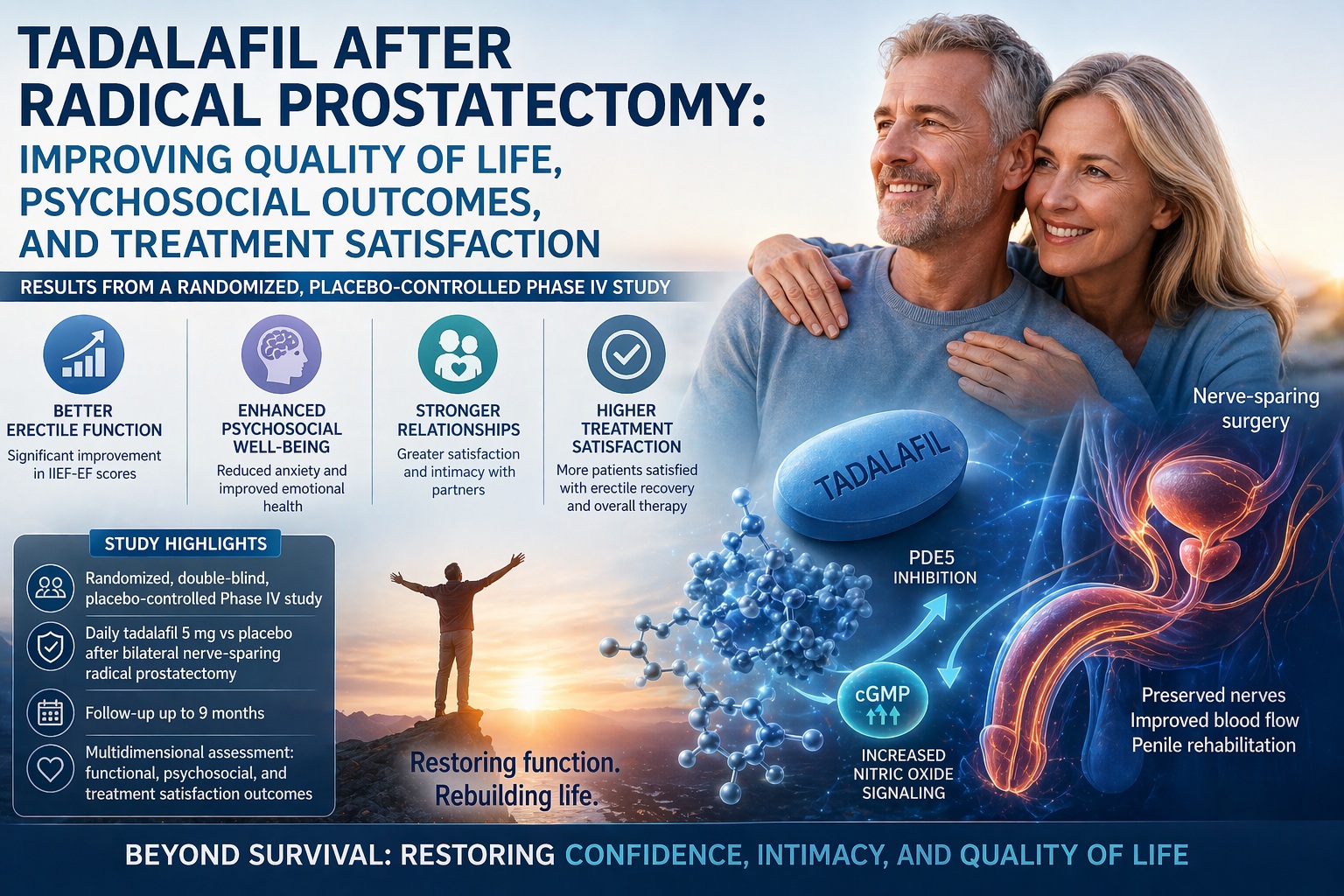
The study demonstrates that men undergoing prostatectomy experience significant declines in multiple domains of quality of life, particularly in sexual function, emotional well-being, and interpersonal relationships .
These changes are not trivial. Sexual health is closely tied to self-esteem, partnership satisfaction, and overall life satisfaction. When it is compromised, the impact extends far beyond the bedroom.
Interestingly, patients often report that the psychological burden of ED exceeds the physical limitation itself. The anticipation of failure becomes a barrier to intimacy, creating a self-perpetuating cycle.
In this context, interventions that restore function also restore confidence—and that distinction is clinically significant.
Tadalafil as a Rehabilitation Strategy: More Than a Symptom Reliever
Tadalafil, a long-acting PDE5 inhibitor, offers a unique advantage in postoperative rehabilitation.
Unlike on-demand therapies, daily tadalafil provides continuous enhancement of nitric oxide–mediated vasodilation. This supports penile blood flow even in the absence of sexual activity, promoting tissue oxygenation and preventing structural degeneration.
In the study, tadalafil was administered in a controlled, randomized, placebo-controlled design, allowing for robust evaluation of its effects .
The findings suggest that tadalafil does more than facilitate erections—it contributes to penile rehabilitation, preserving tissue integrity and supporting long-term recovery.
This distinction is critical. Rehabilitation is proactive; it aims to prevent deterioration, not merely respond to it.
Psychosocial Outcomes: The Quiet Transformation
One of the most compelling aspects of the study is its focus on psychosocial outcomes.
Patients receiving tadalafil reported improvements not only in erectile function, but also in emotional well-being, relationship satisfaction, and overall confidence. These effects were measured using validated instruments, ensuring that subjective experiences were captured with scientific rigor.
The improvement in psychosocial domains reflects a deeper truth: sexual function is not an isolated physiological process—it is embedded in identity, relationships, and self-perception.
When function improves, patients often experience a cascade of positive changes. Communication with partners improves, anxiety decreases, and a sense of normalcy begins to return.
In this sense, tadalafil acts not only on the vasculature, but on the psyche.
Treatment Satisfaction: The Patient’s Perspective
Treatment satisfaction is an often-overlooked endpoint, yet it provides invaluable insight into real-world effectiveness.
In the study, patients treated with tadalafil reported significantly higher satisfaction compared to placebo. This included satisfaction with erectile function, sexual experience, and overall treatment outcome .
Interestingly, satisfaction was not solely dependent on achieving full erectile function. Even partial improvement—when accompanied by realistic expectations—was associated with positive outcomes.
This highlights the importance of communication. Patients who understand the goals and limitations of therapy are more likely to perceive benefit.
In clinical practice, satisfaction is not just about results—it is about alignment between expectation and experience.
Daily Versus On-Demand Therapy: A Question of Philosophy
Tadalafil can be administered either daily or on demand, and each approach reflects a different therapeutic philosophy.
On-demand therapy is reactive—it responds to anticipated sexual activity. Daily therapy, by contrast, is proactive—it maintains a continuous physiological environment conducive to recovery.
The study suggests that daily tadalafil offers advantages in terms of both functional and psychosocial outcomes. Continuous exposure supports tissue health, reduces performance anxiety, and integrates treatment into routine.
From a patient perspective, daily therapy removes the need for planning and restores a sense of spontaneity—an often underappreciated aspect of sexual health.
In rehabilitation, consistency often outperforms intensity.
Partner Dynamics: The Unspoken Variable
Sexual recovery after prostatectomy is not an individual process—it is relational.
Partners play a critical role in shaping outcomes. Their expectations, understanding, and support can influence both psychological and functional recovery.
The study indirectly highlights this dynamic, showing that improved erectile function correlates with better relationship satisfaction .
However, the relationship is bidirectional. Open communication and mutual adaptation can enhance treatment effectiveness, while misunderstanding can undermine it.
Clinicians should therefore consider involving partners in the rehabilitation process. Education, reassurance, and shared goal-setting can transform recovery from an individual struggle into a collaborative effort.
Limitations and Clinical Nuance
Despite its strengths, the study has limitations.
The follow-up period may not capture long-term outcomes, particularly in terms of sustained erectile function after discontinuation of therapy. Additionally, patient populations in clinical trials often differ from those in routine practice.
There is also variability in surgical technique, baseline function, and individual response to therapy.
Nevertheless, the consistency of findings across multiple domains—functional, psychological, and relational—supports the overall conclusion.
Tadalafil is not a panacea, but it is a valuable component of a comprehensive rehabilitation strategy.
Practical Clinical Guidance: Turning Evidence into Action
Translating these findings into practice requires a structured approach.
Early initiation of therapy appears beneficial, ideally within weeks of surgery. This timing aligns with the window of neural recovery and may prevent irreversible tissue changes.
Patient education is equally important. Setting realistic expectations, explaining the purpose of rehabilitation, and addressing concerns can improve adherence and outcomes.
A holistic approach should include:
- Pharmacological therapy (e.g., tadalafil)
- Psychological support
- Partner involvement
- Lifestyle optimization
Recovery after prostatectomy is not a single intervention—it is a process.
Conclusion: Restoring Function, Rebuilding Identity
The impact of radical prostatectomy extends far beyond the surgical field. It touches the most personal aspects of a patient’s life—sexuality, relationships, and self-perception.
Tadalafil offers a means to address these challenges, not only by improving erectile function, but by supporting the broader process of recovery.
The study reminds us that successful treatment is not defined solely by clinical metrics. It is defined by how patients feel, how they live, and how they reconnect with their lives.
In this sense, tadalafil is more than a drug. It is part of a strategy to restore wholeness.
FAQ: Key Questions After Prostatectomy and Tadalafil Therapy
1. When should tadalafil be started after prostatectomy?
Ideally within weeks after surgery, as early intervention supports tissue preservation and recovery.
2. Does tadalafil guarantee recovery of erectile function?
No, but it significantly improves the likelihood of recovery and enhances overall outcomes.
3. Is daily dosing better than on-demand use?
Daily therapy appears more effective for rehabilitation and reduces performance-related anxiety.
4. Can tadalafil improve psychological well-being?
Yes. Improvements in function often lead to better confidence, reduced anxiety, and improved relationships.
5. Should partners be involved in the recovery process?
Absolutely. Partner support and communication play a crucial role in successful rehabilitation.
