

Introduction: Why Erectile Dysfunction in Type 2 Diabetes Is Different
Erectile dysfunction in men with type 2 diabetes mellitus is not merely a more frequent version of ordinary erectile dysfunction. It is often more severe, more persistent, and more resistant to standard oral therapy. Diabetes damages the vascular, neurological, hormonal, and metabolic systems that support erection. When several of these systems fail at the same time, a single tablet may help, but it may not fully restore function.
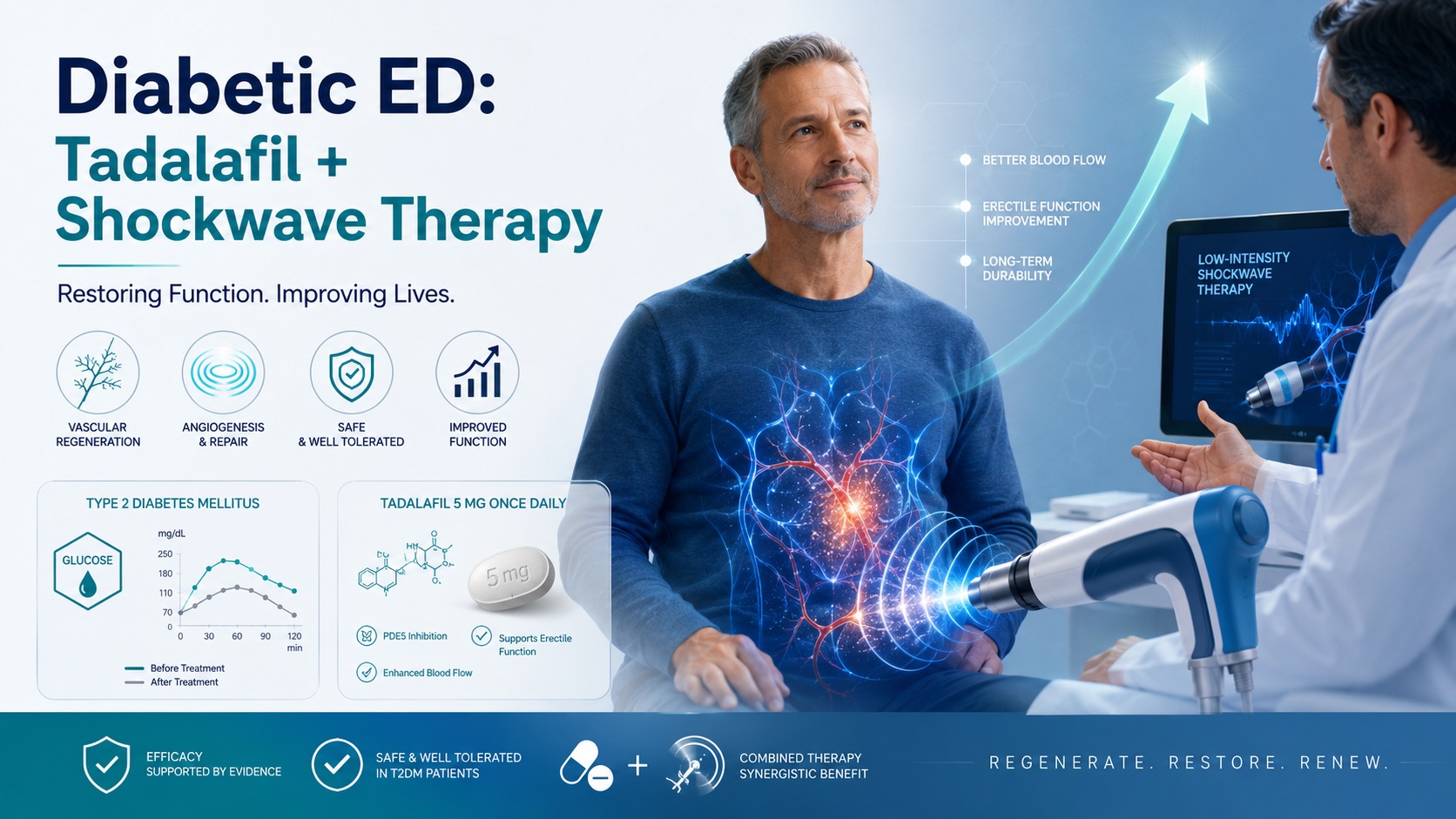
The study “Efficacy and safety of low-intensity shockwave therapy plus tadalafil 5 mg once daily in men with type 2 diabetes mellitus and erectile dysfunction: a matched-pair comparison study” examined whether combining daily tadalafil with low-intensity extracorporeal shockwave therapy could produce better and more durable outcomes than tadalafil alone in men with type 2 diabetes and erectile dysfunction. The investigators compared 78 men receiving tadalafil 5 mg daily plus LiESWT with 78 matched men receiving tadalafil 5 mg daily alone.
This is a clinically important question because diabetic erectile dysfunction is a stubborn condition. The usual PDE5 inhibitor pathway depends on vascular responsiveness and nitric oxide signaling, both of which are impaired in diabetes. Tadalafil can support the nitric oxide–cGMP pathway, but diabetes often creates structural tissue damage that pharmacological vasodilation alone cannot fully correct. This is where low-intensity shockwave therapy becomes interesting: it aims not only to improve function temporarily but also to stimulate vascular repair.
The appeal of this combined strategy is clear. Tadalafil provides daily biochemical support for erectile response, while LiESWT may promote tissue remodeling, endothelial recovery, neoangiogenesis, and possibly nerve regeneration. In plain English, one therapy improves signaling, and the other may help rebuild the road on which the signal travels. In medicine, this kind of teamwork is usually preferable to asking one drug to perform a symphony alone.
The Biological Problem: Diabetes, Blood Vessels, Nerves, and Penile Tissue
A normal erection requires intact arterial inflow, functional endothelium, responsive cavernosal smooth muscle, healthy neural input, and appropriate psychological context. Type 2 diabetes can interfere with every one of these elements. Chronic hyperglycemia promotes oxidative stress, endothelial dysfunction, microvascular injury, neuropathy, and impaired smooth muscle relaxation. The result is not a simple mechanical failure but a progressive biological weakening of erectile physiology.
Men with diabetes often have reduced nitric oxide bioavailability. Nitric oxide is essential for activating soluble guanylate cyclase and increasing cGMP, the intracellular messenger responsible for cavernosal smooth muscle relaxation. PDE5 inhibitors such as tadalafil prevent cGMP breakdown, but they work best when the upstream nitric oxide pathway still has enough activity to amplify. In diabetes, the signal may be too weak, the tissue too damaged, or the vascular bed too compromised for full response.
Diabetic neuropathy adds another layer of difficulty. Somatic and autonomic nerve damage may reduce sensory input and impair parasympathetic activity, both of which are necessary for erection. Even if blood flow improves pharmacologically, neural impairment can limit the erectile response. This is why diabetic ED is frequently described as difficult to treat, and why clinicians should avoid promising effortless correction with pills alone.
Visceral adiposity, insulin resistance, hypogonadism, hypertension, dyslipidemia, and smoking may further worsen erectile dysfunction. These factors are common in patients with type 2 diabetes and often coexist in the same individual. The penis, being supplied by small arteries, tends to reveal vascular decline early. It is not being dramatic; it is simply anatomically efficient at reporting bad news.
Why Combine Tadalafil with Low-Intensity Shockwave Therapy?
Tadalafil is a long-acting PDE5 inhibitor with established efficacy in erectile dysfunction. When taken once daily at 5 mg, it provides continuous pharmacological support and reduces the need to time medication around sexual activity. In diabetic men, this daily approach may be useful because it maintains steady exposure rather than relying on occasional dosing in a compromised vascular environment.
Low-intensity extracorporeal shockwave therapy works through a different therapeutic logic. It delivers acoustic energy to penile tissue, creating controlled mechanical stimulation rather than destructive injury. Experimental evidence suggests that this stimulation may increase angiogenic factors such as vascular endothelial growth factor and endothelial nitric oxide synthase, improve local hemodynamics, and support tissue regeneration.
The rationale for combining the two is therefore biologically plausible. Tadalafil enhances erectile signaling through the cGMP pathway, while LiESWT may improve tissue responsiveness by promoting vascular and structural recovery. If tadalafil helps the body use the existing erectile pathway more effectively, LiESWT may help improve the condition of that pathway itself.
This distinction is important. Many ED treatments are functional: they help erection occur when used. Regenerative strategies attempt something more ambitious: they aim to improve the tissue environment so that function becomes more durable. Whether LiESWT truly “cures” ED remains debated, but its potential to improve endothelial function, angiogenesis, and nerve-related pathways makes it a reasonable candidate for combination treatment in diabetic ED.
Study Design: What Was Actually Tested
The study used a retrospective matched-pair comparison based on a prospectively maintained database. Seventy-eight men with type 2 diabetes and erectile dysfunction received tadalafil 5 mg once daily at bedtime for 12 weeks plus LiESWT during the first three weeks. These patients were matched one-to-one with 78 men receiving tadalafil 5 mg once daily alone for 12 weeks. Matching was performed according to age, baseline IIEF-5 score, and smoking exposure.
LiESWT was performed using an electrohydraulic focused shockwave device. Shockwaves were applied to the distal, mid, and proximal penile shaft and to both crura. The treatment schedule consisted of two sessions per week for three weeks, with sessions separated by three days. Each session lasted approximately 20 minutes, used an energy density of 0.09 mJ/mm², and delivered different shockwave numbers depending on subgroup.
The investigators divided the combination group into three subgroups: 1500 shockwaves per session, 1800 shockwaves per session, and 2400 shockwaves per session. This was a particularly useful element of the study because LiESWT protocols vary widely in clinical practice. Devices, energy settings, number of shocks, anatomical targets, and session schedules are not yet standardized. The field has enthusiasm, but enthusiasm is not a protocol.
The primary outcome was change in the International Index of Erectile Function-5 score from baseline. Outcomes were assessed at 4, 12, and 24 weeks after the end of treatment. The study therefore examined not only early improvement but also durability—an especially important issue in diabetic ED, where short-term response may fade once therapy stops.
Key Findings: Improvement Occurred, but Dose of Shockwaves Mattered
Both tadalafil alone and the combined approach improved erectile function at early follow-up. At four weeks, all groups showed statistically significant IIEF-5 improvement compared with baseline, and there were no significant intergroup differences. This suggests that daily tadalafil itself provided meaningful early benefit, while the added value of shockwave therapy was not yet clearly separated at the earliest time point.
The difference became more visible at 12 and 24 weeks. Patients receiving tadalafil plus LiESWT with 2400 shockwaves per session had significantly greater improvement in IIEF-5 scores than those receiving tadalafil alone. At 12 weeks, the 2400-shockwave subgroup showed a mean improvement of approximately +5.0 points. At 24 weeks, the improvement remained high at approximately +4.7 points. By comparison, the tadalafil-alone group declined to a smaller benefit at 24 weeks.
This finding is clinically relevant because it suggests that the most intensive LiESWT protocol tested may provide not only greater improvement but also more durable response. In diabetic ED, durability matters. A therapy that produces a brief numerical improvement but fades quickly may satisfy a graph but not a patient.
The study also found that all treatments were well tolerated, with no serious treatment-related adverse events. This supports the safety profile of the combined approach, at least within the limits of this study population and design. LiESWT is attractive partly because it can be performed without anesthesia in an outpatient setting, making it less invasive than intracavernosal injections or surgical approaches.
The results should not be interpreted as proof that every diabetic man with ED should receive shockwave therapy. They do, however, suggest that selected men with type 2 diabetes may benefit from a combined strategy, especially when a sufficient number of shockwaves is delivered. The 2400-shockwave protocol appears more promising than lower-dose protocols in this dataset.
Clinical Interpretation: From Symptom Support to Tissue-Oriented Therapy
The study supports a broader shift in ED management: moving from purely symptomatic treatment toward tissue-oriented strategies. PDE5 inhibitors remain first-line therapy, and tadalafil is one of the most useful agents because of its long half-life and daily dosing option. Yet diabetic ED often requires more than pharmacological support. The damaged vascular and neural environment must be considered.
LiESWT may help address this gap. Preclinical studies suggest that shockwave therapy can stimulate regeneration of nitric oxide synthase-positive nerves, endothelium, and smooth muscle in diabetic models. Some mechanisms may be independent of the nitric oxide–cGMP pathway, which is particularly interesting because diabetic patients often have impaired nitric oxide signaling.
The combination may therefore be additive or synergistic. Additive means each therapy contributes separately. Synergistic means the combined effect is greater than the sum of the parts. The present study cannot definitively distinguish between these possibilities, but the durability signal in the 2400-shockwave subgroup suggests that LiESWT may be doing more than simply boosting the immediate effect of tadalafil.
For clinical counseling, the message should be precise. Patients should be told that daily tadalafil may improve erectile function, but in type 2 diabetes response may be incomplete. Adding LiESWT may improve the magnitude and persistence of benefit, especially when a more robust protocol is used. At the same time, patients should understand that evidence is still evolving and that protocol standardization remains incomplete.
This is where good medicine avoids both pessimism and salesmanship. The combined approach is promising, but not magical. It should be discussed as an evidence-supported option requiring proper patient selection, realistic expectations, and follow-up.
Practical Guidance for Patient Selection and Counseling
Men with type 2 diabetes and erectile dysfunction should first receive a comprehensive evaluation. This includes assessment of diabetes control, cardiovascular risk, testosterone status, medication history, smoking, obesity, hypertension, dyslipidemia, and psychological factors. Erectile dysfunction in diabetes may be the visible symptom of broader vascular disease, and treating the erection while ignoring the arteries would be clinically lazy.
Daily tadalafil may be appropriate for men without contraindications, especially those seeking a steady therapeutic background rather than on-demand planning. It should not be used with nitrates, and caution is required with certain cardiovascular conditions. Glycemic control, weight management, exercise, smoking cessation, and cardiovascular risk reduction should be presented as part of erectile treatment, not as unrelated lifestyle decoration.
LiESWT may be considered in men with organic or vasculogenic ED, particularly those with incomplete response to PDE5 inhibitors. In diabetic men, the discussion should include the possibility that tissue regeneration and vascular improvement may take time. Patients should not expect immediate dramatic results after one session. The study’s strongest durability signal appeared later, not instantly.
Clinicians should also be transparent about protocol uncertainty. Different devices and treatment schedules exist, and the optimal protocol is not fully established. In this study, the most favorable results occurred with 2400 shockwaves per session, delivered twice weekly for three weeks in combination with tadalafil 5 mg daily. That does not prove universal superiority, but it gives a practical benchmark for discussion.
Finally, outcomes should be measured. The IIEF-5 questionnaire is simple and useful. Baseline scoring and follow-up scoring help distinguish real improvement from vague impressions. Men deserve measurable goals, not motivational fog.
Limitations: Why the Findings Are Important but Preliminary
The study has several limitations. Its retrospective matched-pair design is weaker than a prospective randomized controlled trial. Matching can reduce imbalance, but it cannot eliminate all selection bias. Patients receiving combination therapy may differ from controls in unmeasured ways that influence response.
The subgroup analysis included only 26 patients in each shockwave-dose subgroup. This limits the ability to identify predictors of response, such as diabetes duration, HbA1c level, smoking intensity, hypertension, obesity, or baseline ED severity. A larger trial could clarify which patients are most likely to benefit.
The study used IIEF-5 change as the main outcome. This is clinically relevant, but additional endpoints would be valuable, including penile Doppler parameters, endothelial markers, medication-free erectile function, partner satisfaction, and long-term durability beyond 24 weeks. For a therapy proposed as regenerative, longer follow-up is essential.
The results also depend on one LiESWT device type and protocol. Shockwave therapy is not a single uniform intervention. Energy source, focal depth, anatomical target, total energy, number of shocks, and treatment intervals all matter. Until protocols are standardized, translating results between devices and clinics requires caution.
Despite these limitations, the study provides meaningful preliminary evidence. It identifies a plausible combined strategy, shows a dose-related signal favoring 2400 shockwaves per session, and emphasizes durability—an outcome that diabetic ED research badly needs.
Conclusion: A Smarter Combination for a Harder Form of ED
Type 2 diabetes-associated erectile dysfunction is difficult because it reflects vascular damage, neural impairment, metabolic dysfunction, and reduced tissue responsiveness. Tadalafil 5 mg once daily can improve erectile function, but in many diabetic men, pharmacological support alone may be insufficient or may lose strength over time.
The study suggests that adding low-intensity extracorporeal shockwave therapy—especially using a protocol of 2400 shockwaves per session—may produce greater and more durable improvement than tadalafil alone. This supports the concept that diabetic ED may benefit from a combined approach targeting both erectile signaling and tissue repair.
The most responsible interpretation is optimistic but cautious. LiESWT plus tadalafil is not yet a universal standard for every diabetic man with ED, but it is a clinically promising strategy deserving further prospective randomized research. If confirmed, it may help shift diabetic ED management from short-term pharmacological rescue toward longer-lasting functional restoration.
In a condition where patients often hear “try a pill and see,” this combined approach offers a more ambitious message: improve the signal, support the tissue, and treat the vascular problem with the seriousness it deserves.
FAQ
Does tadalafil work less effectively in men with type 2 diabetes?
Yes, many diabetic men respond less strongly to PDE5 inhibitors because diabetes damages blood vessels, nerves, endothelial function, and cavernosal tissue. Tadalafil can still help, but response may be incomplete.
What did the study show about LiESWT plus tadalafil?
The combination improved IIEF-5 scores, and the most durable benefit was seen in men receiving tadalafil 5 mg daily plus 2400 shockwaves per LiESWT session.
Is shockwave therapy painful or invasive?
Low-intensity shockwave therapy is noninvasive and is usually performed in an outpatient setting without anesthesia. In this study, treatments were well tolerated with no serious treatment-related adverse events.
How long did the benefit last?
The study followed patients for 24 weeks after treatment. The tadalafil-alone group showed some decline over time, while the 2400-shockwave combination subgroup maintained a stronger improvement.
Should every diabetic man with ED receive LiESWT?
No. It should be considered selectively after proper medical evaluation. Larger randomized studies are still needed to define the best candidates and optimal treatment protocol.
