

Introduction: Beyond Pills — A New Era of Combined Therapy
Erectile dysfunction (ED) is one of those conditions that refuses to remain purely physiological. It quietly crosses into psychology, relationships, and quality of life, making it far more than a clinical diagnosis. For decades, pharmacological therapy—especially phosphodiesterase type 5 inhibitors—has been the cornerstone of treatment. Among them, tadalafil stands out for its long half-life and patient-friendly pharmacokinetics.
Yet medicine has a habit of asking uncomfortable questions. What happens when a well-established drug is not enough? What if the underlying pathology involves not only vascular dysfunction but also structural damage to penile tissue? These questions have led researchers to explore combined therapeutic strategies, blending pharmacology with regenerative medicine.
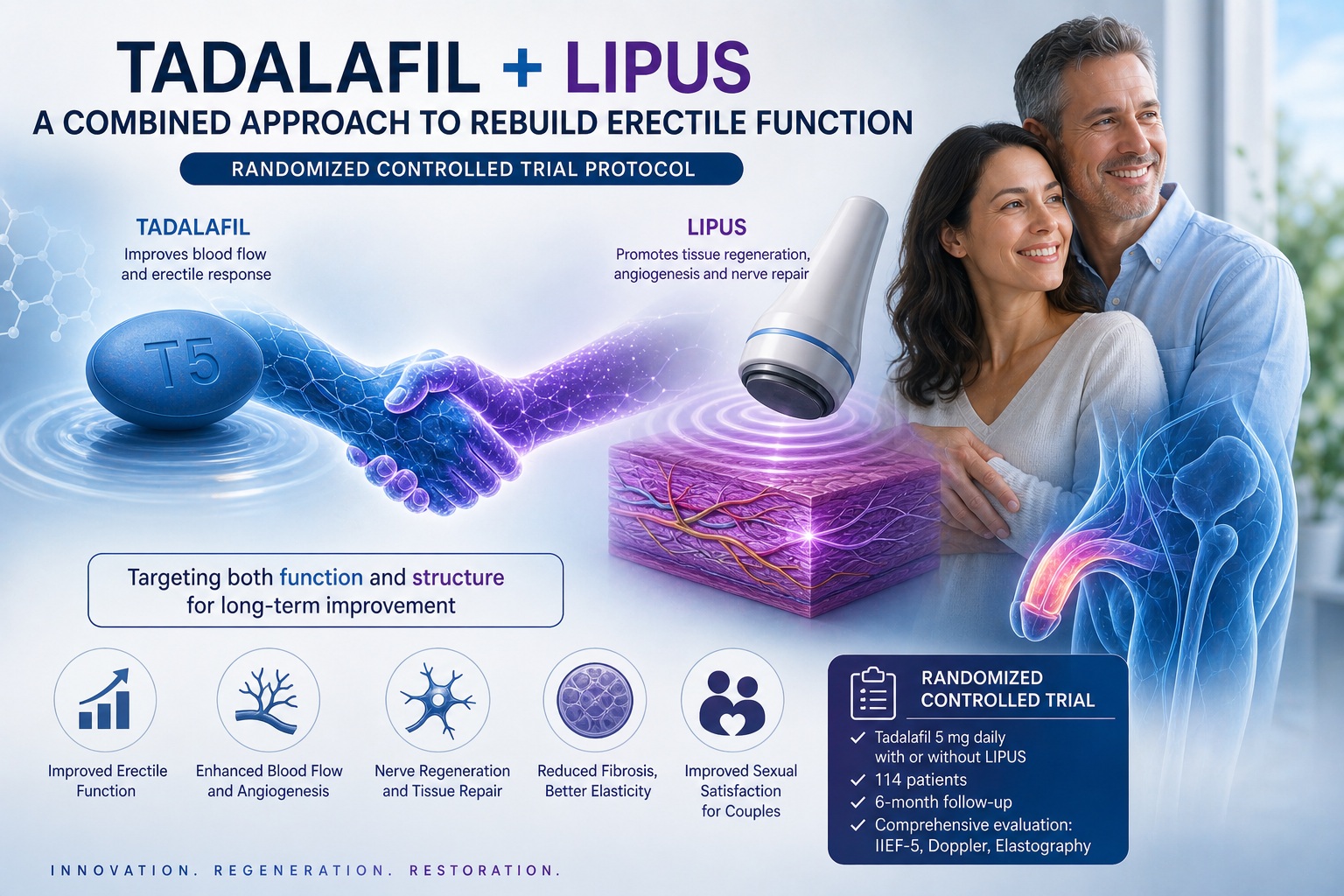
A recent randomized controlled trial protocol proposes exactly that: combining tadalafil with Low-Intensity Pulsed Ultrasound (LIPUS). The idea is elegant, ambitious, and—if proven effective—potentially transformative.
This article explores the scientific rationale, clinical design, and broader implications of this emerging therapeutic paradigm.
The Clinical Landscape of Erectile Dysfunction: A Multifactorial Challenge
Erectile dysfunction is not a single disease but a syndrome with multiple etiologies. Age remains the most prominent risk factor, with prevalence rising dramatically after 60 years. However, the modern patient rarely presents with age alone as the culprit.
Cardiovascular disease, diabetes, metabolic syndrome, hormonal imbalances, and psychological stress all contribute to ED. These factors converge on a shared pathway: impaired blood flow and structural degeneration of the corpora cavernosa.
Tadalafil, like other PDE5 inhibitors, works by enhancing nitric oxide-mediated vasodilation. It improves blood flow, facilitating erection. But—and this is crucial—it does not directly repair damaged tissue.
This limitation becomes particularly evident in moderate-to-severe ED, diabetic patients, and those with fibrosis of penile tissue. In such cases, pharmacological enhancement alone may resemble turning up the volume on a broken speaker—it amplifies, but does not repair.
Tadalafil: Strengths, Limitations, and Clinical Role
Tadalafil occupies a unique position among PDE5 inhibitors. Its extended half-life of approximately 17.5 hours allows for sustained efficacy up to 36 hours . This pharmacokinetic advantage translates into greater spontaneity and patient satisfaction.
Daily low-dose tadalafil (typically 5 mg) maintains steady plasma levels, improving erectile function over time while minimizing side effects. Clinical studies consistently demonstrate improvements in IIEF scores, sexual satisfaction, and overall quality of life.
However, the drug is not universally effective. Patients with advanced vascular damage or structural changes in penile tissue often exhibit suboptimal responses. This is not a failure of tadalafil—it is a reflection of disease complexity.
In these scenarios, the therapeutic goal must shift from functional enhancement to structural restoration. And this is where LIPUS enters the stage.
Low-Intensity Pulsed Ultrasound: Regeneration, Not Just Stimulation
Low-Intensity Pulsed Ultrasound (LIPUS) represents a different therapeutic philosophy. Rather than enhancing existing function, it aims to repair and regenerate tissue.
LIPUS delivers pulsed acoustic ऊर्जा at low intensities, triggering a cascade of biological effects:
- Promotion of angiogenesis (new blood vessel formation)
- Stimulation of nerve regeneration
- Reduction of inflammation
- Improvement in smooth muscle-to-collagen ratio
Preclinical studies demonstrate increased expression of nitric oxide synthase, enhanced Schwann cell proliferation, and improved tissue elasticity. In simpler terms, LIPUS helps rebuild the structural foundation necessary for normal erectile function.
Clinical studies have shown promising results, particularly in mild-to-moderate ED, with improvements in erectile scores and minimal adverse effects .
Unlike tadalafil, which acts quickly, LIPUS works gradually—quietly remodeling tissue over time. It is less a quick fix and more a biological investment.
The Rationale for Combination Therapy: When Mechanisms Align
The logic of combining tadalafil with LIPUS is almost irresistible. One drug enhances blood flow; the other improves tissue structure. Together, they could theoretically produce a synergistic effect.
Tadalafil ensures adequate hemodynamics, maintaining oxygenation and preventing further damage. Meanwhile, LIPUS promotes regeneration, potentially reversing existing pathology.
This dual approach addresses both symptoms and causes—an ideal scenario in chronic disease management.
The trial protocol explicitly hypothesizes that combination therapy will outperform tadalafil alone, improving not only erectile function but also objective parameters such as blood flow velocity and tissue elasticity.
If successful, this would mark a shift from symptomatic treatment to disease modification.
Study Design: Precision, Structure, and Clinical Intent
The trial described in the protocol is a randomized, controlled, parallel-group study involving 114 patients with erectile dysfunction . Participants are divided equally into two groups: tadalafil alone versus tadalafil combined with LIPUS.
The treatment regimen is carefully structured:
- Daily tadalafil 5 mg for all participants
- LIPUS applied twice weekly in cycles (4 weeks on, 4 weeks off)
- Total study duration: 6 months
This intermittent LIPUS schedule is particularly noteworthy. Continuous stimulation may lead to tissue adaptation, reducing efficacy. By incorporating rest periods, the protocol aims to maintain responsiveness while improving patient compliance.
Primary outcomes are measured using the IIEF-5 score, with clinically meaningful improvement defined by established thresholds. Secondary outcomes include erection hardness, penile blood flow, and tissue elasticity.
The inclusion of objective imaging—specifically two-dimensional shear wave elastography—is a significant strength. It allows researchers to quantify structural changes, moving beyond subjective assessments.
Measuring What Matters: From Function to Tissue Integrity
Traditional ED studies rely heavily on patient-reported outcomes. While valuable, these measures do not fully capture underlying pathology.
This trial introduces a more sophisticated approach by incorporating:
- Penile Doppler ultrasound to assess blood flow
- Shear wave elastography to measure tissue stiffness
- Hormonal profiling for baseline characterization
Shear wave elastography, in particular, represents a technological leap. By measuring the elasticity of penile tissue, it provides a non-invasive proxy for fibrosis and structural health.
Increased stiffness correlates with worse erectile function. Therefore, a reduction in stiffness after treatment would suggest true tissue improvement—not merely symptomatic relief.
This integration of functional and structural metrics reflects a growing trend in modern medicine: treating diseases at their biological roots.
Clinical Implications: Toward Personalized Medicine
If the hypothesis of this trial is confirmed, the implications will extend far beyond ED.
Combination therapy could become the standard for patients who do not respond adequately to PDE5 inhibitors alone. It may also open the door to personalized treatment strategies, where therapy is tailored based on vascular, neural, and structural profiles.
Moreover, the concept of combining pharmacological and physical therapies could be applied to other conditions involving tissue degeneration.
However, caution is warranted. This is a study protocol, not a completed trial. The results remain to be seen, and clinical enthusiasm must be balanced with scientific rigor.
A Subtle Irony: The Future Lies in Integration
There is a certain elegance—and irony—in this approach. For years, medicine has oscillated between pharmacology and technology, often treating them as separate domains.
Now, we see them converging. A small daily tablet and a precisely calibrated ultrasound device, working in tandem to restore function.
It is a reminder that progress often lies not in choosing between options, but in combining them intelligently.
Conclusion: A Promising Step Toward Comprehensive Care
The combination of tadalafil and LIPUS represents a thoughtful response to the limitations of current ED therapy. By addressing both vascular function and tissue integrity, it offers a more holistic approach to treatment.
The trial protocol provides a robust framework for evaluating this strategy, integrating clinical, physiological, and structural endpoints.
Whether the results will fulfill expectations remains uncertain. But the direction is clear: the future of erectile dysfunction treatment lies not in stronger drugs, but in smarter combinations.
And in medicine, that is often the difference between managing a condition and truly treating it.
FAQ: Key Questions About Combination Therapy
1. Why combine tadalafil with LIPUS?
Because tadalafil improves blood flow while LIPUS promotes tissue repair, potentially creating a synergistic effect.
2. Is LIPUS safe for erectile dysfunction?
Yes, it is considered a non-invasive and well-tolerated therapy with minimal reported side effects.
3. Who might benefit most from this combination?
Patients with moderate-to-severe ED or those who do not respond fully to tadalafil alone.
4. How is treatment success measured in the study?
Primarily through improvements in IIEF-5 scores, along with blood flow and tissue elasticity measurements.
5. Is this therapy already available in clinical practice?
LIPUS is used in some settings, but combination therapy with tadalafil is still under investigation and not yet standard care.
