

Introduction: Why Measuring Erectile Function in Research Still Matters
Erectile dysfunction (ED) remains one of the most extensively studied conditions in sexual medicine. Despite the availability of effective pharmacotherapy—including well-known phosphodiesterase type-5 inhibitors such as tadalafil—understanding the mechanisms behind erectile function and dysfunction continues to require careful experimental work. Much of this work takes place in animal models, particularly rats, where researchers can study vascular, neurological, and metabolic pathways under controlled conditions.
Animal models have helped clarify the role of endothelial dysfunction, neural injury, metabolic disease, and aging in erectile physiology. These models are also essential for evaluating emerging therapeutic strategies such as regenerative medicine, gene therapy, and pharmacologic innovations. However, the value of such studies depends heavily on one central factor: the ability to measure erectile function accurately.
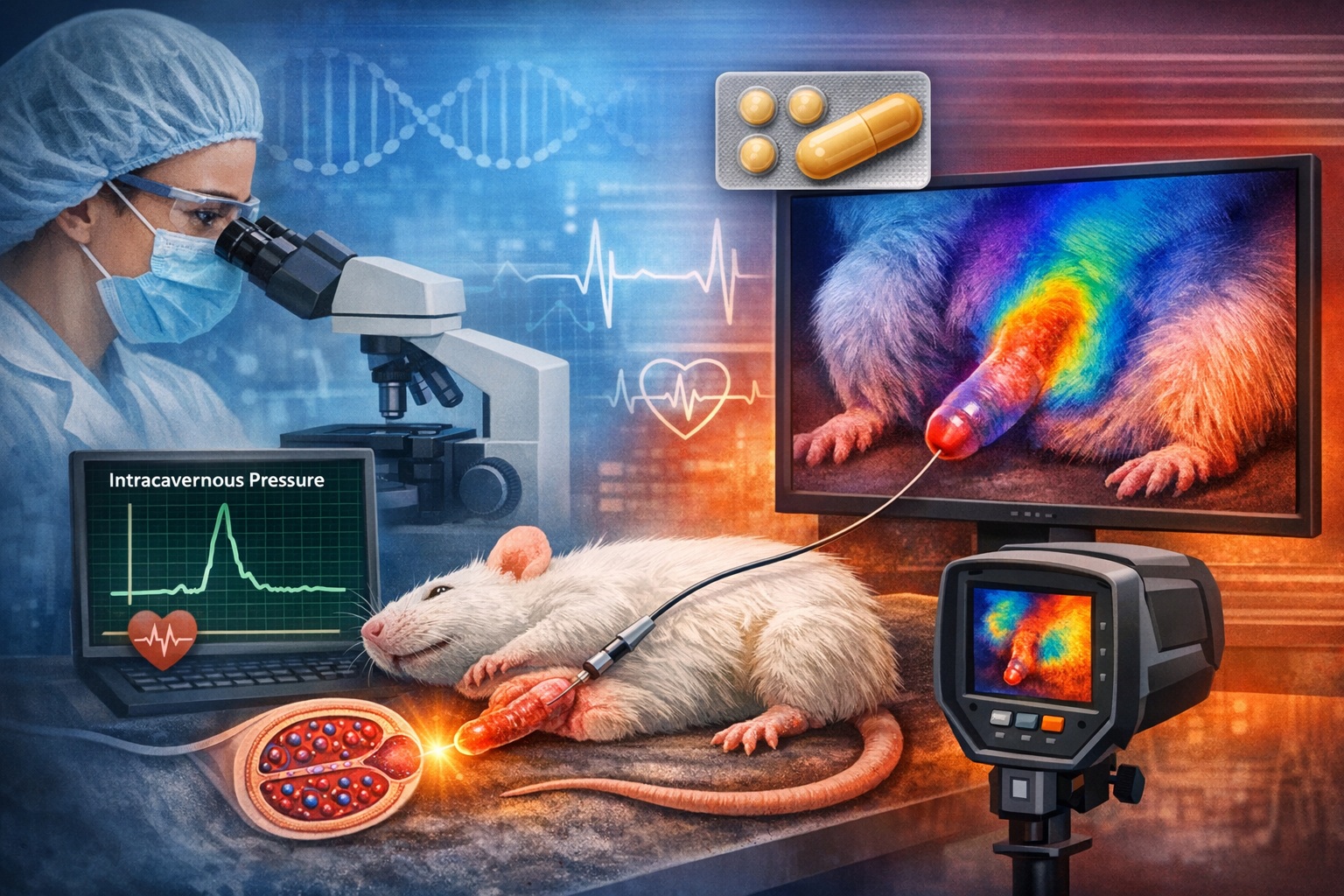
For decades, the gold standard in experimental andrology has been the measurement of intracavernous pressure (ICP). While ICP provides reliable physiological data, it is an invasive technique that requires surgical access and instrumentation. The procedure is not only technically demanding but also destructive in many cases, preventing repeated measurements in the same animal over time. In other words, the method that provides the most precise measurement also limits longitudinal research.
This dilemma has prompted researchers to search for alternatives—methods that can evaluate erectile function without invasive instrumentation. Among the most promising developments is infrared thermography, a technology capable of detecting subtle temperature changes associated with blood flow. Recent experimental work suggests that thermal imaging may provide a practical and accurate method for evaluating erectile responses in animal models. Interestingly, the technology also allows dynamic monitoring during pharmacologic intervention, offering a window into treatment responses in real time.
In modern biomedical research, where ethical considerations and reproducibility increasingly shape experimental design, the development of a non-invasive method for erectile function assessment represents more than a technical improvement. It represents a shift toward more humane, efficient, and longitudinal experimental studies.
The Traditional Gold Standard: Intracavernous Pressure Measurement
To appreciate the significance of thermal imaging, it is important to understand the method it seeks to replace. Measurement of intracavernous pressure has long been considered the most reliable way to quantify erectile responses in animal studies.
During this procedure, a needle connected to a pressure transducer is inserted directly into the corpus cavernosum of the penis. Electrical stimulation of the cavernous nerve triggers an erectile response, and the resulting increase in intracavernous pressure is recorded in real time. The pressure curve reflects the hemodynamic processes responsible for erection: arterial inflow, smooth muscle relaxation, and venous occlusion.
From a physiological perspective, ICP measurement offers several advantages. It provides a direct and quantitative indicator of erectile function, allowing researchers to compare responses between experimental groups. Parameters such as peak pressure, pressure rise time, and area under the pressure curve provide valuable insights into vascular and neural integrity.
However, the method has significant limitations. The most obvious drawback is its invasive nature. Surgical exposure of the cavernous nerve and placement of the pressure needle inevitably cause tissue trauma. In many experimental designs, this makes repeated measurements in the same animal impractical or impossible.
Another limitation is that ICP measurement captures a single moment in time. Because the procedure is terminal or highly invasive, researchers cannot easily track functional changes throughout disease progression or treatment. For example, evaluating how erectile function evolves during a course of drug therapy requires multiple groups of animals sacrificed at different time points.
These constraints become particularly problematic in studies examining chronic diseases such as diabetes-related erectile dysfunction. The ability to observe gradual physiological changes—or the early response to therapy—would significantly improve experimental precision. Unfortunately, the invasive nature of ICP measurement often prevents such longitudinal observation.
In addition, ethical considerations in animal research increasingly favor methods that reduce surgical interventions and animal suffering. Thus, while ICP remains a benchmark for physiological accuracy, the field has long needed a complementary approach capable of delivering meaningful data without the associated invasiveness.
Infrared Thermography: A Physiological Window Through Heat
Infrared thermography, often abbreviated as IRT, is a technology that detects and visualizes temperature differences across a surface. Originally developed for industrial and military applications, thermal imaging has gradually entered medical diagnostics, where it has been used to assess vascular disorders, inflammation, and metabolic activity.
The principle behind the technology is elegantly simple. All biological tissues emit infrared radiation proportional to their temperature. Specialized cameras can detect these emissions and convert them into detailed thermal maps. In living tissues, temperature variations frequently reflect underlying blood flow and metabolic activity.
This relationship makes thermography particularly attractive for studying erectile physiology. An erection is fundamentally a hemodynamic event: increased arterial inflow into the corpus cavernosum raises local blood volume and temperature. As a result, the surface temperature of the penis rises measurably during erection.
By capturing thermal images in real time, researchers can monitor these temperature changes and derive quantitative parameters such as peak temperature and the rate of temperature increase. These parameters may correspond closely to the hemodynamic changes traditionally measured through intracavernous pressure.
The major advantage of thermal imaging is its non-invasive nature. The technology requires no surgical procedures, needles, or implanted sensors. A thermal camera positioned above the animal can continuously record temperature changes without physically interacting with the tissue.
Beyond convenience, this non-invasive quality allows repeated measurements in the same subject. Researchers can observe erectile function over time, track disease progression, and monitor the effects of pharmacological treatments. This capability opens the door to a more dynamic understanding of erectile physiology.
One might say that thermography transforms the study of erectile function from a snapshot into a movie—capturing not just whether an erection occurs, but how it develops and resolves over time.
Establishing an Experimental Thermal Imaging System
Developing a reliable thermal imaging method for erectile assessment requires careful experimental design. Temperature measurements are sensitive to environmental conditions, animal positioning, and physiological variability. Without strict control of these factors, the resulting data could become unreliable.
In experimental settings, animals are typically anesthetized and placed in a controlled environment to minimize external temperature fluctuations. A high-resolution infrared camera is positioned above the genital area, allowing continuous monitoring of surface temperature. The system records thermal images at defined intervals, generating a temperature curve that corresponds to physiological changes during nerve stimulation.
Cavernous nerve stimulation remains an essential part of the protocol. Electrical stimulation triggers the erectile response, just as in traditional ICP measurement. However, instead of recording pressure changes inside the penis, researchers record the surface temperature dynamics associated with increased blood flow.
Two thermal parameters have proven particularly informative:
- Peak penile temperature, reflecting the maximum temperature reached during erection
- Temperature rise rate, representing the speed at which temperature increases after stimulation
These parameters provide insight into vascular responsiveness and erectile quality. In experimental models of erectile dysfunction, both peak temperature and temperature rise rate tend to decrease, reflecting impaired blood flow.
Importantly, thermal imaging allows researchers to generate continuous curves rather than isolated data points. The shape of the temperature curve—its slope, peak, and decline—mirrors the hemodynamic events occurring during erection.
When validated against traditional ICP measurements, these thermal curves show remarkably similar patterns. The correlation suggests that thermal imaging captures the same physiological events, albeit through a different measurable signal.
From a methodological perspective, the system offers another advantage: reproducibility. Because the technique does not damage tissue, the same animal can undergo multiple tests over time. This feature dramatically improves the statistical power of experimental studies while reducing the number of animals required.
Evaluating Erectile Dysfunction Models with Thermal Imaging
To determine whether thermal imaging can reliably assess erectile function, researchers have tested the technology across multiple experimental models of erectile dysfunction. These models mimic different pathological mechanisms commonly observed in human disease.
Common experimental ED models include:
- Diabetic erectile dysfunction, reflecting vascular and metabolic impairment
- Cavernous nerve injury, modeling postoperative ED following prostate surgery
- Vascular injury models, representing compromised penile blood supply
- Age-related erectile dysfunction, associated with endothelial decline
Each model affects erectile physiology through different mechanisms. Diabetes impairs endothelial function and nitric oxide signaling, while nerve injury disrupts neural pathways essential for erection. Aging introduces structural and vascular changes that reduce erectile responsiveness.
Thermal imaging has demonstrated strong diagnostic performance across these diverse models. In animals with erectile dysfunction, the peak penile temperature during stimulation is significantly lower than in healthy controls. Similarly, the rate of temperature increase is slower, reflecting reduced arterial inflow.
Statistical analysis shows high sensitivity and specificity when thermal parameters are used to distinguish healthy animals from those with erectile dysfunction. In many cases, the diagnostic accuracy approaches that of intracavernous pressure measurements.
Perhaps more importantly, the method captures the dynamic process of erectile impairment. Rather than simply identifying dysfunction, thermal imaging reveals how rapidly the erectile response develops and how effectively blood flow increases.
This capability is particularly useful in mechanistic studies. Researchers can observe how different disease processes alter the thermal response curve, providing insight into underlying physiological deficits.
In essence, thermal imaging does not merely confirm that erectile dysfunction exists—it helps explain why.
Monitoring Pharmacological Treatment: The Case of Tadalafil
One of the most intriguing applications of thermal imaging lies in its ability to monitor treatment responses over time. In pharmacological studies, researchers often need to evaluate how quickly a therapy improves erectile function and whether the effect persists.
Traditional ICP measurement makes such monitoring difficult because repeated invasive procedures can damage tissue and influence subsequent measurements. Thermal imaging eliminates this obstacle.
Consider the example of tadalafil, a widely used phosphodiesterase type-5 inhibitor. The drug enhances erectile function by increasing cyclic GMP levels in penile smooth muscle, promoting vasodilation and improved blood flow. In clinical practice, tadalafil is valued for its long half-life and sustained therapeutic effect.
In experimental diabetic rat models, thermal imaging allows researchers to observe how erectile function changes during treatment. By conducting repeated measurements at different time points, investigators can track the gradual improvement in penile blood flow.
Interestingly, thermal data show that measurable recovery of erectile function can appear relatively early during tadalafil therapy. Even within a few weeks of treatment, increases in peak penile temperature and temperature rise rate become detectable.
Such findings highlight the value of longitudinal monitoring. Rather than waiting until the end of an experimental protocol to evaluate outcomes, researchers can observe the trajectory of recovery. This approach provides a more nuanced understanding of drug efficacy and therapeutic mechanisms.
Moreover, the non-invasive nature of thermal imaging allows investigators to study individual variability in treatment response. Some animals may demonstrate rapid improvement, while others respond more gradually. These differences can yield valuable insights into disease mechanisms and pharmacodynamics.
In this sense, thermal imaging functions not only as a diagnostic tool but also as a research instrument capable of capturing the living physiology of erectile recovery.
Implications for Future Research and Clinical Translation
Although thermal imaging has been developed primarily for experimental animal studies, its broader implications are worth considering. Advances in imaging technology often begin in laboratory settings before eventually influencing clinical diagnostics.
In human medicine, thermography has already been explored for vascular assessment and inflammatory conditions. Its application to sexual medicine remains limited but promising. Non-invasive monitoring of penile temperature changes could potentially complement existing diagnostic tools such as Doppler ultrasound.
For researchers, however, the most immediate impact lies in experimental design. The ability to repeatedly measure erectile function in the same animal transforms how studies can be conducted. Longitudinal experiments become feasible, allowing investigators to observe disease progression and therapeutic response in real time.
This capability also aligns with modern principles of ethical animal research. By reducing the need for terminal procedures and minimizing invasive interventions, thermal imaging contributes to the refinement of experimental methodologies.
From a scientific perspective, the technology also enhances data richness. Continuous thermal curves provide detailed information about erectile dynamics, offering insights that single pressure measurements cannot capture.
Of course, thermal imaging does not entirely replace intracavernous pressure measurement. ICP remains valuable for direct hemodynamic assessment, particularly when validating new models or therapies. However, thermal imaging provides a powerful complementary method—one that prioritizes observation over intervention.
And in science, as in medicine, the ability to observe physiological processes without disturbing them is often the most elegant solution.
FAQ
What is infrared thermography in erectile research?
Infrared thermography is a non-invasive imaging technique that detects temperature changes on the surface of tissues. In erectile research, it measures temperature increases in the penis during erection, which reflect increased blood flow.
Why is intracavernous pressure measurement considered invasive?
The technique requires inserting a needle into the corpus cavernosum and stimulating the cavernous nerve surgically. This procedure causes tissue trauma and usually cannot be repeated multiple times in the same animal.
Can drugs like tadalafil be evaluated using thermal imaging?
Yes. Thermal imaging allows researchers to monitor improvements in erectile function over time during pharmacological treatment. In experimental models, therapies such as tadalafil can produce measurable increases in penile temperature responses, indicating improved blood flow and erectile recovery.
