

Introduction: When Recovery Is More Than Healing
Posterior urethroplasty, particularly after pelvic fracture–related urethral injury (PFUI), represents one of the most technically demanding reconstructive procedures in urology. While surgical success is often measured by restored urinary flow, patients rarely judge outcomes by that metric alone. For many—often young men—the true measure of recovery lies in the return of erectile function.
And here lies the problem.
Despite advances in nerve-sparing techniques, erectile dysfunction (ED) remains a frequent and deeply distressing consequence of PFUI and its surgical repair, with reported rates ranging from 20% to 80% . This is not simply a mechanical issue. It is a complex interplay of vascular injury, neural disruption, fibrosis, and psychological burden.
The study in focus introduces a pragmatic and compelling solution: combining tadalafil with a vacuum erection device (VED). The conclusion is straightforward yet impactful—this combination significantly improves penile rehabilitation compared to tadalafil alone.
What follows is not just a treatment protocol. It is a shift in philosophy—from passive recovery to active rehabilitation.
The Pathophysiology of Postoperative ED: A Perfect Storm of Injury
Erectile dysfunction following PFUI and posterior urethroplasty is rarely caused by a single factor. Instead, it emerges from a convergence of biological insults.
Trauma itself disrupts vascular supply and neural pathways. Surgical intervention, although restorative, may introduce additional microvascular and nerve damage. The result is impaired nitric oxide signaling, reduced arterial inflow, and compromised smooth muscle function.
Over time, a more insidious process begins: hypoxia-driven fibrosis. In the absence of regular erections, oxygen tension within the corpora cavernosa decreases. This hypoxic environment promotes collagen deposition and smooth muscle loss, leading to structural changes that further impair erectile function .
Psychological factors add another layer. Patients who experience prolonged periods without sexual activity often develop performance anxiety, further exacerbating ED.
The result is a self-reinforcing cycle—one that requires intervention, not patience.
Penile Rehabilitation: From Concept to Clinical Practice
Penile rehabilitation is based on a simple but powerful idea: the penis, like any other organ, requires regular physiological stimulation to maintain function.
In healthy individuals, spontaneous nocturnal erections provide periodic oxygenation and prevent tissue degradation. After injury or surgery, these natural mechanisms are often disrupted.
Rehabilitation strategies aim to replicate these physiological conditions artificially. The goal is not merely to achieve erections for sexual activity, but to preserve tissue integrity, prevent fibrosis, and maintain vascular health.
Historically, phosphodiesterase type 5 inhibitors (PDE5Is) such as tadalafil have been the cornerstone of this approach. However, monotherapy has limitations. Up to 35% of patients do not respond adequately .
This has led to the exploration of combination therapies—strategies that address multiple aspects of erectile physiology simultaneously.
Tadalafil: A Pharmacological Foundation for Recovery
Tadalafil occupies a unique position among PDE5 inhibitors. Its long half-life allows for sustained enhancement of nitric oxide–mediated vasodilation, providing continuous support for penile blood flow.
In the study, tadalafil was administered at a dose of 10 mg every other day for six months. This regimen reflects a balance between efficacy and tolerability, allowing for consistent plasma levels without excessive dosing .
Mechanistically, tadalafil improves arterial inflow and promotes smooth muscle relaxation via the cGMP pathway. This not only facilitates erections but also enhances tissue oxygenation.
Experimental data suggest that chronic tadalafil use may prevent smooth muscle loss and reduce fibrosis following nerve injury. In essence, it acts as a protective agent, preserving the structural integrity of penile tissue.
However, pharmacology alone is not always sufficient. Blood must not only flow—it must be mechanically delivered.
Vacuum Erection Devices: Mechanical Therapy with Biological Impact
The vacuum erection device (VED) is often underestimated. At first glance, it appears to be a simple mechanical tool. In reality, it exerts profound physiological effects.
By creating negative pressure, the VED draws arterial blood into the penis, inducing an erection. Unlike pharmacological agents, this process is independent of neural signaling.
More importantly, VED use significantly increases oxygen tension within the corpora cavernosa. Studies have shown that penile oxygenation can increase by more than 50% during vacuum-induced erections .
This oxygen-rich environment counteracts hypoxia-induced fibrosis, preserving smooth muscle content and preventing structural deterioration.
In the study protocol, patients used the VED for 10 minutes twice daily—without a constriction ring. This approach minimizes discomfort while maximizing physiological benefit.
The result is a therapy that is both simple and remarkably effective.
Study Design: A Direct Comparison of Strategies
The study enrolled 78 patients with ED following posterior urethroplasty. They were divided into two groups:
- Combination therapy: tadalafil + VED (36 patients)
- Monotherapy: tadalafil alone (42 patients)
Patients were followed for six months, with multiple outcome measures including:
- International Index of Erectile Function (IIEF-5)
- Quality of Erection Questionnaire (QEQ)
- Penile length
- Testosterone levels
- Nocturnal penile tumescence (NPT) testing
Baseline characteristics were comparable between groups, ensuring that observed differences were attributable to treatment.
This design provides a robust framework for evaluating the added value of mechanical therapy.
Clinical Outcomes: Where Combination Therapy Excels
The results are both statistically significant and clinically meaningful.
Patients receiving combination therapy demonstrated greater improvement in erectile function. The mean IIEF-5 score increased by approximately 8 points, significantly higher than in the tadalafil-only group .
Similarly, QEQ scores—reflecting subjective satisfaction—were markedly higher in the combination group.
Functional outcomes also improved. After treatment:
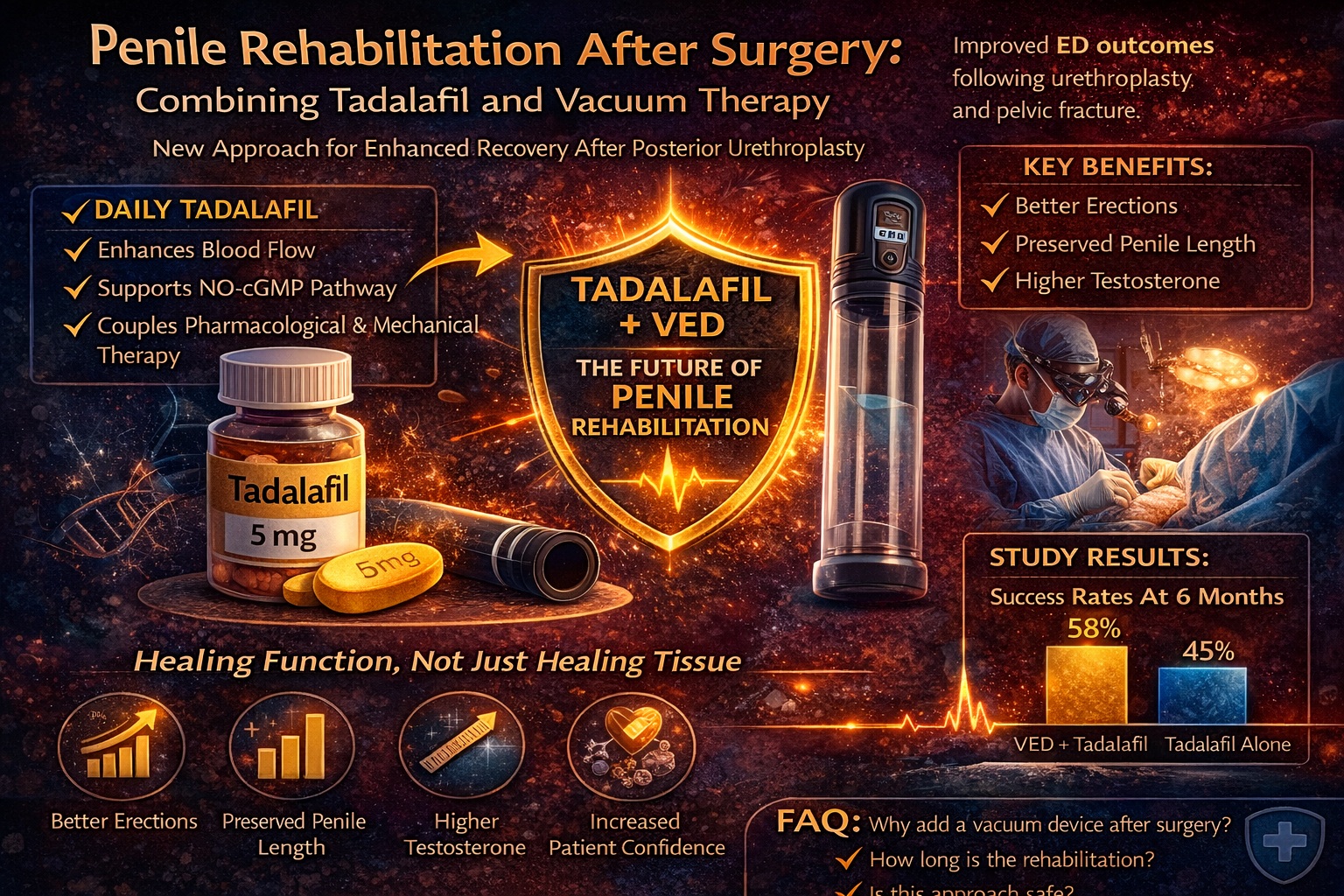
- 58.3% of patients in the combination group achieved vaginal penetration
- Compared to 45.2% in the monotherapy group
Perhaps most interestingly, patients reported increased confidence and engagement in their recovery process. This psychological benefit should not be underestimated.
Rehabilitation, after all, is as much about mindset as it is about physiology.
Penile Length Preservation: An Overlooked Outcome
Penile shortening is a common and distressing consequence of urethroplasty.
In this study, the difference between treatment groups was striking:
- Combination therapy: +0.4 cm change
- Tadalafil alone: −0.8 cm change
This represents not just preservation, but partial recovery of penile length.
The mechanism is clear. Regular oxygenation prevents fibrosis and maintains tissue elasticity. The VED, by mimicking natural erections, plays a central role in this process.
For patients, this outcome is more than cosmetic. It is closely tied to self-image and sexual confidence.
In clinical practice, it may be one of the most persuasive arguments for combination therapy.
Hormonal Changes: A Surprising Finding
An unexpected but intriguing result was the improvement in testosterone levels.
While both groups showed increases, the combination group experienced a significantly greater rise .
The explanation is likely indirect. Increased sexual activity and improved confidence may stimulate endogenous hormone production. Additionally, improved tissue oxygenation may enhance testicular function.
This finding highlights the interconnected nature of physiological systems. Treating one aspect of sexual health can influence others.
It also reinforces the importance of holistic approaches in medicine.
Limitations: Interpreting Results with Perspective
Despite its strengths, the study has limitations.
It was non-randomized, with patients selecting their treatment group. This introduces potential selection bias.
The absence of a VED-only group limits the ability to isolate the independent effect of mechanical therapy.
Additionally, the follow-up period was relatively short, and long-term outcomes remain unknown.
Nevertheless, the consistency of findings across multiple parameters supports the overall conclusion.
Conclusion: A New Standard for Rehabilitation
The combination of tadalafil and VED represents more than a treatment—it represents a strategy.
By addressing both pharmacological and mechanical aspects of erectile function, this approach offers a comprehensive solution to a complex problem.
It improves erectile function, preserves penile length, enhances hormonal balance, and increases patient confidence.
Most importantly, it transforms recovery from a passive process into an active one.
In modern urology, this may well become the new standard.
FAQ: Key Questions About Tadalafil and VED Therapy
1. Why combine tadalafil with a vacuum device?
Because they work through different mechanisms—pharmacological and mechanical—providing synergistic benefits.
2. Does this therapy really improve erectile function?
Yes. Combination therapy significantly improves IIEF-5 and QEQ scores.
3. Can it prevent penile shortening?
Yes. It helps preserve—and sometimes improve—penile length.
4. Is the therapy safe?
Generally yes. Minor discomfort may occur with improper VED use but is manageable.
5. How long should rehabilitation continue?
At least six months, although longer durations may provide additional benefits.
