

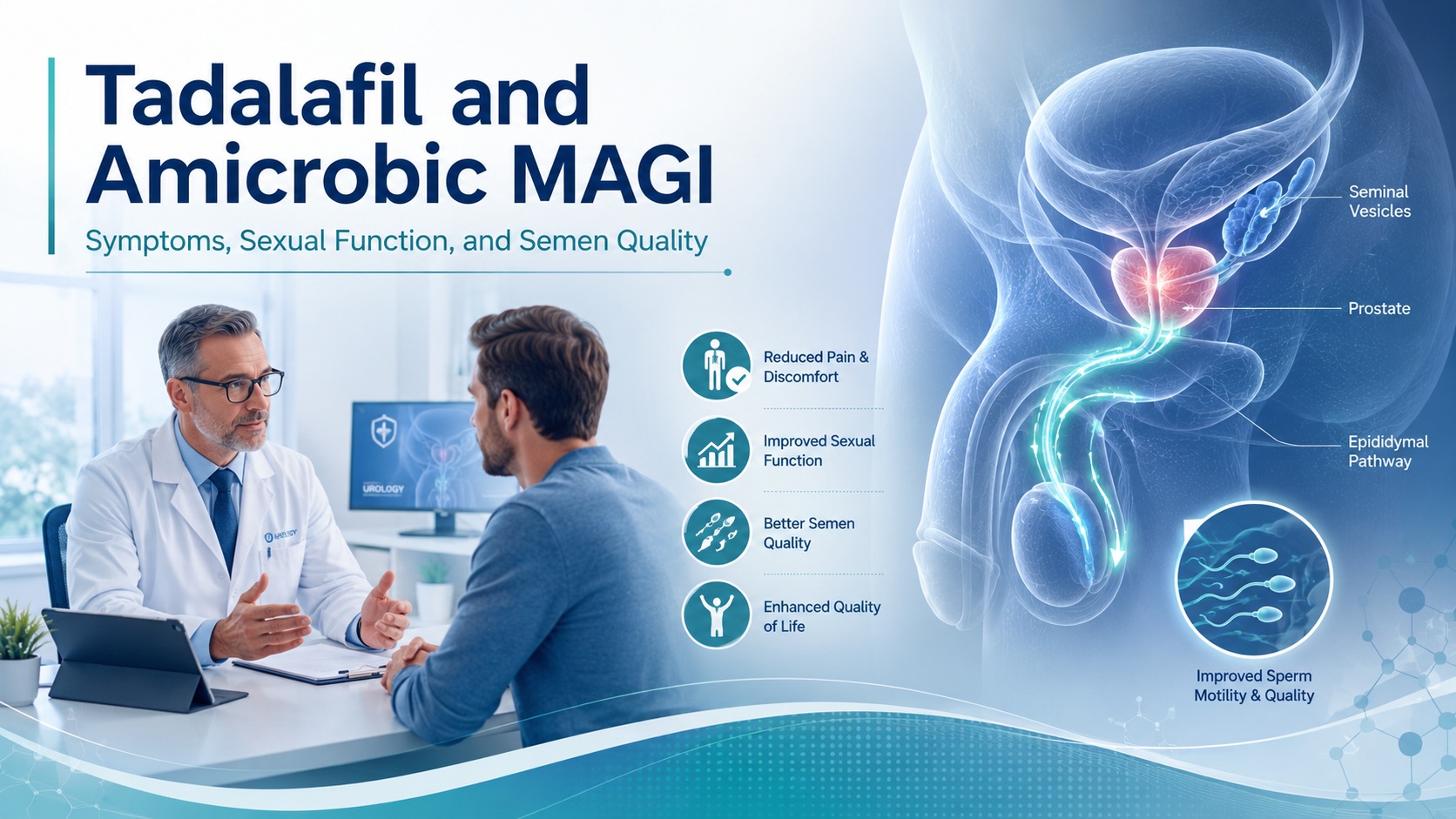
Introduction: When “Nonbacterial” Does Not Mean Harmless
Male accessory gland inflammation, commonly abbreviated as MAGI, is a clinically important but often underestimated condition involving the prostate, seminal vesicles, and sometimes the epididymis. It may present with pelvic discomfort, urinary symptoms, ejaculatory pain, sexual dysfunction, or impaired semen quality. The word “amicrobic” means that no active microbial infection is detected, but that does not make the condition imaginary, mild, or irrelevant. In medicine, the absence of bacteria does not automatically mean the absence of disease—if only clinical life were that polite.
The study “Chronic Administration of Tadalafil Improves the Symptoms of Patients with Amicrobic MAGI: An Open Study” examined whether daily tadalafil 5 mg for six months could improve symptoms, erectile function, ultrasound findings, and sperm parameters in selected young men with amicrobic MAGI and mild-to-moderate erectile dysfunction. The investigators enrolled 120 men aged 20–45 years and evaluated them using the IIEF-5 questionnaire, semen analysis, the SI-MAGI structured interview, and ultrasound assessment before and after treatment.
This article translates those findings into a broader clinical discussion. The key point is not that tadalafil is suddenly an anti-inflammatory miracle drug. It is not. Rather, the study suggests that in carefully selected patients, chronic low-dose tadalafil may improve pelvic symptoms, sexual function, and certain semen parameters by influencing smooth muscle tone, glandular drainage, and local functional dynamics.
Understanding Amicrobic MAGI: A Functional Disorder with Anatomical Consequences
MAGI is not a single uniform disease. It represents inflammation affecting male accessory reproductive glands, and its clinical expression depends heavily on anatomical extension. When inflammation is limited to the prostate, it is considered an uncomplicated form. When it extends to the seminal vesicles or epididymis, it becomes more complex and is often associated with more severe symptoms and poorer sperm quality.
The study classified patients into three categories: prostatitis, prostate-vesiculitis, and prostate-vesiculo-epididymitis. At baseline, 68 patients had uncomplicated prostatitis, while 52 had complicated forms, including 30 cases of prostate-vesiculitis and 22 cases of prostate-vesiculo-epididymitis. This distinction matters because the more extensive forms are usually harder to treat and more likely to affect fertility-related parameters.
The authors used ultrasound criteria to define these forms. This is clinically valuable because symptoms alone are often misleading. A patient may report pelvic pain or ejaculatory discomfort, but ultrasound can reveal whether inflammation is localized or has extended into seminal vesicles or epididymal structures. In this setting, imaging becomes more than a diagnostic accessory; it becomes a map of disease extension.
The SI-MAGI questionnaire also played a central role. It evaluates urinary disorders, spontaneous or ejaculatory pain, sexual function, and quality of life. This is important because MAGI is not adequately captured by asking one or two vague questions about pelvic discomfort. A structured interview helps quantify the daily burden of the disease and makes follow-up more objective.
Why Tadalafil Was Considered: Beyond Erectile Function
Tadalafil is best known as a phosphodiesterase type 5 inhibitor used for erectile dysfunction. Its mechanism involves enhancing nitric oxide–mediated cyclic guanosine monophosphate signaling, leading to smooth muscle relaxation and improved blood flow. In the penis, this improves erectile response. In the lower urinary tract and pelvic organs, the same pharmacological pathway may have additional effects.
The rationale for tadalafil in amicrobic MAGI is linked to smooth muscle relaxation in the prostate and seminal tract. One proposed mechanism is reduction of intraprostatic urinary reflux. Intraprostatic reflux has been suggested as a contributor to chronic abacterial prostatitis, where refluxed urine products may irritate tissue and perpetuate inflammation. By relaxing prostatic smooth muscle, tadalafil may theoretically improve drainage and reduce local functional stress.
Another possible mechanism involves seminal vesicle function. The seminal vesicles contribute substantially to ejaculate volume and provide biochemical support for sperm motility. If inflammatory congestion impairs vesicular emptying, sperm motility may suffer. Prior work cited by the authors suggests that tadalafil can improve seminal vesicle ejection fraction, possibly through a decontracting or drainage-enhancing effect.
This does not mean tadalafil should be used indiscriminately in all men with pelvic symptoms. The study specifically excluded patients with microbial infection, endocrine causes of erectile dysfunction, vascular disease, obesity, diabetes, hypertension, dyslipidemia, and other confounding conditions. In other words, this was a carefully selected population. That detail is not cosmetic; it defines the clinical boundaries of interpretation.
Clinical Findings: Symptoms, Sexual Function, and Ultrasound Improvement
After six months of tadalafil 5 mg daily, the mean IIEF-5 score improved from 14 to 23, indicating a meaningful improvement in erectile function. This is unsurprising given tadalafil’s established role in ED treatment, but in this study it is clinically important because the erectile dysfunction was observed in the context of amicrobic MAGI rather than classic vascular or endocrine disease.
The SI-MAGI domains also improved significantly. These included urinary symptoms, pelvic or ejaculatory discomfort, sexual function, and quality of life. This broader symptom improvement suggests that tadalafil’s benefit may not be limited to erection quality alone. Patients appeared to experience a more global reduction in the functional burden of MAGI.
Ultrasound findings also shifted favorably. Before treatment, 68 patients had uncomplicated disease and 52 had complicated disease. After treatment, 90 patients were classified as having uncomplicated MAGI, while complicated forms fell to 30. Prostate-vesiculitis decreased from 30 to 20 cases, and prostate-vesiculo-epididymitis decreased from 22 to 10 cases. This redistribution suggests a potential reduction in disease extension or severity as assessed by imaging.
Sexual symptoms beyond erection also improved. The proportion of patients reporting reduced libido fell from 25% to 10%. Difficulties in a second sexual intercourse decreased from 50% to 25%. Premature ejaculation fell from 8% to 4%, painful ejaculation from 10% to 4%, and delayed ejaculation from 12.5% to 8%. These changes are clinically relevant because men with MAGI often experience sexual dysfunction as a cluster, not as an isolated erectile problem.
Semen Quality: Why the PVE Group Matters Most
The most interesting semen-related finding occurred in patients with prostate-vesiculo-epididymitis. This subgroup typically carries the greatest risk of impaired semen quality because inflammation involves multiple structures relevant to sperm transport, maturation, and seminal plasma composition.
In the PVE group, tadalafil treatment was associated with a significant increase in total sperm motility and progressive motility. Total motility improved from markedly reduced baseline values to substantially better post-treatment values, while progressive motility also increased significantly. This finding is important because progressive motility is one of the semen parameters most directly linked to fertility potential.
The improvement was not equally pronounced in all MAGI categories. Patients with isolated prostatitis or prostate-vesiculitis showed smaller or nonsignificant changes in major sperm parameters. This suggests that tadalafil’s effect may be most visible when baseline dysfunction is more severe and when seminal vesicle or epididymal involvement contributes to impaired motility.
The authors discuss the possibility that improved seminal vesicle drainage may help explain better sperm motility. Seminal vesicle dysfunction may reduce seminal fructose and alter the biochemical environment needed for sperm movement. If tadalafil improves emptying and reduces congestion, semen quality may improve indirectly.
At the same time, caution is necessary. Tadalafil has had mixed results in studies of spermatogenesis and sperm function. Some animal data raise concerns at higher equivalent doses, while human studies have generally not shown detrimental effects on sperm production with chronic use. The present study used 5 mg daily for six months, and its findings apply only to the specific clinical context of amicrobic MAGI.
How This Could Change Clinical Thinking
The practical significance of this study lies in its reframing of tadalafil as more than an erectile aid in selected patients. In amicrobic MAGI with mild-to-moderate ED, tadalafil may influence a wider pelvic functional network involving the prostate, seminal vesicles, ejaculation, and semen quality. That is a more sophisticated view than treating every pelvic symptom as either infection or anxiety.
For clinicians, the study supports a more structured diagnostic approach. Men with pelvic symptoms, ejaculatory complaints, semen abnormalities, and ED should not be treated blindly with antibiotics when cultures are negative. The term “amicrobic” should push the clinician toward functional, inflammatory, and anatomical evaluation rather than repeated antimicrobial experiments.
A rational evaluation may include semen analysis, targeted microbiological testing, structured symptom assessment, endocrine evaluation when appropriate, and ultrasound examination of the prostate-vesicular and scrotal tract. The goal is to identify whether the patient has uncomplicated prostatitis or a complicated form involving seminal vesicles or epididymis.
Tadalafil may be considered in selected patients when erectile dysfunction coexists with amicrobic MAGI and when contraindications are absent. However, this should be done with medical supervision. PDE5 inhibitors are not appropriate for patients taking nitrates and require caution in men with certain cardiovascular conditions.
The most responsible interpretation is that tadalafil may be part of a broader therapeutic strategy, not a universal answer. Pelvic inflammation is rarely impressed by simplistic thinking. It usually demands patient selection, careful monitoring, and realistic expectations.
Limitations: Why the Evidence Is Promising but Not Final
The main limitation of the study is its open design and absence of a control group. Without a placebo or comparison arm, it is difficult to determine how much of the improvement was due to tadalafil itself, natural symptom fluctuation, behavioral changes, increased sexual activity, or regression to the mean. This does not invalidate the findings, but it does reduce certainty.
The study population was also highly selected. Men with microbial infection, endocrine disorders, vascular causes of ED, obesity, diabetes, hypertension, atherosclerosis, and dyslipidemia were excluded. This improves internal clarity but limits generalizability. Many real-world patients with pelvic symptoms have overlapping metabolic or vascular conditions.
Another limitation is that the study did not deeply explore long-term durability. Six months is meaningful, but chronic inflammatory pelvic conditions often relapse. We need to know whether benefits persist after discontinuation, whether maintenance therapy is necessary, and whether certain ultrasound phenotypes respond better than others.
The findings on semen quality, while intriguing, should also be interpreted carefully. Fertility outcomes such as pregnancy rate were not assessed. Improvement in sperm motility is encouraging, but semen parameters are surrogate markers. They help estimate fertility potential but do not guarantee reproductive success.
Future studies should be randomized, placebo-controlled, and stratified by MAGI subtype. They should include longer follow-up, standardized ultrasound phenotyping, semen biochemistry, inflammatory markers, and fertility outcomes when relevant. Until then, tadalafil in amicrobic MAGI should be considered a promising clinical hypothesis supported by preliminary evidence.
Conclusion: A Reasoned Role for Tadalafil in Selected MAGI Patients
Daily tadalafil 5 mg for six months was associated with improved erectile function, reduced MAGI-related symptoms, better quality-of-life scores, favorable ultrasound redistribution toward uncomplicated disease, and improved sperm motility in patients with prostate-vesiculo-epididymitis. These findings suggest that tadalafil may influence not only erection but also pelvic glandular function in selected men with amicrobic MAGI.
The likely mechanisms include relaxation of prostatic smooth muscle, reduction of intraprostatic reflux, improved seminal vesicle drainage, and better local functional dynamics. These mechanisms remain partly theoretical, but they are biologically plausible and clinically interesting.
The most important message is balance. Tadalafil is not an antibiotic, not a cure-all, and not a substitute for proper diagnosis. But in carefully selected patients, it may address a cluster of symptoms that conventional approaches often manage poorly.
For men with amicrobic MAGI, especially those with erectile dysfunction and ejaculatory symptoms, this study opens a thoughtful therapeutic direction. It invites clinicians to look beyond infection, beyond erection alone, and toward the functional anatomy of the male reproductive tract.
FAQ
Can tadalafil treat prostatitis or MAGI directly?
Tadalafil is not an antibiotic and does not treat bacterial infection. In amicrobic MAGI, it may help by relaxing smooth muscle, improving glandular drainage, and reducing functional pelvic symptoms.
What dose was used in the study?
The study used tadalafil 5 mg once daily for six months in selected patients with amicrobic MAGI and mild-to-moderate erectile dysfunction.
Did tadalafil improve semen quality?
The clearest semen improvement was observed in patients with prostate-vesiculo-epididymitis, especially in total and progressive sperm motility.
Is tadalafil suitable for every man with pelvic pain or prostatitis symptoms?
No. Patients need proper evaluation. Tadalafil may be considered only in selected cases and is not appropriate for men with contraindications such as nitrate therapy.
What is the main weakness of this study?
The main limitation is the lack of a control group. The results are promising, but randomized controlled trials are needed to confirm the findings.
