

Introduction: Redefining Responsiveness in Erectile Dysfunction Therapy
Erectile dysfunction (ED) has evolved from a stigmatized condition into a rigorously studied clinical entity with well-established therapeutic pathways. Yet, beneath this progress lies a subtle but critical challenge: variability. Patients differ not only in disease severity but also in ethnicity, comorbidities, and physiological response to treatment.
In this context, tadalafil—one of the most widely used phosphodiesterase type 5 (PDE5) inhibitors—has earned a reputation for reliability. However, most early data emerged from predominantly Western populations. The question remained: does this efficacy translate across diverse ethnic and clinical backgrounds?
An integrated analysis of five randomized controlled trials involving Asian men provides a compelling answer . This article explores that evidence in depth, offering a clinically grounded, professionally articulated perspective on the role of on-demand tadalafil therapy in a heterogeneous patient population.
Understanding Erectile Dysfunction in Asian Populations
Erectile dysfunction is a multifactorial condition influenced by vascular, neurological, hormonal, and psychological factors. While its biological mechanisms are universal, its clinical expression and management can vary significantly across populations.
In Asian populations, several distinctive features emerge. First, there is a higher prevalence of metabolic conditions such as diabetes, particularly in regions like South and Southeast Asia. These comorbidities are not merely coincidental; they directly impair endothelial function and reduce nitric oxide availability—key elements in erectile physiology.
Second, cultural factors influence both reporting and treatment adherence. Patients may delay seeking care, underreport symptoms, or use traditional remedies alongside prescribed therapies. This creates a unique clinical environment where pharmacological efficacy must be both robust and adaptable.
Finally, the demographic diversity within Asia itself—from East Asian to South Asian populations—adds another layer of complexity. Any meaningful clinical evaluation must therefore consider not only disease characteristics but also geographic and cultural variability.
Tadalafil as On-Demand Therapy: Pharmacological Strength and Clinical Logic
Tadalafil is distinguished by its pharmacokinetic profile. Unlike shorter-acting PDE5 inhibitors, it offers a prolonged window of efficacy, allowing for greater flexibility in sexual activity. This makes it particularly suitable for on-demand use, where timing and spontaneity are essential.
Mechanistically, tadalafil enhances erectile function by inhibiting PDE5, thereby increasing cyclic guanosine monophosphate (cGMP) levels and promoting smooth muscle relaxation in the corpus cavernosum. The result is improved penile blood flow in response to sexual stimulation.
In the integrated analysis, patients were instructed to take tadalafil as needed, up to once daily, without restrictions on food or alcohol . This reflects real-world conditions more accurately than tightly controlled dosing regimens.
Importantly, the study included both 10 mg and 20 mg doses, allowing for a nuanced evaluation of dose-response relationships. While both doses were effective, the 20 mg dose consistently demonstrated numerically superior outcomes.
Clinical Trial Design: Scale, Diversity, and Methodological Rigor
The integrated analysis draws from five double-blind, placebo-controlled trials conducted across nine Asian countries, involving a total of 1,046 patients . This scale alone lends substantial weight to the findings.
Participants were carefully selected based on clear inclusion and exclusion criteria. All had a history of erectile dysfunction for at least three months and were in stable sexual relationships. Patients with severe cardiovascular instability or contraindicated medications were excluded, ensuring safety without compromising generalizability.
The study design included a four-week baseline period followed by twelve weeks of treatment. Randomization allocated patients to placebo, tadalafil 10 mg, or tadalafil 20 mg groups.
Efficacy was assessed using validated instruments:
- The International Index of Erectile Function (IIEF)
- Sexual Encounter Profile (SEP) diary
- Global Assessment Question (GAQ)
This combination of subjective and objective measures provides a comprehensive evaluation of treatment outcomes.
Efficacy Outcomes: Consistency Across Populations and Conditions
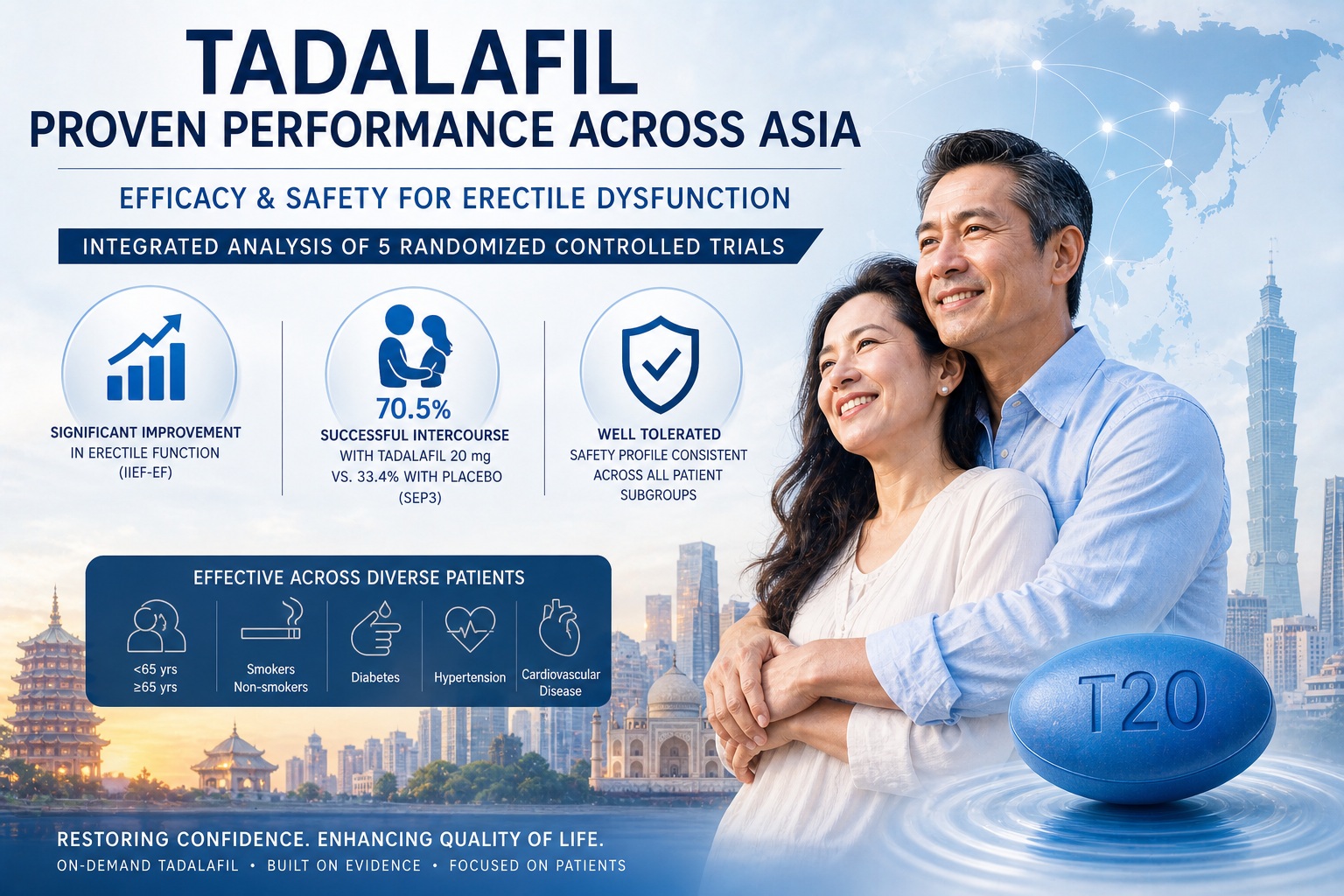
The results are both statistically robust and clinically meaningful. Patients receiving tadalafil—at both 10 mg and 20 mg doses—demonstrated significant improvements across all primary efficacy endpoints compared to placebo (P < 0.001) .
The IIEF-EF domain score, a gold standard in ED assessment, improved markedly. Patients in the 20 mg group achieved an average increase from approximately 14.9 to 23.0, effectively transitioning from moderate dysfunction to mild impairment.
Equally compelling are the SEP results. Successful intercourse (SEP3) rates reached 70.5% in the 20 mg group, compared to just 33.4% in the placebo group . This is not merely a statistical victory—it represents a tangible improvement in patients’ intimate lives.
Perhaps most striking is the consistency of these outcomes across clinical subgroups. Age, smoking status, diabetes, hypertension, and cardiovascular disease did not diminish the therapeutic effect. In fact, patients with more severe baseline dysfunction often experienced greater relative improvements.
This universality underscores the adaptability of tadalafil as a treatment option.
Dose Considerations: Subtle Differences with Clinical Implications
While both 10 mg and 20 mg doses were effective, the higher dose demonstrated a trend toward superior outcomes. This was particularly evident in measures such as SEP3 and the proportion of patients achieving normal erectile function.
Approximately 45% of patients in the 20 mg group reached normal erectile function (IIEF-EF ≥ 26), compared to 36% in the 10 mg group and only 12% in the placebo group .
However, the difference between doses was not always statistically significant. This suggests that while 20 mg may offer incremental benefits, 10 mg remains a viable option for many patients, particularly those concerned about tolerability.
Interestingly, in certain subgroups—such as patients with diabetes—the 10 mg dose performed comparably or even slightly better. This may reflect sample size limitations rather than true pharmacological differences, but it highlights the importance of individualized therapy.
Safety Profile: Predictable, Manageable, and Reassuring
Safety is where tadalafil reinforces its clinical credibility. The incidence of adverse events was low and consistent with known pharmacological effects.
The most commonly reported side effects included:
- Headache
- Back pain
- Myalgia
These events were generally mild and transient. Importantly, discontinuation rates due to adverse events were minimal and comparable to placebo .
No clinically significant changes were observed in vital signs, electrocardiograms, or laboratory parameters. Serious adverse events were rare and not directly attributable to the drug.
An interesting observation is the relatively lower incidence of reported side effects in this Asian population compared to Western cohorts. While this may reflect biological differences, cultural factors in reporting cannot be excluded.
Cultural and Clinical Nuances: More Than Just Pharmacology
One of the more subtle insights from this analysis lies beyond pharmacodynamics. Treatment outcomes are influenced not only by the drug itself but also by how it is used.
Cultural attitudes toward sexuality, timing of medication intake, and expectations of treatment all play a role. For instance, inadequate patient instruction has been identified as a common cause of perceived treatment failure.
In Asian populations, where discussions of sexual health may be more reserved, clinician guidance becomes particularly important. Proper education on dosing, timing, and expectations can significantly enhance therapeutic outcomes.
This underscores a broader principle: effective treatment requires both pharmacological precision and human communication.
Conclusion: A Reliable Therapy Across Diverse Clinical Realities
The integrated analysis provides compelling evidence that tadalafil, when taken on demand, is both effective and safe for the treatment of erectile dysfunction in Asian men.
Its efficacy spans a wide range of clinical conditions, from mild to severe ED and across multiple comorbidities. Its safety profile remains consistent and manageable, reinforcing its role as a first-line therapy.
Perhaps most importantly, the study highlights the adaptability of tadalafil across diverse populations. In a field where variability is the rule rather than the exception, this consistency is invaluable.
In the end, tadalafil does not promise perfection. It offers something far more useful: reliable improvement, grounded in evidence and adaptable to real-world complexity.
FAQ: Practical Insights for Clinicians and Patients
1. Is tadalafil equally effective in Asian and Western populations?
Yes, the study demonstrates comparable efficacy and safety across ethnic groups, including diverse Asian populations.
2. What is the optimal dose for on-demand use?
Both 10 mg and 20 mg are effective, but 20 mg may provide greater improvement in some patients.
3. Does diabetes reduce the effectiveness of tadalafil?
While diabetes can impair baseline function, tadalafil still provides significant improvement in diabetic patients.
4. What are the most common side effects?
Headache, back pain, and muscle aches are the most frequently reported, typically mild and transient.
5. Can tadalafil be taken with food or alcohol?
Yes, in this study, patients used tadalafil without restrictions, reflecting real-world conditions.
