

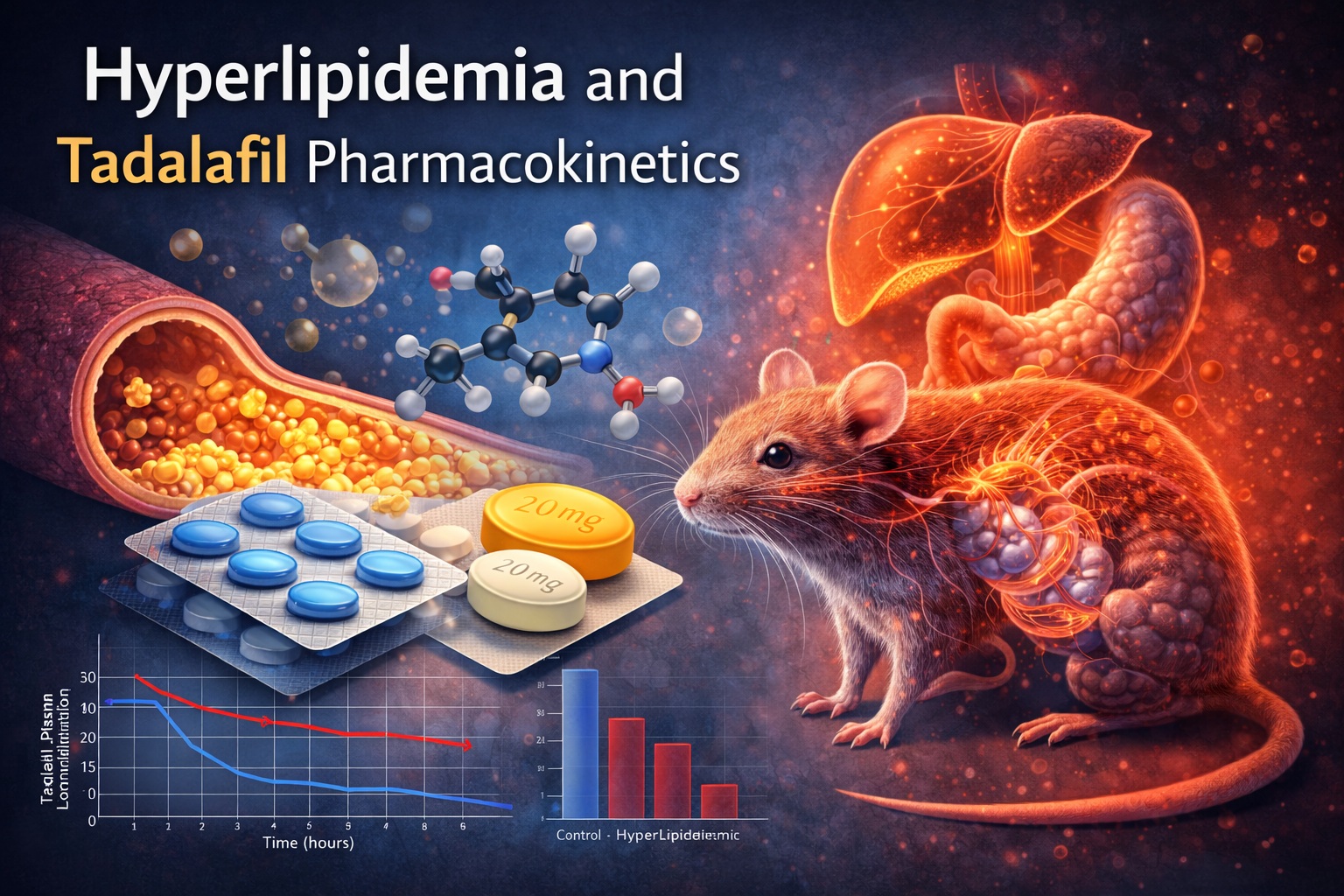
Introduction: A Drug Meets a Metabolic Reality
Tadalafil is widely recognized as a cornerstone therapy in erectile dysfunction, valued for its prolonged duration of action and favorable pharmacokinetic profile. Unlike its shorter-acting counterparts, it offers a window of therapeutic flexibility that has reshaped patient expectations and clinical practice. Yet, as with all pharmacological agents, its behavior in the body is not fixed—it is influenced by the biological environment in which it operates.
Hyperlipidemia represents one such environment. Characterized by elevated levels of cholesterol and triglycerides, it is both a risk factor for erectile dysfunction and a modifier of drug disposition. This dual role makes it particularly relevant in patients likely to receive tadalafil therapy.
The study under discussion explores this interaction in an experimental model, revealing that hyperlipidemia does not merely coexist with tadalafil use—it fundamentally alters its pharmacokinetics . The implications extend beyond academic curiosity, touching on dosing, safety, and therapeutic outcomes in real-world patients.
Pharmacological Profile of Tadalafil: Stability with Hidden Vulnerabilities
Tadalafil belongs to the PDE5 inhibitor class, exerting its effect by enhancing nitric oxide-mediated vasodilation through cGMP accumulation. Its distinguishing feature is its long half-life—up to 36 hours in humans—which allows for greater spontaneity in clinical use.
Unlike sildenafil or vardenafil, tadalafil absorption is not significantly affected by high-fat meals. This characteristic has contributed to its reputation as a pharmacologically stable agent. However, stability in one context does not guarantee invariability in another.
Tadalafil is highly lipophilic and extensively metabolized in the liver, primarily via the cytochrome P450 3A (CYP3A) system. These properties make it particularly susceptible to changes in lipid metabolism and hepatic function—two domains profoundly affected by hyperlipidemia.
Thus, while tadalafil appears predictable under standard conditions, its pharmacokinetic behavior may shift dramatically in the presence of altered metabolic states.
Hyperlipidemia: More Than a Cardiovascular Risk Factor
Hyperlipidemia is often discussed in the context of cardiovascular disease, but its influence extends far beyond atherosclerosis. It alters plasma composition, enzyme activity, and tissue distribution—all of which are critical determinants of drug pharmacokinetics.
In the experimental model described, hyperlipidemia was induced using poloxamer-407, resulting in markedly elevated cholesterol and triglyceride levels. As shown in Table 1 on page 6, lipid levels increased several-fold compared to controls, creating a metabolic environment that significantly deviates from normal physiology .
This altered state affects drug behavior in multiple ways. Lipoproteins, which are abundant in hyperlipidemia, can bind lipophilic drugs such as tadalafil, reducing their free (active) fraction. At the same time, hepatic enzyme expression—particularly CYP3A—is reduced, impairing drug metabolism.
The result is a pharmacokinetic landscape that is both predictable in its direction and complex in its consequences: increased drug exposure, reduced clearance, and altered distribution.
Pharmacokinetic Transformations: What the Data Reveal
The study provides a detailed comparison of tadalafil pharmacokinetics in control and hyperlipidemic rats, offering insights into both intravenous and oral administration.
After intravenous administration, the total drug exposure—measured as the area under the concentration–time curve (AUC)—increased more than twofold in hyperlipidemic animals. At the same time, total body clearance decreased significantly, and the volume of distribution was reduced .
These findings indicate that tadalafil remains in the bloodstream longer and distributes less extensively into tissues. The reduction in volume of distribution is particularly notable, suggesting increased binding to plasma components.
The effects were even more pronounced following oral administration. As illustrated in the concentration–time curves on page 5, hyperlipidemic rats exhibited nearly a twelvefold increase in AUC and a substantial rise in peak plasma concentration .
This dramatic amplification underscores a key point: hyperlipidemia does not simply modify pharmacokinetics—it can magnify drug exposure to clinically significant levels.
Hepatic Metabolism: The Slowing Engine
The liver plays a central role in tadalafil metabolism, primarily through CYP3A enzymes. In hyperlipidemic states, the expression and activity of these enzymes are reduced, leading to slower drug clearance.
The in vitro experiments using hepatic S9 fractions provide compelling evidence for this mechanism. As shown in Figure 2 on page 7, tadalafil degradation was significantly reduced in hyperlipidemic samples, with a larger proportion of the drug remaining unmetabolized over time .
This reduction in metabolic activity is consistent with previous findings in other drugs metabolized by CYP3A, suggesting a broader pharmacological principle rather than a tadalafil-specific phenomenon.
From a clinical perspective, reduced hepatic metabolism translates into prolonged drug exposure. While this may enhance efficacy in some cases, it also increases the risk of adverse effects—particularly in drugs with narrow therapeutic windows.
Intestinal First-Pass Effect: An Overlooked Contributor
While hepatic metabolism often takes center stage, the intestine also plays a critical role in drug disposition. Many drugs undergo significant metabolism during their first pass through the intestinal wall, reducing systemic exposure.
In this study, the intestinal first-pass effect of tadalafil was markedly reduced in hyperlipidemic rats. Drug concentrations measured in the portal vein were significantly higher, indicating greater absorption into the systemic circulation .
This finding helps explain the disproportionately large increase in AUC observed after oral administration. It is not merely a matter of reduced hepatic clearance; it is also a consequence of increased initial absorption.
The implication is clear: hyperlipidemia enhances tadalafil exposure through multiple pathways, creating a cumulative effect that exceeds the sum of its parts.
Protein Binding: When More Means Less
One of the more subtle yet significant findings of the study relates to plasma protein binding. In hyperlipidemic rats, tadalafil binding increased from approximately 91% to over 98% .
At first glance, this may seem inconsequential. However, the pharmacological activity of a drug is determined by its unbound fraction—the portion free to interact with target tissues.
Increased protein binding reduces this free fraction, potentially limiting immediate pharmacodynamic effects. Paradoxically, it also contributes to reduced clearance and prolonged systemic exposure, as bound drug is protected from metabolism.
This dual effect creates a complex dynamic. The drug becomes both less available in the short term and more persistent over time—a combination that may alter both efficacy and safety.
Clinical Interpretation: Translating Animal Data to Human Practice
While the study provides valuable insights, its findings must be interpreted with caution. The experimental model involves extreme levels of hyperlipidemia, which may not fully reflect typical human conditions.
Nevertheless, the qualitative trends are likely applicable. Patients with hyperlipidemia—particularly those with severe dyslipidemia—may experience altered tadalafil pharmacokinetics similar in direction, if not magnitude, to those observed in the study.
This raises important clinical considerations. Standard dosing regimens, established in healthy populations, may not be optimal for patients with metabolic disorders. Increased drug exposure could enhance therapeutic effects but also increase the risk of adverse reactions.
The challenge lies in balancing these factors. Personalized dosing, informed by metabolic status, may represent the next step in optimizing PDE5 inhibitor therapy.
Conclusion: Pharmacokinetics in a Changing Metabolic Landscape
The interaction between hyperlipidemia and tadalafil pharmacokinetics highlights a broader principle: drugs do not act in isolation. Their behavior is shaped by the physiological context in which they are administered.
In hyperlipidemic states, tadalafil exhibits increased exposure, reduced clearance, and altered distribution. These changes are driven by decreased hepatic and intestinal metabolism, increased protein binding, and modified absorption dynamics.
For clinicians, this means that prescribing tadalafil is not merely a matter of selecting a dose—it is an exercise in understanding the patient’s metabolic profile. For researchers, it underscores the importance of studying drugs in diverse physiological conditions.
Ultimately, the findings serve as a reminder that even well-characterized drugs can behave unpredictably in altered biological environments. And in medicine, unpredictability is rarely a trivial concern.
FAQ: Practical Questions About Tadalafil and Hyperlipidemia
1. Does hyperlipidemia increase tadalafil levels in the body?
Yes, it can significantly increase systemic exposure by reducing metabolism and increasing absorption.
2. Why does protein binding matter?
Only the unbound fraction of a drug is pharmacologically active. Increased binding alters both activity and clearance.
3. Should tadalafil dosing be adjusted in hyperlipidemic patients?
Potentially, although clinical guidelines are not yet definitive. Individual assessment is recommended.
4. Are these findings directly applicable to humans?
Not entirely. The study uses an animal model, but the trends are likely relevant in clinical practice.
5. What is the biggest clinical concern?
Increased drug exposure may raise the risk of adverse effects, particularly in patients with severe metabolic disorders.
