

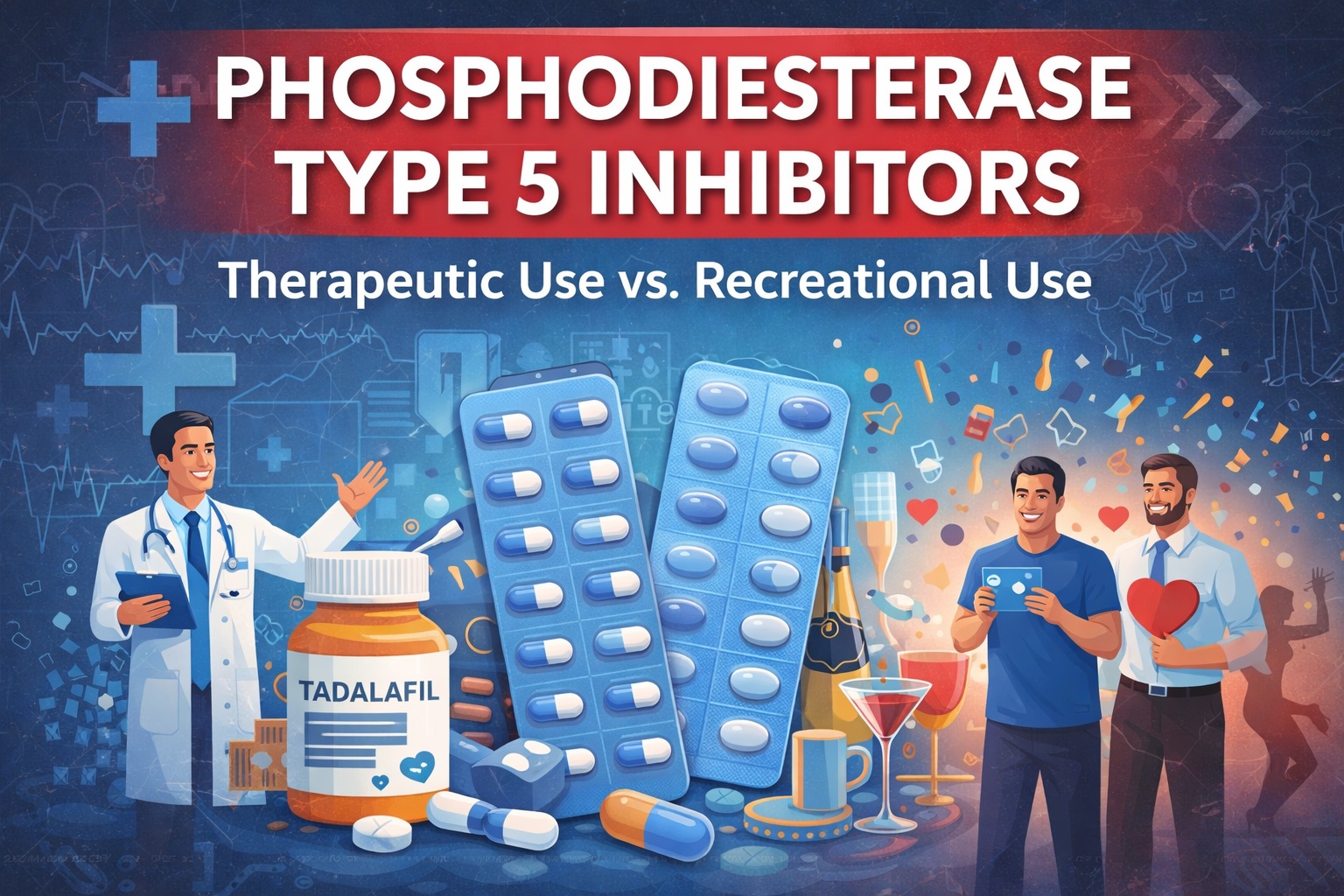
Introduction: When Therapy Becomes Lifestyle
Phosphodiesterase type 5 inhibitors (PDE5 inhibitors) have transformed the management of erectile dysfunction (ED), offering an effective, well-tolerated, and convenient oral therapy. Drugs such as sildenafil, vardenafil, and tadalafil have become synonymous with modern sexual medicine, restoring not only physiological function but also psychological confidence. Yet, as with many successful pharmacological innovations, their widespread availability has blurred the boundary between treatment and enhancement.
The contemporary landscape reveals a paradox. While ED remains a significant clinical condition affecting quality of life, a growing proportion of PDE5 inhibitor consumption occurs in men without a formal diagnosis. This shift from therapeutic to recreational use raises critical questions regarding safety, public health, and the evolving perception of sexual performance.
A recent observational study conducted in Saudi Arabia provides a valuable lens into this phenomenon. It highlights not only the prevalence of PDE5 inhibitor use but also the motivations, knowledge, and behaviors surrounding their consumption . This article builds upon those insights to examine the broader implications of irrational use, with particular attention to tadalafil—one of the most commonly used agents.
Pharmacological Foundations: Why PDE5 Inhibitors Work So Well
To understand why these medications are so widely used—and misused—it is essential to revisit their mechanism of action. PDE5 inhibitors act by blocking the degradation of cyclic guanosine monophosphate (cGMP), a key mediator in the nitric oxide pathway. This results in smooth muscle relaxation within the corpus cavernosum, facilitating increased blood flow and erection in response to sexual stimulation.
The elegance of this mechanism lies in its specificity. These agents do not induce erections spontaneously; rather, they enhance physiological responses. This distinction, however, is often misunderstood by users who perceive the drugs as universal enhancers of sexual performance.
Tadalafil, in particular, has gained prominence due to its pharmacokinetic profile. With a longer half-life compared to sildenafil, it allows for greater spontaneity, reducing the need for precise timing before intercourse. This feature, while advantageous in clinical settings, may also contribute to its popularity among recreational users seeking convenience and perceived reliability.
Erectile Dysfunction vs. Performance Enhancement: A Blurred Boundary
Erectile dysfunction is clinically defined as the persistent inability to achieve or maintain an erection sufficient for satisfactory sexual performance. It is a multifactorial condition influenced by vascular, neurological, hormonal, and psychological factors. Importantly, ED is not merely a physical disorder—it is deeply intertwined with mental health, relationships, and self-perception.
However, the distinction between dysfunction and dissatisfaction is increasingly ambiguous. Many men with normal erectile function report using PDE5 inhibitors to “optimize” performance rather than treat pathology. This phenomenon reflects a broader cultural shift toward enhancement medicine, where normal physiological states are perceived as improvable.
Data from the Saudi cohort illustrate this clearly: a majority of users (over 60%) reported normal erectile function and used PDE5 inhibitors recreationally . This suggests that the drivers of use extend beyond clinical necessity and into the domains of curiosity, confidence, and social expectation.
Epidemiology of Use: Patterns, Profiles, and Paradoxes
The prevalence of PDE5 inhibitor use is striking. In the referenced study, approximately 37.5% of sexually active men reported using these medications at some point . Even more noteworthy is the demographic profile of users.
Contrary to traditional assumptions, users are not exclusively older men with comorbidities. Instead, many are relatively young, well-educated, and financially stable. Higher income and education levels were associated with increased likelihood of use, particularly in the recreational group. This challenges the notion that misuse is driven solely by lack of awareness.
Lifestyle factors also play a role. Smoking, frequent sexual activity, and occupational exposure to healthcare environments were more common among users. These associations suggest that both behavioral and environmental influences contribute to the normalization of PDE5 inhibitor consumption.
The paradox lies in the coexistence of high awareness and irrational use. Despite widespread knowledge about these drugs, most users obtained them without medical supervision, indicating a disconnect between understanding and responsible behavior.
Access Without Oversight: The Role of Healthcare Systems
One of the most concerning findings is the ease of access to PDE5 inhibitors. The majority of users in the study acquired these medications without a prescription, often directly from pharmacies . This lack of regulation effectively transforms prescription drugs into over-the-counter commodities.
Such accessibility has several implications. First, it bypasses essential clinical evaluation. Erectile dysfunction can be an early indicator of systemic conditions such as diabetes or cardiovascular disease. Without proper assessment, these underlying issues may go undetected.
Second, unsupervised use increases the risk of contraindications. PDE5 inhibitors are generally safe but can interact with nitrates and certain antihypertensive medications, potentially leading to serious adverse events.
Finally, the absence of professional guidance fosters misinformation. Users may rely on anecdotal advice from peers or media sources, which often emphasize benefits while minimizing risks.
Motivations Behind Recreational Use: More Than Curiosity
Understanding why men without ED choose to use PDE5 inhibitors is crucial for addressing misuse. The study identifies several key motivations:
- Curiosity and experimentation
- Enhancement of self-confidence
- Desire for prolonged erection or improved performance
- Perceived improvement in sexual satisfaction
These motivations reflect psychological rather than physiological needs. In many cases, the drug serves as a reassurance tool—a pharmacological safety net that reduces performance anxiety.
Interestingly, a significant proportion of recreational users reported subjective improvement in sexual function. This raises the question of whether these benefits are pharmacological or psychological. The placebo effect, combined with increased confidence, likely plays a substantial role.
There is also an element of social signaling. In certain contexts, the use of performance-enhancing drugs may be perceived as a marker of virility or sexual competence. This cultural dimension cannot be overlooked when analyzing patterns of use.
Clinical Outcomes and Perceived Benefits
From a strictly medical perspective, PDE5 inhibitors are highly effective in treating ED. Their safety profile is well established, with most adverse effects being mild and transient, including headache, flushing, and nasal congestion.
In the study population, approximately 80% of users reported improvement in sexual activity . Among recreational users, benefits included enhanced erection rigidity and increased duration. While these findings may seem to justify use, they must be interpreted with caution.
Objective evidence suggests that PDE5 inhibitors do not significantly improve erectile function in men with normal baseline physiology. Therefore, reported benefits may be influenced by psychological factors or subjective expectations.
Moreover, reliance on pharmacological enhancement may have unintended consequences. Some studies suggest that habitual use can reduce confidence in natural erectile ability, creating a cycle of dependency.
Risks, Adverse Effects, and Hidden Dangers
Although PDE5 inhibitors are generally safe, their misuse introduces several risks. These risks are not always immediate or dramatic, which contributes to a false sense of security among users.
Short-term adverse effects are relatively common but usually mild. However, the real concern lies in inappropriate use in individuals with contraindications or underlying health conditions. Without medical screening, these risks remain unmitigated.
Another important consideration is behavioral risk. Recreational use has been associated with increased likelihood of risky sexual behaviors, including multiple partners and reduced condom use. This raises the potential for increased transmission of sexually transmitted infections.
Long-term effects of chronic, non-indicated use remain poorly understood. The absence of robust longitudinal data means that current reassurance regarding safety may be incomplete.
The Socio-Cultural Context: Silence, Stigma, and Self-Medication
Sexual health remains a sensitive topic in many societies, including Saudi Arabia. Cultural norms may discourage open discussion of sexual issues, leading individuals to seek solutions independently.
This environment fosters self-medication. Men may prefer to purchase PDE5 inhibitors discreetly rather than consult a physician. The anonymity of online information and informal networks further reinforces this behavior.
At the same time, societal expectations regarding masculinity and sexual performance exert pressure on individuals. The fear of inadequacy—even in the absence of dysfunction—can drive the use of enhancement drugs.
Ironically, the very stigma that discourages medical consultation also contributes to irrational use. Addressing this paradox requires not only medical intervention but also cultural and educational initiatives.
Regulation, Education, and the Path Forward
The findings highlight the need for a multifaceted approach to address misuse. Regulatory measures alone are insufficient without parallel efforts in education and awareness.
Healthcare systems must ensure that PDE5 inhibitors are dispensed responsibly, with appropriate screening and counseling. Pharmacists play a critical role in this process and should be empowered to enforce prescription requirements.
Public education campaigns should focus on:
- Clarifying the distinction between treatment and enhancement
- Highlighting potential risks and contraindications
- Encouraging medical consultation for sexual health concerns
Importantly, these messages must be culturally sensitive and accessible. Reducing stigma around sexual health is essential for promoting responsible behavior.
Conclusion: A Drug, a Tool, or a Crutch?
PDE5 inhibitors represent one of the most significant advances in sexual medicine. When used appropriately, they offer safe and effective treatment for erectile dysfunction, improving quality of life for millions of men.
However, their widespread availability and perceived benefits have led to a growing trend of recreational use. This shift reflects broader societal changes in attitudes toward performance, confidence, and self-optimization.
Tadalafil, with its long duration of action and convenience, exemplifies both the strengths and challenges of this drug class. Its popularity underscores the need for careful balance between accessibility and control.
Ultimately, the question is not whether PDE5 inhibitors should be used—but how, why, and under whose guidance. Without addressing these issues, the line between therapy and misuse will continue to blur, with implications that extend beyond individual health to public well-being.
FAQ: Key Questions Answered
1. Is it safe to take tadalafil without erectile dysfunction?
While tadalafil is generally safe, using it without medical indication is not recommended. It may expose you to unnecessary risks and can create psychological dependence.
2. Do PDE5 inhibitors improve performance in healthy men?
Evidence suggests they do not significantly enhance physiological function in men with normal erections. Perceived benefits are often psychological.
3. Can I buy PDE5 inhibitors without a prescription?
In some regions, yes—but this practice is discouraged. Medical evaluation is important to rule out contraindications and underlying conditions.
4. Are there long-term risks of recreational use?
Long-term effects are not well studied. Potential concerns include dependency, reduced natural confidence, and unrecognized health risks.
5. Why is tadalafil so popular compared to other drugs?
Its longer duration of action allows for greater spontaneity, making it more appealing for both therapeutic and recreational use.
