

Introduction: From Needles to Photons in Erectile Research
Erectile function has long been a subject of both clinical importance and scientific curiosity. While pharmacological breakthroughs—most notably phosphodiesterase type-5 inhibitors such as tadalafil—have transformed treatment, understanding the underlying physiology still relies heavily on experimental models. Among these, rodent studies remain indispensable for exploring vascular, neural, and metabolic mechanisms of erection.
Yet, the tools used to measure erectile function have historically lagged behind the sophistication of the questions being asked. The traditional gold standard, intracavernous pressure (ICP) measurement, offers precise data but at a cost: it is invasive, technically demanding, and often terminal for the animal subject.
This limitation has sparked the search for alternative methods—approaches that preserve accuracy while reducing invasiveness. Enter infrared thermography (IRT), a technology that detects temperature changes as a proxy for blood flow and tissue activity.
At first glance, using heat to measure erectile function may seem unconventional. However, when one considers that erection is fundamentally a hemodynamic event—characterized by increased blood flow—it becomes clear that temperature changes are not merely incidental but integral to the process.
This article explores the development of an IRT-based system for evaluating erectile function in rats, examining its physiological basis, methodological advantages, and implications for future research. In doing so, it highlights a broader shift in experimental medicine: from invasive measurement toward non-invasive observation.
The Physiology of Erection: A Hemodynamic Symphony
Erection is a complex physiological event involving coordinated interactions between vascular, neural, and endocrine systems. At its core lies a simple principle: increased blood flow into the corpus cavernosum.
Sexual stimulation triggers the release of nitric oxide from endothelial cells and nerve terminals. This molecule activates guanylate cyclase, increasing levels of cyclic guanosine monophosphate (cGMP). The result is smooth muscle relaxation and dilation of penile arteries.
As blood fills the cavernosal spaces, venous outflow is restricted, leading to increased intracavernous pressure and penile rigidity. This process is highly dependent on vascular integrity and endothelial function.
Temperature changes are a natural consequence of this hemodynamic shift. Increased blood flow brings warm arterial blood into the tissue, raising local temperature. This change can be detected using sensitive thermal imaging techniques.
Thus, temperature is not merely a byproduct of erection—it is a measurable indicator of the underlying physiological process.
Understanding this relationship provides the conceptual foundation for using infrared thermography as a tool for assessing erectile function.
Traditional Assessment: The Limitations of Intracavernous Pressure
Intracavernous pressure measurement has long been regarded as the gold standard for evaluating erectile function in animal models. The technique involves inserting a needle into the corpus cavernosum and recording pressure changes during nerve stimulation.
From a physiological standpoint, ICP provides direct and quantitative data. It reflects the balance between arterial inflow and venous outflow, offering insight into vascular and neural integrity.
However, the method is inherently invasive. Surgical exposure of the cavernous nerve and insertion of the pressure probe cause tissue trauma, limiting the possibility of repeated measurements in the same animal.
This constraint has significant implications for experimental design. Longitudinal studies require multiple groups of animals sacrificed at different time points, increasing variability and reducing efficiency.
Additionally, the invasiveness of the procedure raises ethical concerns. Modern research increasingly emphasizes the reduction of animal suffering, prompting the search for less intrusive methods.
In this context, the appeal of a non-invasive alternative becomes clear.
Infrared Thermography: Seeing Physiology Through Heat
Infrared thermography is a non-contact imaging technique that detects infrared radiation emitted by objects. In biological tissues, this radiation correlates with temperature, allowing for the visualization of thermal patterns.
In medical applications, thermography has been used to assess inflammation, vascular disorders, and metabolic activity. Its application to erectile physiology represents a logical extension of these capabilities.
During erection, increased blood flow leads to a rise in penile temperature. By capturing thermal images in real time, researchers can monitor these changes and derive quantitative parameters.
The technique offers several advantages. It is non-invasive, requires no physical contact with the tissue, and allows for continuous monitoring over time.
Moreover, thermography provides spatial information, enabling visualization of temperature distribution across the tissue. This adds a layer of detail not available with pressure measurements alone.
In essence, infrared thermography transforms the assessment of erectile function from a single-point measurement into a dynamic, visual process.
Establishing the IRT-Based System: Methodological Foundations
Developing a reliable IRT system requires careful control of experimental conditions. Temperature measurements are highly sensitive to environmental factors, making standardization essential.
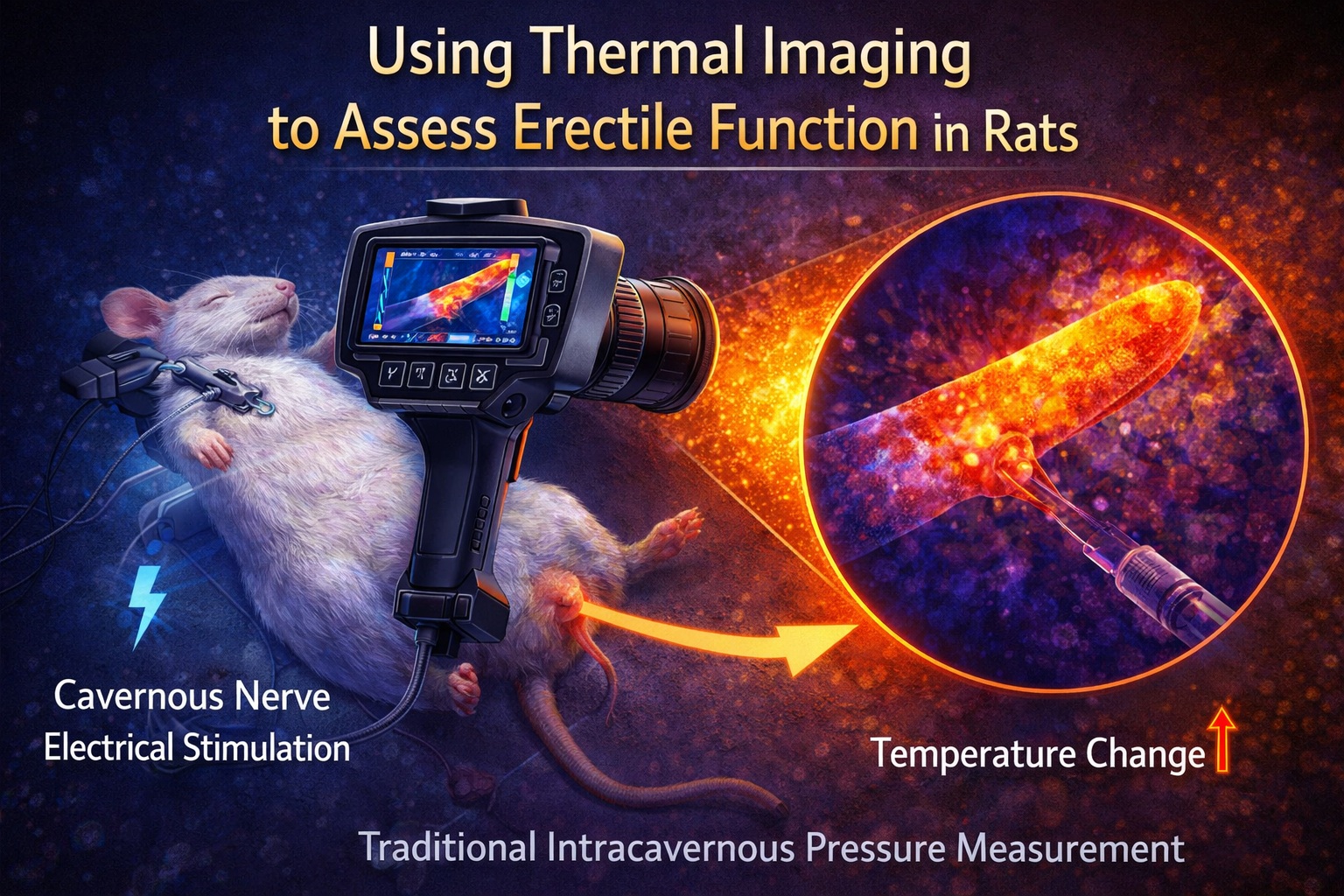
In experimental setups, rats are anesthetized and placed in a temperature-controlled environment. A high-resolution infrared camera is positioned above the genital area to capture thermal images.
Cavernous nerve stimulation is used to induce erection, replicating physiological conditions. As the erectile response develops, changes in penile temperature are recorded in real time.
Key parameters derived from thermal imaging include:
- Peak temperature during erection
- Rate of temperature increase
- Duration of elevated temperature
These parameters correspond to the dynamics of blood flow and vascular response.
Importantly, the system allows for repeated measurements in the same animal. This capability enables longitudinal studies, providing insights into disease progression and treatment effects.
Correlation with Physiological Function
For any new measurement technique, validation is essential. In the case of IRT, this involves comparing thermal data with traditional ICP measurements.
Studies have demonstrated a strong correlation between temperature changes and intracavernous pressure. As ICP rises during erection, penile temperature increases in parallel.
This relationship confirms that thermal imaging captures the same underlying physiological events as pressure measurement, albeit through a different modality.
Moreover, thermal imaging provides additional information about the temporal dynamics of the response. The shape of the temperature curve reflects the onset, peak, and resolution of the erectile process.
These findings establish IRT as a reliable and informative method for assessing erectile function.
Applications in Disease Models and Pharmacological Research
The utility of IRT extends beyond basic physiological assessment. It is particularly valuable in experimental models of erectile dysfunction, where it can detect subtle changes in vascular response.
In diabetic models, for example, reduced temperature changes reflect impaired blood flow and endothelial dysfunction. Similarly, nerve injury models show delayed or diminished thermal responses.
IRT is also well suited for evaluating pharmacological interventions. Treatments such as tadalafil can be assessed by monitoring changes in temperature dynamics.
Improved erectile function is reflected in increased peak temperature and faster temperature rise. These changes provide a non-invasive indicator of therapeutic efficacy.
The ability to perform repeated measurements enhances the study of treatment effects over time, offering insights into both immediate and long-term outcomes.
Advantages and Future Directions
Infrared thermography offers several advantages over traditional methods. It reduces invasiveness, allows for longitudinal studies, and provides rich, dynamic data.
From an ethical perspective, the reduction in animal suffering aligns with modern research standards. From a scientific perspective, the ability to observe physiological processes in real time enhances experimental precision.
Future developments may include integration with advanced imaging techniques, improved resolution, and automated data analysis.
As technology evolves, the role of non-invasive methods in biomedical research is likely to expand.
Conclusion: A Shift Toward Non-Invasive Insight
The development of an IRT-based system for evaluating erectile function represents more than a technical innovation—it reflects a broader shift in scientific thinking.
By replacing invasive measurement with non-invasive observation, researchers can gain deeper insights while minimizing harm. This approach aligns with the principles of modern medicine: precision, efficiency, and respect for biological systems.
In the study of erectile physiology, as in many fields, the ability to see without touching may prove to be the most powerful tool of all.
FAQ
What is infrared thermography in erectile research?
Infrared thermography is a non-invasive imaging technique that measures temperature changes in tissue, reflecting blood flow and physiological activity during erection.
How does it compare to intracavernous pressure measurement?
While ICP provides direct pressure data, it is invasive. Thermography offers a non-invasive alternative that correlates well with physiological changes and allows repeated measurements.
Can IRT be used to evaluate treatments like tadalafil?
Yes. IRT can monitor changes in penile temperature dynamics, providing a non-invasive way to assess the effectiveness of treatments such as tadalafil.
