

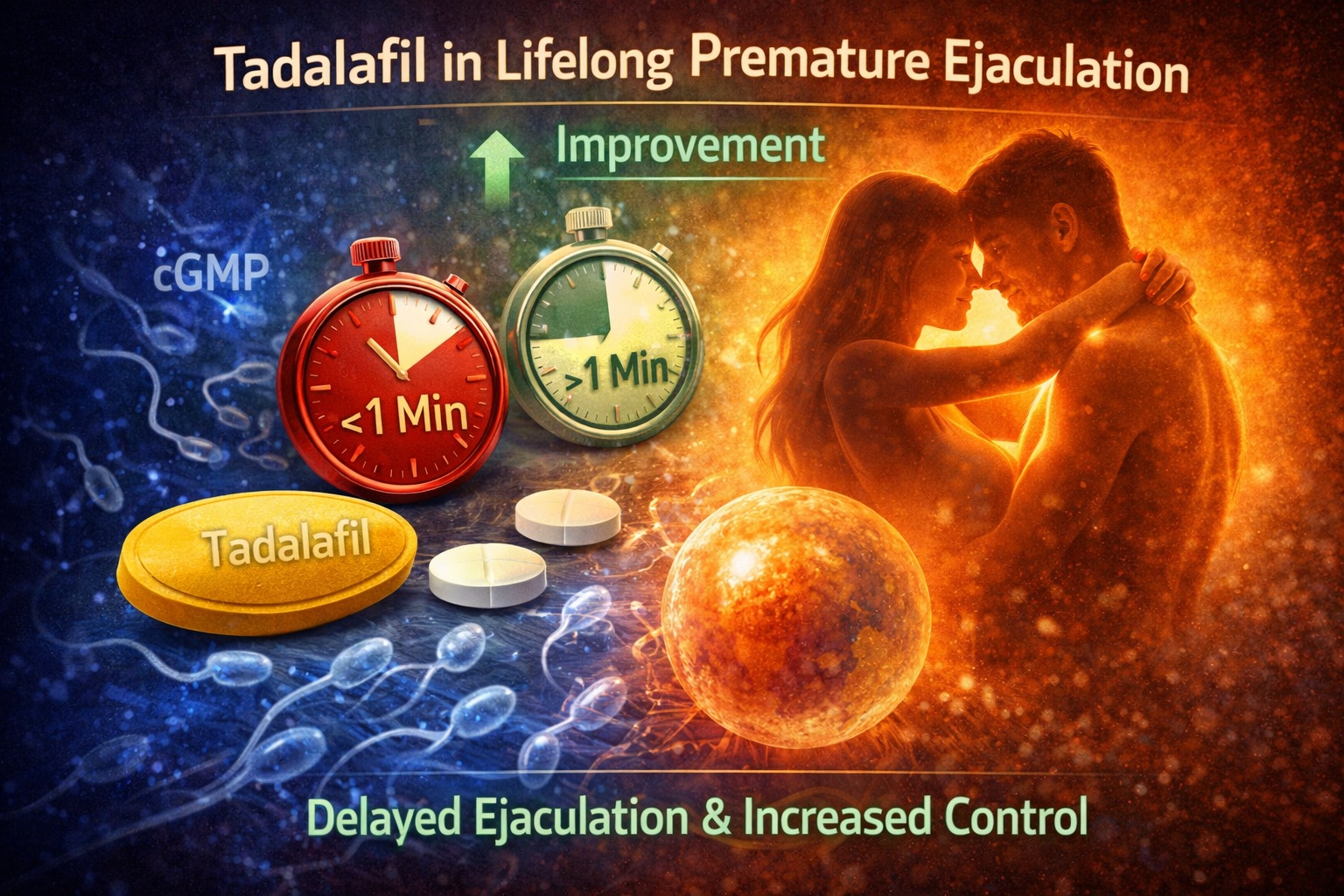
Introduction: A Condition Defined by Seconds, Experienced in Years
Premature ejaculation (PE) is one of the most common male sexual disorders, yet also one of the least consistently understood. For many patients, it is not simply a matter of reduced ejaculatory latency—it is a persistent condition that affects psychological well-being, relationship satisfaction, and overall quality of life.
Lifelong premature ejaculation, in particular, represents a distinct clinical entity. Unlike acquired forms, it begins with the earliest sexual experiences and persists throughout life. Patients often describe a lack of voluntary control, with ejaculation occurring within seconds or even before penetration.
Traditional therapeutic approaches have focused on behavioral techniques, topical anesthetics, and selective serotonin reuptake inhibitors (SSRIs). While these methods can be effective, they are not universally successful and often come with limitations related to adherence, side effects, or delayed onset of action.
In this context, interest has grown in the potential role of phosphodiesterase type-5 inhibitors, particularly tadalafil, as an alternative or adjunctive therapy. Although tadalafil is primarily used for erectile dysfunction, its pharmacological profile suggests broader effects on sexual function.
A single-blinded, placebo-controlled study investigating daily tadalafil 5 mg in patients with lifelong premature ejaculation provides valuable insights into this possibility. The findings challenge traditional assumptions and open new avenues for understanding ejaculatory control.
This article explores the physiological basis of premature ejaculation, the rationale for using tadalafil, and the clinical implications of emerging evidence.
Lifelong Premature Ejaculation: Mechanisms Beyond the Obvious
Lifelong premature ejaculation is often misunderstood as a purely psychological condition. While psychological factors can contribute, the underlying mechanisms are far more complex and involve neurobiological, genetic, and physiological components.
At the core of ejaculation lies a coordinated reflex involving the central nervous system, peripheral nerves, and pelvic musculature. This reflex is tightly regulated by neurotransmitters, particularly serotonin, dopamine, and oxytocin.
In patients with lifelong PE, there is evidence of altered serotonergic signaling. Reduced serotonin activity in specific brain regions may lower the threshold for ejaculation, leading to rapid onset of the ejaculatory reflex.
Peripheral factors also play a role. Hypersensitivity of penile receptors and altered sensory processing may contribute to reduced ejaculatory latency. These factors can amplify the central drive toward ejaculation.
Importantly, the condition is not simply about speed—it is about control. Patients often describe an inability to delay ejaculation despite conscious effort, highlighting the involuntary nature of the disorder.
Understanding these mechanisms is essential for developing effective treatments. It also explains why therapies targeting a single pathway may have limited success.
The Role of Tadalafil: Beyond Erectile Function
Tadalafil is widely recognized for its role in treating erectile dysfunction. By inhibiting PDE5, it enhances nitric oxide–mediated vasodilation and improves penile blood flow.
However, the effects of tadalafil extend beyond vascular function. The drug influences smooth muscle tone, neural signaling, and possibly central nervous system pathways involved in sexual function.
One proposed mechanism for its effect on premature ejaculation involves improved erectile stability. A more reliable erection may reduce performance anxiety, allowing patients to focus less on maintaining rigidity and more on controlling ejaculation.
Another hypothesis relates to sensory modulation. By altering blood flow and tissue dynamics, tadalafil may influence penile sensitivity, potentially increasing ejaculatory latency.
There is also evidence suggesting that PDE5 inhibitors may affect central neurotransmission. While not their primary mechanism, these effects could contribute to improved ejaculatory control.
Unlike SSRIs, which act directly on serotonin pathways, tadalafil offers a different approach—one that integrates vascular, neural, and psychological factors.
Study Design: Evaluating Daily Tadalafil in Lifelong PE
The clinical study evaluating tadalafil in lifelong premature ejaculation was designed as a single-blinded, placebo-controlled trial, reflecting a balance between methodological rigor and practical feasibility.
Participants included men diagnosed with lifelong PE, characterized by consistently short intravaginal ejaculatory latency times (IELT) and a perceived lack of control over ejaculation.
Patients were assigned to receive either tadalafil 5 mg once daily or placebo over a defined treatment period. The use of a daily dosing regimen is particularly relevant, as it provides continuous pharmacological activity rather than episodic effects.
Outcome measures included IELT, patient-reported control over ejaculation, and satisfaction levels. These parameters capture both objective and subjective aspects of the condition.
By combining quantitative measurements with patient-reported outcomes, the study aimed to provide a comprehensive assessment of therapeutic impact.
Clinical Findings: Extending Time and Restoring Confidence
The results of the study demonstrated that daily tadalafil therapy was associated with significant improvements in ejaculatory latency time compared with placebo.
Patients receiving tadalafil experienced longer IELT, suggesting enhanced control over the ejaculatory reflex. While the absolute increase in time may appear modest in numerical terms, its clinical significance is substantial.
Equally important were improvements in subjective measures. Patients reported greater control over ejaculation, reduced distress, and improved sexual satisfaction.
These findings highlight a critical aspect of sexual medicine: success is not measured solely in seconds, but in the restoration of confidence and quality of life.
Interestingly, the therapeutic effect appeared to be multifactorial. Improvements in erectile function, psychological comfort, and physiological control likely contributed to the observed outcomes.
The safety profile of tadalafil remained favorable, with no unexpected adverse effects reported. This is consistent with its established use in other indications.
Interpreting the Results: A Multifactorial Benefit
The study’s findings suggest that tadalafil may influence premature ejaculation through multiple mechanisms rather than a single direct effect.
Improved erectile function reduces performance anxiety, a well-known contributor to premature ejaculation. When patients are less concerned about maintaining an erection, they may experience better overall control.
Enhanced penile hemodynamics may also play a role. Increased blood flow could alter sensory input, potentially affecting the timing of ejaculation.
Additionally, psychological factors should not be underestimated. The act of taking a medication known to improve sexual performance may itself enhance confidence and reduce anxiety.
This interplay between physiological and psychological factors underscores the complexity of sexual function. It also explains why a drug not originally designed for premature ejaculation can produce meaningful clinical benefits.
Clinical Implications: Where Does Tadalafil Fit?
The use of tadalafil in lifelong premature ejaculation represents an off-label but promising approach. It may be particularly useful in patients who do not respond well to traditional therapies or who experience unacceptable side effects.
Tadalafil may also be beneficial in patients with coexisting erectile dysfunction and premature ejaculation, addressing both conditions simultaneously.
However, it is unlikely to replace established treatments such as SSRIs. Instead, it should be viewed as part of a broader therapeutic toolkit.
Clinicians should consider individual patient characteristics, preferences, and comorbidities when selecting treatment.
As with all therapies, patient education is essential. Understanding expectations, potential benefits, and limitations can improve adherence and outcomes.
Conclusion: Redefining Control in Sexual Medicine
The exploration of tadalafil in lifelong premature ejaculation reflects a broader shift in sexual medicine—from rigid treatment categories toward more integrated approaches.
By addressing vascular, neural, and psychological factors simultaneously, tadalafil offers a unique perspective on ejaculatory control.
While it may not be a universal solution, it represents a valuable addition to the therapeutic landscape.
Perhaps most importantly, it reminds us that sexual function is not governed by a single mechanism. It is a complex interplay of systems—each of which can be influenced in ways we are only beginning to understand.
And sometimes, improving control is not about slowing things down—it is about restoring balance.
FAQ
Can tadalafil really help with premature ejaculation?
Yes, studies suggest that daily tadalafil may improve ejaculatory latency time and control, although it is not a first-line treatment for premature ejaculation.
How does tadalafil differ from SSRIs in treating PE?
SSRIs act on serotonin pathways to delay ejaculation, while tadalafil works through vascular and possibly neural mechanisms, offering a different therapeutic approach.
Is tadalafil safe for long-term use in PE?
Tadalafil has a well-established safety profile, but its use for premature ejaculation should be guided by a physician, as it is considered an off-label indication.
