

Introduction: When Seconds Matter More Than We Admit
Premature ejaculation (PE) remains one of the most prevalent male sexual dysfunctions, affecting up to 30% of men under the age of 40. It is defined not merely by speed, but by loss of control, distress, and dissatisfaction. Clinically, the most practical metric is the intravaginal ejaculation latency time (IELT), particularly when it measures less than 1.5 minutes in lifelong cases .
For decades, selective serotonin reuptake inhibitors (SSRIs), especially paroxetine, have been considered first-line pharmacologic therapy. They reliably increase IELT, often by several-fold. Yet the therapeutic ceiling of SSRIs is imperfect. Some patients plateau at suboptimal levels of control, while others discontinue treatment due to side effects or dissatisfaction.
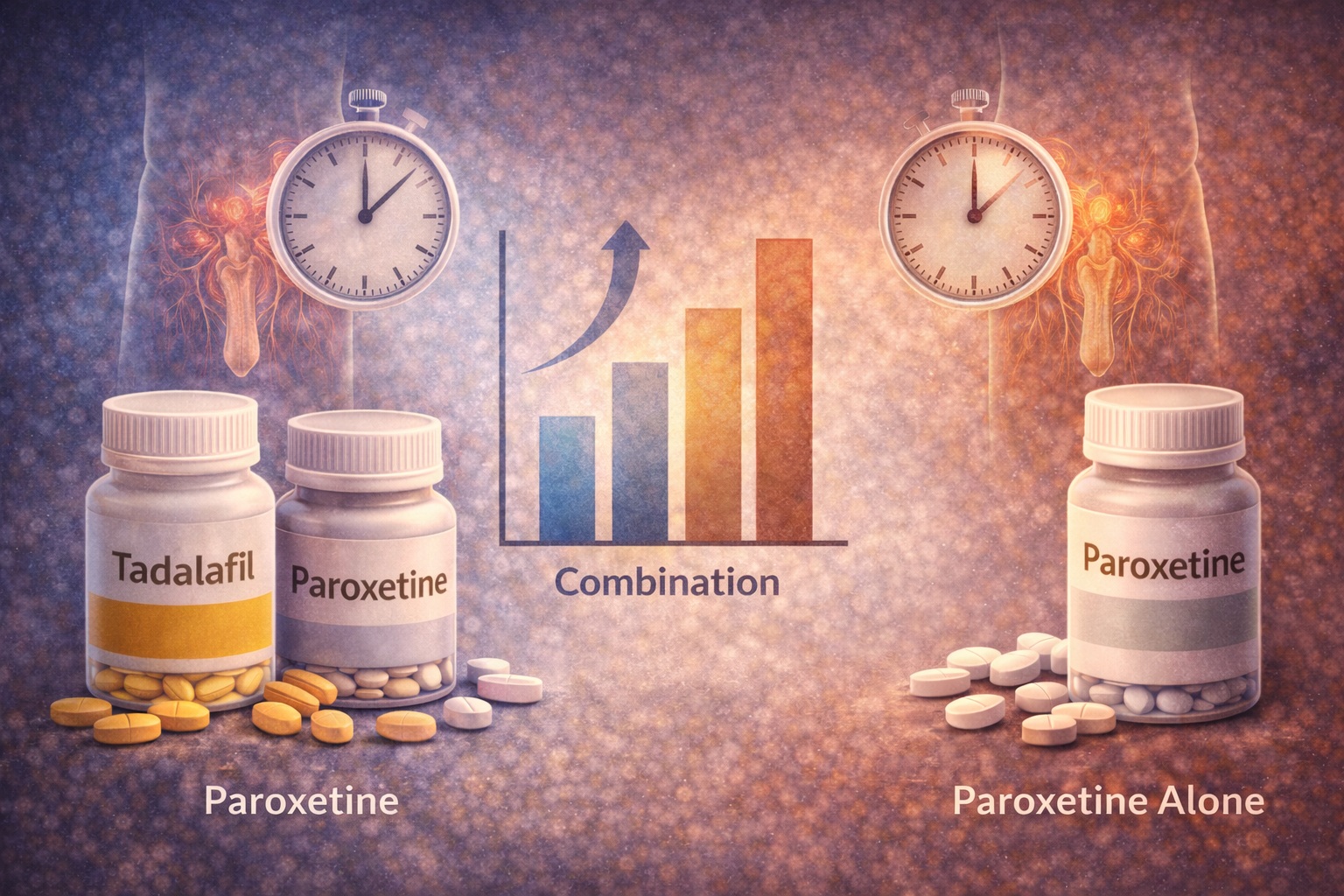
Recent years have witnessed growing interest in combining SSRIs with phosphodiesterase type 5 (PDE5) inhibitors. Tadalafil, widely known for its role in erectile dysfunction (ED), has emerged as a candidate adjunct therapy—even in men without ED. The study analyzed here directly compares paroxetine alone with paroxetine plus tadalafil in potent men with lifelong PE .
The result is a nuanced discussion of physiology, psychology, pharmacology—and expectation.
Premature Ejaculation: A Disorder of Threshold and Control
PE is not simply a rapid reflex. It represents a complex interplay between serotonergic neurotransmission, sympathetic activation, psychological conditioning, and penile sensory thresholds. Lifelong PE, in particular, is thought to involve altered central serotonergic modulation.
Clinically, IELT is central to diagnosis and monitoring. While stopwatch measurement is the gold standard, self-estimation provides approximately 80% sensitivity and specificity . In routine practice, self-reported IELT is sufficient.
Treatment strategies fall into two broad categories:
- Behavioral techniques (pause-squeeze, start-stop)
- Pharmacologic therapies (SSRIs, topical anesthetics, PDE5 inhibitors, others)
SSRIs remain the mainstay because they delay ejaculation by enhancing synaptic serotonin, particularly via 5-HT2C receptor activation and downstream desensitization processes. Paroxetine, in comparative analyses, consistently demonstrates superior efficacy over fluoxetine, sertraline, and clomipramine .
However, even effective pharmacology does not eliminate performance anxiety. And anxiety, as we know, accelerates reflexes.
Why Consider Tadalafil in PE Without Erectile Dysfunction?
At first glance, prescribing tadalafil in men without ED appears counterintuitive. Yet the theoretical rationale is intriguing.
PDE5 inhibitors enhance nitric oxide–mediated smooth muscle relaxation in penile vasculature, improving erection quality and reliability. While they do not directly act on ejaculatory pathways, they may influence sexual confidence and arousal thresholds.
Several mechanisms have been proposed:
- Reduction of performance anxiety
- Lowering of erectile threshold, requiring greater arousal for ejaculation
- Improved post-ejaculatory recovery time
- Enhanced subjective sexual satisfaction
These mechanisms remain partly speculative. Nonetheless, prior open-label studies suggested that combining sildenafil with SSRIs improved IELT and satisfaction compared to SSRIs alone . Tadalafil, with its longer half-life and smoother pharmacokinetic profile, offers theoretical advantages for planned intercourse.
Thus, the study under discussion sought to compare paroxetine monotherapy with paroxetine plus tadalafil in lifelong PE.
Study Design: A Direct Clinical Comparison
The quasi-experimental study enrolled 100 potent married men aged 17 to 49 years, all diagnosed with lifelong PE and IELT under 1.5 minutes . Importantly, men with erectile dysfunction, prostatitis, psychiatric disorders, or significant organic disease were excluded.
Participants were randomized into two groups:
- Group A: Paroxetine 10 mg daily, taken four hours before intercourse (dose escalation to 20 mg if needed).
- Group B: Paroxetine 10 mg daily plus tadalafil 10 mg one hour before intercourse (dose escalation permitted).
Treatment continued for six months. Primary outcome: IELT. Secondary outcomes: intercourse satisfaction (IIEF domain) and side effects.
Although the study was open-label, the outcome assessor was blinded—an important but incomplete safeguard against bias.
Efficacy Results: Improvement Without Statistical Separation
Baseline characteristics were similar between groups, including age and frequency of intercourse .
IELT Outcomes
At 3 months:
- Paroxetine alone: 4.5 ± 1.5 minutes
- Paroxetine + tadalafil: 5.0 ± 2.4 minutes
- P = 0.285
At 6 months:
- Paroxetine alone: 4.8 ± 1.0 minutes
- Paroxetine + tadalafil: 5.3 ± 2.0 minutes
- P = 0.278
Numerically, combination therapy produced slightly longer IELT. Statistically, the difference was not significant.
From a strictly statistical standpoint, superiority was not demonstrated. From a clinical standpoint, the incremental increase—approximately 30 seconds to 1 minute—may or may not be meaningful depending on patient expectation.
It is a reminder that statistical significance and clinical relevance do not always align.
Intercourse Satisfaction and Psychological Dimensions
Intercourse satisfaction scores improved in both groups. Again, no statistically significant difference was detected .
Yet satisfaction in sexual medicine rarely correlates linearly with stopwatch measurements. Confidence, perceived control, and reduction in anxiety often matter more than absolute duration.
The addition of tadalafil may influence subjective experience even if IELT differences remain modest. Erectile rigidity and reduced concern about losing erection may indirectly enhance perceived control over ejaculation.
In sexual medicine, perception frequently outweighs physiology.
Side Effect Profile: The Cost of Combination
Paroxetine monotherapy produced expected SSRI-related adverse effects:
- Gastrointestinal upset (10%)
- Headache (8%)
- Decreased libido (4%)
- Delayed ejaculation (2%)
Combination therapy introduced PDE5-related effects:
- Headache (22%)
- Flushing (16%)
- Gastrointestinal upset (8%)
Flushing was significantly more frequent in the combination group.
While no severe adverse events were reported, clinicians must weigh marginal IELT gains against increased side effects—particularly in men without ED.
Interpreting the Findings: What Does It Really Mean?
The study concludes that tadalafil may increase mean IELT when combined with paroxetine . Yet the absence of statistical significance tempers enthusiasm.
Several limitations must be acknowledged:
- Open-label design
- Modest sample size
- Lack of placebo control
- Self-estimated IELT
- No long-term discontinuation analysis
Additionally, patients with ED were excluded. It remains possible that the greatest benefit of PDE5 inhibitors in PE occurs in men with concomitant erectile instability.
In potent men with lifelong PE, tadalafil may offer incremental benefit—but not dramatic transformation.
Where Does Tadalafil Fit in Modern PE Management?
Current guidelines prioritize SSRIs as first-line pharmacologic therapy. Behavioral techniques remain useful adjuncts. Topical anesthetics provide local desensitization. Dapoxetine offers on-demand serotonergic delay.
PDE5 inhibitors, including tadalafil, occupy a more selective role:
- PE with coexisting ED
- Performance anxiety contributing to rapid ejaculation
- Inadequate response to SSRI monotherapy
- Patient preference for combination therapy
In such contexts, tadalafil may serve as a confidence amplifier rather than a primary ejaculatory modulator.
The clinician must individualize treatment rather than pursue theoretical pharmacologic elegance.
Clinical Recommendations
When considering tadalafil plus paroxetine in PE:
- Confirm absence of contraindications (nitrates, significant cardiovascular instability).
- Discuss realistic expectations regarding IELT improvement.
- Monitor for additive side effects.
- Reassess after 3–6 months.
- Consider tapering strategies if satisfactory control is achieved.
Combination therapy is not a universal upgrade—it is a strategic option.
Medicine is rarely about adding drugs reflexively. It is about adding value.
Conclusion: Modest Gains, Meaningful Conversations
The study demonstrates that paroxetine effectively increases IELT in lifelong PE. Adding tadalafil produces a numerical but not statistically significant improvement .
For some patients, that incremental gain may justify combination therapy. For others, monotherapy suffices. The decision hinges on expectations, side-effect tolerance, psychological factors, and comorbidities.
Tadalafil is not a primary anti-ejaculatory drug. It is a vascular modulator with psychological implications. Used thoughtfully, it may complement serotonergic therapy. Used indiscriminately, it adds cost and side effects without clear superiority.
The art lies in knowing the difference.
FAQ
1. Is tadalafil effective for premature ejaculation on its own?
Evidence for PDE5 inhibitors as monotherapy in PE is limited. They may improve confidence and satisfaction but do not consistently prolong IELT significantly in men without erectile dysfunction.
2. Does combining tadalafil with paroxetine significantly increase ejaculation time?
In the referenced study, combination therapy showed a slightly higher IELT compared to paroxetine alone, but the difference was not statistically significant .
3. Who should consider combination therapy?
Men with PE who also experience performance anxiety or borderline erectile instability may benefit most from adding tadalafil to SSRI therapy.
