

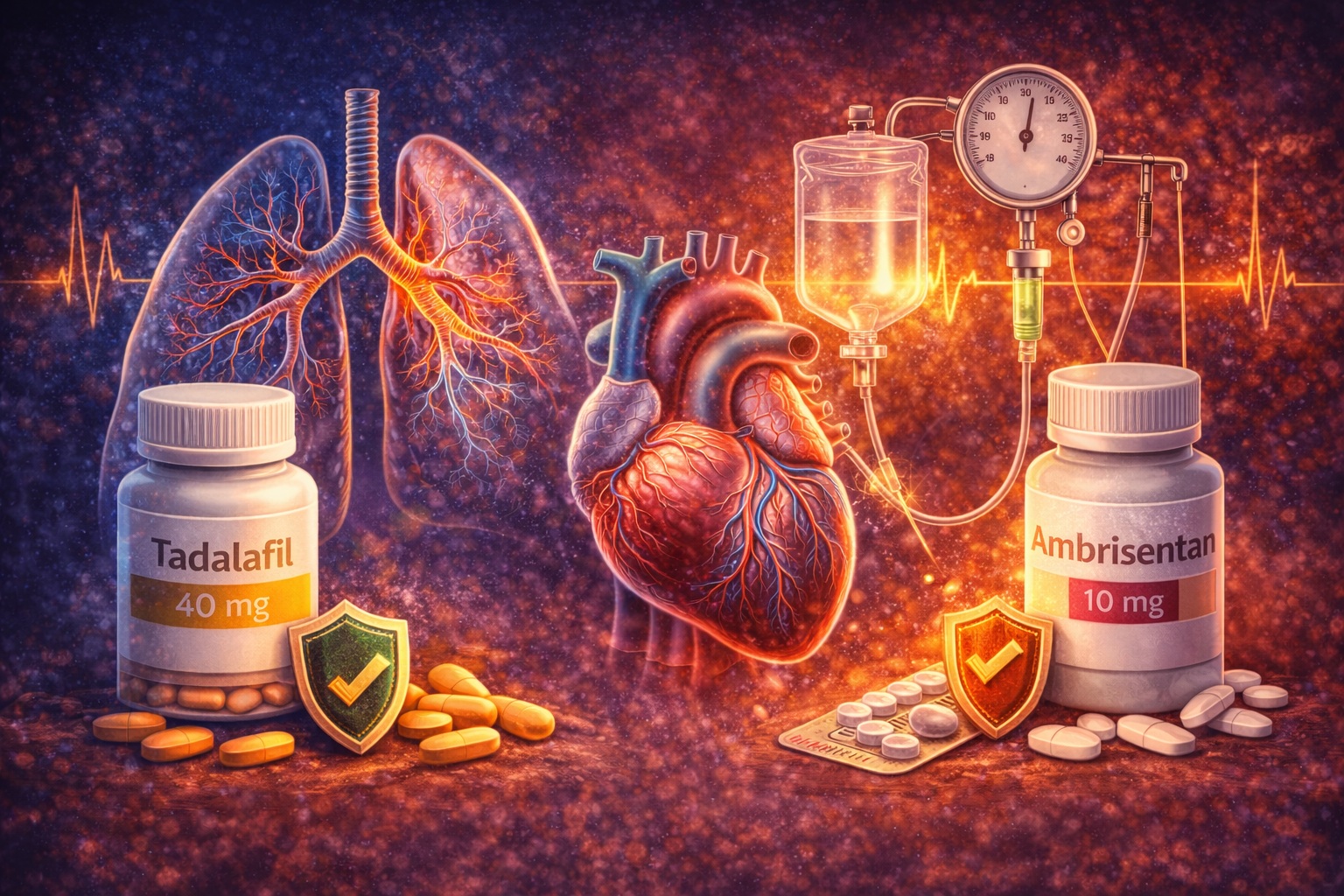
Pulmonary arterial hypertension (PAH) remains one of the most demanding challenges in modern cardiopulmonary medicine. Despite major therapeutic advances, it continues to carry significant morbidity and mortality. Over the past two decades, targeted therapies have reshaped the disease trajectory, turning a once rapidly fatal diagnosis into a chronic, manageable condition for many patients. Yet, a central clinical dilemma persists: what should we do when initial therapy is simply not enough?
The ATHENA-1 study addressed this very question. Specifically, it examined whether adding ambrisentan—an endothelin receptor antagonist (ERA)—to ongoing phosphodiesterase type 5 inhibitor (PDE5i) therapy could improve outcomes in patients with PAH who exhibited a suboptimal response to monotherapy. Many of these patients were receiving sildenafil or tadalafil, including tadalafil at doses up to 40 mg daily. The findings provide meaningful insight into sequential combination therapy, a strategy that is both biologically rational and clinically practical.
This article explores the scientific logic, hemodynamic outcomes, functional implications, and broader clinical relevance of adding ambrisentan to background PDE5i therapy. We will also consider how these findings align with current treatment paradigms and what they mean for everyday practice.
The Therapeutic Landscape of Pulmonary Arterial Hypertension
Pulmonary arterial hypertension is defined by elevated pulmonary vascular resistance (PVR) and mean pulmonary arterial pressure (mPAP), leading ultimately to right ventricular failure. Historically, the median survival after diagnosis was measured in a few short years. Fortunately, the therapeutic revolution targeting specific molecular pathways has changed this outlook substantially.
Three principal signaling pathways are implicated in PAH pathophysiology:
- The nitric oxide (NO) pathway
- The endothelin pathway
- The prostacyclin pathway
Each pathway contributes differently to vasoconstriction, vascular remodeling, inflammation, and thrombosis. As a result, pharmacologic agents targeting these pathways—including PDE5 inhibitors such as tadalafil, ERAs such as ambrisentan, and prostacyclin analogues—have become foundational therapies.
Tadalafil, a long-acting PDE5 inhibitor, enhances nitric oxide signaling by preventing cyclic guanosine monophosphate (cGMP) degradation. This results in pulmonary vasodilation and improved right ventricular performance. However, while tadalafil and sildenafil provide meaningful benefit, not all patients achieve optimal hemodynamic or functional improvement with PDE5i monotherapy alone.
Ambrisentan, on the other hand, selectively blocks endothelin-A receptors. Endothelin-1 is a potent vasoconstrictor and mitogenic peptide elevated in PAH. By antagonizing its effects, ambrisentan reduces vascular tone and inhibits maladaptive remodeling.
From a mechanistic standpoint, combining tadalafil and ambrisentan is not merely additive—it is complementary. One enhances vasodilatory signaling; the other suppresses vasoconstrictive signaling. Together, they address two core pathological drivers.
The Clinical Problem: Suboptimal Response to PDE5i Therapy
Despite appropriate dosing of PDE5 inhibitors—often including tadalafil 40 mg once daily—many patients remain symptomatic. WHO functional class III status, persistently elevated PVR, and inadequate improvement in exercise capacity signal incomplete therapeutic response.
The ATHENA-1 study focused specifically on this group: patients with WHO functional class III PAH who had been on stable PDE5i monotherapy for at least 12 weeks yet still demonstrated:
- PVR ≥ 400 dyn·s·cm⁻⁵
- Persistent symptoms
- Reduced exercise tolerance
This population is clinically important. These are not newly diagnosed, treatment-naïve individuals. They represent patients already engaged in therapy, adherent, and yet insufficiently controlled.
Sequential combination therapy—adding a second agent rather than replacing the first—offers a strategic escalation. It allows clinicians to build upon established pharmacologic effects without discarding potential benefit already achieved.
Hemodynamic Improvements: More Than Just Numbers
The primary endpoint of ATHENA-1 was change in pulmonary vascular resistance at 24 weeks after adding ambrisentan to background PDE5i therapy.
The results were compelling:
- PVR decreased by approximately 32%
- Mean pulmonary arterial pressure decreased by 11%
- Cardiac index increased by 25%
These are not marginal fluctuations. In PAH, even modest reductions in PVR can translate into meaningful decreases in right ventricular afterload. An increase in cardiac index reflects improved forward flow—arguably one of the most clinically relevant hemodynamic markers.
Importantly, baseline PVR predicted magnitude of improvement. Patients with higher initial PVR experienced greater reductions, suggesting that those with more severe vascular burden may derive the greatest benefit from combination therapy.
From a prognostic perspective, prior registry data have linked improvements in cardiac index and PVR to enhanced transplant-free survival. While ATHENA-1 was not powered for mortality endpoints, the directionality of hemodynamic change aligns with markers known to influence long-term outcomes.
In short, these were not cosmetic improvements. They were physiologically meaningful.
Functional Capacity and Biomarkers: Translating Hemodynamics into Daily Life
Hemodynamic changes matter, but patients experience disease through symptoms and limitations—not catheterization numbers.
Exercise capacity, assessed by the 6-minute walk distance (6MWD), improved by 18 meters at 24 weeks. While modest in absolute terms, this improvement occurred in a population already receiving optimized PDE5i therapy, including tadalafil. It suggests that sequential therapy can produce incremental benefit even when monotherapy gains have plateaued.
Dyspnea scores improved as well, reflecting symptomatic relief.
Perhaps even more compelling was the reduction in NT-proBNP levels by approximately 31%. NT-proBNP is a biomarker of right ventricular strain. Its reduction indicates decreased cardiac stress and improved hemodynamic status.
The majority of patients either improved or maintained WHO functional class at both 24 and 48 weeks. Stabilization itself is valuable in PAH, where progression is common.
When taken together, improvements in PVR, cardiac index, NT-proBNP, and exercise tolerance form a coherent clinical picture. The changes move in the same direction, reinforcing internal consistency.
Safety and Tolerability: Practical Considerations
No combination strategy is viable if tolerability is poor. Fortunately, the addition of ambrisentan to background PDE5i therapy was generally well tolerated.
Common adverse effects included:
- Nasal congestion
- Headache
- Peripheral edema
- Upper respiratory tract infections
Most events were mild to moderate in severity. Discontinuation rates were relatively low, and no unexpected safety signals emerged.
Importantly, pharmacokinetic interaction studies have shown no clinically relevant interaction between ambrisentan and tadalafil. This supports co-administration without complex dose adjustments.
In an era where polypharmacy is common, simplicity matters. Two once-daily oral agents—tadalafil and ambrisentan—represent a manageable regimen for patients with chronic disease.
Sequential Combination Therapy in Context
The concept of combination therapy in PAH is not new. Initial combination therapy—starting two agents simultaneously—has shown benefit in treatment-naïve patients. However, many real-world patients begin with monotherapy and require escalation.
ATHENA-1 supports the rationale for sequential add-on therapy when response to PDE5i monotherapy is inadequate.
Comparisons to other studies reveal important distinctions. Some trials adding ERAs to sildenafil have shown mixed results, potentially due to drug-drug interactions or trial design limitations. The tadalafil-ambrisentan combination appears pharmacologically harmonious.
The broader lesson is strategic personalization. Rather than reflexively switching therapies, clinicians can build upon existing benefit. In patients stable on tadalafil but insufficiently improved, adding ambrisentan represents a logical next step.
Clinical Implications and Practical Application
For clinicians managing PAH, several practical conclusions emerge:
- Persistent WHO functional class III symptoms despite optimized PDE5i therapy warrant reassessment.
- Sequential addition of ambrisentan can meaningfully reduce PVR and improve cardiac index.
- Biomarker reductions reinforce physiological improvement.
- Tadalafil remains an important backbone therapy within combination regimens.
The decision to escalate therapy should consider symptom burden, hemodynamic parameters, biomarker trends, and patient preference. However, the evidence supports proactive escalation rather than therapeutic inertia.
There is a subtle but important message here: stability is not necessarily success. If PVR remains elevated and functional limitation persists, further optimization is justified.
Conclusion
Pulmonary arterial hypertension demands strategic, pathway-targeted intervention. While PDE5 inhibitors such as tadalafil provide essential benefit through nitric oxide pathway enhancement, monotherapy is not always sufficient.
The ATHENA-1 study demonstrates that adding ambrisentan to background PDE5i therapy yields significant hemodynamic, functional, and biomarker improvements in patients with suboptimal response. The reductions in pulmonary vascular resistance, increases in cardiac index, and decreases in NT-proBNP collectively support the physiological and clinical validity of sequential combination therapy.
In modern PAH management, escalation should be guided by data, not hesitation. When monotherapy plateaus, thoughtful combination therapy offers a path forward.
FAQ
1. When should ambrisentan be added to tadalafil in PAH?
Ambrisentan may be added when a patient on stable tadalafil (or another PDE5 inhibitor) remains symptomatic, particularly in WHO functional class III with persistently elevated pulmonary vascular resistance. Sequential add-on therapy is appropriate when response to monotherapy is inadequate.
2. Does combination therapy improve survival?
While ATHENA-1 was not powered to definitively assess mortality, improvements in cardiac index and PVR are associated with better long-term outcomes in registry analyses. Combination therapy reduces markers linked to disease progression.
3. Is the combination of tadalafil and ambrisentan safe?
Yes. The combination is generally well tolerated, with predictable adverse effects such as headache and peripheral edema. Pharmacokinetic studies demonstrate no clinically significant interaction between tadalafil and ambrisentan.
