

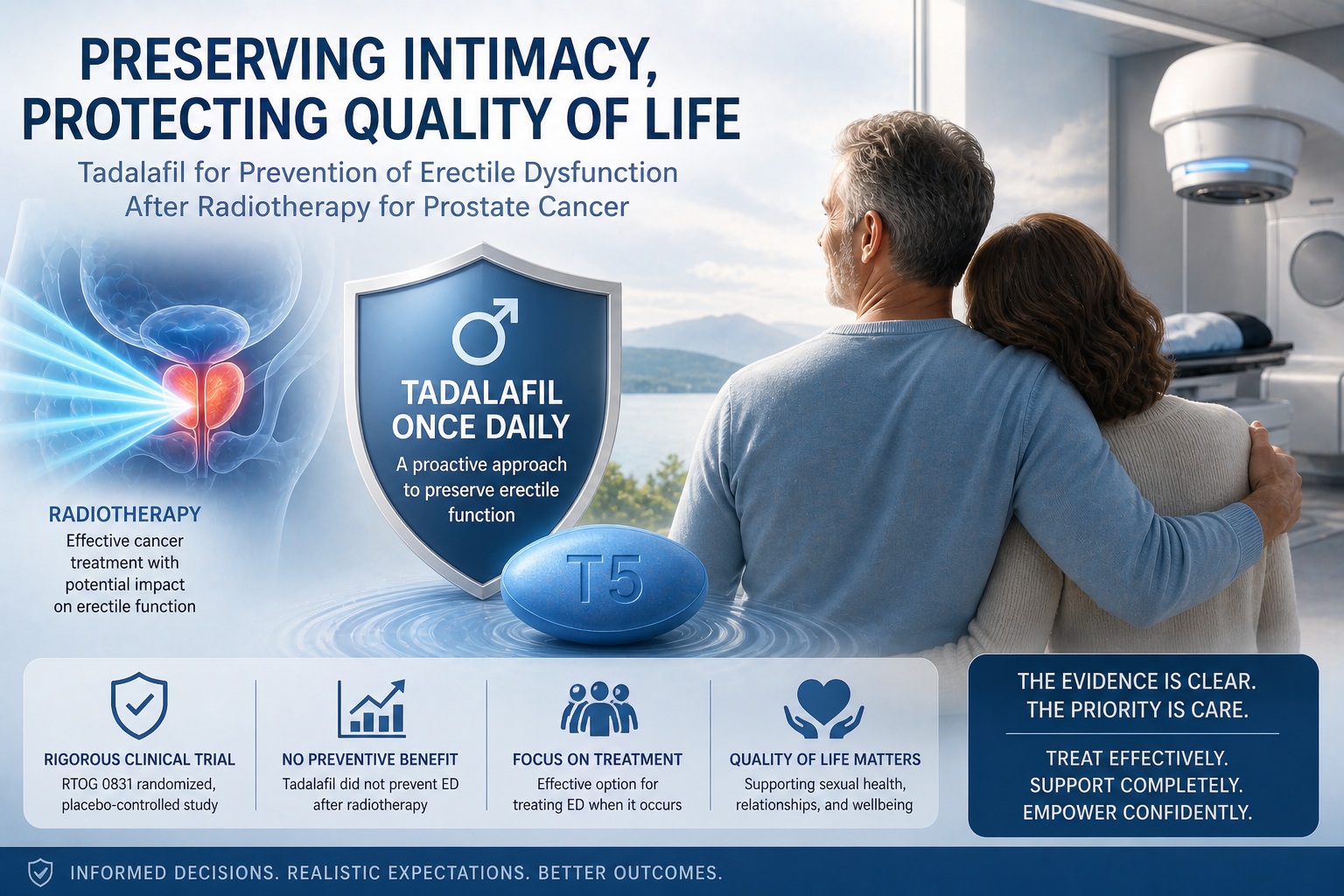
Introduction: When Prevention Meets Expectation
Radiotherapy remains one of the most effective treatments for localized prostate cancer. Yet, like many powerful therapies, it carries a cost—one that is often deeply personal. Erectile dysfunction (ED) following radiotherapy is not merely a side effect; it is a life-altering consequence that affects identity, relationships, and psychological well-being.
In this context, the idea of prevention becomes irresistibly appealing. If we can treat ED effectively, why not prevent it altogether? This question lies at the heart of the randomized clinical trial , which explored whether daily tadalafil could preserve erectile function in men undergoing radiotherapy.
The results, however, tell a more nuanced story—one that challenges assumptions, refines clinical expectations, and reminds us that biology rarely yields to simplicity.
This article distills the essence of that study and expands it into a broader clinical narrative, exploring not only what was found, but what it means for modern medical practice.
Understanding Post-Radiotherapy Erectile Dysfunction: A Slow, Silent Process
Erectile dysfunction after radiotherapy does not typically occur overnight. Unlike surgical trauma, which can produce immediate nerve injury, radiation-induced ED evolves gradually. Patients may initially retain function, only to experience progressive decline months or even years later.
The underlying mechanism is complex but increasingly understood. Radiation damages the delicate vascular endothelium of penile tissue, leading to reduced nitric oxide availability, impaired vasodilation, and eventual cavernosal hypoxia. Over time, this environment promotes fibrosis—a quiet but relentless remodeling of erectile tissue.
This slow progression creates a therapeutic window. If endothelial dysfunction begins early, perhaps early pharmacological intervention could preserve function. This hypothesis has driven interest in phosphodiesterase type 5 (PDE5) inhibitors like tadalafil as preventive agents.
Yet, as the study demonstrates, theoretical plausibility does not guarantee clinical success.
Trial Design: A Rigorous Test of a Logical Hypothesis
The Radiation Therapy Oncology Group (RTOG) 0831 trial was designed with methodological rigor. It was a multicenter, randomized, double-blind, placebo-controlled study involving 242 men with intact erectile function prior to radiotherapy .
Participants were assigned to receive either tadalafil 5 mg daily or placebo for 24 weeks, beginning at the initiation of radiotherapy. Importantly, the primary endpoint was not erectile function during treatment, but spontaneous erectile function after discontinuation of the drug—an attempt to assess true preservation rather than temporary pharmacological enhancement.
Assessments were conducted using validated tools, including the International Index of Erectile Function (IIEF), alongside measures of sexual satisfaction and marital adjustment. Partner-reported outcomes were also included, reflecting a commendable recognition that sexual health is rarely an individual phenomenon.
In short, this was not a casual inquiry—it was a carefully constructed test of a compelling idea.
Key Findings: When Expectations Meet Evidence
The central finding of the trial is both clear and, for some, surprising: daily tadalafil did not significantly prevent erectile dysfunction after radiotherapy.
At 28 to 30 weeks, 79% of men in the tadalafil group retained erectile function compared with 74% in the placebo group—a difference that was not statistically significant . At one year, the numbers were nearly identical: 72% versus 71%.
Equally important, no meaningful differences were observed in broader domains of sexual function, satisfaction, or marital adjustment. Even partner-reported outcomes failed to show benefit.
These findings effectively dismantle the assumption that continuous PDE5 inhibition during radiotherapy can preserve erectile function in a clinically meaningful way.
If this were a novel drug, such results might end its development. But tadalafil is not a failure—it simply excels in a different role.
Why Didn’t It Work? Exploring the Biological Disconnect
The absence of preventive benefit raises an important question: why did a pharmacologically sound approach fail?
One explanation lies in the nature of radiation injury. Unlike transient endothelial dysfunction, radiation-induced damage may involve structural changes that are not easily reversible. Fibrosis, once initiated, is not readily prevented by enhancing blood flow alone.
Another factor is timing. Although tadalafil was administered during radiotherapy, the pathological cascade leading to ED may extend beyond the treatment window. A 24-week intervention may simply be insufficient to counter a process that unfolds over years.
There is also the issue of mechanism. PDE5 inhibitors amplify existing nitric oxide signaling—but they do not create it. If radiation significantly impairs nitric oxide production, the drug may have little substrate to act upon.
In this light, tadalafil’s failure as a preventive agent is less surprising. It is not a flaw of the drug, but a limitation of its mechanism.
Treatment vs Prevention: A Critical Distinction
One of the most important lessons from this study is the distinction between treatment and prevention.
Tadalafil is highly effective in treating erectile dysfunction, including that which occurs after radiotherapy. Patients can achieve erections sufficient for intercourse when using the drug on demand or as part of a daily regimen.
However, treatment success does not imply preventive capability. The ability to restore function pharmacologically does not necessarily translate into the ability to preserve underlying physiology.
This distinction is subtle but essential. In clinical practice, it prevents misplaced expectations and guides more realistic patient counseling.
As physicians, we must resist the temptation to extend therapeutic logic beyond its evidence.
Psychosocial Dimensions: The Unseen Outcomes
Although the study found no significant differences in sexual satisfaction or marital adjustment, these outcomes deserve careful interpretation.
Sexual health is influenced by more than physiology. Emotional intimacy, communication, and expectations all play critical roles. The absence of measurable improvement does not necessarily mean absence of perceived benefit—but it does suggest that pharmacological intervention alone is insufficient.
Interestingly, the study found no strong correlation between patient and partner responses, highlighting the complexity of shared sexual experience. What improves function for one partner may not translate into satisfaction for the other.
This underscores the need for a holistic approach to post-radiotherapy care—one that integrates medical, psychological, and relational support.
Safety Profile: Reassuring but Secondary
From a safety perspective, tadalafil performed as expected. Most adverse events were mild to moderate, with a small proportion of severe events .
Common issues included urinary symptoms, gastrointestinal disturbances, and headache—many of which overlap with radiotherapy-related effects. Importantly, no new safety concerns emerged.
However, safety alone does not justify use in a preventive context. A drug must demonstrate benefit to warrant routine administration, particularly over extended periods.
In this case, the balance tilts toward restraint.
Clinical Implications: Rethinking Strategy
The implications of this study are both practical and philosophical.
First, daily tadalafil should not be prescribed with the expectation of preventing ED after radiotherapy. This is a clear and evidence-based conclusion.
Second, clinicians should focus on early identification and treatment of ED rather than attempting to preempt it with pharmacotherapy.
Third, alternative strategies deserve exploration. These may include:
- Optimization of radiotherapy techniques to spare erectile tissue
- Investigation of antifibrotic or neuroprotective agents
- Integration of lifestyle interventions to support vascular health
In other words, prevention may require a broader approach than a single drug can provide.
A Note on Irony: The Drug That Works, But Not Here
There is a certain irony in this narrative. Tadalafil, a drug celebrated for restoring erectile function, proves ineffective in preserving it under specific conditions.
Yet this irony is instructive. It reminds us that pharmacology operates within biological constraints. A drug’s success in one context does not guarantee success in another.
In medicine, as in life, timing and mechanism matter.
Conclusion: Evidence Over Assumption
The RTOG 0831 trial delivers a clear message: daily tadalafil does not prevent erectile dysfunction after radiotherapy for prostate cancer.
This conclusion may disappoint those who hoped for a simple solution. But it also clarifies the path forward. Instead of pursuing ineffective prevention strategies, clinicians can focus on evidence-based treatment and comprehensive patient care.
Tadalafil remains a valuable tool—just not the one we imagined in this context.
In the end, good medicine is not about confirming our assumptions. It is about refining them.
FAQ: Key Questions Answered
1. Can tadalafil prevent erectile dysfunction after radiotherapy?
No. Clinical evidence shows no significant preventive benefit compared with placebo.
2. Does tadalafil still help after ED develops post-radiotherapy?
Yes. It remains effective as a treatment for erectile dysfunction.
3. Why doesn’t daily tadalafil prevent ED in this case?
Because radiation causes structural and vascular damage that PDE5 inhibitors cannot fully counteract.
4. Should patients take tadalafil during radiotherapy anyway?
Not for prevention. It may be used later for treatment if ED develops.
5. What is the best strategy to manage ED after radiotherapy?
Early diagnosis, individualized treatment, and a multidisciplinary approach including psychological support.
