

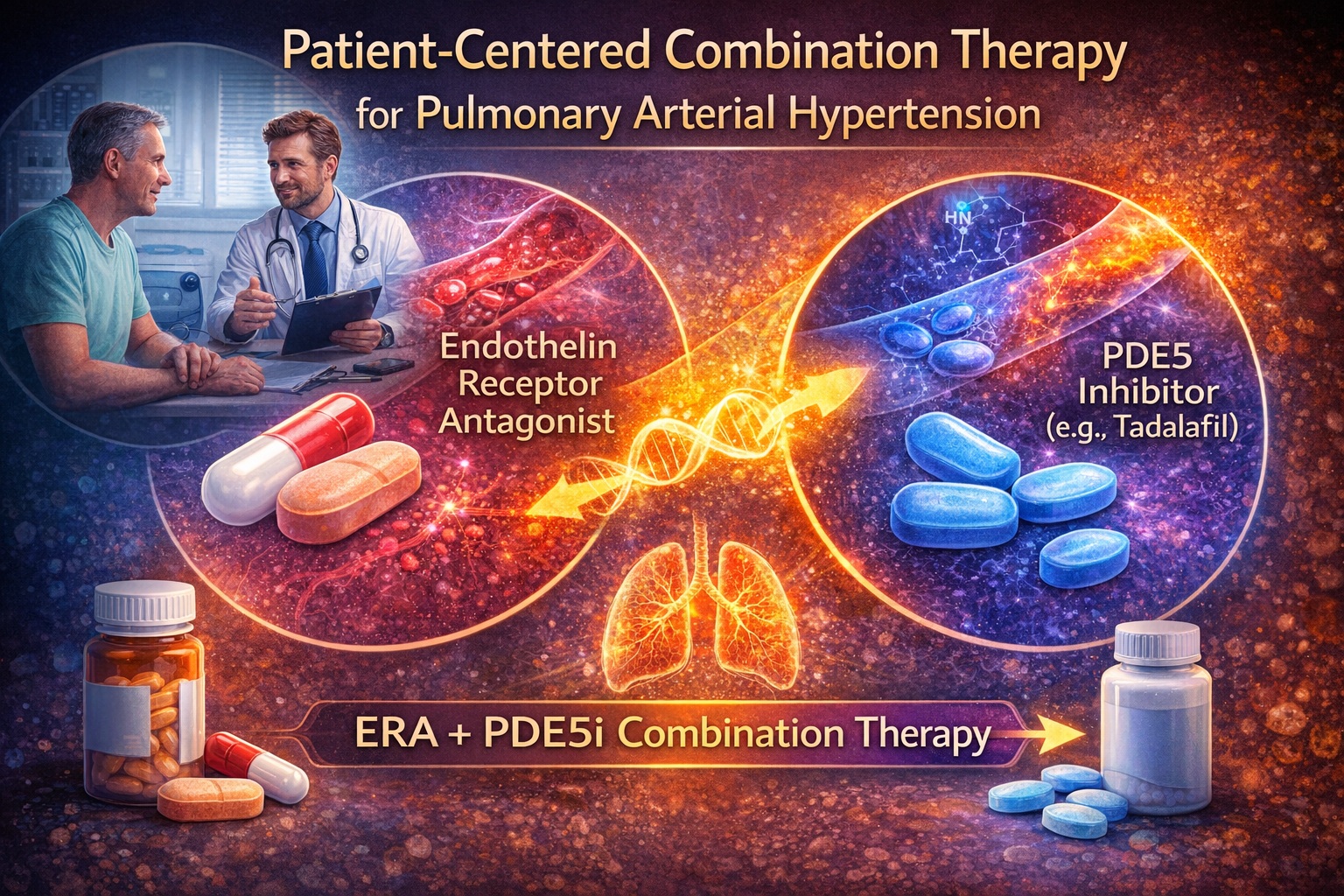
Introduction: When Efficacy Meets Experience
Pulmonary arterial hypertension (PAH) has undergone a therapeutic transformation over the past two decades. Once a relentlessly progressive and fatal disease, it is now managed through targeted pharmacological strategies that significantly improve survival and quality of life. Among these, combination therapy—particularly endothelin receptor antagonists (ERAs) paired with phosphodiesterase type-5 inhibitors (PDE5i) such as tadalafil—has emerged as a standard of care.
From a purely clinical perspective, the rationale for combination therapy is compelling. PAH is driven by multiple dysregulated pathways, including endothelin overactivity and impaired nitric oxide signaling. Addressing both simultaneously offers superior hemodynamic and functional outcomes compared with monotherapy.
Yet medicine does not exist in a vacuum of physiology alone. Patients do not experience treatment as a set of molecular interactions—they experience it as daily routines, side effects, expectations, and trade-offs. In this context, the question becomes not only what works, but also what patients are willing and able to sustain.
Recent research exploring patient preferences in ERA + PDE5i combination therapy highlights an essential evolution in clinical thinking: the shift from physician-centered to patient-centered care. This approach recognizes that adherence, satisfaction, and long-term outcomes are deeply influenced by how patients perceive and tolerate their treatment.
This article examines the interplay between pharmacological efficacy and patient preference in PAH therapy. It explores how treatment decisions are shaped not only by clinical guidelines but also by the lived experience of patients.
The Rationale for Combination Therapy in PAH
Pulmonary arterial hypertension is characterized by progressive narrowing of pulmonary arteries, increased vascular resistance, and eventual right heart failure. The disease involves multiple overlapping pathways, each contributing to vascular remodeling and dysfunction.
Two of the most critical pathways are the endothelin system and the nitric oxide–cGMP pathway. Endothelin-1 is a potent vasoconstrictor that promotes smooth muscle proliferation, while nitric oxide is a vasodilator that counteracts these effects.
Endothelin receptor antagonists block the action of endothelin-1, reducing vasoconstriction and cellular proliferation. PDE5 inhibitors such as tadalafil enhance nitric oxide signaling by preventing the degradation of cGMP.
When used together, these therapies provide complementary effects. One reduces pathological constriction, while the other enhances physiological relaxation. The result is improved pulmonary hemodynamics and exercise capacity.
Clinical trials have consistently demonstrated the superiority of combination therapy over monotherapy. However, these benefits must be weighed against the practical realities of treatment.
Beyond Physiology: The Importance of Patient Preference
While clinical efficacy is essential, it does not guarantee adherence. Patients must integrate treatment into their daily lives, often for years or even decades.
Factors influencing patient preference include dosing frequency, pill burden, side effects, perceived effectiveness, and overall quality of life. These considerations may seem secondary to clinical outcomes, but they are often decisive in real-world practice.
For example, a therapy that improves hemodynamics but causes intolerable side effects may ultimately be discontinued. Conversely, a slightly less effective therapy that is well tolerated may lead to better long-term outcomes.
Patient preference is therefore not a luxury—it is a clinical variable that directly influences treatment success.
Understanding these preferences requires systematic evaluation, often through surveys, interviews, and patient-reported outcome measures.
Key Drivers of Patient Preference in Combination Therapy
Research into patient preferences has identified several factors that consistently influence decision-making in PAH therapy.
One of the most important is treatment burden. Patients often express concern about the number of medications they must take, particularly when dosing schedules are complex.
Another critical factor is side effect profile. ERAs are associated with potential liver toxicity and peripheral edema, while PDE5 inhibitors may cause headaches, flushing, and hypotension. Patients weigh these effects differently depending on their severity and impact on daily life.
Perceived effectiveness also plays a significant role. Patients who notice improvements in symptoms such as dyspnea or exercise tolerance are more likely to adhere to therapy.
Common preference drivers include:
- Simplicity of dosing regimen
- Tolerability and side effect management
- Perceived improvement in symptoms
- Impact on daily activities and independence
These factors highlight the importance of aligning treatment strategies with patient expectations and experiences.
Tadalafil in Combination Therapy: A Patient-Friendly Option?
Among PDE5 inhibitors, tadalafil offers several advantages that may influence patient preference. Its long half-life allows for once-daily dosing, reducing treatment complexity.
This simplicity can be particularly appealing in combination therapy, where patients may already be taking multiple medications. A once-daily regimen is easier to integrate into daily routines and may improve adherence.
Tadalafil’s side effect profile is generally well tolerated, although individual experiences vary. For many patients, the balance between efficacy and tolerability is favorable.
Additionally, tadalafil’s effects extend beyond pulmonary hemodynamics. Improvements in overall vascular function may contribute to enhanced quality of life.
These characteristics position tadalafil as a potentially preferred option within combination therapy, particularly for patients seeking simplicity and consistency.
Balancing Efficacy and Experience: The Clinician’s Role
Clinicians face the challenge of balancing evidence-based recommendations with individual patient needs. Guidelines provide a framework, but they cannot account for every nuance of patient experience.
Effective communication is essential. Patients should be informed about the benefits and risks of combination therapy, as well as the rationale for each component.
Shared decision-making allows patients to express their preferences and concerns, leading to more personalized treatment plans. This approach fosters trust and improves adherence.
Clinicians must also remain flexible. Treatment plans may need to be adjusted based on patient feedback, side effects, or changes in clinical status.
In this context, the role of the physician shifts from directive to collaborative—guiding patients rather than dictating choices.
Real-World Implications: Adherence and Outcomes
The relationship between patient preference and clinical outcomes is well established. Adherence to therapy is a key determinant of treatment success in chronic diseases such as PAH.
Non-adherence can lead to disease progression, increased hospitalization, and reduced survival. Conversely, therapies that align with patient preferences are more likely to be maintained over time.
This dynamic underscores the importance of considering patient experience in treatment design. A therapy that is theoretically optimal but practically unsustainable is unlikely to achieve its intended outcomes.
Incorporating patient preferences into clinical practice is therefore not only compassionate—it is strategically effective.
Future Directions: Toward Truly Patient-Centered Care
The exploration of patient preferences in PAH therapy represents a broader shift in medicine. Increasingly, treatment success is defined not only by clinical metrics but also by patient-reported outcomes.
Advances in digital health, remote monitoring, and personalized medicine may further enhance this approach. Patients can provide real-time feedback, allowing for more responsive and adaptive treatment strategies.
Pharmaceutical development is also evolving. New therapies are being designed with patient convenience in mind, including simplified dosing regimens and improved tolerability.
As these trends continue, the integration of patient preference into clinical decision-making will become increasingly central to healthcare.
Conclusion: Medicine as a Partnership
Combination therapy with ERAs and PDE5 inhibitors such as tadalafil represents a powerful tool in the management of pulmonary arterial hypertension. Yet its success depends not only on pharmacological efficacy but also on patient acceptance.
By understanding and incorporating patient preferences, clinicians can optimize treatment strategies and improve long-term outcomes.
In the end, medicine is not merely about correcting physiological abnormalities—it is about supporting individuals in living their lives as fully as possible.
And sometimes, the most effective treatment is the one that patients are willing to continue.
FAQ
Why is combination therapy used in pulmonary arterial hypertension?
Combination therapy targets multiple disease pathways simultaneously, improving pulmonary hemodynamics and clinical outcomes more effectively than single-drug treatment.
What role does tadalafil play in PAH treatment?
Tadalafil is a PDE5 inhibitor that enhances nitric oxide signaling, promoting vasodilation and improving blood flow in the pulmonary arteries.
Why are patient preferences important in treatment decisions?
Patient preferences influence adherence, satisfaction, and long-term outcomes. Treatments that align with patient needs are more likely to be maintained and effective.
