

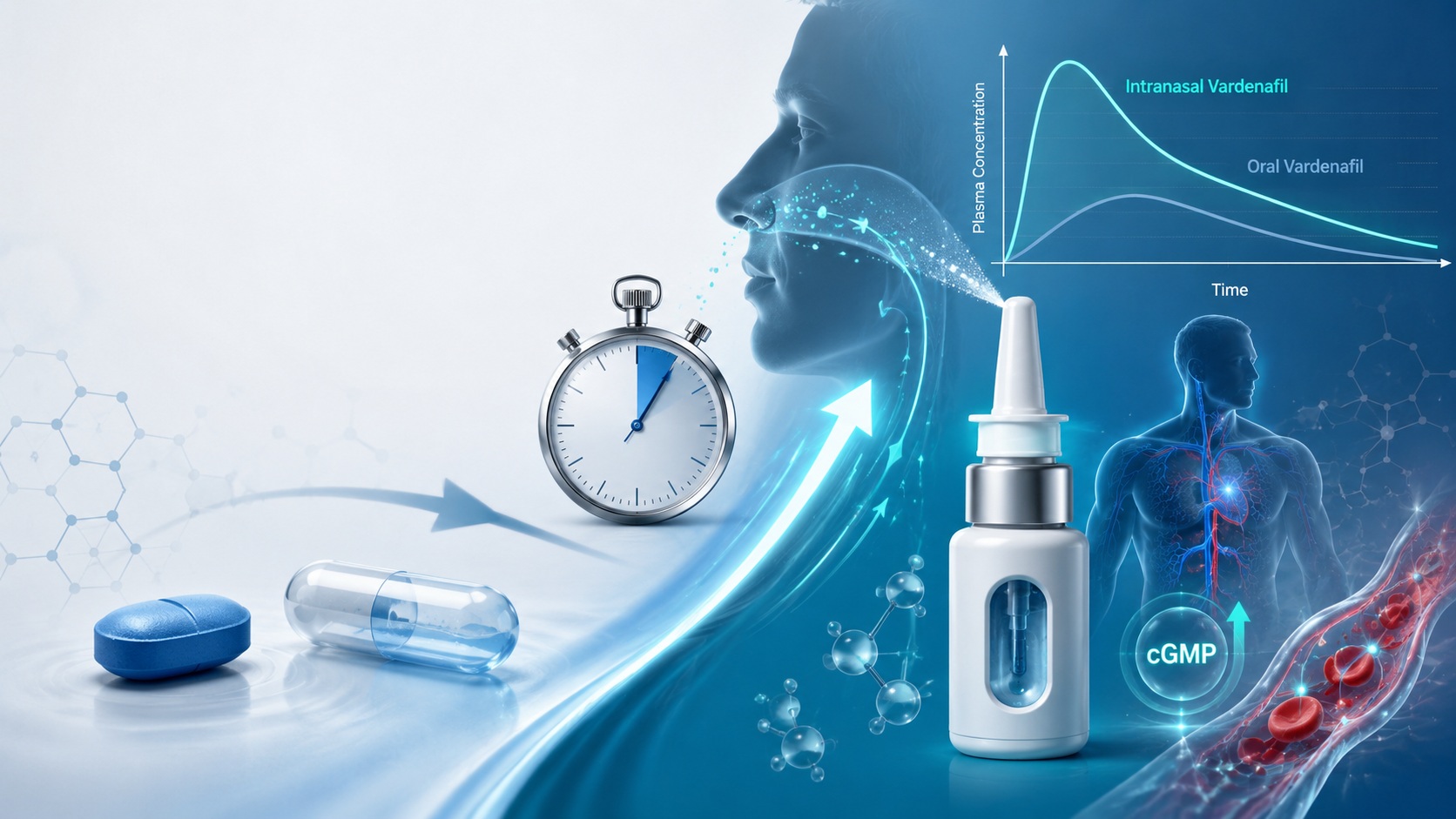
Introduction: Erectile Dysfunction Therapy Still Has a Timing Problem
Erectile dysfunction is not only a disorder of penile blood flow. It is also a disorder of timing, confidence, expectation, and intimacy. A medication may be effective in a clinical trial, but if a man must plan sexual activity around tablets, meals, absorption delays, and uncertainty, treatment can feel less like restoration and more like scheduling a minor procedure. This is one reason why discontinuation rates with phosphodiesterase type 5 inhibitors remain clinically relevant despite their proven efficacy.
The study “Pharmacokinetics of an oral versus intranasal delivered formulation of the phosphodiesterase type 5 inhibitor vardenafil in healthy men” examines a practical and important question: can a different route of administration make PDE5 inhibitor therapy faster and more patient-friendly? The investigators compared a new intranasal vardenafil formulation, SDS-089 nasal spray, with a conventional oral vardenafil tablet in healthy men. The aim was not to prove clinical efficacy in erectile dysfunction, but to understand pharmacokinetics: how quickly and how much vardenafil enters the bloodstream after each route.
This question is more than technical. PDE5 inhibitors work well for many men, but their oral administration introduces delays and variability. Food can slow absorption for several agents, and the need to take medication before anticipated sexual activity can reduce spontaneity. Tadalafil partly solves this problem through its long half-life and prolonged window of action, but not every patient wants or needs a long-acting drug. Some patients may prefer rapid onset with shorter systemic exposure. That is where intranasal delivery becomes clinically interesting.
The study found that intranasal vardenafil produced a much shorter time to peak plasma concentration than oral vardenafil, although formal bioequivalence was not demonstrated. In simpler terms, the nasal spray acted faster, but it was not statistically equivalent to the tablet across all standard pharmacokinetic measures. That distinction is essential: faster is not automatically identical, and identical is not always necessary for clinical usefulness.
Why Drug Delivery Route Matters in Erectile Dysfunction
The biology of erection depends on nitric oxide release, cGMP accumulation, smooth muscle relaxation, and arterial inflow into the corpus cavernosum. PDE5 inhibitors support this process by blocking cGMP degradation. However, they do not directly create sexual desire and do not cause an erection in the absence of sexual stimulation. This is a point worth repeating because it remains one of the most common misunderstandings in ED treatment.
Oral PDE5 inhibitors must first pass through the gastrointestinal tract before entering systemic circulation. This process introduces delays and variability. Some drugs are affected by high-fat meals, and many patients are unsure when the medication will work best. Tadalafil is the notable exception regarding food effect and has the longest half-life at approximately 17.5 hours, which supports a prolonged duration of activity. Vardenafil, sildenafil, and avanafil have shorter half-lives, generally in the range of several hours, making timing more relevant.
The study highlights that commercially available oral PDE5 inhibitors have heterogeneous pharmacokinetic profiles. Avanafil tends to reach peak concentration relatively quickly, while tadalafil reaches peak levels later but remains active much longer. Vardenafil and sildenafil sit somewhere in between. These differences are not academic decoration. They influence how patients plan intimacy, how satisfied they feel, and whether they continue therapy.
Intranasal administration offers a different strategy. The nasal mucosa is vascular and can allow rapid drug absorption into systemic circulation. A nasal spray may bypass part of the delay associated with gastrointestinal absorption. In ED therapy, that could reduce the planning burden. A treatment that works in minutes rather than closer to an hour may better match real sexual behavior, which—despite the best efforts of clinical pharmacology—is not always scheduled with laboratory precision.
Study Design: A Phase 1 Trial Built Around Pharmacokinetics
This was a phase 1, randomized, open-label, single-dose, two-period, two-treatment crossover study. Nineteen healthy men aged 18 to 45 years entered the trial, and 18 completed the pharmacokinetic evaluation. Each participant received both treatments in different periods: SDS-089 nasal spray delivering 5 mg vardenafil and an oral tablet delivering 10 mg vardenafil, separated by a three-day washout.
The crossover design is useful because each participant effectively serves as his own comparator. This reduces variability and allows a clearer assessment of route-dependent pharmacokinetic differences. The study was conducted under fasting conditions, which is appropriate for isolating drug absorption characteristics but does not fully replicate the real-world context of meals, alcohol, stress, and varying sexual timing.
The primary endpoint was relative bioavailability. The investigators assessed standard pharmacokinetic parameters such as Tmax, Cmax, AUC, half-life, clearance, and volume of distribution. Bioequivalence would have required the 90% confidence intervals for key ratios to fall within the conventional 80% to 125% range. This is a strict statistical standard, and the study did not meet it.
The figure on page 3 presents the study design visually, showing the screening period, randomized treatment sequence, crossover, and follow-up. This matters because the design was not a casual comparison of “spray versus pill”; it was a structured pharmacokinetic trial intended to examine whether the nasal formulation behaves similarly enough to oral vardenafil to support further clinical development.
Pharmacokinetic Findings: Faster Peak, Different Exposure
The most clinically striking finding was the difference in Tmax. Intranasal vardenafil reached peak plasma concentration between 0.150 and 0.250 hours after dosing, with a median around 10 minutes. Oral vardenafil reached peak levels between 0.500 and 2.500 hours, with a median around 45 minutes. This means the nasal formulation reached peak concentration roughly three to four times faster than the tablet.
This is the core pharmacokinetic advantage. For a patient seeking spontaneity, the difference between 10 minutes and 45 minutes can feel enormous. It may reduce anticipation pressure, improve confidence, and make medication use less intrusive. The psychology of ED therapy should not be underestimated. A drug that works quickly may reduce the sense that intimacy must wait for pharmacology to catch up.
However, total exposure was lower after the nasal spray than after the oral tablet, which is expected because the nasal dose was 5 mg while the oral dose was 10 mg. Mean AUC and mean Cmax were higher with the oral tablet in non-dose-normalized analysis. When adjusted for dose, the nasal formulation showed higher relative values for certain parameters, suggesting efficient absorption per milligram, but formal bioequivalence was still not established.
The pharmacokinetic profile can be summarized as follows:
- Intranasal vardenafil reached peak concentration faster, with Tmax around 10 minutes compared with approximately 45 minutes for oral vardenafil.
- Total drug exposure was higher with the oral tablet, largely reflecting the higher 10 mg dose compared with the 5 mg nasal dose.
- Dose-normalized exposure suggested efficient nasal absorption, although standard bioequivalence criteria were not met.
- Half-life was similar between formulations, approximately 4.15 hours for the nasal spray and 4.23 hours for the oral tablet.
- Safety was broadly comparable, although local nasal and throat irritation occurred more often with intranasal delivery.
The figure on page 6 is especially useful because it shows plasma concentration-time curves on both linear and logarithmic scales. The shaded early interval highlights the 0–4 hour period where the formulations differ most visibly. The nasal spray rises quickly and peaks early; the oral tablet rises more slowly and sustains a broader exposure curve. This visual pattern captures the clinical trade-off: speed versus conventional oral exposure.
Clinical Meaning: Spontaneity as a Legitimate Treatment Goal
The study did not test whether intranasal vardenafil improves erections in men with ED. That must be stated clearly. Healthy volunteers were studied, and pharmacokinetics were the focus. Still, the findings have important clinical implications because ED treatment success depends not only on molecular efficacy but also on how well a treatment fits into a patient’s life.
Many men discontinue PDE5 inhibitors despite adequate pharmacological potential. Reasons include lack of perceived efficacy, side effects, cost, partner-related issues, cultural factors, and dissatisfaction with the planning required before sexual activity. The paper specifically discusses spontaneity as a residual flaw in existing oral therapy.
A faster-onset formulation could be valuable for men who dislike planning medication 30–60 minutes in advance. It may also help men whose sexual activity is less predictable or who experience performance anxiety during the waiting period after taking a tablet. The irony is familiar in sexual medicine: a drug designed to restore natural function may feel unnatural if it demands too much planning.
Tadalafil offers another solution to spontaneity through long duration rather than rapid peak. Its long half-life allows a broad therapeutic window, and daily low-dose tadalafil can separate medication timing from sexual activity. Intranasal vardenafil represents a different philosophy: instead of staying in the body longer, it may act faster. These are not competing ideas so much as different tools for different patients.
The future of ED therapy will likely be more individualized. Some men may prefer tadalafil because it provides freedom over many hours. Others may prefer a rapid-onset vardenafil spray if further trials confirm clinical efficacy and acceptable tolerability. The best drug is not always the strongest or longest acting; it is the one that matches the patient’s physiology, relationship pattern, expectations, and safety profile.
Safety and Tolerability: Systemic Familiarity, Local Trade-Offs
Both formulations were generally well tolerated in the study. No serious adverse events were reported. The adverse effects with oral vardenafil were consistent with known PDE5 inhibitor effects, including headache, nasal congestion, nausea, vomiting, and feeling hot. With SDS-089 nasal spray, headache was also common, but local respiratory symptoms were more frequent. These included nasal congestion, sneezing, pharyngeal discomfort, and rhinalgia.
This makes sense. A nasal delivery system places the drug and formulation excipients directly onto nasal mucosa. Some irritation is therefore unsurprising. The key question for future development is whether these local effects are mild, transient, and acceptable to patients. A faster onset is useful only if the route remains comfortable enough for repeated real-world use.
No clinically concerning signals were identified in laboratory values, vital signs, ECGs, or physical examination. That is reassuring, but the study was small and conducted in healthy men. ED patients are often older and may have hypertension, diabetes, dyslipidemia, obesity, cardiovascular disease, post-prostatectomy changes, or medication interactions. A phase 1 study cannot answer all those questions.
Importantly, contraindications remain relevant. Vardenafil, like tadalafil and other PDE5 inhibitors, must not be combined with nitrates or guanylate cyclase stimulators because of the risk of clinically significant hypotension. Faster delivery does not remove the pharmacological class warning. Convenience never cancels mechanism.
Limitations: Why This Is Promising but Not Yet Practice-Changing
The study’s main limitation is that it evaluated pharmacokinetics in healthy volunteers, not clinical efficacy in men with erectile dysfunction. Blood concentration matters, but it is not the same as successful intercourse, patient satisfaction, partner satisfaction, or long-term adherence. Those outcomes require larger clinical trials in actual ED populations.
The sample size was small, with 19 participants enrolled and 18 evaluable for pharmacokinetics. This is acceptable for an early phase study but insufficient for broad clinical conclusions. The participants were also relatively young and healthy, with a mean age of about 30 years. That differs substantially from many men seeking ED treatment in routine practice.
The trial was open-label. For pharmacokinetic endpoints, this is less concerning than it would be for subjective efficacy outcomes, but it still reflects an early development-stage design. The study also used fasting conditions, whereas real patients may use medication after meals, during travel, after alcohol intake, or under emotional stress. Real life is rarely a pharmacokinetic unit.
The failure to meet formal bioequivalence criteria is not necessarily a failure of the formulation. Nasal and oral delivery are biologically different, and the goal of an intranasal PDE5 inhibitor may not be to mimic the tablet perfectly. It may be to provide a faster, clinically effective, acceptably safe alternative. That hypothesis remains plausible, but it still requires direct clinical testing.
Conclusion: A Faster Route Toward a More Natural Treatment Experience
The study provides an important early signal: intranasal vardenafil can reach peak plasma concentration much faster than oral vardenafil while producing broadly similar systemic exposure characteristics after dose adjustment, although formal bioequivalence was not demonstrated. The nasal route produced more local irritation, but no serious safety signals emerged in this small healthy volunteer trial.
The clinical importance lies in what this formulation may offer: speed. For men with ED, faster onset could mean less planning, less pressure, and greater spontaneity. That matters because sexual medicine is not simply about vascular mechanics; it is about restoring a function that patients experience as personal, relational, and time-sensitive.
Tadalafil remains the classic long-duration option among PDE5 inhibitors, useful when extended responsiveness or daily therapy is preferred. Intranasal vardenafil, if future studies confirm efficacy and tolerability, may offer a different kind of freedom: not the freedom of a 36-hour window, but the freedom of a rapid start.
The next step is clear. Larger trials in men with erectile dysfunction must determine whether this faster pharmacokinetic profile translates into meaningful clinical benefit. If it does, intranasal vardenafil may become a valuable addition to ED therapy—not because it replaces existing PDE5 inhibitors, but because it solves a problem they have never fully solved: the awkward distance between desire and drug onset.
FAQ
Is intranasal vardenafil already proven to treat erectile dysfunction?
Not yet. This study evaluated pharmacokinetics in healthy men, not treatment efficacy in men with erectile dysfunction. Clinical efficacy trials are still needed.
How much faster was the nasal spray compared with the oral tablet?
The nasal formulation reached peak plasma concentration at about 10 minutes, while the oral tablet reached peak concentration at about 45 minutes in this study.
Was the nasal spray bioequivalent to oral vardenafil?
No. The study did not meet formal bioequivalence criteria, although dose-normalized results suggested efficient nasal absorption.
How does this compare with tadalafil?
Tadalafil has a slower peak but a much longer half-life, making it useful for prolonged responsiveness. Intranasal vardenafil aims for rapid onset rather than long duration.
What were the main side effects of the nasal spray?
Headache was common, as with oral PDE5 inhibitors. Nasal congestion, sneezing, throat discomfort, and nasal pain occurred more often with the intranasal formulation.
