

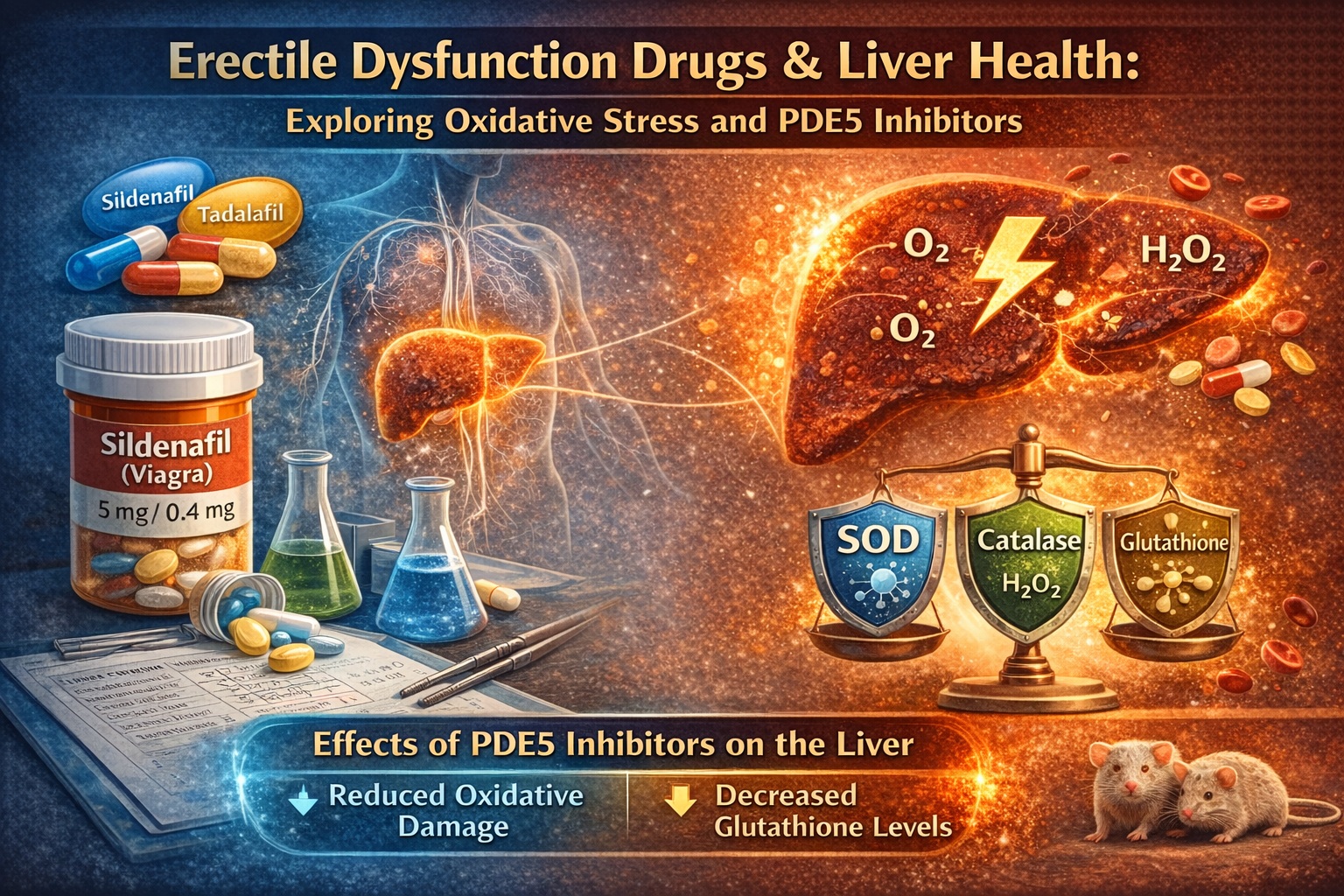
Introduction: Beyond the Penis — When Erectile Dysfunction Therapy Becomes Systemic
Erectile dysfunction affects hundreds of millions of men worldwide and, for many, phosphodiesterase type 5 inhibitors (PDE5 inhibitors) represent one of the most successful therapeutic innovations in modern medicine. Sildenafil, tadalafil, and vardenafil have transformed sexual medicine by offering effective, oral, and generally well-tolerated treatment options. Their mechanism of action—enhancing nitric oxide–cGMP signaling—has become textbook knowledge.
However, the systemic nature of these drugs is often underestimated. PDE5 is not confined to penile tissue. It is widely expressed in vascular beds, cardiac muscle, and metabolically active organs, including the liver. As a result, PDE5 inhibitors inevitably interact with oxidative and metabolic pathways far beyond their intended target.
The liver, as the central hub of drug metabolism and redox regulation, offers a unique window into the systemic effects of erectile dysfunction drugs. Studying hepatic oxidative stress is not an academic exercise—it is a necessary step toward understanding long-term safety, adaptive mechanisms, and potential trade-offs of chronic PDE5 inhibitor use.
This article explores how erectile dysfunction drugs influence oxidative stress, antioxidant defenses, and cellular balance in the liver, and why these findings matter clinically, even if they originate from experimental models.
Oxidative Stress and Erectile Dysfunction: A Two-Way Relationship
Oxidative stress plays a pivotal role in the pathophysiology of erectile dysfunction itself. Reactive oxygen species (ROS) reduce nitric oxide bioavailability, impair endothelial function, and promote vascular stiffness. In conditions such as diabetes, hypertension, and metabolic syndrome, oxidative imbalance is often the hidden driver behind erectile failure.
PDE5 inhibitors, paradoxically, are not only victims of this oxidative environment but also active modulators of it. By enhancing nitric oxide signaling, they indirectly influence redox homeostasis. Nitric oxide interacts closely with reactive oxygen species, and the balance between the two determines vascular tone, cellular signaling, and tissue integrity.
The liver becomes relevant here because it is both a generator and a scavenger of oxidative species. Hepatocytes maintain a delicate equilibrium between pro-oxidant metabolism and antioxidant defense systems. Any drug that alters this balance—even indirectly—can leave a biochemical fingerprint in hepatic tissue.
Thus, investigating how sildenafil, tadalafil, and vardenafil affect oxidative stress in the liver is not about liver toxicity alone. It is about understanding how systemic modulation of nitric oxide and cGMP reshapes redox biology at an organ level.
Antioxidant Defense Systems: The Liver’s Biochemical Firewall
The liver relies on a tightly coordinated antioxidant network to protect itself from oxidative injury. Central to this system are enzymes such as superoxide dismutase (SOD), catalase, glutathione reductase, and glutathione peroxidase, along with the tripeptide glutathione itself.
Superoxide dismutase converts highly reactive superoxide radicals into hydrogen peroxide, which is then detoxified by catalase and glutathione peroxidase. Glutathione reductase regenerates reduced glutathione, ensuring a continuous supply of this essential antioxidant molecule.
This system is highly adaptive. When oxidative stress increases, antioxidant enzymes are often upregulated as a compensatory response. When oxidative burden decreases, some components may downregulate. Importantly, not all antioxidant pathways respond uniformly, and selective modulation can occur.
Erectile dysfunction drugs appear to engage this system in a nuanced and drug-specific manner. Rather than producing a simple antioxidant or pro-oxidant effect, they reshape the antioxidant landscape—enhancing some defenses while suppressing others.
PDE5 Inhibitors and Hepatic Oxidative Markers: What Changes, and Why It Matters
Experimental data demonstrate that chronic exposure to sildenafil, tadalafil, or vardenafil leads to a consistent reduction in lipid peroxidation markers in the liver. Malondialdehyde (MDA), a widely used indicator of oxidative damage to cell membranes, is significantly decreased following treatment with all three agents.
This finding suggests that PDE5 inhibitors reduce oxidative injury at the tissue level. From a mechanistic perspective, this reduction likely reflects improved redox efficiency rather than mere suppression of metabolic activity. In simple terms, fewer free radicals are damaging cellular lipids.
Concurrently, activities of key antioxidant enzymes such as superoxide dismutase and catalase are increased, particularly with sildenafil and vardenafil. This enzymatic induction represents a classic adaptive antioxidant response, reinforcing the liver’s capacity to neutralize reactive oxygen species.
From a functional standpoint, this antioxidant shift may support nitric oxide signaling by limiting its degradation through oxidative reactions. Reduced oxidative stress preserves nitric oxide bioavailability, reinforcing the very pathway PDE5 inhibitors are designed to enhance.
The Glutathione Paradox: Protection at a Cost?
While reductions in oxidative damage markers and increased activity of certain antioxidant enzymes appear beneficial, the story becomes more complex when examining glutathione-dependent systems.
Chronic treatment with PDE5 inhibitors is associated with a marked reduction in hepatic glutathione levels and decreased activity of glutathione reductase. This finding may appear counterintuitive: why would antioxidant drugs reduce one of the most important cellular antioxidants?
The answer lies in metabolic redistribution. Enhanced activity of SOD and catalase reduces the oxidative burden that would otherwise require glutathione-mediated detoxification. As a result, glutathione utilization patterns shift, and its regeneration via glutathione reductase becomes less critical—or less stimulated.
However, glutathione is not merely an antioxidant. It is a central regulator of cellular detoxification, redox signaling, and nitric oxide synthesis. Sustained depletion of glutathione pools may compromise the liver’s ability to respond to additional toxic insults, particularly in patients with comorbidities or polypharmacy.
Thus, while PDE5 inhibitors reduce oxidative damage markers, they may simultaneously narrow the liver’s metabolic safety margin.
Drug-Specific Differences: Not All PDE5 Inhibitors Behave Alike
One of the most clinically relevant insights is that sildenafil, tadalafil, and vardenafil do not produce identical biochemical effects.
Vardenafil uniquely increases both the activity and protein expression of glutathione peroxidase, an enzyme critical for detoxifying hydrogen peroxide and lipid peroxides. This suggests a more robust engagement of glutathione-dependent antioxidant pathways.
In contrast, sildenafil and tadalafil suppress glutathione peroxidase activity and expression, potentially shifting antioxidant reliance toward catalase and SOD. Additionally, sildenafil markedly reduces the expression of glutathione S-transferase isoforms, enzymes involved in phase II detoxification of xenobiotics.
These differences may help explain why histopathological changes—such as inflammation and fibrosis—are observed in the livers of animals treated with sildenafil and vardenafil, but not tadalafil. The absence of overt structural damage with tadalafil suggests a more balanced redox adaptation.
Clinically, these distinctions may become relevant in patients with preexisting liver disease, long-term PDE5 inhibitor use, or concurrent exposure to hepatotoxic agents.
Histological Findings: When Biochemistry Meets Tissue Reality
Biochemical markers provide early signals, but histology reveals the final outcome. Examination of liver tissue following chronic PDE5 inhibitor exposure shows variable structural responses.
Sildenafil and vardenafil are associated with inflammatory infiltrates and fibrotic changes in hepatic tissue. These alterations suggest that despite reduced oxidative damage markers, other stress pathways—possibly related to glutathione depletion or altered detoxification—remain active.
Tadalafil-treated liver tissue, by contrast, shows preserved architecture without significant inflammatory or fibrotic changes. This observation aligns with its more favorable glutathione profile and may explain its reputation for better long-term tolerability in some patient populations.
It is important to emphasize that these findings arise from experimental models. However, they offer mechanistic insights that deserve attention when translating chronic therapy into real-world clinical practice.
Clinical Implications: What Should Physicians Take Away?
For clinicians, the key message is not alarm, but awareness. PDE5 inhibitors are generally safe, effective, and well tolerated. However, they are biologically active molecules with systemic effects that extend beyond erectile tissue.
In patients with healthy liver function, adaptive antioxidant responses likely compensate for biochemical shifts. In patients with chronic liver disease, metabolic syndrome, or heavy medication burden, these adaptations may be less robust.
Understanding that PDE5 inhibitors modulate oxidative stress pathways opens opportunities for more personalized prescribing. Choice of agent, dosing strategy, and duration of therapy may all influence long-term outcomes.
From a broader perspective, these findings reinforce a central principle of pharmacology: no drug acts in isolation, and therapeutic benefit is often accompanied by subtle metabolic trade-offs.
Conclusion: Redox Balance as an Unseen Dimension of Erectile Dysfunction Therapy
Erectile dysfunction drugs have reshaped sexual medicine, but their influence reaches far beyond the penile vasculature. By modulating nitric oxide signaling and oxidative stress pathways, PDE5 inhibitors interact intimately with hepatic antioxidant systems.
They reduce oxidative damage, enhance selected antioxidant defenses, and alter glutathione metabolism in ways that reflect adaptive, but not entirely neutral, biological responses. Differences among sildenafil, tadalafil, and vardenafil highlight that pharmacological class does not guarantee biochemical uniformity.
For clinicians and researchers alike, the liver serves as a reminder that systemic therapies require systemic thinking. The success of erectile dysfunction treatment should not be measured solely by erection quality, but by long-term physiological harmony.
FAQ
1. Do erectile dysfunction drugs cause liver damage in humans?
There is no strong clinical evidence of significant liver toxicity in healthy individuals, but experimental data suggest drug-specific differences in hepatic stress responses.
2. Are all PDE5 inhibitors equally safe for long-term use?
They share a common mechanism but differ in redox and detoxification effects. Individual patient factors and drug selection may matter in long-term therapy.
3. Should liver function be monitored in patients using PDE5 inhibitors?
Routine monitoring is not required for most patients, but may be reasonable in those with existing liver disease or prolonged high-dose use.
