

Introduction: Erectile Dysfunction Is Not a Shortcut Diagnosis
Erectile dysfunction (ED) occupies a curious position in modern clinical practice. On one hand, it is common, well recognized, and supported by clear evidence-based treatments. On the other, it is frequently reduced to a single symptom rather than approached as a multidimensional clinical condition. This contradiction becomes most visible at the point of referral from primary to secondary care.
In the UK healthcare system, general practitioners (GPs) serve as the gatekeepers to specialist services. For erectile dysfunction, this role is guided by structured referral pathways designed to ensure that patients receive appropriate investigations, initial treatment, and psychological support before secondary care involvement. In theory, this optimizes patient outcomes and protects specialist resources. In practice, the system often falls short.
An audit of GP referrals for erectile dysfunction within North Central London reveals a recurring pattern: incomplete clinical histories, limited diagnostic workup, and premature referral without exhausting first-line management options. These are not merely administrative oversights. They reflect deeper issues in how erectile dysfunction is conceptualized, prioritized, and managed in primary care.
This article explores what such referral audits teach us—not only about erectile dysfunction, but about clinical responsibility, system efficiency, and the quiet consequences of skipping clinical fundamentals.
Erectile Dysfunction as a Clinical Signal, Not a Standalone Complaint
Erectile dysfunction is rarely an isolated phenomenon. It is frequently the first clinical manifestation of cardiovascular disease, metabolic dysfunction, hormonal imbalance, psychological distress, or a combination of these factors. When approached correctly, ED offers clinicians a valuable opportunity for early detection of systemic disease.
Despite this, referral data show that key elements of patient history are often omitted. Sexual history, medication review, cardiovascular risk factors, body mass index, smoking status, and psychosocial context are inconsistently documented. This absence undermines clinical reasoning and shifts diagnostic responsibility unnecessarily onto secondary care.
The irony is difficult to ignore. Erectile dysfunction is one of the most protocol-driven conditions in medicine, yet it is frequently managed without full adherence to its own pathway. Blood tests that are inexpensive and easily accessible—testosterone, lipid profile, glucose control, thyroid function—are often missing at the point of referral.
This pattern suggests not a lack of knowledge, but a failure of process. Erectile dysfunction becomes something to “send on” rather than something to systematically evaluate.
The Referral Pathway: Designed for Care, Not Bureaucracy
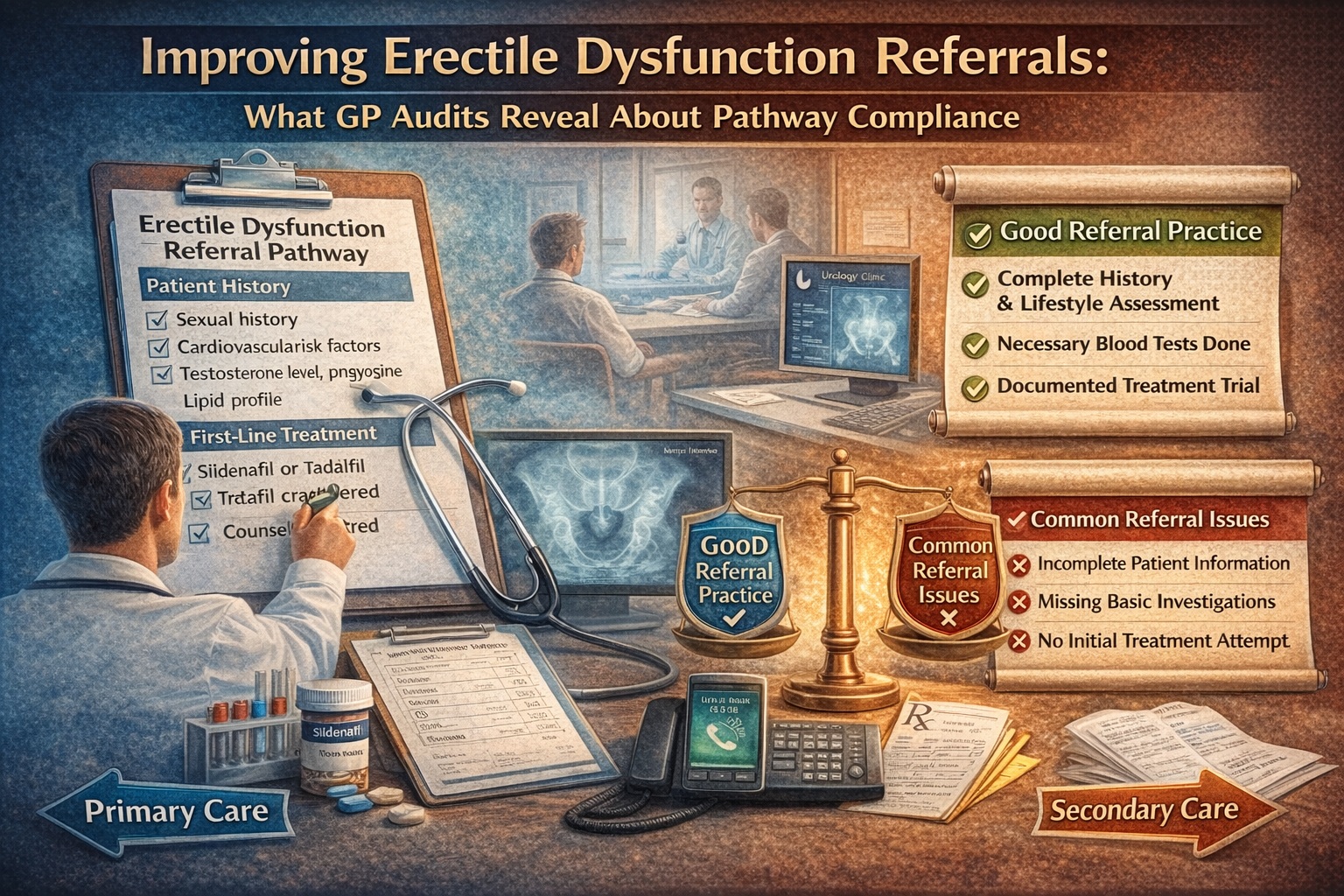
The Erectile Dysfunction Referral Pathway (EDRP) exists for clear clinical reasons. It requires GPs to document a comprehensive history, exclude reversible causes, initiate appropriate pharmacological therapy, and consider psychological support before referral.
Audit data from North Central London demonstrate that compliance with this pathway is poor. Many patients are referred without documented trials of first-line phosphodiesterase type 5 inhibitors, despite no clear contraindications. Others are referred without adequate explanation of treatment failure or intolerance.
This undermines the very purpose of the pathway. Secondary care clinics are structured to manage complex or refractory cases, not to initiate baseline investigations or first prescriptions. When referrals arrive incomplete, specialist consultations become inefficient, repetitive, and frustrating for both clinician and patient.
From a system perspective, this translates into longer waiting times, increased costs, and diluted specialist expertise. From a patient perspective, it often means delayed diagnosis, repeated appointments, and erosion of trust.
What the Audit Reveals About Real-World Practice
A detailed review of referrals over several years identified a striking gap between guideline expectations and clinical reality. Only a minority of referrals contained a complete sexual history. Documentation of erectile function characteristics—such as difficulty achieving versus maintaining erections—was inconsistent. Psychological factors were rarely explored.
Equally concerning was the limited use of basic blood tests. Testosterone levels were documented in a small proportion of referrals. Metabolic markers, despite the well-established link between erectile dysfunction and cardiovascular disease, were frequently absent.
Treatment trials were also incomplete. While sildenafil was the most commonly prescribed agent, many patients had not trialed tadalafil or alternative dosing strategies before referral. Some were referred without any documented pharmacological attempt, effectively transferring primary care responsibilities to secondary services.
These findings do not imply negligence. Rather, they highlight how time pressure, discomfort discussing sexual health, and overreliance on specialist referral can subtly erode clinical thoroughness.
The Cost of Incomplete Referrals: Clinical and Systemic Consequences
Incomplete referrals have consequences that extend beyond paperwork. For patients, they often result in delayed reassurance, delayed treatment optimization, and unnecessary escalation of care. For specialists, they create inefficiency and diagnostic redundancy.
More broadly, such patterns contribute to the misperception that erectile dysfunction is inherently a specialist condition. In reality, the majority of ED cases can—and should—be effectively managed in primary care.
When referral pathways are bypassed, the healthcare system absorbs avoidable strain. Specialist clinics become congested with cases that could have been resolved earlier, while truly complex patients wait longer for expert input.
There is also a subtle educational loss. When GPs do not engage fully with ED management, opportunities for professional development in sexual medicine, cardiovascular risk assessment, and holistic care are missed.
Education, Structure, and the Power of the Proforma
One of the most practical conclusions drawn from referral audits is the value of structured proformas. When clinicians are supported by standardized templates, compliance with pathways improves dramatically.
A well-designed proforma does not replace clinical judgment; it reinforces it. By prompting key history elements, required investigations, and treatment trials, it reduces cognitive load and variability in care. It also normalizes conversations about sexual health, making them less awkward and more routine.
Education is equally critical. GPs must be reminded that erectile dysfunction is not an embarrassing footnote but a legitimate clinical complaint with significant diagnostic value. Training should emphasize not only how to prescribe PDE5 inhibitors, but how to evaluate failure, intolerance, and underlying risk factors.
The combination of education and structural support represents a low-cost, high-impact intervention—one that benefits patients, clinicians, and healthcare systems alike.
Rethinking Referral Culture: From Transfer to Partnership
At its core, the issue revealed by ED referral audits is cultural rather than technical. Referral should represent escalation after due diligence, not delegation of responsibility.
Primary and secondary care function best as partners, not as sequential silos. When GPs provide comprehensive, pathway-compliant referrals, specialists can focus on advanced diagnostics, complex psychosexual issues, and multidisciplinary management.
This partnership model improves patient experience. Consultations become more meaningful, less repetitive, and more focused on resolution rather than reconstruction of missing information.
In this sense, erectile dysfunction serves as a microcosm of broader healthcare challenges: how systems manage common conditions, how clinicians balance efficiency with thoroughness, and how pathways translate from paper to practice.
Conclusion: Erectile Dysfunction as a Test of Clinical Discipline
Erectile dysfunction is not difficult to treat, but it is easy to oversimplify. The audit of GP referrals in North Central London demonstrates that when pathways are ignored, both patients and healthcare systems pay the price.
Improving referral quality does not require new drugs, technologies, or funding. It requires attention to fundamentals: history, examination, investigation, and appropriate first-line management.
In an era obsessed with innovation, it is worth remembering that clinical excellence often begins with doing the basics well—and doing them consistently.
Frequently Asked Questions (FAQ)
1. Why should most erectile dysfunction cases be managed in primary care?
Because ED is common, often linked to modifiable risk factors, and usually responds well to first-line treatments available to GPs.
2. What is the biggest problem with current ED referrals?
Incomplete history, missing investigations, and failure to exhaust first-line therapies before referral.
3. How can referral quality be improved quickly?
By using standardized proformas and reinforcing GP education on erectile dysfunction pathways.
