

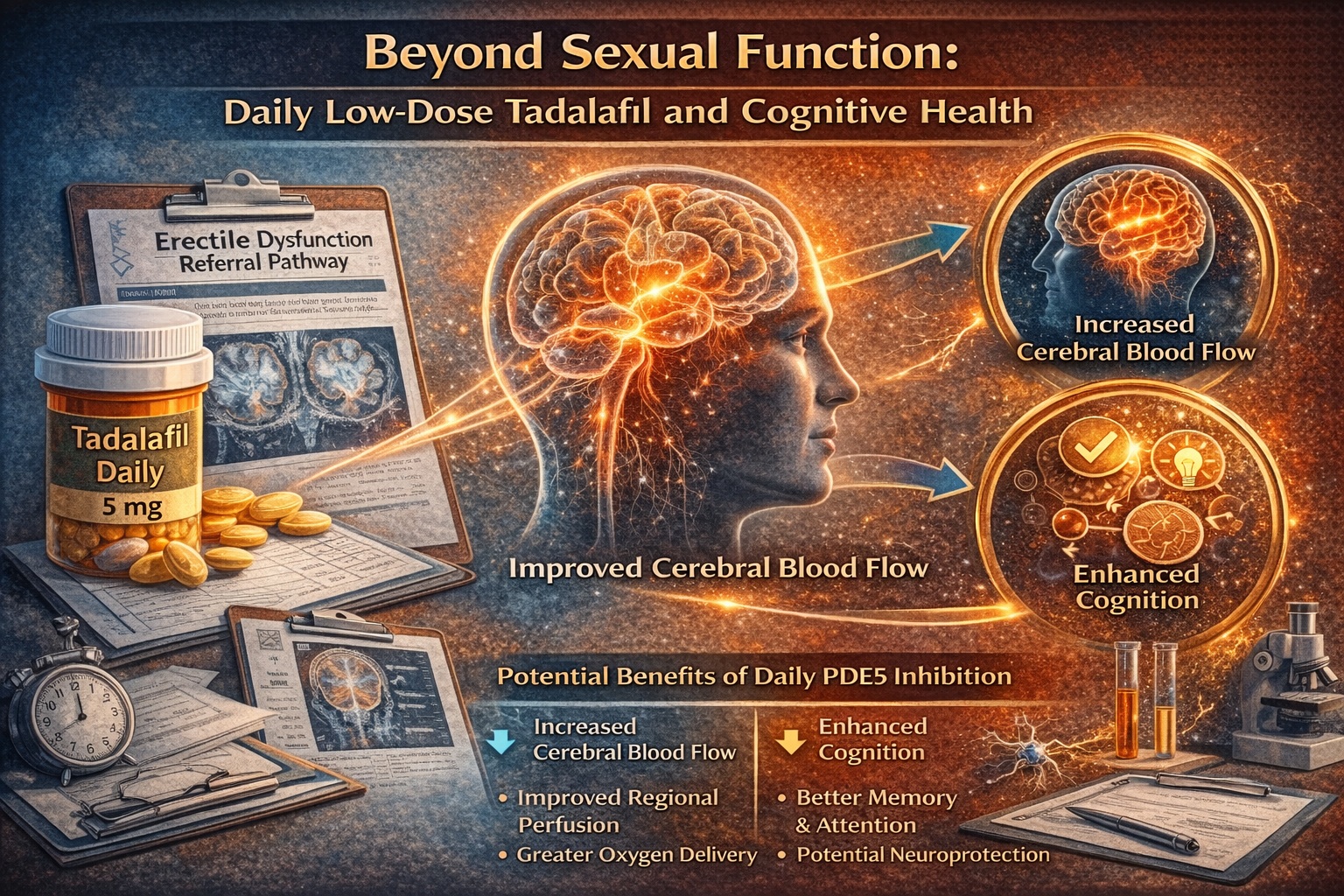
Introduction: When Erectile Dysfunction Becomes a Neurological Clue
Erectile dysfunction is traditionally framed as a quality-of-life issue, addressed within the boundaries of sexual medicine. Yet this narrow framing increasingly fails to reflect clinical reality. Erectile dysfunction, particularly in older men, frequently coexists with vascular disease, metabolic disorders, and subtle cognitive decline. In this context, ED may represent not an isolated symptom, but an early systemic signal.
Mild cognitive impairment (MCI) occupies a similarly ambiguous clinical space. It is neither normal aging nor dementia, but a transitional state with variable outcomes. Some patients remain stable for years, others progress toward neurodegenerative disease. What unites them is impaired cerebral perfusion and endothelial dysfunction—processes strikingly similar to those implicated in erectile failure.
This overlap raises a provocative clinical question: if erectile dysfunction and cognitive impairment share vascular and endothelial mechanisms, could therapies designed for one condition meaningfully influence the other? Daily low-dose tadalafil, a phosphodiesterase type 5 inhibitor with systemic vascular effects, offers a compelling test case.
This article explores how chronic tadalafil therapy may affect cerebral blood flow and cognition, and why these findings invite clinicians to rethink the therapeutic boundaries of PDE5 inhibitors.
Vascular Health as a Shared Pathway Between Brain and Penis
The penis and the brain share a critical dependency: adequate blood flow regulated by endothelial integrity and nitric oxide signaling. In both organs, vascular insufficiency translates into functional impairment—erectile failure in one, cognitive decline in the other.
Phosphodiesterase type 5 inhibitors act by enhancing cyclic guanosine monophosphate (cGMP) signaling, prolonging nitric oxide–mediated vasodilation. While their clinical use has focused on penile tissue, PDE5 receptors are widely distributed throughout the vascular system, including cerebral vessels.
Reduced cerebral blood flow has long been associated with cognitive impairment, particularly in attention, executive function, and memory. In aging populations, even modest reductions in regional perfusion may have measurable cognitive consequences. From this perspective, PDE5 inhibitors represent not merely sexual aids, but systemic vascular modulators.
Importantly, tadalafil differs pharmacokinetically from other PDE5 inhibitors. Its long half-life allows stable plasma concentrations with daily dosing, potentially producing sustained vascular effects rather than transient peaks. This characteristic makes tadalafil particularly relevant for exploring chronic cerebral perfusion changes.
Daily Low-Dose Tadalafil: From On-Demand Drug to Continuous Modulator
Historically, PDE5 inhibitors were prescribed on demand, reinforcing their identity as situational medications. Daily low-dose tadalafil challenged this paradigm by offering continuous pharmacological modulation with minimal fluctuation.
Daily dosing transforms tadalafil from an episodic facilitator of erection into a steady-state enhancer of endothelial signaling. This distinction is not semantic—it fundamentally alters how the drug interacts with vascular beds, including those supplying the brain.
Chronic PDE5 inhibition may improve endothelial responsiveness, reduce vascular resistance, and support microcirculatory flow. In theory, this could stabilize cerebral perfusion in regions vulnerable to hypoperfusion, particularly in patients with vascular risk factors.
The concept is clinically elegant: a single medication addressing sexual symptoms while subtly supporting cerebral physiology. However, elegance requires evidence.
Measuring the Brain’s Response: Cerebral Perfusion and Functional Change
Advanced neuroimaging techniques allow clinicians to move beyond speculation. Single-photon emission computed tomography (SPECT) offers a window into regional cerebral blood flow, capturing functional changes that structural imaging may miss.
In patients with erectile dysfunction and mild cognitive impairment, chronic low-dose tadalafil administration has been associated with measurable increases in regional cerebral perfusion. Notably, these changes are not diffuse but localized, affecting areas with established roles in cognition and sensory integration.
The postcentral gyrus, involved in somatosensory processing, demonstrates increased perfusion. This region plays a role in bodily awareness and integration of sensory information—functions often subtly impaired in cognitive decline. The precuneus, a key hub for episodic memory, visuospatial processing, and consciousness, also shows enhanced blood flow.
Perhaps most intriguingly, increased perfusion is observed in the brainstem, a structure traditionally associated with autonomic and motor functions but increasingly recognized for its contribution to cognitive networks. These regional changes suggest that tadalafil’s effects extend beyond global vasodilation into functionally meaningful neurovascular modulation.
Cognitive Outcomes: Small Gains with Potentially Large Meaning
Cognitive improvement in patients with mild cognitive impairment is notoriously difficult to achieve. Even modest gains may represent meaningful stabilization rather than mere fluctuation.
Following daily low-dose tadalafil therapy, patients demonstrate statistically significant improvement in global cognitive scores. These improvements are not limited to a single domain but span attention, language, abstraction, and delayed recall. Importantly, orientation and visuospatial executive function remain largely unchanged, suggesting selective rather than indiscriminate cognitive effects.
From a clinical perspective, this pattern is encouraging. It aligns with the observed perfusion changes in regions supporting attention and memory integration rather than executive planning alone.
It is worth emphasizing that these cognitive improvements occur alongside, not instead of, improved erectile function. The drug does not force a trade-off between sexual and cognitive benefit; it appears to support both.
Mechanistic Considerations: Blood Flow, Plasticity, and Beyond
Improved cerebral perfusion provides a plausible but incomplete explanation for cognitive enhancement. PDE5 inhibitors influence several additional pathways relevant to brain function.
Enhanced nitric oxide signaling may facilitate synaptic plasticity through modulation of long-term potentiation, a fundamental mechanism of learning and memory. Experimental models suggest that PDE5 inhibition supports hippocampal plasticity, although translating these findings to humans remains complex.
Emotional and psychological effects must also be acknowledged. Improved sexual function can enhance mood, self-esteem, and social engagement—factors known to influence cognitive performance. While such effects are secondary, they are not trivial and may amplify biological changes.
The interaction between vascular, synaptic, and psychosocial mechanisms highlights the multidimensional nature of cognitive health. Tadalafil’s influence likely emerges from convergence rather than a single dominant pathway.
Safety and Tolerability: The Price of Systemic Action
No discussion of chronic pharmacotherapy is complete without addressing safety. Daily low-dose tadalafil is generally well tolerated, but adverse effects do occur.
Muscle pain, dizziness, and mild gastrointestinal symptoms are the most commonly reported events. These effects are typically transient and resolve without intervention, yet they can lead to treatment discontinuation in a minority of patients.
Importantly, no significant deterioration in systemic clinical parameters is observed with short-term use in appropriately selected patients. However, careful patient selection remains essential, particularly in individuals with cardiovascular instability or contraindicated medications.
From a risk–benefit perspective, the possibility of cognitive and vascular benefit may justify cautious exploration of daily tadalafil in selected populations, but not indiscriminate use.
Clinical Implications: Redefining the Scope of PDE5 Inhibitors
The emerging evidence invites clinicians to reconsider how PDE5 inhibitors are framed and prescribed. Erectile dysfunction should not be viewed in isolation, nor should its treatment be dismissed as purely symptomatic.
For patients with erectile dysfunction and mild cognitive impairment, daily tadalafil may offer dual benefit: improved sexual function and modest cognitive enhancement. This does not transform tadalafil into a cognitive drug, but it broadens its therapeutic context.
Such findings also reinforce the importance of vascular health in cognitive aging. Treating endothelial dysfunction may be as relevant as targeting neurotransmitters, particularly in early cognitive decline.
However, caution is warranted. Larger, randomized controlled trials are needed before daily tadalafil can be recommended as a cognitive intervention. Until then, its cognitive effects should be viewed as promising secondary benefits rather than primary indications.
Limitations and the Path Forward
Current evidence is limited by small sample sizes, short treatment durations, and lack of placebo control in imaging studies due to ethical constraints. Confounding factors such as education, baseline cognitive reserve, and lifestyle are difficult to control fully.
Neuroimaging techniques such as SPECT provide valuable functional data but have inherent resolution limitations, particularly in small structures like the hippocampus. Future studies incorporating multimodal imaging may clarify regional effects more precisely.
Despite these limitations, the consistency between perfusion changes and cognitive improvement supports biological plausibility and justifies further investigation.
Conclusion: A Broader Vision of Erectile Dysfunction Therapy
Daily low-dose tadalafil challenges traditional boundaries between sexual medicine, neurology, and vascular biology. By enhancing cerebral perfusion and supporting cognitive function in patients with erectile dysfunction and mild cognitive impairment, it illustrates how systemic therapies can produce unexpected benefits.
The lesson is not that tadalafil is a cognitive drug, but that erectile dysfunction is a systemic condition with neurological relevance. Treating it thoughtfully may yield dividends beyond the bedroom.
As medicine moves toward integrated, mechanism-based care, such cross-disciplinary insights will become increasingly valuable.
Frequently Asked Questions (FAQ)
1. Can tadalafil be prescribed to improve cognition?
No. Current evidence supports cognitive improvement as a secondary effect in specific populations, not as a primary indication.
2. Why focus on daily low-dose tadalafil rather than on-demand use?
Daily dosing provides stable vascular modulation, which is more relevant for cerebral perfusion than intermittent exposure.
3. Which patients might benefit most from these effects?
Men with erectile dysfunction, vascular risk factors, and mild cognitive impairment may represent the most relevant group.
