

Radical prostatectomy remains one of the most effective curative options for localized prostate cancer. The surgery is technically elegant, oncologically meaningful, and—if you ask most patients—life-saving. Then the postoperative reality arrives with less elegance: erectile dysfunction (ED) and urinary incontinence (UI) are still the two complications that patients remember long after the pathology report has been filed away. Even with bilateral nerve-sparing radical prostatectomy (BNSRP), recovery of erectile function is frequently incomplete, and continence recovery can be slow, unpredictable, and emotionally exhausting.
Phosphodiesterase type 5 inhibitors (PDE5 inhibitors) are the standard first-line pharmacologic tool for ED, and they are widely used in “penile rehabilitation” after prostatectomy. Yet one question has remained surprisingly stubborn: what dosing strategy is most useful after surgery? Many clinicians prescribe on-demand use for sexual attempts. Others advocate scheduled dosing to support cavernous tissue oxygenation and reduce fibrosis during nerve recovery. The evidence has been mixed, and the debate has often been louder than the data.
A second, more ambitious idea has also circulated: perhaps PDE5 inhibitors could help urinary continence recovery. Mechanistically, it is not absurd—cGMP pathways exist in the lower urinary tract, pelvic blood flow might improve sphincter function, and smooth muscle biology may respond to these signals. The difficulty is that plausibility is not proof, and post-prostatectomy continence recovery is influenced by anatomy, surgical technique, rehabilitation behavior, and time.
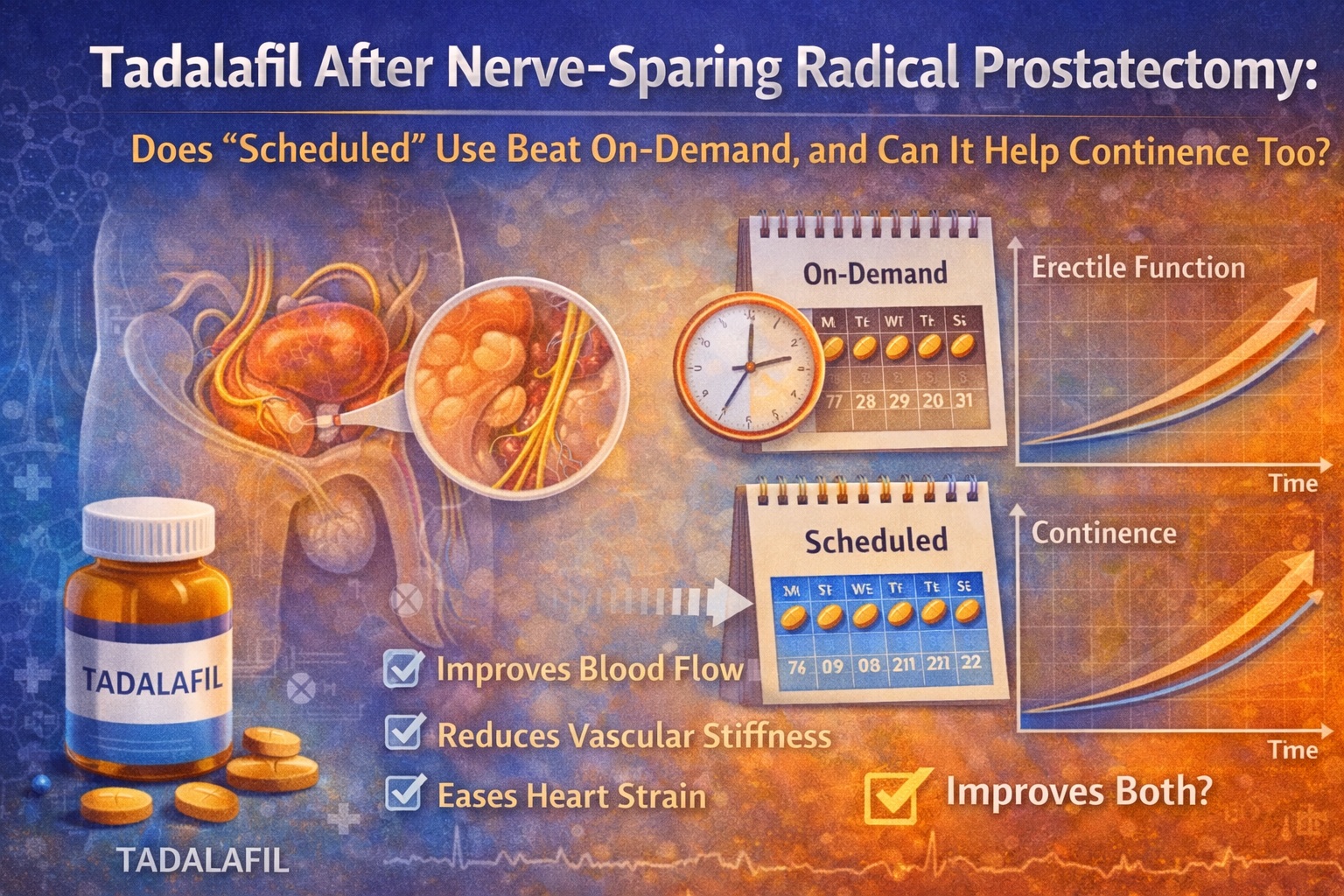
The study behind this article tackles both questions directly by comparing tadalafil 20 mg three times per week versus tadalafil 20 mg on-demand in men undergoing BNSRP, with a control group receiving no PDE5 inhibitor. The headline is simple: scheduled tadalafil improved erectile function at 12 months more than on-demand or no tadalafil, but it did not improve continence recovery. The details, however, are where the real clinical value lies.
The Clinical Problem After BNSRP: Two Recoveries, Two Different Biological Timelines
Post-prostatectomy ED is not merely “psychological” or “inconvenient.” After BNSRP, erectile dysfunction is typically driven by neuropraxia of the cavernous nerves, endothelial dysfunction, reduced nitric oxide signaling, and secondary changes within the corpora cavernosa—particularly hypoxia-related smooth muscle loss and collagen deposition. The result is a functional deficit that may improve slowly, often over 6–24 months, and not always fully. When recovery stalls, patients can shift from hopeful to resigned—sometimes within a single follow-up visit.
Urinary incontinence after RP is biologically and mechanically different. Continence depends on the external sphincter complex, urethral length, pelvic floor control, and the integrity of the bladder neck and supportive tissues. Early after catheter removal, UI can be common. Over time, pelvic floor strengthening and tissue healing improve control in many men, but a meaningful subset continues to struggle. Importantly, continence recovery can be strongly influenced by surgical details and patient behavior, sometimes more than by any pharmacologic strategy.
One of the seductive clinical assumptions is that sexual and urinary recovery are linked: “If nerves recover, both improve.” Some studies have hinted at correlations; others have not. This trial explicitly tested whether ED and UI are correlated in this postoperative context—and found no correlation at 6 weeks or 12 months. Clinically, that matters. It suggests that you should not promise a patient that improving erections will “bring back continence,” or that poor continence predicts permanent ED. They may travel together for some men, but they are not reliably married.
And then there is the practical question patients rarely phrase politely: “Doctor, do I really need to take a pill even on days I don’t plan sex?” The answer depends on whether scheduled dosing actually improves long-term recovery rather than simply facilitating intercourse attempts. This study helps move that conversation from opinion to evidence.
Study Design and Patient Selection: Who Was Studied and Why That Matters
This was a single-center, prospective, randomized controlled trial conducted in Turkey. Men with localized prostate cancer underwent retropubic BNSRP, performed by a single surgeon—an important detail, because variability in surgical technique can heavily influence outcomes and can blur treatment effects in multicenter trials. The study enrolled men between 2006 and 2010, with an emphasis on selecting patients where nerve-sparing was oncologically appropriate (low PSA, early stage, favorable biopsy Gleason profile).
Crucially, the study included only men who were preoperatively potent and continent. Those with moderate or severe ED before surgery were excluded. All participants had a stable sexual partner and were able to complete questionnaires. This makes the cohort relatively “clean” and reduces noise in interpretation—if erectile function declines after surgery, the decline is likely surgical in origin rather than baseline disease progression. It also means the results apply best to men who start surgery from a good functional baseline.
Randomization occurred after catheter removal (2 weeks after surgery), and patients were assigned to one of three groups:
- Group 1: tadalafil 20 mg three times per week
- Group 2: tadalafil 20 mg on-demand
- Group 3: no PDE5 inhibitor (control)
All patients were encouraged to resume sexual attempts as soon as possible and were instructed to perform pelvic floor muscle exercises—an important standardization step, because pelvic floor behavior can strongly affect continence outcomes. The medication protocol continued for 12 months in the treated groups.
Baseline comparability was carefully documented: age, PSA, BMI, smoking, alcohol use, and comorbidities (diabetes, hypertension, cardiovascular disease) showed no statistically significant differences among groups. Preoperative symptom scores were also similar: IIEF-6 (erectile function), IPSS (urinary symptoms), ICIQ-SF (incontinence impact—baseline was zero because men were continent), and Beck Depression Index (BDI). This matters because postoperative outcomes can be confounded by mood, vascular disease, and baseline urinary function.
What the Protocol Actually Tested: Scheduled Tadalafil Versus “Sex-Only” Tadalafil
The two tadalafil strategies were not subtle variations; they represent two different philosophies of care.
On-demand dosing is straightforward: take a tablet about an hour before sexual activity. It is practical, familiar, and aligns with the classic “symptomatic treatment” model. Scheduled dosing—here, three times per week—tries to do something more ambitious: maintain repeated pharmacologic support of penile hemodynamics during the recovery period, potentially reducing hypoxic remodeling and improving long-term tissue preservation.
The researchers deliberately chose tadalafil over other PDE5 inhibitors because its longer half-life makes it suitable for rehabilitation-style dosing without requiring daily medication. In other words, it is an attempt to balance “regular exposure” with “acceptable burden.” The scheduled group took tadalafil one hour before bedtime three times weekly; the on-demand group took it one hour before sexual activity.
Both strategies started early—immediately after catheter removal. This is clinically relevant because early post-prostatectomy months are when hypoxia-associated tissue changes may be most active. It also raises a realistic caveat: not every man will develop persistent ED after surgery, and starting medication early means some men receive treatment they might not ultimately need. The authors acknowledge this as a limitation, and it is worth taking seriously when translating results into routine practice.
The study measured outcomes at 6 weeks and 12 months after surgery using validated instruments. Erectile function was assessed using the IIEF-6. Continence status was assessed using the ICIQ-SF, a widely accepted and validated questionnaire. Psychological status was assessed with BDI. This multi-domain assessment is clinically sensible: erectile recovery, continence recovery, and mood are interwoven in real life, even if statistical correlation between ED and UI is absent.
Results: Erectile Function Improved More with Three-Times-Weekly Tadalafil—But Only in the Long Run
At 6 weeks after surgery, erectile function was similarly poor in all three groups. The IIEF-6 scores were roughly comparable (about 15 in each group), and there was no significant difference. This is a point clinicians should remember: early after prostatectomy, nerve recovery is still in its infancy. A patient asking at 6 weeks whether the rehabilitation plan “worked” is essentially asking if a broken bone healed while still in the cast.
At 12 months, the picture changed. The IIEF-6 score was significantly higher in the scheduled tadalafil group (Group 1) compared with both the on-demand group (Group 2) and controls (Group 3). Mean IIEF-6 at 12 months was approximately:
- Group 1: 19.89 ± 5.90
- Group 2: 15.8 ± 6.97
- Group 3: 13.47 ± 5.66
The difference reached statistical significance (p = 0.011). Importantly, Group 2 did not differ significantly from controls at 12 months. That finding is clinically provocative: it implies that merely enabling sexual attempts with on-demand tadalafil does not necessarily improve long-term erectile recovery, whereas scheduled use may offer a rehabilitation advantage.
The result does not mean that on-demand tadalafil is “useless.” It can still support intercourse attempts, reduce performance anxiety, and improve quality of life in the short term. But if the goal is long-term functional recovery after BNSRP, this study suggests that scheduled tadalafil (at least in this three-times-weekly format) may be more effective than on-demand alone.
There is a subtle irony here: many men prefer medication only when needed, yet the approach that appears to help recovery is the one that asks for consistent dosing when sex is not necessarily planned. Biology does not always accommodate convenience.
Continence Outcomes: No Long-Term Benefit, and an Unexpected Early Signal
The continence results were clear at the 12-month endpoint: tadalafil—whether scheduled or on-demand—did not improve continence recovery compared with controls. ICIQ-SF scores at 12 months did not differ significantly among groups. This aligns with the authors’ conclusion that evidence is insufficient to recommend PDE5 inhibitors as a continence rehabilitation strategy after BNSRP.
However, at 6 weeks there was a surprising finding: the scheduled tadalafil group had worse incontinence scores than the other groups. Specifically, Group 1 had a significantly higher ICIQ-SF score at 6 weeks (p = 0.006). The authors state they could not explain this with a clear pathophysiological mechanism.
How should a clinician interpret this? Carefully. Early postoperative continence is influenced by edema, healing dynamics, pelvic floor coordination, and behavior. A transient difference might reflect chance, differences in early activity patterns, or subtle variations in reporting rather than a true pharmacologic effect. The study was not designed primarily to detect early continence harms, and there is no mechanistic consensus that tadalafil should worsen continence. Still, the signal is worth remembering: if a patient on early scheduled tadalafil reports bothersome leakage, do not dismiss it as unrelated, but also do not panic—because the difference disappeared by 12 months.
Perhaps the more robust message is that continence recovery remains primarily a function of surgical technique, pelvic floor rehabilitation, and time. PDE5 inhibition may influence smooth muscle biology in lower urinary tissues, but in this trial that influence did not translate into clinically meaningful continence benefits by one year.
ED and Incontinence: The Study Finds No Correlation—Why This Is Clinically Useful
One of the quieter but more useful outcomes is the finding that ED and UI were not correlated at either follow-up point. This matters for counseling. Patients often experience these complications together and assume they share a single cause. They may also catastrophize: “If I still leak, I’ll never recover erections,” or the reverse.
This study suggests that, at least in the setting of BNSRP and within the measured timeframe, ED recovery and continence recovery behave independently. That is consistent with the idea that continence depends more on sphincter integrity and pelvic floor control, while erectile recovery depends more on neurovascular integrity and corporal tissue health.
The psychological implication is also relevant: a man struggling with leakage may avoid sexual activity, which can worsen confidence and reduce sexual rehabilitation attempts. That behavioral link can look like a physiologic correlation, but it is not the same thing. Clinically, separating these concepts can reduce anxiety and improve adherence to rehabilitation plans.
Finally, the authors assessed depression (BDI) and found no significant differences among groups. That helps reduce concern that group differences in erectile outcomes were simply mood-related reporting artifacts. It does not eliminate placebo effects, but it improves interpretability.
Safety and Tolerability: What Adverse Events Look Like in Real Patients
Both tadalafil regimens were well tolerated. No participant stopped medication due to adverse events, and reported side effects were typical for PDE5 inhibitors: flushing, headache, dizziness, and dyspepsia. Headache and flushing were most common. The adverse event profile did not differ significantly between the two tadalafil groups.
From a practical standpoint, this is reassuring. A three-times-weekly regimen at 20 mg is not a trivial dose, and clinicians may worry about tolerability in older men with comorbidities. The study’s population had a mean age around 63 and included men with cardiovascular conditions and metabolic risk factors, yet tolerability remained acceptable.
Still, “well tolerated in a trial” does not always translate to “well tolerated in daily practice,” where adherence, expectations, and concurrent medications vary. The important takeaway is that scheduled dosing did not introduce an obvious safety penalty compared to on-demand dosing—at least over one year in this selected population.
Interpreting the Study Honestly: Strengths, Limitations, and What It Means for Practice
The study has several strengths: it is prospective and randomized, includes a control group, uses validated questionnaires, and has a 12-month follow-up. It also benefits from surgical consistency (one surgeon), which reduces technique-related variability.
The limitations are also important. It is single-center and lacks a placebo arm; patients knew whether they were taking tadalafil, and that knowledge can influence reporting and sexual behavior. Starting tadalafil immediately after catheter removal means some men may have received therapy despite not developing long-term ED, potentially diluting measured effects. Dropout occurred (8 in the scheduled group, 4 in on-demand, 5 in control), and although discontinuation rates were not extreme, attrition can bias outcomes.
There is also a conceptual limitation: IIEF-6 is a clinically useful measure, but it does not capture all aspects of sexual function (desire, orgasmic function, partner factors). Nor does the study incorporate objective penile hemodynamic testing. For continence, questionnaires are appropriate and validated, but urodynamic studies could have clarified mechanisms. The authors explicitly note the lack of placebo and acknowledge the trial duration and early initiation strategy as limitations.
So what should clinicians do with this? The reasonable application is not to declare scheduled tadalafil the universal standard, but to recognize a credible signal: tadalafil 20 mg three times weekly may provide superior long-term erectile recovery after BNSRP compared with on-demand use. Meanwhile, do not sell tadalafil as a continence therapy; the evidence here does not support that claim.
Practical Guidance: How to Translate These Findings into Patient-Centered Care
A postoperative rehabilitation plan should be framed as a time-limited, goal-driven strategy rather than an endless prescription. Patients tolerate inconvenience better when they understand the purpose. Scheduled dosing can be presented as a “tissue support program” during nerve recovery rather than as a demand for constant medication.
Clinicians should also normalize the early timeline: lack of difference at 6 weeks is expected; meaningful differences appear later. This helps prevent early discouragement and premature abandonment of rehabilitation. Encouraging early sexual attempts, as the trial did, is not about immediate performance—it is about maintaining sexual engagement, reducing avoidance, and supporting neurovascular retraining.
For continence, pelvic floor exercises remain foundational. If a patient asks whether tadalafil will help leakage, a blunt but humane answer is best: “It helps erections for many men after this surgery, but it has not been shown to reliably speed continence recovery.” That clarity builds trust.
And yes, a little controlled irony is sometimes useful in the clinic: the prostate can be removed with precision, the cancer can be controlled, and yet the recovery of sexual and urinary function may still proceed at the speed of biology—slow, nonlinear, and indifferent to our scheduling preferences.
FAQ
1) After nerve-sparing radical prostatectomy, is scheduled tadalafil better than on-demand?
In this randomized trial, tadalafil 20 mg three times per week produced a significantly higher erectile function score at 12 months than tadalafil used on-demand or no PDE5 inhibitor. No difference was seen at 6 weeks.
2) Can tadalafil help urinary continence recovery after prostatectomy?
Not based on this study. At 12 months, continence outcomes (ICIQ-SF) did not differ between tadalafil groups and controls. There was also no correlation between continence and erectile function recovery.
3) Is three-times-weekly tadalafil safe after prostatectomy?
In this study, both tadalafil regimens were well tolerated, and no patients stopped medication due to adverse events. Reported side effects were typical (headache, flushing, dizziness, dyspepsia).
