

Erectile dysfunction (ED) is often described in textbooks with neat definitions, but in real clinics it behaves like a chronic condition with mood swings. A patient may do “fine” for months, then relapse after stress, vascular progression, or simply aging doing what aging does. Clinicians and developers of ED therapies share the same frustration: many interventions work—until they don’t. The practical question is not only whether erectile function improves, but how long the improvement remains meaningful in daily life.
Phosphodiesterase type 5 inhibitors (PDE5i) remain first-line therapy because they are effective, widely available, and familiar. Yet their limitations are well known: on-demand dosing can reduce spontaneity, adverse effects lead to discontinuation, and the benefit is often palliative rather than disease-modifying. Meanwhile, invasive options such as injections or prostheses can be highly effective but are not exactly what most men hope to discuss at an early visit. This gap has driven interest in restorative approaches—interventions that aim to improve underlying penile vascular and tissue biology, not just temporarily enhance hemodynamics.
Low-intensity extracorporeal shock wave therapy (Li-ESWT) entered this space with an attractive promise: a noninvasive office-based intervention that may promote angiogenesis and improve erectile function beyond the dosing window of a pill. Meta-analyses and guideline discussions have supported its role, particularly for vasculogenic ED, and European guidance has included Li-ESWT as a first-line option in selected patients. But there is a recurring clinical theme: the effect may fade over time, and the literature has not always agreed on how durable the benefit is at one year.
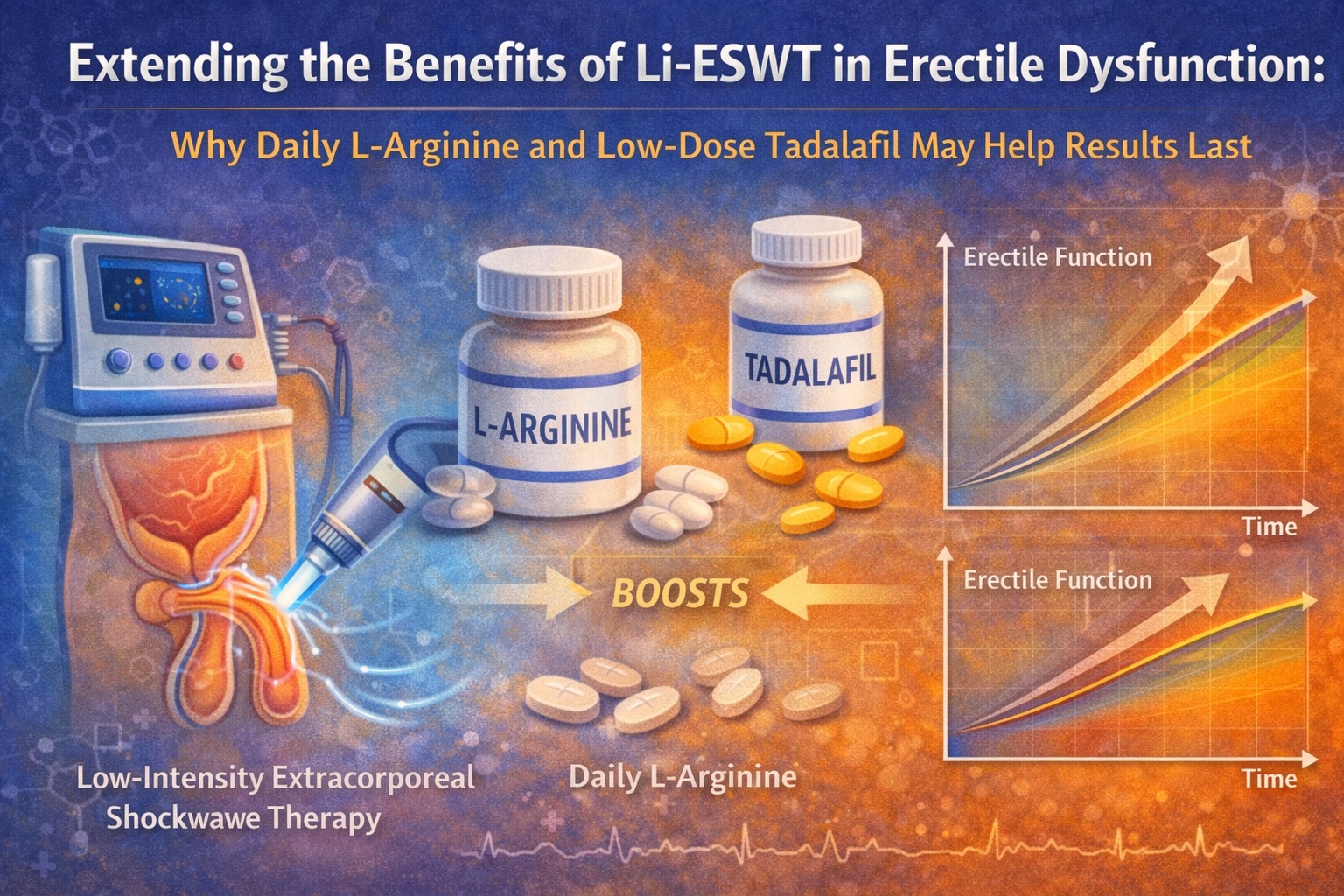
The study behind this article asked a pragmatic, clinician-minded question: can we make Li-ESWT work better and last longer by combining it with a simple daily oral regimen—L-arginine 2,500 mg plus tadalafil 5 mg—without sacrificing safety? It is not a philosophical question. It is the kind of question that determines whether a man returns for follow-up smiling or returns disappointed, claiming the therapy “stopped working.”
The Clinical Logic: Why Combine a Regenerative Signal with Daily Pharmacologic Support?
Li-ESWT is not “magic vibrations.” It is a mechanical stimulus that appears to trigger biologic responses relevant to erectile function—particularly angiogenic pathways and endothelial signaling. A central concept is that shock waves may upregulate nitric oxide synthase (NOS) activity and promote vascular remodeling, thereby improving penile blood flow and endothelial function over time rather than only acutely. If that premise is even partly true, then Li-ESWT resembles a rehabilitation stimulus: it initiates repair signals, but the tissue still needs the right biochemical environment to capitalize on those signals.
This is where the combination strategy becomes intellectually tidy. Nitric oxide (NO) production depends on substrate availability—L-arginine is the precursor used by NOS enzymes. In the study’s discussion, the authors outline the mechanistic rationale: Li-ESWT may activate and upregulate endothelial NOS (eNOS) and neuronal NOS (nNOS), and both rely on L-arginine to generate NO. At the same time, shock waves can increase cyclic guanosine monophosphate (cGMP), the second messenger mediating smooth muscle relaxation; tadalafil prevents cGMP degradation through PDE5 inhibition. In simplified terms: shock waves may push the accelerator on vascular signaling, arginine supplies the fuel for NO production, and tadalafil keeps the cGMP signal from leaking away.
There is also a behavioral logic—often underappreciated in “mechanism-first” writing. Many men prefer oral therapy because it is easy, predictable, and private. Li-ESWT requires appointments, motivation, and patience. A combined approach can provide early functional improvement and confidence while the slower biologic effects of Li-ESWT develop. The protocol in this trial was designed to gradually step away from dependence on oral therapy, not to lock patients into pills forever: tadalafil was prescribed for three months, L-arginine for six months, while Li-ESWT was delivered over six weekly sessions. That staging is clinically strategic: it supports function during the months when regenerative effects may still be stabilizing.
Study Design in Plain Medical English: What Was Done and Why It Matters
This was a prospective, randomized, single-blinded trial conducted in two Italian centers specializing in male sexual dysfunction. Men with ED were assessed at baseline with two established patient-reported instruments: the International Index of Erectile Function—Erectile Function domain (IIEF-EF) and the Erection Hardness Score (EHS). Participants were then randomized 1:1 into two arms: Li-ESWT alone (control) versus Li-ESWT plus daily tadalafil and L-arginine (treatment).
Importantly, the study targeted a population where a restorative approach is most plausible: mild to moderate ED. Inclusion required an IIEF-EF score of 18–25 (mild) or 11–17 (moderate), at least three months of ED, stable relationship, and a washout from erectogenic aids. The exclusion criteria were extensive and clinically sensible, removing severe ED, significant systemic vascular disease, endocrine disorders, neuropathy, Peyronie disease, major psychiatric disorders, and multiple medication classes that could confound erectile function. This selection makes the cohort more “clean,” but also means conclusions apply mainly to men without major complicating pathology.
Follow-up was performed at 1, 6, and 12 months after the final shock wave session. To reduce bias, follow-up assessments were conducted by a second investigator blinded to group allocation. Outcomes were changes in IIEF-EF and EHS from baseline, and the proportion reaching a minimal clinically important difference (MCID)—defined as +2 points for mild ED and +5 points for moderate ED. This MCID framing is clinically valuable because it connects score changes to meaningful patient experience rather than “statistical significance that nobody feels.”
The Protocol Details: Li-ESWT Delivery and the Oral Adjuvant Regimen
The Li-ESWT protocol was consistent and clearly described. All participants received six weekly sessions using a focused electromagnetic shock wave generator (Duolith SD1 T-TOP, Storz Medical). Each session delivered 3,000 shock waves at an energy density of 0.25 mJ/mm² and frequency 4 Hz, lasting approximately 15 minutes, performed as an outpatient procedure without anesthesia. The penis was divided into six treatment zones—shaft base and distal regions bilaterally, plus the right and left crura—so that shock waves were distributed homogeneously rather than concentrated in a single area.
The adjuvant oral regimen was deliberately structured in duration: participants in the combination arm began oral therapy with the first Li-ESWT session, taking tadalafil 5 mg daily for three months and L-arginine 2,500 mg daily for six months. Participants in the control arm were asked not to use PDE5 inhibitors during the study. This is important because it reduces contamination of the control group and makes outcome differences more interpretable, though it also creates a real-world limitation—many men outside trials will not happily forgo rescue therapy.
From a practical perspective, the dosing choices are noteworthy. Tadalafil 5 mg daily is widely used in chronic ED management and has data suggesting endothelial benefits that may persist after discontinuation. The L-arginine dose (2,500 mg daily) is within commonly used supplemental ranges and aligns with prior work suggesting synergy between PDE5 inhibitors and arginine. The study’s design therefore combines a regenerative intervention with two relatively accessible pharmacologic supports—an approach likely to be reproducible in many real practices.
Key inclusion and exclusion highlights from the trial (clinically useful for patient selection):
- Included: adult men (≥18) with mild or moderate ED, stable relationship, active heterosexual life desired, and washout from erectogenic aids
- Excluded: severe ED, significant renal/hepatic/cardiovascular/cerebrovascular disease, neuropathy, endocrine disease, prior pelvic surgery, Peyronie disease, major psychiatric disorders, substance abuse, and contraindicated medications (e.g., nitrates)
Outcomes That Matter: IIEF-EF, EHS, and the Durability Question
The results tell a consistent story: both groups improved, but the combination group improved more and maintained benefits better over time. Baseline erectile function was similar between groups (mean IIEF-EF ~16 in both arms). At one month, the combination group reached a mean IIEF-EF of 24.8 ± 3.4, compared with 22.7 ± 4.2 in the Li-ESWT-only group. At six months, scores were 23.3 ± 4.6 versus 21.5 ± 4.5. At twelve months, 21.6 ± 5.5 versus 19.5 ± 4.9—showing decline from the one-month peak in both groups, but a higher plateau with adjuvant therapy. Statistical comparisons favored the combination arm at multiple timepoints.
EHS results echoed the same pattern. The combination group increased from 2.07 ± 0.72 at baseline to 3.39 ± 0.59 at one month, 3.17 ± 0.67 at six months, and 2.98 ± 0.72 at twelve months. The control group improved from 2.12 ± 0.80 to 3.07 ± 0.78 at one month and 2.95 ± 0.76 at six months, with a lower value reported at twelve months (2.76 ± 0.73) in the results table. In practical language: both groups moved toward “more reliable hardness,” but the combination arm stayed closer to EHS ~3 over a year.
The MCID analysis is where the clinical meaning becomes sharper. At one month, 100% of men in the combination group reached MCID versus 88.1% in the control group. At six months: 87.8% versus 76.2%. At one year: 75.6% versus 66.7%. Those numbers suggest not only a higher response rate but also a better durability profile. Importantly, “durability” here does not mean the benefit is unchanged—both groups decline from their peak—but rather that more men remain above a clinically meaningful improvement threshold at twelve months with adjunct therapy.
Subgroup Signals: Age, Severity, and Who Might Benefit Most
The authors stratified outcomes by ED severity (mild vs moderate) and age (≤50 vs >50). These subgroup analyses are always a double-edged sword—clinically tempting, statistically fragile—yet they can still guide hypotheses and patient counseling.
For mild ED, both groups performed very well, with high MCID rates across timepoints. Mean IIEF-EF improvements were strong in both arms, but the combination group showed higher scores at later follow-ups, including at twelve months (mean IIEF-EF 25.8 ± 2.0 vs 23.2 ± 1.1 in controls). In other words, if you start with mild ED, Li-ESWT already has a good chance of meaningful benefit, but adjunct therapy may help preserve that advantage and reduce drift back toward baseline.
For moderate ED, the pattern favored combination therapy even more clearly early on. The combination group had higher IIEF-EF and EHS at one and six months, while twelve-month differences were less consistently significant. This may reflect a biological reality: moderate ED often has deeper vascular or neurogenic contributors, so “regenerative plus support” helps, but the disease still pushes back over time. It also may reflect sample size limits—subgroups shrink quickly, and statistical power evaporates faster than optimism at a follow-up visit.
Age effects were also consistent with broader ED literature: younger men tended to show better and more durable responses. In older men (>50), improvements persisted but were smaller. The study notes that in the control group older than 50, the twelve-month improvement was less pronounced. This matters in counseling: a 42-year-old with mild vasculogenic ED is a different therapeutic creature than a 68-year-old with multiple cardiovascular risk factors, even if their baseline IIEF-EF scores look similar.
Safety, Tolerability, and the Real-World Problem of Motivation
The combination regimen was reported as safe, with a low incidence of minor adverse events. During Li-ESWT, some patients experienced a stinging sensation—especially in the perineal region when treating the crura—but energy reduction was not required, and treatment discontinuation for Li-ESWT discomfort did not occur. One patient in the oral-therapy group discontinued due to myalgia, which is a recognized PDE5 inhibitor-associated complaint in some individuals.
Safety is only half the story. The other half is adherence—an outcome rarely treated as “medical,” though it often determines success more than physiology. The study’s CONSORT flow diagram and recruitment data reveal a key barrier: patient motivation. Out of 238 assessed men, 94 declined participation due to cost, time constraints, poor motivation, distance, or satisfaction with oral therapy. Even among randomized patients, several discontinued for similar reasons. This is not a trivial footnote; it is a clinical reality that can quietly destroy the effectiveness of any office-based regimen.
There is a mild irony here that deserves respectful mention: many men want a “curative” solution, but they also want it to be as effortless as taking a pill. Li-ESWT asks for weekly visits, patience, and sustained engagement. Oral therapy asks for much less. A combined protocol may therefore serve a psychological function—providing early improvement and reinforcing the perception that the time investment is worthwhile—thereby indirectly improving adherence and long-term outcomes.
Interpreting the Evidence: What This Trial Suggests—and What It Cannot Prove
This study provides a credible signal that daily L-arginine (2,500 mg) plus tadalafil (5 mg) as adjunct therapy can enhance both the magnitude and duration of Li-ESWT benefits for mild-to-moderate ED over a one-year horizon. The design is prospective, randomized, and single-blinded at follow-up, which strengthens internal validity compared with uncontrolled series. Outcome measures (IIEF-EF, EHS, MCID) are clinically familiar and meaningful.
At the same time, careful readers should resist the urge to call this “definitive.” The trial did not include a sham placebo Li-ESWT group, which limits the ability to separate true physiological benefit from expectancy effects—especially early after treatment. The endpoints are questionnaire-based rather than hemodynamic measures (e.g., penile Doppler parameters), which would have provided mechanistic reinforcement. The analysis set included 41 and 42 patients per group after exclusions, a respectable but not large sample when exploring subgroup effects.
Clinically, the results are still useful because the question asked is practical: “How do we make Li-ESWT benefits last longer?” Even if part of the improvement includes placebo contribution, durability at twelve months in a symptomatic condition is not trivial. The more important interpretation is not that “arginine and tadalafil cure ED,” but that supporting the NO–cGMP pathway during and after Li-ESWT may help sustain functional gains, particularly in patients with milder disease and younger age.
Practical Clinical Takeaways: Turning Data into a Treatment Conversation
If you are considering a combined approach in real practice, patient framing matters. The best candidates resemble the study population: mild to moderate ED, motivated for a restorative option, and without major contraindications to tadalafil. A clinician should also be honest about the time-course: improvement can be strong early, but effects may soften over time. The advantage of adjunct therapy is not immortality of benefit, but a higher and longer-lasting plateau.
The regimen timing used in the trial is clinically rational: tadalafil daily for three months and L-arginine for six months. This creates a taper-like transition where pharmacologic support is strongest during the period when Li-ESWT’s biologic remodeling is expected to consolidate. Patients often appreciate structured plans: not “take this forever,” but “take it for a defined period to support the response.”
Two counseling points can prevent disappointment. First, remind patients that ED is often a marker of systemic vascular health; lifestyle modification and cardiovascular risk management are not optional background noise. Second, clarify that “spontaneity” is not a switch flipped by technology—spontaneity returns when function becomes reliable enough that the patient stops anticipating failure. Combined strategies may accelerate that psychological shift, which can itself reinforce sexual function.
Clinically actionable themes suggested by the trial:
- Expect improvement after Li-ESWT, but plan for gradual decline over a year; adjunct therapy may slow that decline and improve durability
- Best responses tend to occur in mild ED and younger men; set expectations accordingly in older or moderate ED patients
Conclusion: A Simple Adjunct Strategy That Targets Durability, Not Just Response
Li-ESWT is appealing because it aims beyond temporary symptom control. Yet the one-year question has remained the awkward part of the story: does benefit persist, and can we help it persist? In this randomized, single-blinded follow-up study, adding daily L-arginine 2,500 mg and tadalafil 5 mg improved erectile function outcomes and helped maintain benefits longer compared with Li-ESWT alone, with an acceptable safety profile.
The clinical message is not that pills replace shock waves or that shock waves make pills obsolete. The message is more practical: ED is multifactorial, and durable improvement may require a multimodal plan that supports endothelial biology while functional confidence is rebuilt.
If you want a single sentence to bring into the clinic: Li-ESWT may start the remodeling process, and daily NO–cGMP pathway support may help the patient stay in the “improved” zone long enough for that remodeling to matter.
FAQ
1) Is Li-ESWT effective on its own, or is adjunct therapy necessary?
Li-ESWT alone improved IIEF-EF and EHS scores in this study, but the combination with daily tadalafil and L-arginine produced greater improvements at several follow-up points and tended to preserve benefits better at one year.
2) How long should tadalafil and L-arginine be continued in a combined protocol?
In this trial, tadalafil 5 mg daily was used for 3 months and L-arginine 2,500 mg daily for 6 months, starting with the first Li-ESWT session. This staged duration was intended to support early response and extend durability while gradually moving toward more spontaneous function.
3) Who is most likely to benefit from this combined strategy?
Men with mild to moderate ED, especially younger patients, tended to have better and more durable responses. Severe ED and patients with major comorbidities were excluded, so results should be applied cautiously outside that profile.
