

Introduction: Oral Drug Absorption Begins with Dissolution, Not with Hope
Oral administration remains the dominant route for drug delivery, not because it is perfect, but because patients tolerate it and regulators understand it. Yet, from a biopharmaceutical perspective, swallowing a tablet is only the beginning of a complex physicochemical journey. A drug must first dissolve in gastrointestinal fluids before it can cross the intestinal membrane and reach systemic circulation. No dissolution, no absorption — pharmacology cannot rescue poor physics.
This is why solubility is not merely a laboratory parameter but a clinical determinant of exposure, variability, and therapeutic reliability. The Biopharmaceutics Classification System (BCS) and its more development-focused successor, the Developability Classification System (DCS), both place solubility at the center of decision-making in formulation strategy, bioequivalence assessment, and even regulatory waivers. Yet, despite this central role, what we often call “intestinal solubility” is typically measured in simplified buffers or single simulated media, producing a neat number that looks precise and feels comforting — and is often misleading.
Human intestinal fluid (HIF) is not a fixed recipe. It is a dynamic, multicomponent system with substantial inter- and intra-individual variability. Bile salts, phospholipids, fatty acids, cholesterol, and pH fluctuate depending on physiology, circadian rhythms, and nutritional status. Expecting one artificial medium to represent this biological diversity is optimistic at best and scientifically risky at worst.
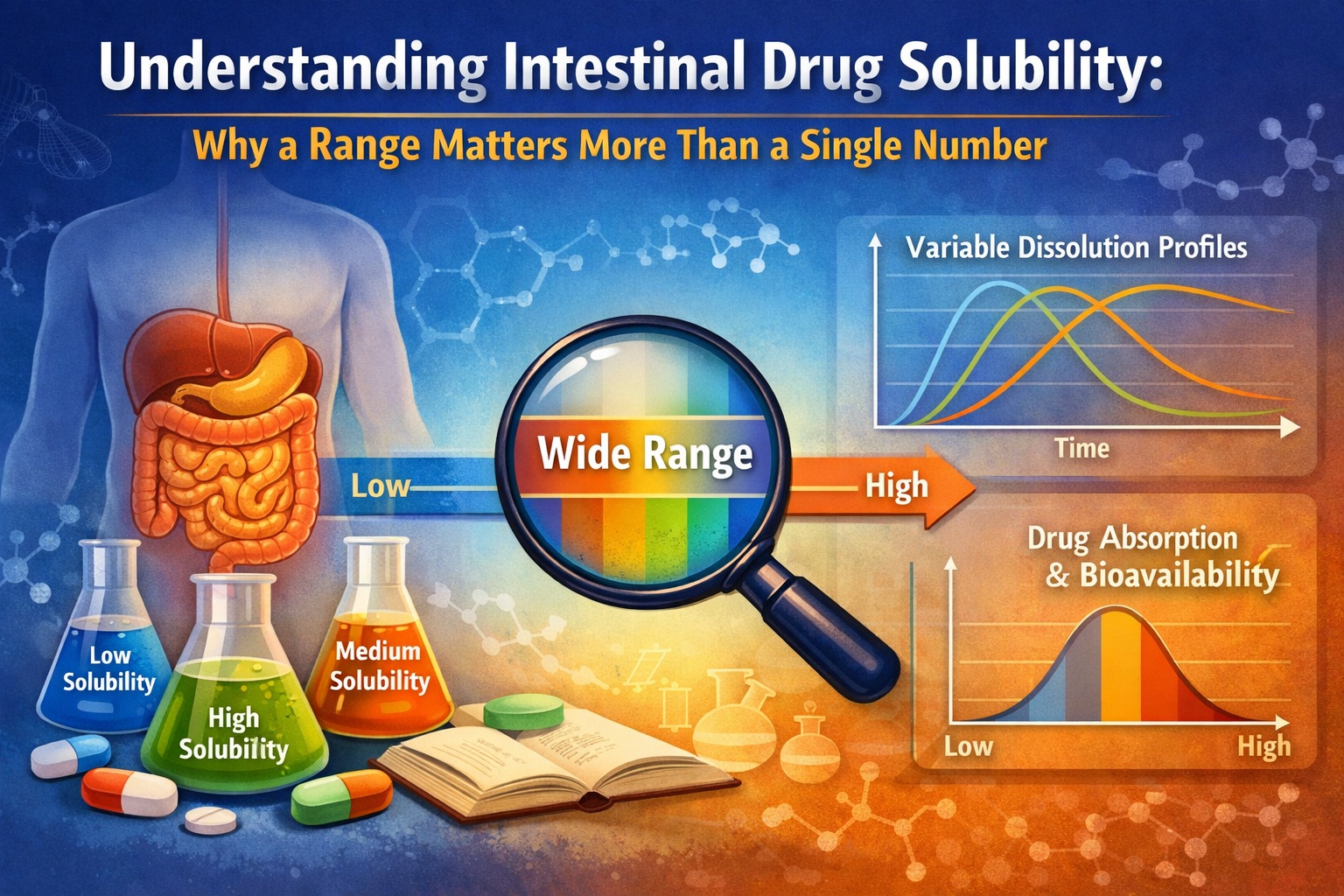
The study underlying this article challenges a deeply rooted habit in pharmaceutical sciences: reporting solubility as a single value. Instead, it proposes that intestinal solubility should be understood as a bioequivalent range, reflecting the physiological envelope in which a drug must perform. This shift is not merely semantic; it changes how we interpret risk, design formulations, and predict in vivo behavior.
Why Human Intestinal Fluid Is Both the Gold Standard and a Practical Nightmare
From a purist’s standpoint, the most accurate way to measure intestinal solubility is to use aspirated human intestinal fluid. This approach captures the true chemical environment that a drug encounters in vivo, including mixed micelles, endogenous surfactants, and physiological ionic strength. Unfortunately, accuracy comes at a steep logistical and ethical price.
Collecting HIF requires invasive intubation, precise catheter positioning in the small intestine, and prolonged aspiration under fasting conditions. Volunteers must tolerate uncomfortable procedures, and the volumes obtained are small, variable, and biologically unstable. Samples must be frozen quickly to preserve composition, and even then, enzymatic and oxidative changes are difficult to fully prevent.
Beyond logistics, variability becomes the dominant feature. Two samples taken from different individuals — or even from the same individual at different times — may differ substantially in bile salt concentration, lipid composition, and pH. Consequently, solubility values measured in HIF are not only difficult to reproduce but also difficult to interpret as representative of a broader population.
From a development perspective, this creates a paradox. We want physiologically relevant data, but we also need reproducibility, scalability, and reasonable cost. For routine formulation screening or regulatory documentation, direct use of HIF is simply not practical.
This tension is what drove the development of simulated intestinal fluids (SIF), designed to mimic key features of HIF while remaining controllable and reproducible. But as with all simulations, the critical question is not whether they are realistic, but how realistic — and in which dimensions.
Simulated Intestinal Fluids and the Illusion of a Perfect Recipe
Over the past decades, multiple SIF recipes have been proposed, each with different combinations of bile salts, phospholipids, buffer systems, ionic strength, and sometimes enzymes or fatty acids. Well-known examples such as FaSSIF (fasted-state simulated intestinal fluid) have become quasi-standard in dissolution testing and preformulation studies.
However, the literature reveals an inconvenient truth: different SIF compositions can yield markedly different solubility values for the same drug. This is not a minor technical detail; it directly affects classification under BCS or DCS frameworks and may influence regulatory decisions.
Design of Experiment (DoE) approaches were introduced to address this problem systematically. By varying multiple media components simultaneously and applying statistical models, researchers could identify which factors — pH, bile salt concentration, phospholipid levels, fatty acids — most strongly influenced solubility for different classes of drugs. These studies were scientifically elegant and highly informative.
Yet, DoE methods have their own limitations. They are experimentally intensive, often requiring dozens of solubility measurements per drug. More importantly, they deliberately explore extreme and sometimes physiologically unlikely combinations of media components, because statistical efficiency demands orthogonality, not biological realism.
In other words, DoE maps the mathematical response surface of solubility, but not necessarily the biological distribution of intestinal environments. High bile salt with low phospholipid, or vice versa, may be statistically useful but physiologically rare. This disconnect raises a fundamental question: are we measuring what the intestine actually does, or what our experimental design allows it to do?
The answer, increasingly, is that we need a method grounded in real HIF composition, not just in theoretical factor spaces.
A Multidimensional View of Intestinal Fluid: From Recipes to Physiological Space
The conceptual breakthrough behind the bioequivalent approach is deceptively simple: instead of designing media compositions statistically, derive them from actual human intestinal fluid data using multidimensional analysis.
In this framework, HIF is treated as a system defined by several continuous variables — notably pH, bile salt concentration, phospholipid concentration, fatty acid levels, and cholesterol. Each HIF sample becomes a point in a five-dimensional space. By analyzing the distribution of these points, it becomes possible to identify clusters and representative compositions that collectively capture most of the observed physiological variability.
Using this method, researchers identified a limited number of SIF compositions that together represent more than 90% of the variability seen in fasted-state HIF samples. These are not statistical extremes but bioequivalent points, each corresponding to a realistic intestinal environment.
A center point is also defined, not as a simple arithmetic mean of components, but as a multidimensional centroid that respects the actual distribution of physiological data. This distinction matters, because component distributions in HIF are not normal, and averaging individual parameters can produce combinations that rarely occur in vivo.
The practical outcome is powerful: instead of running 60 or more DoE experiments, one can assess equilibrium solubility in nine carefully selected media, each biologically plausible and collectively representative of the fasted intestinal environment.
This strategy does not aim to explain solubilization mechanisms in mechanistic detail. Its goal is different and arguably more pragmatic: to define the realistic solubility envelope within which a drug is likely to operate in patients.
Measuring Solubility as a Distribution, Not a Point
When equilibrium solubility of multiple drugs was measured across these bioequivalent media, several important patterns emerged.
First, the overall solubility ranges were statistically comparable to those obtained from large DoE studies and consistent with literature values from both HIF and conventional SIF media. This confirms that the bioequivalent approach does not underestimate or distort the solubility landscape. It measures essentially the same “space” — but with fewer experiments and greater physiological relevance.
Second, the total variability in solubility was often smaller than that observed in DoE studies. This is not a methodological artifact but a biological insight. By excluding unrealistic combinations of media components, the method avoids artificial amplification of variability that would rarely occur in vivo.
Third, and perhaps most intriguing, some drugs exhibited remarkably narrow solubility ranges across all bioequivalent media. This behavior was seen in chemically diverse compounds, including acidic, basic, and neutral molecules, suggesting that molecular structure — not just ionization state — can constrain solubilization capacity in intestinal fluids.
This finding challenges a common assumption: that changing bile salt or phospholipid concentration will always meaningfully shift solubility. For certain molecular architectures, micellar solubilization appears to reach a plateau quickly, beyond which additional amphiphiles offer little benefit.
Such insights are invisible in single-medium testing and easily obscured in broad DoE factor spaces. Only by examining solubility as a distribution can these patterns become visible.
What Actually Drives Solubility in Bioequivalent Media
Although the bioequivalent method is not designed to replace mechanistic DoE studies, it is still possible to analyze which media factors correlate most strongly with solubility changes within the physiological range.
For acidic drugs, pH remains the dominant determinant, as expected. When ionization changes across the physiological pH window, aqueous solubility increases dramatically, and micellar effects become secondary. This is classical physical chemistry behaving exactly as textbooks promise — a rare but pleasant occurrence.
For neutral and basic compounds, lipidic components such as phospholipids and fatty acids often play a larger role. However, their influence is not universal. Some drugs respond strongly to changes in lecithin concentration, while others show minimal sensitivity, even when bile salt levels vary substantially.
Importantly, because bioequivalent media are not statistically orthogonal, this approach cannot reliably quantify interactions between factors. It answers a different question: within realistic intestinal environments, which components appear to matter most for a given drug?
If the objective is to design solubilizing formulations or lipid-based delivery systems, formal DoE remains indispensable. But if the goal is to estimate in vivo-relevant solubility limits, the bioequivalent approach is more aligned with clinical reality.
In practical terms, this distinction matters. Mechanistic understanding supports innovation; physiological realism supports prediction. Drug development needs both, but not always in the same experiment.
Why Intestinal Solubility Should Be Treated as a Range in Drug Development
From a regulatory and formulation standpoint, the idea that solubility is a range rather than a constant has far-reaching implications.
First, classification under BCS and DCS frameworks may depend on which end of the solubility spectrum is considered. A drug that appears dose-soluble in one medium may fail that criterion in another physiologically plausible medium. Treating solubility as a distribution allows developers to assess risk more realistically, rather than relying on optimistic or pessimistic single values.
Second, dissolution testing becomes more meaningful when media variability is acknowledged. A formulation that performs well across a range of bioequivalent conditions is more likely to be robust in diverse patient populations, including those with altered bile secretion or intestinal pH.
Third, in silico absorption models benefit from solubility inputs that reflect biological variability. Feeding such models with single deterministic values can produce deceptively precise predictions that fail when confronted with real-world heterogeneity.
Finally, from a scientific standpoint, accepting variability as intrinsic rather than as experimental noise encourages better mechanistic hypotheses. Instead of asking why solubility is inconsistent, we begin to ask why it is sometimes surprisingly consistent — and what molecular features confer that stability.
In short, moving from points to ranges is not a complication. It is an upgrade in biological honesty.
Practical Advantages of the Bioequivalent Small-Scale Method
Beyond conceptual elegance, the method offers several pragmatic benefits that are difficult to ignore in modern pharmaceutical development environments.
- It dramatically reduces experimental burden, making multi-media solubility testing feasible even in early discovery phases where compound availability is limited.
- It is reproducible, because media compositions are well defined and not dependent on biological sampling.
- It remains grounded in real physiology, unlike purely statistical or arbitrary media designs.
Perhaps most importantly, it encourages scientists to think probabilistically rather than deterministically about solubility. Instead of asking “What is the solubility?”, we begin to ask “Within what physiological window does this drug remain soluble enough to be absorbed?”
That is a question formulation scientists, pharmacokineticists, and regulators can all agree is worth answering.
Limitations and What This Method Is Not Meant to Do
No method, however elegant, should be asked to solve problems it was not designed to address.
The bioequivalent approach does not replace mechanistic DoE studies when the objective is to understand how specific media components interact to enhance or inhibit solubilization. It cannot reliably detect higher-order interactions, nor can it identify subtle nonlinear effects driven by component ratios outside physiological norms.
It also does not capture dynamic processes such as supersaturation, precipitation kinetics, or digestion-driven changes in colloidal structures, which are critical in fed-state absorption and lipid-based formulations.
Furthermore, it reflects population-level physiological variability, not pathological states. Conditions such as cholestasis, pancreatic insufficiency, or bariatric surgery can profoundly alter intestinal fluid composition and may fall outside the modeled envelope.
Therefore, the method should be seen as a baseline physiological screen, not as a universal predictor of all clinical scenarios.
Implications for Future Research and Predictive Biopharmaceutics
The concept of mapping physiological variability into experimental design is likely to expand beyond solubility testing.
Similar multidimensional approaches could be applied to permeability models, dissolution testing, and even microbiome-mediated drug metabolism, where biological heterogeneity is the rule rather than the exception.
From a computational standpoint, integrating solubility distributions into physiologically based pharmacokinetic (PBPK) models could improve prediction of exposure variability and support better dose selection in early clinical development.
From a formulation science perspective, understanding which drugs exhibit inherently narrow solubility ranges may help prioritize which compounds truly require aggressive solubilization strategies and which may not benefit significantly from them.
In a field often tempted by increasingly complex technologies, it is refreshing to see that sometimes the most impactful advance is not adding more variables, but choosing more meaningful ones.
Conclusion: From Laboratory Precision to Physiological Relevance
The bioequivalent small-scale method for assessing intestinal solubility represents a shift in how we think about in vitro biopharmaceutics. It accepts variability as biological truth rather than experimental inconvenience and uses real human data to guide experimental design.
By demonstrating that intestinal solubility is better described as a range rather than a single value, this approach aligns laboratory testing more closely with clinical reality. It does not discard statistical rigor, but it places physiology back at the center of experimental logic.
For drug developers, this means better risk assessment. For formulation scientists, more realistic performance expectations. And for patients, indirectly, more reliable oral medicines that work not only in beakers, but in bodies — which, after all, is where drugs are supposed to perform.
FAQ — Three Common Questions After Reading This Article
1. Why can’t we just use one standard FaSSIF medium for all solubility testing?
Because no single composition can represent the full physiological variability of human intestinal fluid. Using only one medium risks over- or underestimating solubility, especially for drugs sensitive to lipid composition or pH. A small set of bioequivalent media better captures real in vivo conditions.
2. Does this method replace Design of Experiment (DoE) studies?
No. DoE is still essential when the goal is to understand mechanistic drivers of solubilization or to optimize formulation components. The bioequivalent method is complementary, focusing on predicting realistic solubility ranges rather than dissecting causal relationships.
3. How can this approach help in early drug development?
It allows developers to identify whether poor solubility is consistently problematic or only under certain physiological conditions. This helps prioritize formulation efforts, select candidate molecules more rationally, and avoid unnecessary complexity when intrinsic solubility is already sufficiently robust.
