

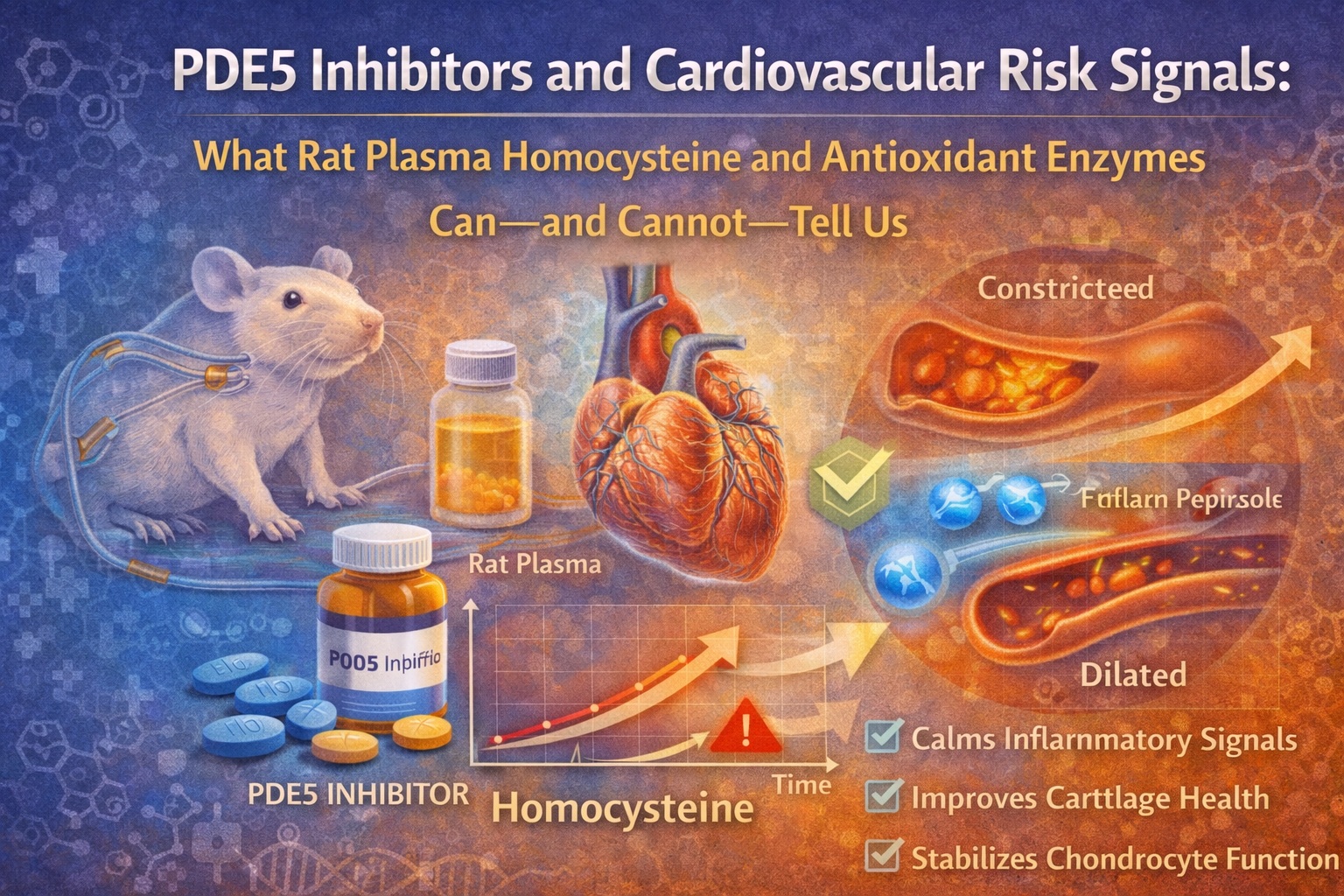
Erectile dysfunction (ED) drugs are often discussed in the language of convenience: “quick onset,” “long duration,” “works when you need it.” That framing is practical, but biologically incomplete. Phosphodiesterase type 5 (PDE5) inhibitors do not operate only in the penis; PDE5 is expressed across vascular beds and even in cardiac myocytes, and these agents modulate nitric oxide (NO)–cyclic GMP signaling in multiple tissues. When a drug is taken by millions of men, the responsible question is not just whether it helps erections, but what it quietly does elsewhere—especially in pathways linked to cardiovascular disease.
The experimental study at the center of this article examined an overlooked angle: whether commonly used ED medications change plasma homocysteine levels and antioxidant enzyme activities. Homocysteine is a sulfur-containing amino acid with a long history in cardiovascular epidemiology; elevated plasma homocysteine (hyperhomocysteinemia) has been associated with premature atherosclerosis, thrombosis, and endothelial dysfunction. Oxidative stress—another familiar suspect—also plays a major role in vascular disease, and antioxidant enzymes such as superoxide dismutase (SOD) and catalase are part of the body’s defense system against reactive oxygen species.
In short: the authors asked whether sildenafil (Viagra), vardenafil (Levitra), and tadalafil (Cialis) alter biochemical risk signals relevant to cardiovascular health. They used male rats, treated them daily for three weeks, and measured homocysteine, SOD, catalase, and lipid parameters. The results were not identical across drugs—an important detail that makes this more than a “class effect” story. Sildenafil and vardenafil substantially increased homocysteine; tadalafil did not. All three increased catalase activity, and sildenafil/vardenafil increased SOD activity. HDL also increased with all three drugs, while total cholesterol and LDL did not change significantly.
This article translates the study’s meaning into practical medical language: what the findings suggest, what they do not prove, and how clinicians and researchers should interpret “biochemical changes” without turning them into panic—or marketing.
Why Homocysteine and Oxidative Stress Matter in a Conversation About ED Drugs
Homocysteine is not a fashionable biomarker; it is the kind of variable that quietly returns in cardiology lectures like an older professor who refuses to retire. Its metabolism depends primarily on two pathways: remethylation back to methionine (requiring folate and vitamin B12) and trans-sulfuration to cystathionine (requiring vitamin B6 in its active pyridoxal-5-phosphate form). When these pathways are impaired—by genetics, nutrition, drugs, renal dysfunction, or systemic disease—plasma homocysteine can rise.
The cardiovascular concern is not theoretical. Epidemiologic data have repeatedly associated higher homocysteine with coronary, cerebral, and peripheral atherosclerosis. The study summarizes key evidence: even modest increments in total plasma homocysteine have been linked with higher coronary risk, and hyperhomocysteinemia has been tied to endothelial dysfunction, oxidative injury, prothrombotic shifts, and vascular smooth muscle proliferation. Whether homocysteine is a causal factor, a marker, or a mixture of both remains debated in clinical practice, but its association with vascular disease is strong enough to justify attention when a medication appears to raise it.
Oxidative stress is the second half of the story. Reactive oxygen species (ROS) can degrade NO bioavailability, impair endothelial signaling, and contribute to vascular remodeling. In ED pathophysiology, oxidative stress is not merely an accessory—it can directly reduce penile vascular function and is notably relevant in diabetes and metabolic disease. Antioxidant enzymes like SOD and catalase are part of the physiologic counterweight: SOD converts superoxide into hydrogen peroxide, and catalase then breaks down hydrogen peroxide. When these enzyme activities increase, it may signal a protective response—or a compensatory reaction to increased oxidative load.
So, when an ED drug changes homocysteine and antioxidant enzyme activity, the medically mature response is neither “This drug causes heart disease” nor “This drug is cardio-protective.” The correct response is: this is a signal that deserves mechanistic interpretation and human confirmation. That is exactly where this rat study places itself.
The Study in Brief: What Was Done, With Enough Detail to Trust the Results
The investigators used male Sprague–Dawley rats (200–220 g), housed under standard conditions with free access to food and water, following ethical approval and NIH-concordant protocols. Animals were acclimatized and then divided into four groups: a control group receiving water vehicle and three treatment groups receiving sildenafil, vardenafil, or tadalafil daily for three weeks.
The dosing is not a trivial footnote because dose selection drives interpretability. In the methods section, sildenafil was administered at 1.48 mg/kg/day, while tadalafil and vardenafil were administered at 0.2 mg/kg/day for three weeks. The abstract presents a closely aligned dosing scheme and emphasizes daily administration over the experimental period. After treatment, animals were sacrificed, fasting blood samples were collected, and plasma was separated and stored at –80°C until analysis.
Biochemical assays were clearly described. Total homocysteine was measured after reduction of disulfide bonds and conversion into S-adenosyl-L-homocysteine (SAH), followed by a competitive enzyme immunoassay. SOD activity was measured using the xanthine/xanthine oxidase system with inhibition of formazan dye formation (a standard approach). Catalase activity was assessed by the rate of hydrogen peroxide decomposition measured spectrophotometrically. Lipid parameters included total cholesterol, HDL, LDL, and triglycerides using enzymatic and detergent-based methods as appropriate. The statistical approach was relatively simple: means with standard errors, Student’s t tests, with significance set at p < 0.05.
You could argue that the statistics are not sophisticated (and you would be right), but the experimental design is straightforward and the signal sizes are large enough to merit attention—especially the homocysteine changes with sildenafil and vardenafil.
The Results: Homocysteine Goes Up With Sildenafil and Vardenafil, Not With Tadalafil
The headline result is direct: sildenafil and vardenafil increased plasma homocysteine, while tadalafil did not significantly change it. In numerical terms, the study reports baseline homocysteine around 7.75 μM in controls. Tadalafil remained essentially unchanged. Vardenafil increased homocysteine to roughly 12.95 μM (about +67%), and sildenafil increased it to roughly 14.92 μM (about +93%), both statistically significant.
This pattern is clinically provocative because it suggests the possibility of drug-specific effects within the PDE5 inhibitor class—at least in this animal model. The authors interpret tadalafil’s neutrality on homocysteine as a potential safety advantage, proposing that its mechanism or pharmacokinetics (notably longer duration) may produce a different systemic biochemical footprint. That interpretation is cautious in wording, but the conclusion does lean toward tadalafil being “safer” in the context of homocysteine changes.
However, interpreting homocysteine elevation requires discipline. A rise in homocysteine is not, by itself, proof of vascular injury, and animal plasma changes may not translate directly to humans. Still, it is a risk signal worth exploring, because homocysteine is linked to endothelial dysfunction through several plausible mechanisms: increased oxidative species generation, impaired NO-mediated vasodilation, pro-coagulant shifts, and stimulation of vascular smooth muscle proliferation. The discussion highlights these pathways and connects them to the observed biochemical profile.
The most practical takeaway from this section is not “avoid sildenafil.” It is: if a medication appears to increase homocysteine in a controlled experiment, it is reasonable to investigate whether similar changes occur in humans—particularly in men already at cardiovascular risk, who represent a large portion of ED patients.
Antioxidant Enzymes Rise: Protection, Compensation, or a Biochemical Alarm Bell?
The enzyme results are fascinating because they can be read in two opposing ways, and both readings are biologically plausible.
First, sildenafil and vardenafil increased SOD activity significantly (approximately +35% and +46%, respectively), while tadalafil did not show a significant SOD increase. Second, catalase activity increased with all three drugs, including tadalafil (approximately +33% for sildenafil, +50% for vardenafil, +43% for tadalafil).
One interpretation is protective: PDE5 inhibitors might enhance antioxidant defenses and reduce oxidative stress. The discussion cites prior findings that sildenafil can increase antioxidant levels and reduce oxidative stress, supporting the idea that increased SOD and catalase could be part of a beneficial adaptive response. If oxidative stress contributes to ED, then improving antioxidant capacity might indirectly support erectile function beyond cGMP signaling.
A second interpretation is compensatory: antioxidant enzyme activity may rise because oxidative stress increased. In this study, sildenafil and vardenafil also increased homocysteine, and homocysteine is known to generate superoxide and hydrogen peroxide. If homocysteine rises and oxidative load increases, the body may respond by upregulating SOD and catalase to defend tissues. Under this reading, higher enzyme activity is not a victory lap—it is the biochemical equivalent of “we’re putting out more fires.”
The authors lean toward a blended view: ED drugs may increase antioxidant properties and thereby attenuate oxidative stress resulting from hyperhomocysteinemia. That is reasonable within the study’s logic, but it leaves an important unresolved question: are we seeing net benefit, net harm, or simply a shift in equilibrium? Without direct measures of oxidative damage (lipid peroxidation markers, endothelial function testing, histology), enzyme activity changes remain a proxy, not a verdict.
If you want the slightly ironic clinical translation: the body appears to be cleaning up more reactive oxygen species—whether because the environment got cleaner or because it got messier first is the kind of detail biology refuses to answer without additional experiments.
Lipid Findings: HDL Increased, Total Cholesterol and LDL Did Not—And That Matters Less Than You Think
The lipid profile changes were modest and selective. Total cholesterol showed a nonsignificant increase across treatments; LDL did not change significantly. HDL increased with sildenafil, vardenafil, and tadalafil (reported increases approximately 25%, 41%, and 25%, respectively), and triglycerides decreased significantly only with sildenafil in the table.
At first glance, increased HDL sounds like good news. Higher HDL has long been associated with lower cardiovascular risk in observational studies. Yet modern cardiology has taught us to be skeptical: raising HDL pharmacologically does not consistently reduce cardiovascular events, and HDL function matters as much as HDL quantity. In an animal study, an HDL rise is a finding worth recording, but it is not automatically a cardioprotective conclusion.
The authors suggest that oxidative stress can oxidize HDL to LDL and that enhanced antioxidant enzyme activity could contribute to increased HDL levels. This is an interesting hypothesis, but the causal chain remains speculative in this dataset. It is also worth noting that in the discussion there is a confusing sentence implying that increased SOD and catalase “consequently increased the levels of oxidative stress,” which likely reflects a phrasing issue rather than a true mechanistic claim. The overall intent is clear: antioxidant responses and lipid shifts may be linked, but the study is not designed to map that network precisely.
Practically, lipid shifts should not be the primary clinical takeaway from this paper. The more important signal is the divergence in homocysteine effects between sildenafil/vardenafil and tadalafil, because homocysteine sits at the intersection of endothelial health, thrombosis biology, and oxidative stress pathways.
Mechanistic Plausibility: How Could PDE5 Inhibitors Affect Homocysteine Metabolism?
The study does not experimentally define a mechanism for homocysteine elevation, but it provides enough biochemical context to generate hypotheses. Homocysteine levels are influenced by methylation capacity, B-vitamin availability, hepatic metabolism, renal clearance, and systemic oxidative status. If sildenafil and vardenafil increased homocysteine within three weeks, possible explanations include altered enzyme activity in remethylation/trans-sulfuration pathways, increased homocysteine production, or reduced clearance.
The authors propose a practical mitigation strategy: patients taking sildenafil or vardenafil “should be advised” to take vitamin B12 and folic acid to reduce homocysteine, since these vitamins support conversion of homocysteine to methionine. The nutritional biochemistry behind this is correct. What remains uncertain is whether PDE5 inhibitor use meaningfully raises homocysteine in humans to a clinically important degree, and whether supplementation would be necessary or beneficial in that setting.
It is also worth considering pharmacokinetics. Tadalafil’s longer half-life and distinct tissue distribution might create different systemic signaling patterns compared with shorter-acting agents. The authors hint at this by suggesting tadalafil’s vasodilatory mechanism may differ, “perhaps associated with its prolonged effect.” This is not a mechanistic proof, but it is a plausible explanation for asynchrony among drugs in biomarker profiles.
A key scientific point here is that “same class” does not always mean “same systemic biology.” PDE5 inhibition is the shared label, but individual molecules can influence off-target pathways, metabolite profiles, and secondary regulatory systems differently. This study’s value is that it generates a testable human hypothesis: do sildenafil and vardenafil raise homocysteine more than tadalafil?
What This Study Should Not Be Used to Claim
This is the section where good science protects itself from enthusiastic misinterpretation.
First, the study does not prove that sildenafil or vardenafil cause cardiovascular disease. It demonstrates changes in biomarkers (homocysteine and antioxidant enzymes) in rats after three weeks of daily dosing. Biomarkers can suggest risk, but they do not equal clinical outcomes. Cardiovascular events in humans are the product of complex, long-term interactions—genetics, lifestyle, comorbidities, medications, and time.
Second, it does not prove that tadalafil is cardioprotective. Tadalafil did not raise homocysteine in this model and did increase catalase activity and HDL, but those findings are not the same as improved endothelial function or reduced atherosclerosis. Absence of homocysteine elevation is reassuring as a signal, but it is not a full safety profile.
Third, it does not settle the homocysteine debate. In human trials, lowering homocysteine with B vitamins has not consistently reduced cardiovascular event rates, despite successfully reducing homocysteine levels. That historical context matters: even if PDE5 inhibitors did raise homocysteine in humans, the clinical consequence would still need careful validation.
The best use of this paper is as an early warning and hypothesis generator: it suggests certain PDE5 inhibitors may influence biochemical pathways relevant to vascular health and that human studies are warranted to verify translation. The authors explicitly call for human research to determine whether these effects occur in patients.
Practical Implications: How Clinicians and Researchers Can Use These Findings Responsibly
For clinicians, the most reasonable interpretation is situational. Many ED patients already carry elevated cardiovascular risk: diabetes, hypertension, obesity, dyslipidemia, smoking history. ED itself is often a vascular warning sign. In such patients, it is sensible to ensure that basic cardiovascular risk management is in place before focusing exclusively on sexual performance. This study adds a nuance: if future human data confirm that some PDE5 inhibitors raise homocysteine, clinicians might consider baseline and follow-up homocysteine testing in selected high-risk patients or discuss nutritional adequacy of folate/B12—especially in older adults or those with dietary limitations.
For researchers, this study points to obvious next steps. A translational study in humans would need standardized dosing, measurement of fasting homocysteine before and after therapy, control for diet and vitamin status, and ideally assessment of endothelial function markers. It would also benefit from measuring oxidative damage biomarkers rather than enzyme activities alone. If a consistent signal emerges, comparative trials between tadalafil and shorter-acting agents could clarify whether the difference is reproducible and clinically meaningful.
For drug safety communication, the tone should be calm and accurate. PDE5 inhibitors have extensive human safety experience, and their major contraindications (notably concomitant nitrates) are well established. Introducing biomarker concerns should not create alarm. The sensible message is: “ED drugs are systemic vascular agents; it is worth studying their biochemical effects beyond erections.” That is a mature position—scientifically and ethically.
And for patients, the practical irony remains: the medications taken to improve vascular function in one organ might shift vascular risk signals elsewhere—perhaps transiently, perhaps not. Biology rarely provides one-way benefits at no cost; it usually negotiates.
Conclusion: A Biochemical Signal Worth Following, Not a Verdict Worth Selling
This rat study reports that sildenafil and vardenafil markedly increased plasma homocysteine after three weeks of daily dosing, while tadalafil did not. It also shows increases in antioxidant enzyme activities—SOD with sildenafil and vardenafil, and catalase with all three drugs—along with modest shifts in HDL and triglycerides.
The authors interpret the homocysteine rise as a potential cardiovascular risk signal and suggest B12 and folic acid supplementation as a mitigation strategy, given their role in homocysteine remethylation. That suggestion is biochemically reasonable but clinically unproven in the context of PDE5 inhibitor therapy, and the paper appropriately calls for human studies.
If you want one sentence to retain: this work does not indict PDE5 inhibitors, but it does remind us that systemic vascular drugs can influence systemic vascular biomarkers—and that “widely used” is not the same as “fully understood.”
FAQ
1) Does this study prove that sildenafil or vardenafil increase cardiovascular risk in humans?
No. It shows increased homocysteine and antioxidant enzyme activity in rats after three weeks of daily dosing. These are biomarkers, not clinical events, and translation to humans requires dedicated studies.
2) Why would B12 and folic acid be suggested for patients taking sildenafil or vardenafil?
Homocysteine is metabolized back to methionine through a pathway that requires folate and vitamin B12. If homocysteine rises, supporting that pathway nutritionally is biologically plausible. Whether supplementation is necessary or beneficial for PDE5 inhibitor users in humans is not established by this study.
3) Is tadalafil “safer” than sildenafil or vardenafil based on this paper?
In this rat model, tadalafil did not significantly change homocysteine, while sildenafil and vardenafil did. That suggests a potentially favorable biomarker profile for tadalafil regarding homocysteine, but it does not prove superior cardiovascular safety in humans.
