

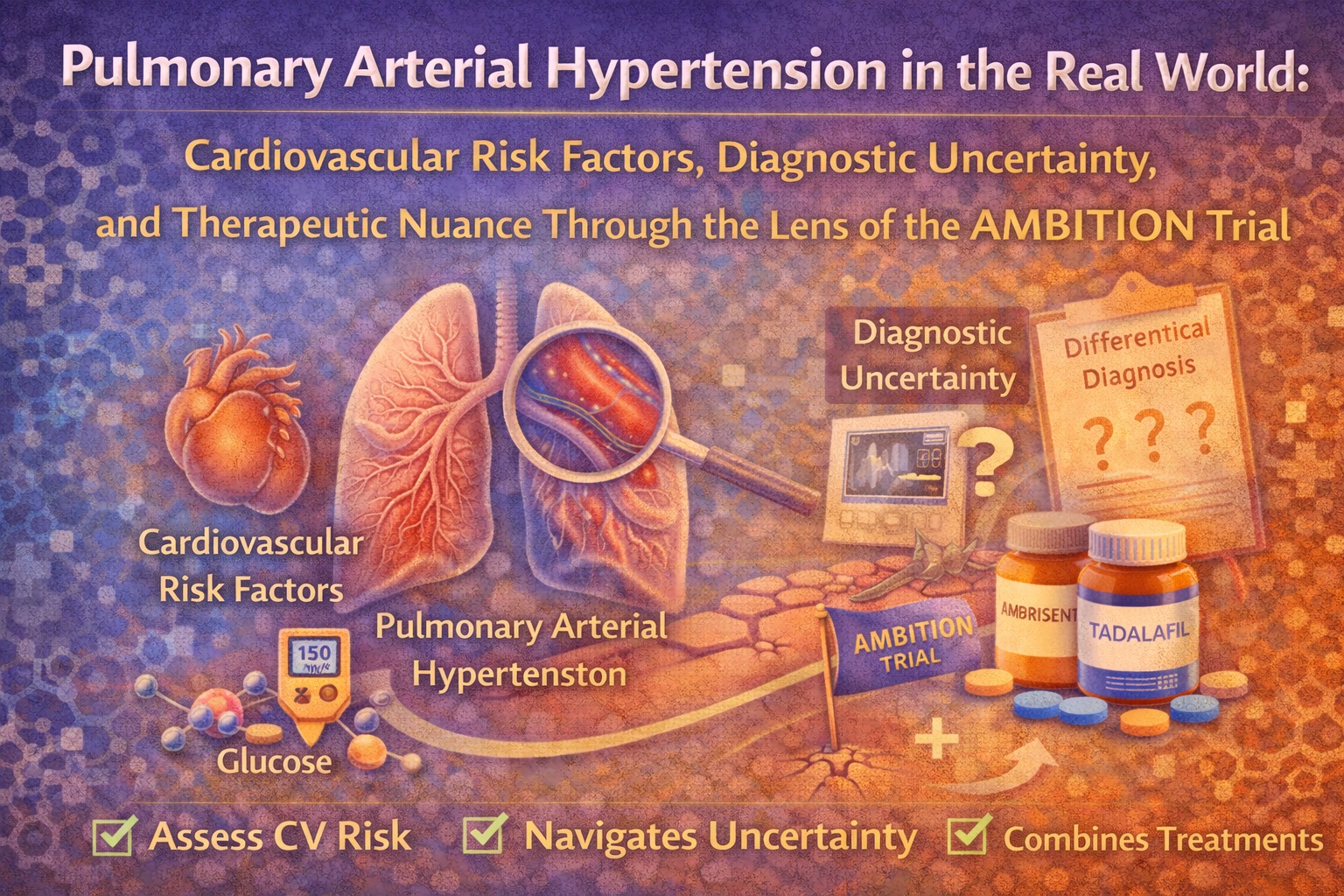
Pulmonary arterial hypertension (PAH) has long been described in textbooks as a rare disease of younger patients, often women, with few comorbidities and a clean cardiovascular background. That image is now largely obsolete. Contemporary registries and everyday clinical practice tell a different story: patients are older, heavier, metabolically burdened, and far less “pure” from a pathophysiological standpoint. The AMBITION trial, and particularly its analysis of patients with and without cardiovascular risk factors, provides a rare and valuable opportunity to examine how modern PAH behaves outside the idealized boundaries of classical definitions .
This article explores what happens when PAH collides with cardiovascular risk factors traditionally associated with left ventricular diastolic dysfunction. More importantly, it examines how these patients respond to evidence-based PAH therapy, how their outcomes differ, and why rigid diagnostic labels may no longer be sufficient in an era of aging populations and overlapping disease phenotypes.
The Changing Face of Pulmonary Arterial Hypertension
Pulmonary arterial hypertension is no longer a disease confined to a narrowly defined demographic. Over the past two decades, registries across Europe and North America have consistently shown a shift toward older patients with a higher prevalence of systemic hypertension, diabetes mellitus, obesity, and coronary artery disease. These changes are not cosmetic; they fundamentally alter disease presentation, progression, and response to therapy.
The AMBITION trial was conducted during this epidemiological transition. Although its original design targeted treatment-naïve patients with clearly defined Group 1 PAH, early enrollment revealed a surprisingly high proportion of individuals with multiple cardiovascular risk factors. These patients technically fulfilled the hemodynamic criteria for PAH, yet their clinical profiles raised uncomfortable questions: Are they truly suffering from pulmonary vascular disease, or are they displaying a mixed or transitional phenotype that overlaps with pulmonary hypertension due to left heart disease?
This diagnostic ambiguity is not merely academic. Therapeutic decisions in PAH carry significant implications, including exposure to potent vasodilators, potential adverse effects, and substantial healthcare costs. The AMBITION investigators recognized this challenge early and amended the protocol to introduce stricter inclusion criteria. As a result, the trial uniquely captured two distinct populations: those meeting the revised, more stringent definition (the primary analysis set) and those who would later be excluded (the ex-primary analysis set). This natural experiment offers rare insight into how cardiovascular comorbidity reshapes PAH.
Cardiovascular Risk Factors as a Biological Modifier of PAH
Cardiovascular risk factors do not simply coexist with PAH; they actively modify its biology. Hypertension, diabetes, obesity, and coronary disease are all associated with systemic inflammation, endothelial dysfunction, and impaired ventricular relaxation. When present together, they create a hemodynamic environment in which pulmonary vascular resistance may rise modestly, while left-sided filling pressures hover near the upper limits of normal.
Patients in the ex-primary analysis set exemplify this overlap. They were older, had lower exercise capacity at baseline, and carried a much higher burden of metabolic and cardiovascular disease. Their pulmonary hemodynamics were less severe on paper, with lower pulmonary vascular resistance and higher wedge pressures, yet their clinical outcomes were worse. This paradox highlights a crucial point: numbers alone do not define disease severity.
From a pathophysiological perspective, these patients likely represent a heterogeneous group. Some may have early or mild PAH complicated by comorbidities. Others may have combined pre- and post-capillary pulmonary hypertension, temporarily masquerading as isolated PAH under resting conditions. In either case, cardiovascular risk factors appear to blunt physiological reserve, limit treatment responsiveness, and increase vulnerability to adverse events.
The Rationale for Initial Combination Therapy
The AMBITION trial was designed around a simple but bold hypothesis: targeting multiple pathogenic pathways from the outset would improve outcomes in PAH. By combining an endothelin receptor antagonist (ambrisentan) with a phosphodiesterase-5 inhibitor (tadalafil), investigators aimed to achieve more effective pulmonary vasodilation, improved right ventricular function, and reduced clinical deterioration.
In patients without significant cardiovascular risk factors, this strategy worked remarkably well. Initial combination therapy halved the risk of clinical failure compared with monotherapy, reduced hospitalizations, improved biomarkers, and enhanced exercise capacity. These results firmly established upfront combination therapy as a cornerstone of modern PAH management.
The more interesting question, however, is whether this approach retains value in patients with cardiovascular comorbidities. The AMBITION data suggest that it does—but with important caveats. In the ex-primary analysis set, combination therapy produced directionally similar benefits, yet the magnitude of effect was smaller, and statistical certainty was lost. This attenuation reflects not therapeutic failure, but biological complexity.
Clinical Outcomes in Patients With and Without Cardiovascular Risk Factors
When outcomes are examined side by side, the contrast between the two populations becomes clear. Patients without multiple cardiovascular risk factors experienced fewer clinical failure events, lower mortality, and better functional improvement. Their disease behaved more predictably, and their response to therapy was robust.
By contrast, patients with cardiovascular risk factors faced a steeper uphill battle. They experienced higher rates of disease progression and death, regardless of treatment assignment. Even when treated aggressively with combination therapy, their improvements in six-minute walk distance and NT-proBNP levels were modest. These findings underscore a critical reality: comorbidity is not a passive background feature—it actively shapes prognosis.
Hospitalization patterns offer further insight. In both populations, the reduction in clinical failure events with combination therapy was driven primarily by fewer hospitalizations for worsening PAH. This consistency suggests that, even in complex patients, targeting pulmonary vascular tone remains clinically meaningful. However, the overall vulnerability of patients with cardiovascular risk factors remains higher, reflecting the cumulative burden of multisystem disease.
Tolerability and Safety: The Cost of Complexity
One of the most striking findings from the AMBITION analysis is the difference in tolerability between the two populations. Patients with cardiovascular risk factors experienced significantly higher rates of adverse events, serious adverse events, and permanent treatment discontinuation. Peripheral edema, gastrointestinal symptoms, musculoskeletal complaints, and systemic side effects were more frequent and more consequential.
This pattern likely reflects reduced physiological resilience. Older patients with diabetes or coronary disease are less able to compensate for vasodilatory effects, fluid shifts, and drug interactions. What is a manageable side effect in a younger patient may become a treatment-limiting complication in an older one.
Importantly, this does not argue against treatment—it argues for precision. Clinicians must balance potential benefit against tolerability, adjust doses carefully, and monitor closely. The data suggest that combination therapy can still be beneficial, but it must be applied with humility and vigilance rather than algorithmic rigidity.
Rethinking Classification: When PAH Is Not Pure
The AMBITION trial exposes a growing fault line in pulmonary hypertension classification. The traditional boundaries between Group 1 PAH and Group 2 pulmonary hypertension due to left heart disease are increasingly blurred in real-world patients. Many individuals occupy a gray zone where rigid categories fail to capture clinical reality.
Patients with multiple cardiovascular risk factors may meet hemodynamic criteria for PAH at rest, yet their disease trajectory and treatment response differ substantially from classical PAH. This raises an uncomfortable but necessary question: should we continue to force these patients into existing categories, or should classification evolve to reflect phenotypic diversity?
The AMBITION investigators wisely avoided definitive labels, instead focusing on observed outcomes. Their approach highlights a pragmatic truth: effective care depends less on perfect classification and more on careful phenotyping, longitudinal assessment, and individualized treatment strategies.
Implications for Clinical Practice
For practicing clinicians, the lessons from this analysis are both sobering and empowering. Sobering, because cardiovascular comorbidities clearly worsen outcomes and complicate therapy. Empowering, because even in these challenging patients, thoughtful use of PAH-targeted therapy can reduce hospitalizations and stabilize disease.
Several practical principles emerge:
- Cardiovascular risk factors should prompt caution, not therapeutic nihilism.
- Initial combination therapy may still offer benefit, but expectations must be realistic.
- Close monitoring for adverse events is essential, especially early in treatment.
Most importantly, clinicians must resist the temptation to oversimplify. PAH in the modern era is rarely a single-disease problem. It is a syndrome unfolding within a complex biological and clinical context.
Looking Ahead: Research and the Next Generation of Trials
The AMBITION trial’s inclusion of patients with cardiovascular risk factors was not a flaw—it was a preview of the future. As populations age and metabolic disease becomes ubiquitous, PAH trials must adapt. Excluding complex patients may produce cleaner data, but it risks irrelevance.
Future studies should embrace stratification rather than exclusion, incorporating detailed phenotyping, advanced imaging, and biomarkers to better define patient subgroups. Only then can therapy be tailored with the precision that modern medicine promises but has yet to fully deliver.
Conclusion
The AMBITION trial teaches us that pulmonary arterial hypertension is no longer a monolithic disease. Cardiovascular risk factors profoundly influence its presentation, progression, and response to therapy. While initial combination therapy remains a powerful tool, its effects are moderated by age, comorbidity, and biological complexity.
Rather than viewing these findings as limitations, clinicians should see them as an invitation—to think more deeply, treat more thoughtfully, and accept that in PAH, as in life, simplicity is increasingly the exception rather than the rule.
FAQ
1. Do patients with cardiovascular risk factors truly have pulmonary arterial hypertension?
Some do, but many likely represent overlapping or mixed phenotypes. Hemodynamics alone may be insufficient to fully characterize their disease.
2. Is initial combination therapy still appropriate in these patients?
Yes, but with caution. Benefits are present but attenuated, and tolerability issues are more common, requiring individualized decision-making.
3. Should future PAH trials exclude patients with cardiovascular comorbidities?
No. These patients represent a growing proportion of real-world practice and must be studied systematically rather than ignored.
