

Introduction: When the Best Therapy Works Only If It Is Taken
Pulmonary arterial hypertension (PAH) is a disease that does not forgive inconsistency. Its pathophysiology is relentless, progressive, and largely indifferent to intention. Over the past two decades, the therapeutic landscape of PAH has evolved dramatically, transforming a once uniformly fatal diagnosis into a chronic, though still severe, condition. Targeted therapies addressing endothelin, nitric oxide, and prostacyclin pathways have reshaped prognosis and improved quality of life.
Yet modern treatment success depends not only on pharmacological sophistication, but on a far less glamorous factor: adherence. Even the most precisely chosen drug regimen loses its value when doses are missed, schedules drift, or treatment is quietly abandoned. In PAH, where clinical deterioration may be subtle until it is abrupt, non-adherence is particularly dangerous.
This article explores treatment patterns and medication adherence in PAH and chronic thromboembolic pulmonary hypertension (CTEPH), drawing on real-world data to illuminate how patients actually use their therapies. More importantly, it examines why adherence is so difficult to measure, so easy to misinterpret, and so central to meaningful clinical outcomes.
Pulmonary Arterial Hypertension as a Long-Term Therapeutic Commitment
PAH is not treated episodically. It requires continuous, lifelong pharmacotherapy aimed at slowing vascular remodeling, reducing pulmonary vascular resistance, and preserving right ventricular function. For most patients, this means years of daily medication, often in combination regimens, layered onto treatment for multiple comorbidities.
From the patient’s perspective, PAH therapy is both a lifeline and a burden. Many targeted drugs are associated with adverse effects such as headache, gastrointestinal discomfort, flushing, or hypotension. Some regimens involve multiple daily doses or complex administration routes. The disease itself imposes fatigue and exercise limitation, further complicating daily routines.
These realities create a paradox. Patients are often highly motivated—aware that their medication controls a life-threatening condition—yet simultaneously challenged by the cumulative demands of chronic therapy. Understanding adherence in PAH therefore requires moving beyond simplistic notions of “compliance” and toward a nuanced appreciation of patient behavior over time.
Treatment Patterns in Contemporary PAH Management
Modern PAH treatment rarely relies on monotherapy. Current guidelines favor combination regimens that target multiple pathophysiological pathways, particularly in patients with intermediate or high-risk disease. Endothelin receptor antagonists (ERAs) and phosphodiesterase type-5 inhibitors (PDE5i) form the backbone of many first-line strategies, often supplemented by soluble guanylate cyclase stimulators or prostacyclin pathway agents as disease severity increases.
Real-world data confirm this shift. Most patients are treated with double or triple therapy rather than a single agent. Combinations such as macitentan with tadalafil or ambrisentan with tadalafil are especially common, reflecting both guideline recommendations and clinical experience.
Importantly, these regimens are rarely prescribed in isolation. Patients with PAH often take several additional medications for comorbid cardiovascular, metabolic, or systemic conditions. The result is a dense therapeutic landscape in which PAH-specific drugs compete for attention alongside antihypertensives, anticoagulants, and other chronic therapies.
Measuring Adherence: Objective Numbers and Subjective Truths
Adherence is deceptively difficult to quantify. In clinical research and practice, it is commonly assessed using either objective pharmacy-based measures or subjective patient-reported tools. Each approach captures a different reality—and neither tells the full story.
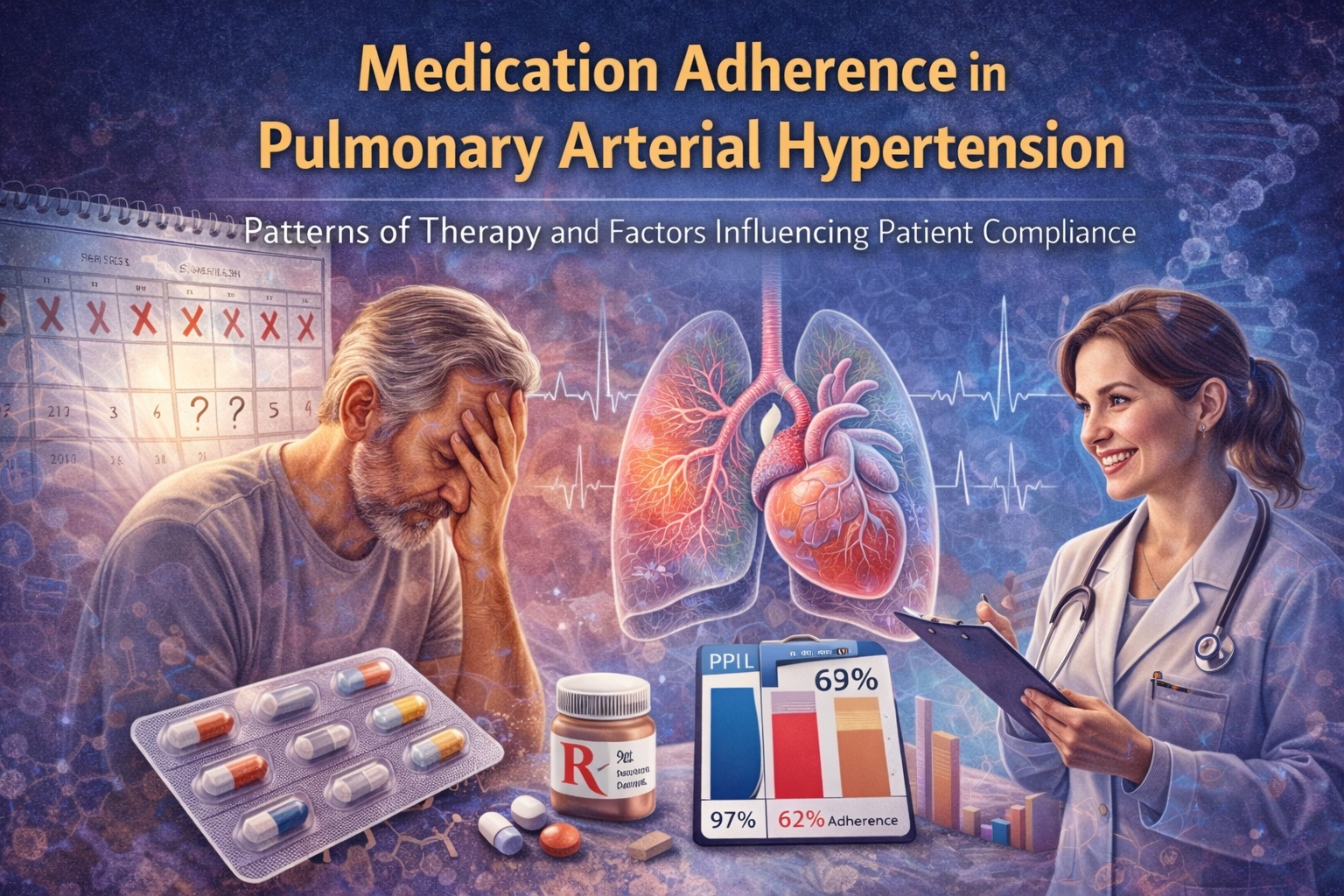
The proportion of days covered (PDC) is widely used because it is simple, reproducible, and based on dispensing records. If a patient collects medication regularly, PDC assumes that doses are taken as prescribed. In PAH cohorts, PDC frequently suggests very high adherence, often exceeding 90%.
In contrast, self-reported questionnaires such as the Simplified Medication Adherence Questionnaire (SMAQ) paint a more cautious picture. By asking patients directly about missed doses, timing deviations, and intentional interruptions, these tools often reveal substantially lower adherence rates. The discrepancy between objective and subjective methods is not an error—it is a reflection of different dimensions of behavior.
The Illusion of Agreement Between Adherence Measures
One of the most striking findings in real-world PAH studies is the poor agreement between PDC and questionnaire-based assessments. A patient may appear fully adherent according to pharmacy records while simultaneously acknowledging missed doses when asked directly. Conversely, some patients report excellent adherence despite gaps in dispensing data.
This divergence highlights a fundamental truth: collecting medication is not the same as consuming it. PDC captures access and persistence, while questionnaires capture behavior and intention. In chronic diseases like PAH, both matter.
Clinically, this means that reliance on a single adherence metric can be misleading. High PDC values may offer reassurance to healthcare providers, while unrecognized non-adherence continues quietly. Conversely, strict questionnaire criteria may classify patients as non-adherent despite clinically acceptable patterns of use.
Factors Influencing Adherence: What Matters—and What Surprisingly Does Not
Conventional wisdom suggests that adherence is shaped by age, education, employment, social support, and regimen complexity. Yet real-world data in PAH challenge many of these assumptions.
Across multiple studies, including the one analyzed here, most demographic and clinical variables show no consistent association with adherence. Age, number of medications, time since diagnosis, and educational level often fail to predict whether patients take their therapy as prescribed.
One intriguing and controversial observation is the association between female sex and lower adherence when assessed by self-report tools. This finding does not appear in objective measures and may reflect differences in symptom perception, reporting behavior, or health beliefs rather than true differences in medication use. It serves as a reminder that adherence data are as much about psychology as pharmacology.
Adverse Effects and Perceived Efficacy: A Delicate Balance
More than half of patients receiving PAH therapy report adverse effects. Headache, diarrhea, flushing, and musculoskeletal discomfort are common and often persistent. From a purely pharmacological standpoint, these effects are expected and manageable. From a patient’s perspective, they can be exhausting.
Paradoxically, high rates of adverse effects do not necessarily translate into poor adherence. Many patients continue therapy despite discomfort, particularly when they perceive the treatment as effective. Perceived benefit appears to be a powerful motivator, often outweighing inconvenience or side effects.
This highlights the importance of patient perception. When patients understand the purpose of therapy and recognize its impact on symptoms or disease stability, they are more likely to persist—even imperfectly. Conversely, when benefits are abstract or delayed, adherence becomes fragile.
The Role of the Clinical Pharmacist: An Underestimated Asset
One consistent theme in high-adherence PAH cohorts is the presence of structured pharmaceutical care. Regular contact with clinical pharmacists, particularly in specialized outpatient settings, appears to support sustained medication use.
Pharmacists provide more than dispensing. They reinforce education, address adverse effects, coordinate refills, and serve as accessible points of contact for patient concerns. Frequent pharmacy visits create natural opportunities for adherence monitoring and intervention.
In this sense, adherence is not solely a patient responsibility. It is a system-level outcome shaped by healthcare organization, continuity of care, and the availability of supportive professionals.
Adherence as a Dynamic Process, Not a Fixed Trait
Perhaps the most important lesson from adherence research in PAH is that adherence is not static. It fluctuates with disease progression, life events, emotional state, and treatment burden. A patient who is adherent today may struggle tomorrow, and vice versa.
This dynamic nature makes adherence difficult to capture in cross-sectional snapshots. It also argues against labeling patients as “adherent” or “non-adherent” in absolute terms. Instead, adherence should be viewed as a variable clinical parameter—one that requires ongoing assessment and adjustment.
Clinicians who recognize this fluidity are better positioned to intervene early, before lapses translate into clinical deterioration.
Clinical Implications: From Measurement to Meaningful Action
Understanding adherence patterns in PAH has practical consequences. It influences how clinicians interpret treatment failure, how they escalate therapy, and how they communicate with patients. A perceived lack of drug efficacy may, in reality, reflect inconsistent use rather than pharmacological resistance.
Effective adherence management requires combining objective data with empathetic dialogue. Pharmacy records can flag potential issues, while direct conversation can uncover their causes. Neither approach alone is sufficient.
Ultimately, improving adherence in PAH is less about enforcing discipline and more about building trust, simplifying regimens where possible, and aligning treatment goals with patient priorities.
Conclusion
Adherence to pulmonary arterial hypertension therapy is generally high when assessed objectively, yet significantly lower when explored through patient self-report. This discrepancy reflects the complexity of human behavior rather than methodological failure.
Real-world treatment patterns show widespread use of combination therapy, substantial treatment burden, and frequent adverse effects—yet also high patient-perceived efficacy and engagement. No single demographic or clinical factor reliably predicts poor adherence, underscoring the need for individualized, patient-centered care.
In PAH, adherence is not a footnote to therapy; it is a core determinant of outcome. Recognizing its nuances allows clinicians to move beyond assumptions and toward more effective, compassionate care.
FAQ
1. Why do adherence rates differ so much depending on the measurement method?
Because objective measures capture medication access, while questionnaires capture actual behavior and perception. Each reflects a different aspect of adherence.
2. Does combination therapy reduce adherence in PAH?
Not necessarily. Real-world data show high adherence even with double or triple therapy, especially when patients are well supported.
3. How can clinicians improve adherence in PAH patients?
Through regular follow-up, clear communication, management of adverse effects, and integration of clinical pharmacists into patient care.
