

Introduction
Erectile dysfunction (ED) has long been recognized not only as a condition impairing intimacy but also as a sentinel of broader vascular health. Affecting more than half of men between 40 and 70 years, ED carries implications for physical, psychological, and relational well-being. The Massachusetts Male Aging Study first underscored its prevalence, and subsequent surveys across Asia, Europe, and North America confirmed that ED is both common and underestimated.
Since the introduction of phosphodiesterase type 5 inhibitors (PDE5i), the management of ED has been transformed. Sildenafil was the first, but tadalafil quickly distinguished itself with its unique pharmacokinetics: a half-life of nearly 17.5 hours and clinical efficacy lasting up to 36 hours. This property earned it the moniker of the “weekend pill,” providing men with an unprecedented degree of flexibility.
Initially, tadalafil was used “on demand,” taken 30 minutes to 1 hour before anticipated sexual activity. However, its pharmacology also made it suitable for low-dose daily use—a strategy that promises spontaneity and potentially better long-term outcomes. The key question that continues to intrigue urologists and patients alike is: Is once-daily tadalafil truly superior to on-demand dosing in improving erectile function?
Daily Dosing: The Concept of Penile Readiness
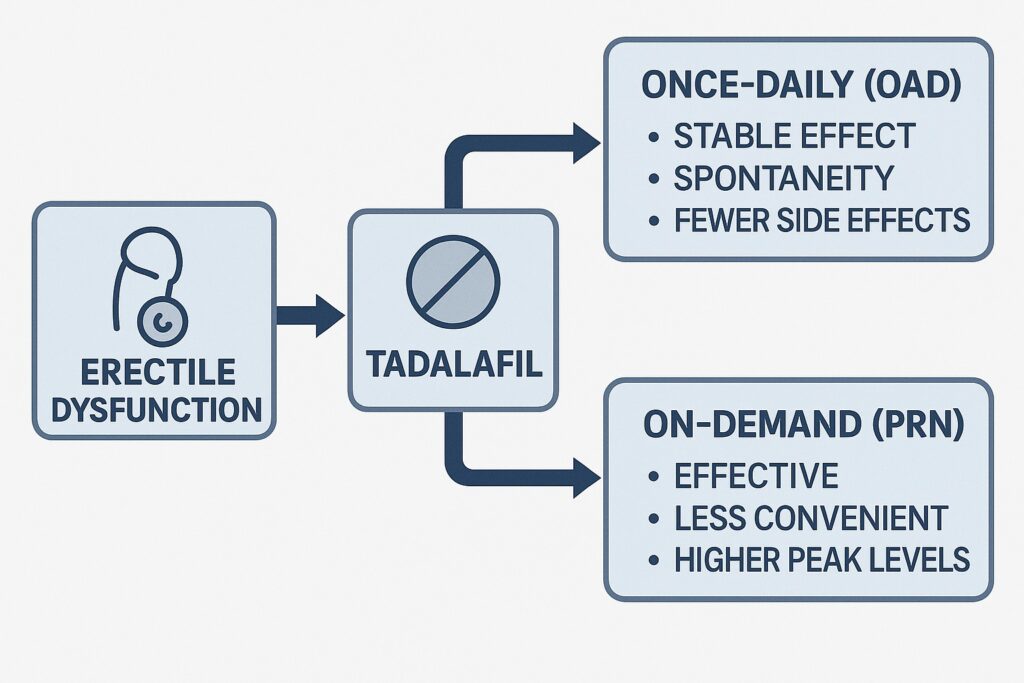
The rationale behind once-daily tadalafil is straightforward. By maintaining a steady plasma concentration of about 55 ng/mL, daily dosing ensures continuous pharmacological support for erectile physiology. This strategy allows:
- Spontaneity of sexual activity, eliminating the “pill-clock countdown.”
- Reduction of performance anxiety by separating medication intake from intimacy.
- Possible structural benefits to penile tissue through improved oxygenation, reducing risks of fibrosis associated with prolonged ED.
Daily dosing transforms tadalafil from an “event drug” into a therapeutic background agent, aligning sexual health with overall vascular health management.
On-Demand Dosing: Convenience or Constraint?
On-demand tadalafil is usually prescribed at 10–20 mg. It is effective within 30 minutes and lasts for up to 36 hours, meaning that, in principle, one dose could cover multiple encounters. This regimen appeals to men who prefer medication only when needed, minimizing pill burden and cost.
However, drawbacks exist. The need to anticipate sexual activity may feel unnatural or inconvenient. Some patients describe this as “medicated intimacy,” where romance is overshadowed by pharmacological scheduling. Furthermore, fluctuating plasma concentrations may increase the likelihood of side effects such as flushing and headache, as peak drug exposure is higher compared to the flatter pharmacokinetic curve of daily dosing.
Evidence From Randomized Controlled Trials
Buvat et al. (2013)
Involving 509 men, this 24-week RCT compared tadalafil OAD (2.5–5 mg) versus PRN (10–20 mg). Both groups improved in IIEF-EF and SEP-3 scores, but the differences were not statistically significant.
Kang et al. (2012)
A pivotal 12-week parallel RCT of 168 men compared tadalafil OAD 5 mg with PRN 20 mg. The once-daily group showed significantly higher improvements in IIEF-EF (6.5 vs 4.9), SEP-2 (81.8% vs 64.7%), and SEP-3 (77.3% vs 60.3%). This study provided strong support for daily dosing in routine clinical practice.
McMahon et al. (2005)
In this crossover study of 145 men, tadalafil OAD (10 mg) yielded greater improvements in IIEF-EF (11.9 vs 8.3) compared to PRN 20 mg. SEP-2 and SEP-3 scores also favored the OAD regimen.
Rubio-Aurioles et al. (2012)
In 378 men with ED responsive to PDE5i, OAD 5 mg was compared with PRN regimens. Improvements in IIEF-EF were slightly higher in the OAD group (8.7 vs 9.5), but results did not reach statistical significance.
Meta-Analytical Insights
Across trials, several consistent patterns emerged:
- Efficacy: OAD dosing often resulted in greater or at least comparable improvements in erectile function scores.
- Sexual encounter success: Both penetration (SEP-2) and maintenance (SEP-3) rates were generally higher in OAD users.
- Safety: Adverse events were mild and similar between regimens. Interestingly, OAD dosing tended to have fewer headaches and flushing episodes, likely due to the avoidance of high plasma peaks.
Taken together, the balance tips toward daily dosing for men prioritizing spontaneity, consistency, and psychological ease.
Psychological and Lifestyle Considerations
The pharmacology is only half the story. The psychological impact of dosing regimens is equally critical. Patients often report that daily tadalafil liberates them from the anxiety of planning sexual activity, allowing intimacy to occur naturally. This restores confidence and reduces stigma, as the act of taking medication is no longer linked to performance.
Moreover, tadalafil daily has additional benefits: improvement of lower urinary tract symptoms (LUTS) due to benign prostatic hyperplasia (BPH). Thus, daily dosing may serve a dual role, especially in older men with comorbid urinary issues.
On-demand dosing may remain preferable for younger men with infrequent sexual activity or those sensitive to cost. In this context, patient preference and lifestyle patterns should guide the decision.
Safety Profile
Adverse effects of tadalafil, whether OAD or PRN, are typically mild and self-limiting. The most common are:
- Headache
- Flushing
- Dyspepsia
- Nasal congestion
In long-term trials, discontinuation rates due to side effects are low. Notably, serious adverse events are rare, and there is no evidence of increased cardiovascular risk when prescribed responsibly (excluding patients on nitrates or riociguat).
Interestingly, the OAD regimen’s avoidance of plasma concentration spikes may reduce vasodilatory side effects, offering a smoother tolerability profile.
Clinical Implications and Patient-Centered Choice
So, is tadalafil OAD superior to PRN? The answer, as always in medicine, is nuanced. For patients desiring spontaneity, consistency, and potentially smoother side-effect profiles, yes, OAD has advantages. For those with infrequent intercourse, cost concerns, or aversion to daily medication, PRN remains effective and practical.
The clinician’s role is to align therapy with patient expectations, comorbidities, and financial realities. Importantly, neither regimen compromises safety.
Conclusion
Daily tadalafil represents an evolution in the treatment of erectile dysfunction, moving beyond episodic performance to continuous support of erectile physiology. Evidence suggests that OAD therapy not only improves erectile function more consistently than PRN dosing but also enhances psychological comfort, spontaneity, and adherence. While not a universal solution, it is an important option in the therapeutic arsenal, particularly for men seeking reliability and freedom from the “pill-clock.”
Ultimately, the choice between OAD and PRN tadalafil should be personalized, blending clinical evidence with patient lifestyle and preferences.
FAQ
1. Is once-daily tadalafil more effective than on-demand use?
Yes, in several randomized trials, once-daily dosing resulted in significantly higher improvements in erectile function scores and sexual encounter success compared to on-demand dosing.
2. Are side effects worse with daily tadalafil?
No. Side effects are similar or even slightly less frequent with daily dosing, likely due to the avoidance of high plasma peaks.
3. Who should choose daily tadalafil over on-demand use?
Men who value spontaneity, have frequent sexual activity, or also suffer from lower urinary tract symptoms due to BPH may benefit most from daily tadalafil.
