

Introduction
Erectile dysfunction (ED) is more than a clinical nuisance; it is a condition that reverberates through every facet of a man’s quality of life. From psychological confidence to interpersonal relationships, the inability to achieve or maintain an erection sufficient for satisfactory intercourse carries a burden that is both intimate and global. Its prevalence escalates with age: approximately one-third of men in their sixties and nearly half beyond their seventies are affected. While ED may be multifactorial—ranging from vascular pathology to psychological inhibition—it remains a sentinel marker of endothelial health.
Since the late 1990s, the arrival of phosphodiesterase type 5 inhibitors (PDE5i) revolutionized ED therapy. Among them, tadalafil has emerged with unique attributes: a half-life of 17.5 hours and efficacy extending to 36 hours, distinguishing it as the “weekend pill.” This pharmacological profile raises a natural question: Should tadalafil be prescribed on-demand, matching intimacy with ingestion, or once daily, sustaining readiness without anticipation?
The meta-analysis by Zhou and colleagues (2019) provides a long-awaited synthesis of this debate, focusing specifically on long-term outcomes after at least 24 weeks of therapy. Let us unpack the science, sift through the statistics, and translate the evidence into clinical wisdom.
The Rationale Behind Daily Dosing
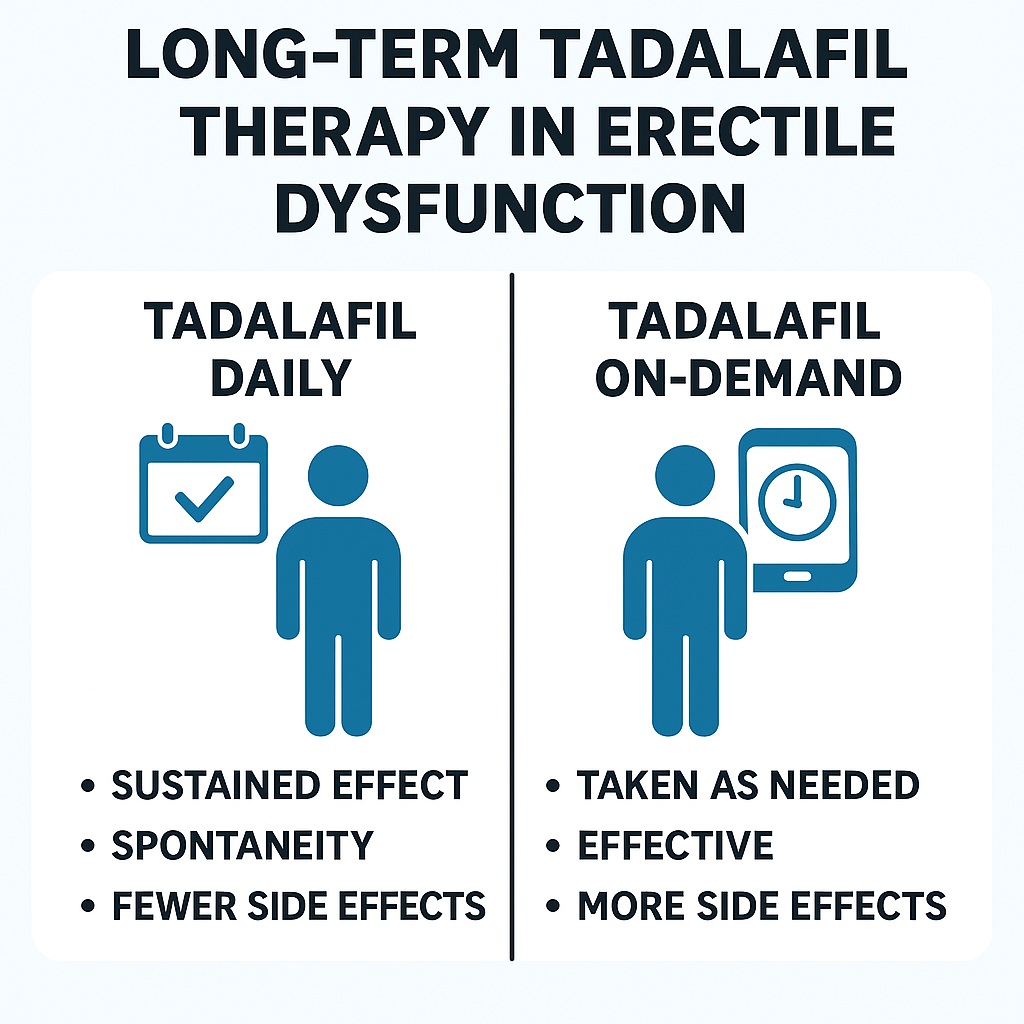
Daily tadalafil, typically at 2.5–5 mg, maintains stable plasma concentrations. This pharmacokinetic steadiness offers several theoretical and observed benefits.
First, it decouples sexual activity from pill intake, allowing intimacy to flow without pharmacological scheduling. Patients often describe this as a restoration of natural spontaneity. Second, the continuous elevation of cGMP may have a penile rehabilitative effect: by enhancing nocturnal and spontaneous erections, the regimen may improve cavernosal oxygenation, thereby reducing fibrosis and preserving endothelial integrity. Third, tadalafil daily at low doses confers a dual therapeutic benefit in men with lower urinary tract symptoms (LUTS) secondary to benign prostatic hyperplasia (BPH).
In short, daily tadalafil transforms from a “drug for the bedroom” into a maintenance therapy for sexual and urinary health.
On-Demand Dosing: Tradition with Constraints
On-demand tadalafil, prescribed at 10–20 mg, has immediate intuitive appeal. It minimizes pill burden and cost, restricting pharmacotherapy to times of anticipated intimacy. For younger patients with infrequent sexual activity or financial considerations, this regimen remains attractive.
Yet, limitations are equally clear. The need to plan intimacy may amplify performance anxiety. Pharmacologically, the higher peaks of plasma tadalafil with on-demand use correlate with greater incidence of transient adverse effects such as headache and flushing. Moreover, the psychological reminder of “taking a pill for sex” can inadvertently reinforce feelings of inadequacy.
Thus, while effective, on-demand therapy risks becoming less about restoring confidence and more about reminding patients of their vulnerability.
Evidence from the Meta-Analysis
The 2019 systematic review included four randomized controlled trials (RCTs) enrolling a total of 1,035 men with ED, all followed for at least 24 weeks. The endpoints included:
- International Index of Erectile Function – Erectile Function domain (IIEF-EF)
- Sexual Encounter Profile Question 2 (SEP2): ability to achieve penetration
- Sexual Encounter Profile Question 3 (SEP3): ability to maintain erection for intercourse
- Safety outcomes: adverse events, discontinuations, myalgia, back pain, headache, dyspepsia, and nasopharyngitis
Efficacy Findings
- IIEF-EF: Daily tadalafil demonstrated a statistically significant improvement compared with on-demand dosing (mean difference 1.24; p = 0.04). While modest in numerical terms, this gain is clinically relevant when considering cumulative sexual function.
- SEP2: Daily tadalafil showed superior outcomes (MD 10.08; p < 0.00001), meaning higher success in penetration attempts.
- SEP3: Again, daily tadalafil outperformed on-demand (MD 8.19; p = 0.009), reflecting better ability to maintain erection to completion.
Safety Profile
Contrary to intuition, on-demand tadalafil had a higher incidence of treatment-emergent adverse events compared with daily dosing. This may be attributed to peak-related pharmacodynamics. Importantly, rates of discontinuation due to adverse events were not significantly different. Myalgia, back pain, headache, dyspepsia, and nasopharyngitis occurred with comparable frequency in both groups.
Clinical Meaning of the Data
The message from these results is nuanced. Daily tadalafil does not merely match but exceeds the efficacy of on-demand therapy in long-term use. Moreover, its tolerability profile appears smoother. This aligns with real-world observations: patients often report fewer “noticeable” side effects when the body adjusts to a steady state of medication.
Interestingly, when asked for preference, a significant majority of men—and often their partners—favor daily therapy. The reasons are not purely biological. By removing the explicit association between sex and pill-taking, daily dosing normalizes intimacy and reduces stigma. In essence, the regimen treats not only the penis but also the psyche.
Psychological and Relationship Dimensions
Sexual medicine cannot be divorced from psychology. ED often spirals into a feedback loop of anxiety and avoidance. On-demand tadalafil, despite efficacy, may inadvertently sustain this cycle: the very act of pill ingestion before intimacy can trigger anxiety.
Daily dosing, conversely, allows the patient to approach intimacy with a baseline of confidence. Several RCTs have specifically evaluated psychosocial outcomes, finding that once-daily tadalafil scored higher in measures of sexual self-confidence, spontaneity, and time concern. These gains, while intangible in numbers, translate into very tangible relationship benefits.
Couples frequently report greater satisfaction when the “medication barrier” is removed. In this sense, tadalafil daily acts as much a relational therapy as a urological one.
Safety Revisited: What Physicians Should Tell Patients
PDE5 inhibitors are generally well tolerated. The most common adverse effects stem from systemic vasodilation: headache, flushing, nasal congestion, dyspepsia. Serious adverse events, including cardiovascular complications, are rare in properly screened patients.
This meta-analysis provides reassurance: neither daily nor on-demand tadalafil was associated with higher discontinuation rates. However, the subtle finding of fewer treatment-emergent adverse events with daily dosing should not be overlooked. For patients requiring long-term therapy, clinicians may emphasize that daily tadalafil provides both greater efficacy and smoother safety.
The Limitations of the Evidence
Like all meta-analyses, this synthesis is only as strong as its constituent studies. Limitations include:
- Variability in tadalafil doses (5 mg daily vs 10–20 mg on-demand).
- Differences in baseline severity of ED among study populations.
- Limited follow-up beyond 36 weeks; long-term cardiovascular safety remains an area for continued vigilance.
- Heterogeneity in psychosocial outcomes, which resist quantification.
Nevertheless, all included trials were randomized, controlled, and of generally high methodological quality. The conclusions are thus robust enough to inform practice.
Practical Implications for Clinicians
When confronted with a patient newly diagnosed with ED, the clinician must tailor therapy not only to erectile mechanics but also to lifestyle, frequency of sexual activity, comorbidities, and psychological milieu.
- For the man with regular sexual activity and performance anxiety, daily tadalafil is the superior choice.
- For the younger patient with occasional encounters and cost concerns, on-demand therapy remains pragmatic.
- For the middle-aged man with concomitant LUTS, daily tadalafil offers dual benefit and should be considered first-line.
Ultimately, both regimens are effective; the art lies in aligning the choice with the patient’s values and expectations.
Conclusion
The meta-analysis of long-term tadalafil therapy crystallizes a critical insight: daily low-dose tadalafil not only improves erectile outcomes more than on-demand use but also does so with fewer adverse events. Its benefits extend beyond physiology to the realm of psychology and relationships, where confidence and spontaneity are as vital as rigidity and duration.
For men and their partners, daily tadalafil represents more than a pill—it represents the restoration of normalcy. And in medicine, restoring normalcy is often the highest form of healing.
FAQ
1. Is daily tadalafil really better than on-demand use in the long run?
Yes. After at least 24 weeks of treatment, daily tadalafil was shown to provide significantly greater improvements in erectile function scores, penetration success, and ability to maintain erections compared to on-demand use.
2. Does daily tadalafil cause more side effects than on-demand?
No. In fact, daily dosing was associated with fewer treatment-emergent adverse events. Rates of common side effects like headache and back pain were similar between the two regimens.
3. Which patients should choose daily over on-demand tadalafil?
Daily tadalafil is ideal for men with frequent sexual activity, performance anxiety, or coexisting urinary symptoms due to BPH. On-demand use remains suitable for those with infrequent intercourse or cost sensitivity.
