

Introduction
Prostate cancer is among the most common malignancies in men, and radical prostatectomy remains a cornerstone of curative treatment. With advances in minimally invasive technology, nerve-sparing robot-assisted radical prostatectomy (nsRARP) has become the preferred surgical technique in many centers. By preserving the delicate neurovascular bundles around the prostate, surgeons aim to safeguard both urinary continence and erectile function.
Yet, despite remarkable progress in surgical precision, erectile dysfunction (ED) continues to cast a long shadow after prostatectomy. The trauma of surgery, even in nerve-sparing approaches, often results in temporary or permanent injury to the cavernous nerves. Recovery of erectile function can take months or years, and in many cases remains incomplete.
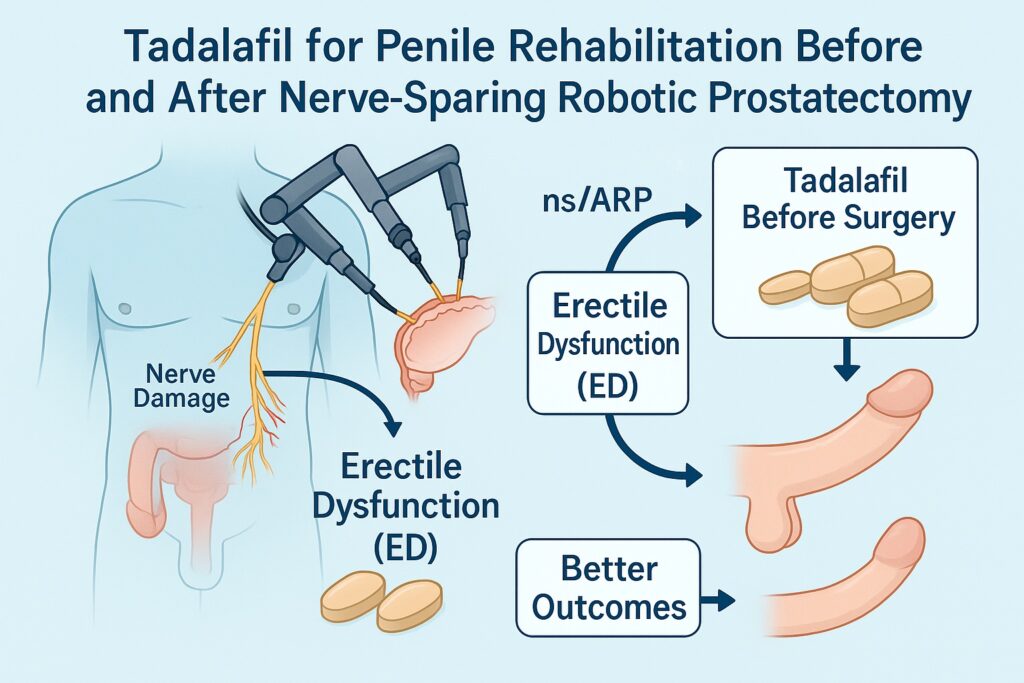
To mitigate this complication, the concept of penile rehabilitation was introduced: initiating pharmacological or mechanical interventions early after surgery to maintain oxygenation, reduce fibrosis, and encourage recovery of erectile capacity. Among the pharmacologic tools, tadalafil, a long-acting phosphodiesterase type 5 inhibitor (PDE5i), stands out. Its extended half-life and tolerability make it suitable for daily use and, theoretically, for continuous support of penile tissue.
The question, however, remains: should rehabilitation begin before the surgical insult occurs? The study at hand, a double-blind pilot trial, sought to answer this by comparing preoperative versus postoperative initiation of tadalafil in men undergoing nsRARP.
The Rationale for Preoperative Rehabilitation
The physiological basis for penile rehabilitation is simple but compelling. When cavernous nerves are stretched, cauterized, or compressed during surgery, they undergo neurapraxia—a temporary dysfunction that interrupts nitric oxide signaling. This reduces cavernosal oxygenation, leading to hypoxia, apoptosis, and smooth muscle fibrosis in the corpora cavernosa. Once fibrosis sets in, erectile recovery becomes exceedingly difficult.
Daily PDE5 inhibition supports the NO–cGMP pathway, maintaining smooth muscle relaxation, facilitating oxygen-rich arterial inflow, and preventing the hypoxia-induced cascade of tissue degeneration. If this process is already in motion before surgery, one might hypothesize that penile tissue becomes more resilient, better oxygenated, and therefore more tolerant of surgical stress.
The idea is not entirely novel. Prehabilitation—preparing organs and tissues before a major insult—has been explored in oncology, cardiology, and orthopedics. In this context, penile prehabilitation represents a logical extension.
Study Design and Methods
This was a prospective, double-blind, randomized pilot study conducted at Korea University. Forty-one men with localized prostate cancer scheduled for bilateral nsRARP were enrolled between 2017 and 2019.
Groups
- PreRARP group (n = 20): Tadalafil 5 mg once daily initiated two weeks before surgery and continued for 24 weeks, followed by placebo for 6 weeks.
- PostRARP group (n = 21): Placebo given until four weeks post-surgery, after which tadalafil 5 mg once daily was administered for 24 weeks.
Both groups received identical treatment durations (30 weeks), ensuring blinding integrity.
Eligibility
Patients were required to have preserved preoperative erectile function, defined as an IIEF-5 score ≥17. Those with advanced disease, incomplete nerve-sparing, or poor compliance (<70% adherence) were excluded.
Endpoints
The primary endpoint was recovery of erectile function, defined as an IIEF-5 score ≥17 during follow-up. Secondary endpoints included changes in IIEF-5 scores at 1, 3, 6, and 12 months, and safety outcomes.
Results: The Numbers Behind the Theory
Erectile Function Recovery
At 12 months, erectile recovery was achieved by 80% in the preRARP group versus 71.4% in the postRARP group. The difference was not statistically significant, likely due to the small sample size.
IIEF-5 Score Differences
Here the signal was clearer. The decline in erectile function from baseline was consistently less severe in the preRARP group:
- 1 month: –11.7 vs –14.7
- 3 months: –7.4 vs –12.0
- 6 months: –5.6 vs –9.7
- 12 months: –4.1 vs –6.0
By the one-year mark, mean IIEF-5 scores were significantly higher in preRARP patients (15.6 vs 12.8, p < 0.001).
Safety
Treatment was well tolerated. Only three patients reported mild adverse events—two with flushing, one with headache. No discontinuations occurred.
Clinical Implications
The study suggests that preoperative tadalafil offers a modest but measurable benefit in preserving erectile function after nsRARP. While the absolute rates of recovery may converge over time, the trajectory of functional decline is more favorable when the drug is initiated before surgery.
For clinicians, the findings support incorporating penile prehabilitation into perioperative care. It is not simply about treating ED after it occurs; it is about priming the tissue to withstand injury, much as preoperative exercise improves postoperative outcomes in other fields of medicine.
Patients, too, may find reassurance in taking proactive steps. Starting therapy before surgery can provide a sense of control at a time when many feel helpless.
Strengths and Limitations
This pilot study has notable strengths: randomized design, double-blind administration, and strict inclusion criteria ensuring a homogeneous cohort. The surgical procedures were performed by a highly experienced surgeon, reducing variability.
However, limitations temper the conclusions. The sample size was small, and the study was underpowered to detect modest differences in recovery rates. The follow-up period of 12 months may be insufficient, given that erectile recovery can continue for up to 24 months postoperatively. Furthermore, there was no untreated control group, nor an “immediate post-op” arm, which some studies suggest yields superior outcomes.
Biological Mechanisms: Why Timing Matters
Early initiation of tadalafil likely confers multiple benefits:
- Enhanced baseline oxygenation: Well-oxygenated tissue is less prone to hypoxia-induced apoptosis.
- Reduced fibrosis risk: Continuous PDE5 inhibition mitigates smooth muscle degeneration.
- Neural preservation: Though tadalafil does not directly heal nerves, maintaining tissue integrity provides a favorable environment for neural recovery.
In short, healthy soil allows injured roots to regrow.
Integrating Penile Rehabilitation Into Prostate Cancer Care
Erectile dysfunction after radical prostatectomy is more than a physiological inconvenience. It affects mental health, relationships, and quality of life. Addressing it should not be viewed as an optional luxury but as an integral part of cancer survivorship.
Rehabilitation strategies include:
- Oral PDE5 inhibitors (tadalafil, sildenafil, vardenafil)
- Vacuum erection devices
- Intracavernosal injections
- Counseling and psychosexual therapy
A multimodal approach, tailored to patient needs and preferences, is likely most effective. Prehabilitation with tadalafil may become the foundation on which these adjuncts are layered.
The Road Ahead
Larger, multicenter trials are required to confirm these findings. Ideally, such studies should include:
- Multiple arms (pre-op, immediate post-op, delayed post-op, control)
- Longer follow-up (24 months or more)
- Quality-of-life metrics, not just IIEF scores
- Cost-effectiveness analyses
Only then can preoperative PDE5i therapy be adopted as standard practice rather than an experimental strategy.
Conclusion
This pilot study provides encouraging evidence that starting tadalafil before nerve-sparing robotic prostatectomy leads to better preservation of erectile function than beginning therapy afterward. While not definitive, the results align with biological plausibility and patient-centered care principles.
The lesson is simple: in rehabilitation, as in life, starting early matters. Waiting until damage has occurred is less effective than preparing tissues for the insult in advance. Penile prehabilitation with tadalafil may therefore represent the next evolution in prostate cancer survivorship strategies.
FAQ
1. Should all men scheduled for robotic prostatectomy start tadalafil before surgery?
Not yet. Evidence is promising but based on small studies. Discuss with your urologist whether preoperative PDE5i therapy is suitable for your case.
2. Does starting tadalafil before surgery guarantee normal erectile function afterward?
No. Recovery depends on multiple factors—age, baseline function, surgical precision, and comorbidities. Preoperative tadalafil improves the odds but is not a panacea.
3. Are there risks to taking tadalafil long-term around surgery?
At 5 mg daily, tadalafil is generally safe. The most common side effects are mild headache, flushing, and dyspepsia. In this study, adverse events were minimal and transient.
