

Erectile dysfunction (ED) has long been viewed as a discreet symptom with profound impacts on male sexual health, confidence, and quality of life. Modern pharmacology, particularly phosphodiesterase-5 (PDE5) inhibitors, has dramatically transformed its management. Yet behind seemingly straightforward prescriptions lies a more complex clinical question: Do patient age, comorbidities, or prior treatment experiences meaningfully influence long-term effectiveness, adherence, and satisfaction?
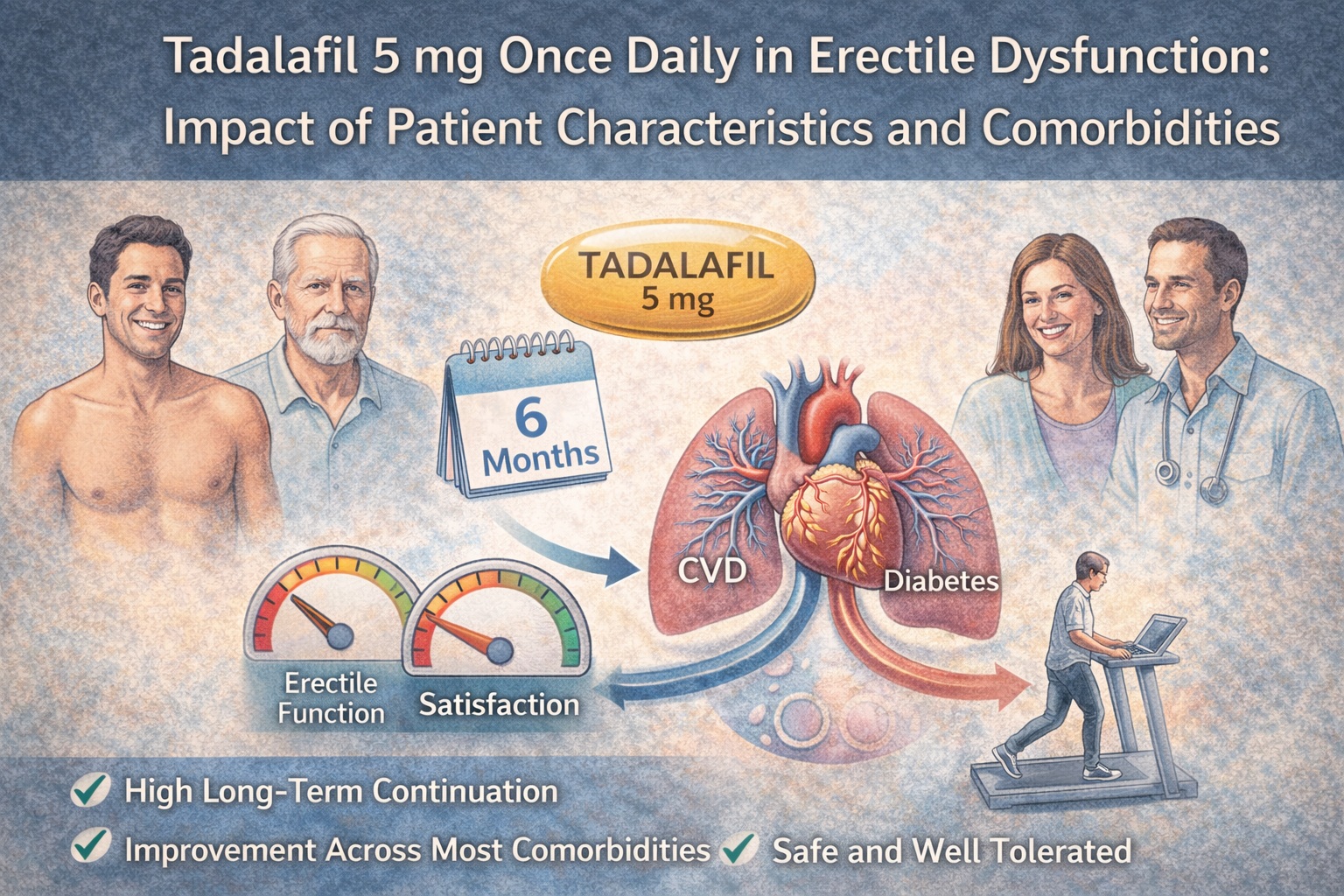
The large observational EDATE study attempts to answer precisely this. Unlike controlled trials sealed from the variability of real-life medicine, EDATE followed nearly 800 men treated with tadalafil 5 mg once daily over 6 months under routine clinical conditions across four European countries. The findings offer refreshing clarity—and occasionally challenge traditional assumptions—about what truly determines therapeutic success.
Below is a deep, structured, and nuanced exploration of these findings, offering clinicians practical insights into personalized ED care.
Understanding Erectile Dysfunction Through the Lens of Real-World Complexity
ED seldom appears in isolation. As the baseline characteristics in the EDATE cohort illustrate, more than half of all men seeking medical therapy for ED carry at least one significant comorbidity, and many present with multiple overlapping cardiovascular risk factors. Hypertension, dyslipidemia, cardiovascular disease (CVD), diabetes, obesity, sedentary lifestyle, and benign prostatic hyperplasia (BPH) frequently shape the clinical picture.
These conditions are not simply spectators—they affect vascular integrity, nerve signaling, hormonal balance, endothelial function, and even psychological wellbeing.
The EDATE dataset reinforces what many clinicians observe anecdotally: men with ED often belong to a metabolically vulnerable demographic. According to the study, 58.4% of men had ≥1 comorbidity and 33.4% had hypertension, while 15.9% had diagnosed diabetes, and a sizable subset reported dyslipidemia and cardiovascular pathology. Younger men were in the minority.
This creates a clinical reality where ED management must perform robustly despite multiple physiological disadvantages—not under idealized trial conditions, but within the messy, unpredictable landscape of daily medical practice.
Tadalafil 5 mg once daily—unlike on-demand PDE5 inhibitors—offers a pharmacokinetic profile designed for sustained endothelial support, improved spontaneous sexual performance, and consistent plasma levels. In theory, its steadiness should yield high adherence, fewer performance-related anxieties, and improved satisfaction. EDATE validates much of this, though with important nuances.
Treatment Continuation: A Measure of Real-World Treatment Success
Continuation rates represent not only tolerability and efficacy but also patient motivation, convenience, and expectations. In ED, where treatment often intersects with sensitive emotional and relational dynamics, long-term persistence is an especially valuable clinical outcome.
Across the entire study population, treatment continuation remained notably high. At 2, 4, and 6 months, 94%, 88.3%, and 86.3% of participants respectively remained on tadalafil. Such figures markedly exceed those typically documented for on-demand PDE5 inhibitors, which often have discontinuation rates above 40–50% within the first year.
Several phenomena likely contribute to this difference:
- Daily therapy reduces the psychological “event pressure” of needing to anticipate sexual activity.
- Patients report increased confidence knowing physiological support is continuously available.
- The treatment format may encourage healthier sexual spontaneity and couple intimacy.
However, adherence was not uniform across all patient groups.
Age Effect: Why Older Men Continue Less Often
Patients above 65 years had the lowest continuation rate: 75% at 6 months, compared to nearly 90% among younger men. Although still high, this drop-off is clinically meaningful.
Older patients may experience:
- Higher fear of side effects due to age or existing comorbidities
- Lower sexual activity frequency, influencing perceived need for daily therapy
- More polypharmacy, increasing concerns about drug interactions
- Greater financial hesitancy regarding long-term treatment
Interestingly, discontinuation reasons did not differ substantially between age groups, suggesting this trend may relate more to health beliefs and lifestyle factors than to measurable physiological differences.
Disease Severity and Adherence
Patients with severe ED also demonstrated a slightly lower continuation rate—still above 80%, but statistically distinct. The emotional burden of severe ED may drive unrealistic expectations; some patients may discontinue early if they do not experience rapid, dramatic improvement. Yet their eventual treatment response patterns (discussed later) reveal an interesting paradox.
Efficacy and Improvements: How Different Patients Respond to Daily Tadalafil
Across the cohort, tadalafil significantly improved all domains of the International Index of Erectile Function (IIEF), including erectile function (EF), orgasmic function, sexual desire, intercourse satisfaction, and overall satisfaction. Improvements were clinically meaningful and sustained through the 6-month period.
However, baseline characteristics did shape the magnitude of these improvements.
PDE5-Inhibitor Pretreated vs. Treatment-Naïve Patients
Men who had previously used PDE5 inhibitors—but switched to tadalafil—demonstrated smaller improvements across EF, orgasmic function, and satisfaction. This finding is intuitive: many switched because of prior insufficient efficacy, meaning they likely represented a more treatment-resistant subgroup.
This reinforces an important counseling message:
Patients switching from another PDE5 inhibitor may improve, but should not always expect dramatic results.
Disease Severity: Paradoxical Patterns
Patients with more severe ED at baseline paradoxically showed greater improvement in several domains. This likely reflects the mathematical reality that greater deficit allows greater measurable change. Mild ED patients, by contrast, have less “room to improve.”
Clinicians should interpret this carefully: greater improvement does not necessarily mean achieving full function—it simply reflects relative change.
Benign Prostatic Hyperplasia (BPH)
Interestingly, BPH was associated with reduced improvement in erectile function, orgasmic function, and sexual desire. This aligns with known BPH-related pelvic hemodynamic alterations and the multifactorial nature of LUTS-driven sexual dysfunction.
However, the number of BPH patients was small, and reported diagnoses were not systematically confirmed. Thus, these findings, although intriguing, should be interpreted cautiously.
Diabetes: A Surprisingly Positive Trend
Contrary to common assumptions about diabetes and ED, men with diabetes exhibited greater improvements in EF and several related domains. The most likely explanation is that diabetic patients in this cohort started with more severe ED, making their relative gains appear stronger.
It does not contradict existing evidence that diabetics generally have more refractory ED—but shows that tadalafil can still achieve meaningful improvements in this difficult population.
Comorbidities with No Significant Effect
CVD, dyslipidemia, hypertension, and ED etiology (organic vs psychogenic vs mixed) did not significantly influence improvements. This is clinically reassuring and reinforces tadalafil’s cardiovascular safety profile and robustness in complex patient populations.
Patient Satisfaction: Who Felt the Benefits Most?
Treatment satisfaction, measured through EDITS, increased significantly across the entire cohort. This reflects not only improved sexual performance but also improved confidence, reduced anxiety, and better partner dynamics.
Surprisingly, satisfaction was not significantly affected by:
- Comorbidities
- ED severity
- ED etiology
- Prior PDE5-inhibitor use
The only factor that significantly influenced satisfaction was age, with younger men reporting higher scores.
Possible explanations include lifestyle differences, sexual activity frequency, or differing expectations between generations. Older men may also have less emphasis on sexual activity as a central contributor to self-esteem or relationship satisfaction.
Safety: Confirming a Well-Established Profile
Only minimal adverse events were reported—primarily headache and dyspepsia—consistent with tadalafil’s well-recognized safety profile. No new concerns emerged. Notably, the presence of comorbidities did not increase adverse event rates or treatment discontinuation.
Given that over 57% of patients were taking at least one concomitant medication, this reinforces tadalafil’s excellent compatibility in polypharmacy environments.
Clinical Implications: What This Study Means for Everyday Practice
The EDATE findings offer several practical insights for clinicians counseling men with ED:
- Age >65 years predicts lower persistence, requiring more targeted counseling around expectations.
- Pretreated patients may see less improvement, and should be advised accordingly.
- Comorbidities generally do not limit treatment success, easing concerns about selecting tadalafil for complex patients.
- Severe ED is not a contraindication to daily dosing; in fact, these patients may experience greater relative improvement.
- Daily therapy is strongly effective and well tolerated, making it an excellent choice for long-term management.
Most importantly, the study shows that daily tadalafil offers a robust, reliable, and adaptable option capable of succeeding across a diverse patient population in real clinical practice—not just in idealized trial settings.
FAQ
1. Does the presence of comorbidities like diabetes or hypertension reduce the effectiveness of tadalafil 5 mg daily?
Generally, no. The study demonstrated that most comorbidities—hypertension, dyslipidemia, CVD—did not significantly affect treatment response. Interestingly, diabetic patients showed even greater improvements, likely because they began with more severe dysfunction. Daily tadalafil remains a strong option in patients with multiple comorbidities.
2. Should older men (>65 years) avoid daily tadalafil because they continue treatment less often?
Not at all. Older men still maintained a 75% continuation rate at 6 months—very high by real-world standards. However, they may require additional counseling on expectations, safety, and onset of benefits. The drug remains safe, effective, and well tolerated.
3. If a patient previously tried another PDE5 inhibitor without satisfaction, will tadalafil daily work better?
Possibly, but expectations must be realistic. Pretreated patients in this study improved, but generally to a lesser degree than treatment-naïve men. Daily dosing may overcome some limitations of on-demand therapies, but complete restoration of function is not guaranteed.
