

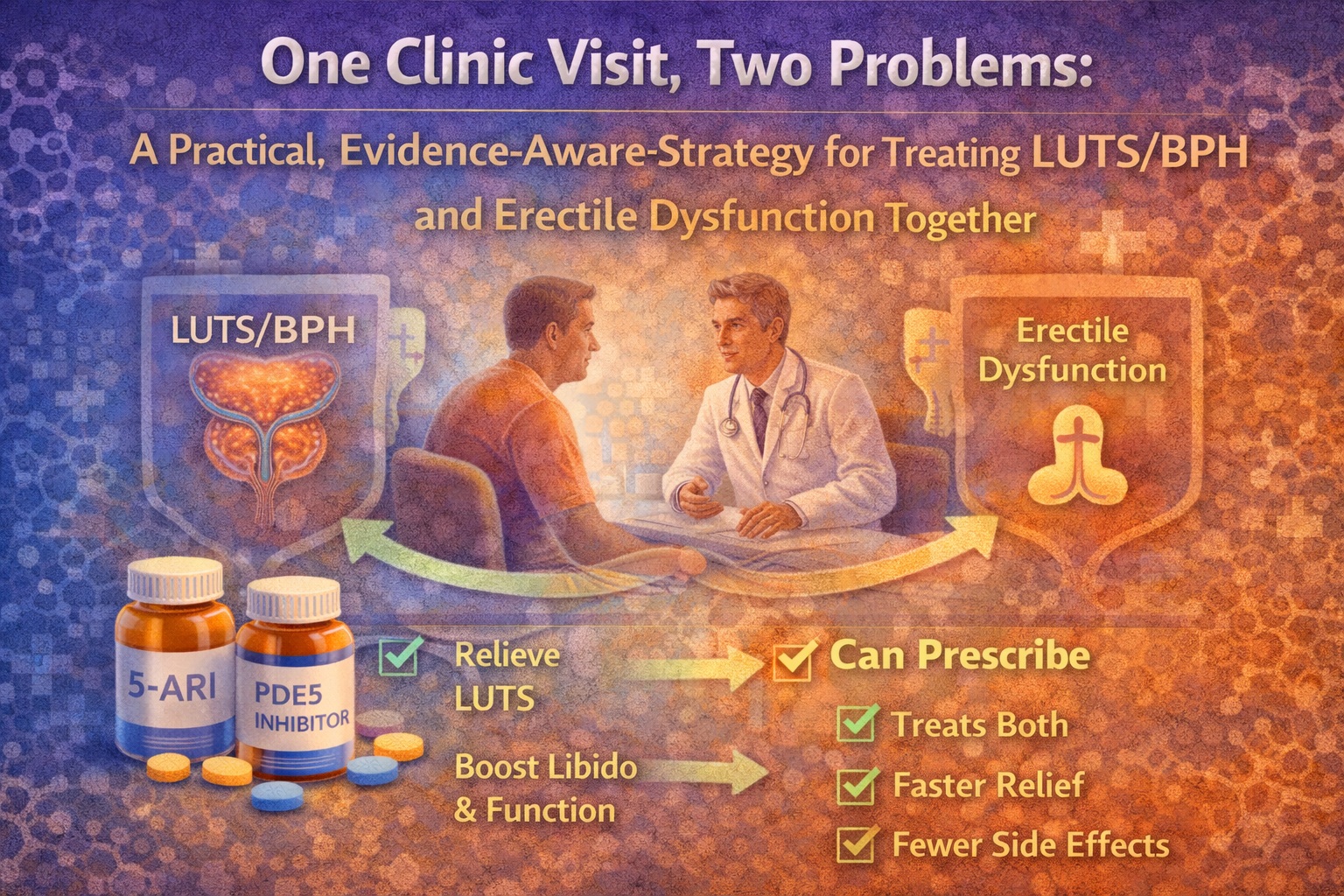
Lower urinary tract symptoms (LUTS) due to benign prostatic hyperplasia (BPH) and erectile dysfunction (ED) are two conditions that like to arrive as a pair—especially as men age. Many patients come in talking about urinary frequency, nocturia, weak stream, or urgency, and only later (often after a brief pause and a strategic glance at the floor) mention erections. Clinically, this pairing is not a coincidence. LUTS/BPH and ED share overlapping biology—vascular dysfunction, inflammation, metabolic drivers, hormonal changes—and they share the same “real life” consequences: impaired sleep, reduced confidence, strained relationships, and a slow erosion of quality of life.
For years, treatment conversations were unnecessarily siloed. Urologists treated urinary symptoms with alpha-blockers and 5-alpha reductase inhibitors, while ED was handled separately with phosphodiesterase type 5 inhibitors (PDE5 inhibitors). The modern view is more integrated: choose therapies that address both conditions when possible, avoid treatments that fix one problem while worsening the other, and tailor the plan based on symptom severity and risk profile. This is not “holistic medicine” as a slogan—it is simply not wasting opportunities to treat two linked diseases with one coherent strategy.
The review you provided makes a clear, clinically useful argument: tadalafil 5 mg once daily is currently the best evidence-supported pharmacologic “bridge” therapy for men who have LUTS/BPH with or without ED, and combination therapy with selective alpha-blockers can be considered when symptoms demand it—provided cardiovascular and blood-pressure considerations are respected. It also explains why other PDE5 inhibitors show promise but remain outside guideline options for LUTS/BPH in many settings.
Why LUTS/BPH and ED Travel Together
The shared biology begins with the obvious: both conditions are strongly associated with aging. But the deeper connection is less about calendar years and more about metabolic and vascular aging—the gradual decline in endothelial function, the rise of low-grade inflammation, dyslipidemia, insulin resistance, and the microvascular consequences that follow. The review highlights metabolic syndrome as a key contributor to both LUTS/BPH and ED, positioning it as a central upstream driver rather than a side note.
The second link is hormonal. Men with BPH may display lower testosterone levels, and hypogonadism can worsen erectile function and may also influence urinary symptoms. Testosterone replacement therapy may help in selected patients, although it requires careful evaluation and monitoring. The important clinical point is not that testosterone is a universal fix, but that hormonal impairment can be part of the shared pathophysiology and should not be ignored when symptoms are stubborn or disproportionate.
Finally, there is the local pelvic biology: prostatic stromal tone, bladder neck dynamics, detrusor overactivity, afferent nerve signaling, and pelvic ischemia. LUT tissues (prostate, urethra, bladder) contain PDE5 activity, and chronic hypoperfusion may contribute to symptom persistence. Meanwhile, ED is often a vascular sentinel event—frequently preceding overt cardiovascular disease by years. Put bluntly: if the penis is complaining about blood flow, the prostate and bladder may be living in the same neighborhood.
How to Assess the Patient Without Turning the Visit Into a Questionnaire Festival
A practical approach starts with two tools the review treats as central: IPSS (International Prostate Symptom Score) and IIEF-5 (a short erectile function questionnaire). These instruments are not busywork; they help quantify symptom severity, guide treatment choice, and make follow-up meaningful. In mixed LUTS/BPH–ED cases, they also prevent the clinician from chasing the loudest symptom while ignoring the clinically important one.
Baseline characteristics matter more than many clinicians admit. The review notes that treatment effects with PDE5 inhibitors can vary with age, BMI, and baseline symptom burden. In the cited analyses, younger age, lower BMI, and higher baseline IPSS were associated with greater LUTS improvement during PDE5 inhibitor therapy. This is clinically intuitive: younger men may have more reversible functional components (vascular tone, smooth muscle regulation), while severe baseline LUTS provides more “room” for measurable improvement.
Assessment also needs one step that is often skipped because it sounds less urologic: cardiovascular screening. Alpha-blockers and PDE5 inhibitors can interact hemodynamically. Many men with ED have silent cardiovascular disease risk factors. Treating LUTS/BPH and ED safely therefore requires you to look beyond the prostate—blood pressure, antihypertensives, nitrate use, dizziness history, and orthostatic symptoms matter. The review explicitly emphasizes counseling from both urologic and cardiac perspectives when combined therapy is considered.
PDE5 Inhibitors as Dual-Purpose Therapy: The cGMP Pathway Leaves the Penis and Enters the Lower Urinary Tract
PDE5 inhibitors increase cyclic GMP (cGMP) by inhibiting PDE5, enhancing smooth muscle relaxation through NO–cGMP signaling. In erectile tissue, this supports cavernosal relaxation and erection. What makes them relevant to LUTS/BPH is that PDE5 activity is also present in the lower urinary tract—prostate, urethra, and bladder—and multiple smooth muscle compartments involved in urinary function show PDE5-related activity.
The review explains several mechanisms by which PDE5 inhibition can improve LUTS. One is smooth muscle relaxation in the bladder neck, prostate, and urethra, reducing functional obstruction and improving both storage and voiding symptoms. Another is improved perfusion and oxygenation of LUT tissues through vasculature effects, potentially counteracting ischemia-related dysfunction. A third mechanism is modulation of afferent nerve activity, where improved NO signaling may dampen overactive sensory pathways in the bladder and urethra. These are mechanistic proposals supported by preclinical and translational findings rather than a single “smoking gun,” which is exactly how most real physiology behaves.
Clinically, the review is careful about what improves and what often does not. Symptom scores and quality of life commonly improve (IPSS, BPH Impact Index, QoL), while urodynamic parameters such as residual urine and maximum flow (Qmax) show mixed results across studies. This is important for expectation management. A patient may feel meaningfully better without a dramatic change in Qmax, because symptom relief is not always strictly proportional to flow rates—especially when sensory/irritative components dominate.
Tadalafil 5 mg Daily: Why It Sits at the Center of Current Medical Strategy
Among PDE5 inhibitors, tadalafil 5 mg once daily holds a special position because it is the only PDE5 inhibitor explicitly approved in Europe for LUTS/BPH with or without ED (approval noted as October 2011 in the review). This is not merely a regulatory trivia fact. It reflects a critical threshold: enough clinical trial consistency to justify positioning tadalafil as a standard option in this combined phenotype.
The review summarizes evidence from randomized trials and meta-analyses showing that tadalafil monotherapy improves total IPSS and both irritative and obstructive subdomains, improves BPH Impact Index and QoL, and improves erectile function scores. The magnitude of IPSS change can be modest in points but clinically meaningful, especially when paired with improved sexual function—because patients experience these outcomes together, not in separate academic compartments.
An equally important point is what tadalafil typically does not do: it usually does not meaningfully change PSA, and often does not produce major changes in residual urine volume. Qmax results are inconsistent across meta-analyses, likely due to differences in enrollment criteria (e.g., sexually active men with ED vs men with isolated LUTS) and baseline flow characteristics. The clinician’s takeaway is practical: tadalafil is best framed as a therapy that improves symptoms and quality of life, not as a drug that reliably “widens the pipe” in urodynamic terms.
The review also identifies the “ideal” candidate profile in broad strokes: a relatively younger man, lower BMI, higher IPSS at baseline. In real practice, that does not mean older men cannot benefit—it means you should be more cautious about promising dramatic LUTS improvement in men whose symptoms are driven by advanced anatomic obstruction, severe detrusor dysfunction, or multiple comorbidities. Tadalafil is powerful in the right phenotype, and merely helpful in others—which is still valuable, if you present it honestly.
Combination Therapy With Alpha-Blockers: When One Drug Is Not Enough, and When Two Drugs Are Too Much
Alpha-adrenergic antagonists are first-line therapy for LUTS/BPH, and they work by reducing smooth muscle tone in the prostate and bladder neck. The logic for combining them with a PDE5 inhibitor is straightforward: one drug targets adrenergic tone, the other targets cGMP-mediated smooth muscle regulation and possibly perfusion and afferent signaling. In multiple studies, combination therapy improved urinary symptom scores more than monotherapy in selected patients.
But combination therapy is not a “free upgrade.” The review emphasizes hemodynamic risk, especially blood pressure lowering. A particularly important safety signal comes from the study where tadalafil was combined with doxazosin: the combination produced a significant decrease in maximum systolic blood pressure and caused dizziness in some patients—sometimes not neatly correlated with measured blood pressure changes. By contrast, combining tadalafil with tamsulosin did not produce significant blood pressure lowering in that study framework, and tadalafil combined with alfuzosin also showed no significant hemodynamic changes in another trial. These distinctions matter because they guide safer prescribing choices.
The review translates this into a clear clinical rule: tadalafil with non-selective alpha-blocker doxazosin is contraindicated, while tadalafil with selective alpha-blockers (such as tamsulosin or alfuzosin) may be possible in selected cases with appropriate precautions. Combination therapy appears particularly useful when LUTS are moderate-to-severe and ED is present, or when monotherapy improves one domain but leaves the other insufficiently treated. This is where integrated urologic–cardiac counseling stops being a formality and becomes the difference between good treatment and an avoidable syncopal episode.
Beyond Tadalafil: Sildenafil, Vardenafil, and Newer Agents—Promising Signals, Uneven Evidence, Limited Guideline Adoption
Sildenafil has a long clinical history in ED and has been studied in LUTS/BPH as well. The review describes multiple studies showing improvements in IPSS and QoL and sometimes nocturia, with inconsistent changes in Qmax and residual urine. The emerging pattern is similar to tadalafil: symptom improvement is more consistent than flow improvement. The limitation is not that sildenafil “fails,” but that evidence has not positioned it as a guideline-preferred LUTS/BPH therapy compared with tadalafil’s daily regimen and approval status.
Vardenafil has been evaluated less widely but showed significant IPSS improvement versus placebo in a randomized trial, with improvements in both obstructive and irritative subscores and QoL, again without a significant difference in Qmax. The review also notes methodological critiques of that trial (for example, absence of a run-in period and a baseline Qmax close to normal), which limits how confidently the results can be generalized. Still, it supports the broader concept: PDE5 inhibition can reduce LUTS, but translating that into standardized clinical pathways requires more consistent trial architecture.
The review also discusses newer or regionally available PDE5 inhibitors—avanafil, mirodenafil, udenafil—with attention to selectivity, pharmacokinetics, and limited LUTS/BPH evidence. Avanafil’s high PDE5 selectivity may reduce off-target adverse effects (such as PDE6-related visual disturbances seen with other agents), but there is no established LUTS/BPH role. Mirodenafil and udenafil show encouraging results in combination with alpha-blockers in studies conducted in Korea and other regions, improving IPSS and IIEF-5 with minimal hemodynamic issues, yet broad approval and guideline positioning remain limited. The clinically sober interpretation is: these drugs may eventually expand options, but tadalafil remains the practical anchor in the LUTS/BPH–ED overlap today.
When LUTS Therapy Harms Sexual Function: Avoiding “Successful” Treatment That Patients Regret
Not all LUTS/BPH treatments are friendly to sexual health. The review highlights that combination therapy involving alpha-blockers and 5-alpha reductase inhibitors (5-ARI) can increase the risk of erectile dysfunction and libido alteration compared with alpha-blocker monotherapy. In the cited meta-analysis, the prevalence of ED and libido alteration was higher in combination therapy than in alpha-blocker therapy alone. It also suggests a higher ED risk compared with 5-ARI alone, while libido changes were not significantly different between combination therapy and 5-ARI alone.
This matters because many men present with LUTS as their “official complaint” but care deeply about sexual function. If you improve nocturia and weaken erections, some patients will experience the treatment as failure—even if symptom scores look better. The clinician’s job is not to chase one domain at the expense of the other, but to prioritize what the patient values while still treating clinically meaningful obstruction and progression risk.
This is where tadalafil’s dual-domain effect becomes strategically valuable. If a man has LUTS/BPH and ED, tadalafil can improve both symptom sets and reduce the likelihood that urinary therapy worsens sexual function. That doesn’t eliminate the need for alpha-blockers or 5-ARI when indicated (particularly in larger prostates or progressive disease), but it shifts the decision from “either/or” to “sequence and combination” tailored to the individual’s priorities and risk.
A Pragmatic Treatment Algorithm You Can Actually Use
The review includes a practical flow-chart (Figure 1 on page 7) that uses IPSS and IIEF-5 to guide first-line pharmacologic choices. Its strength is simplicity: start with quantification, choose the least complex effective therapy, and escalate when symptom domains demand it.
The logic can be summarized without turning your clinic into a math contest. If erectile function is preserved (IIEF-5 > 21) and urinary symptoms are mild (IPSS 0–7), phytotherapy can be considered. If erectile function is preserved but urinary symptoms are more than mild (IPSS > 7), alpha-blocker therapy is appropriate. If erectile function is impaired (IIEF-5 < 21), tadalafil 5 mg daily is suggested, with consideration of adding alpha-blockers in cases where LUTS severity dominates.
Importantly, the review emphasizes that combined therapy should be chosen through an integrated approach that accounts for outcomes and adverse effects—particularly blood pressure effects—and that selective alpha-blockers are safer partners for tadalafil than non-selective agents like doxazosin. In other words, the algorithm is not a rigid recipe; it is a starting structure with safety rules built in.
If you want the clinical “tone” of this strategy in one sentence: treat what is most bothersome, protect what matters most, and do not create a blood-pressure problem while solving a prostate problem.
Conclusion: Treat the Shared Biology, Measure What Matters, and Prescribe Like the Patient Has a Life Outside the Clinic
LUTS/BPH and ED are linked by shared pathophysiology and shared patient impact. Treating them together is not a luxury—it is efficient, realistic medicine. The evidence summarized in the review supports tadalafil 5 mg once daily as the central medical option for men with moderate-to-severe LUTS/BPH with or without ED, particularly when quality of life and sexual function must both be preserved.
When LUTS severity is substantial, alpha-blockers remain foundational, and combination therapy with tadalafil can be effective—especially with selective alpha-blockers and careful attention to hemodynamics. Avoiding risky combinations (notably tadalafil with doxazosin) is a key safety principle. Meanwhile, the clinician should remember that some BPH therapies can worsen erectile function and libido, and this risk should be part of the initial conversation, not a surprise at follow-up.
Finally, effective care depends on measurement and honest expectations. Use IPSS and IIEF-5 at baseline and follow-up. Aim for symptom improvement and quality-of-life gains, not necessarily dramatic urodynamic shifts. And remember the quiet irony of modern urology: men often come in asking for a stronger urine stream, but what they really want is to sleep through the night and feel like themselves again.
FAQ
1) Why is tadalafil 5 mg daily considered the best single-drug option for men with both LUTS/BPH and ED?
Because it has consistent evidence for improving urinary symptom scores and erectile function, and it is the only PDE5 inhibitor specifically approved (in Europe) for LUTS/BPH with or without ED. It tends to improve symptoms and QoL even when flow metrics like Qmax change little.
2) Can tadalafil be combined with alpha-blockers safely?
Sometimes, yes—but not casually. The review highlights meaningful blood-pressure effects when tadalafil is combined with doxazosin (non-selective), making that combination contraindicated, while combinations with selective agents like tamsulosin or alfuzosin show safer hemodynamic profiles in studies. Clinical precautions and cardiovascular awareness are essential.
3) Do standard BPH drugs increase the risk of erectile dysfunction?
They can. Combination therapy with alpha-blockers plus 5-alpha reductase inhibitors has been associated with higher rates of ED and libido changes compared with alpha-blocker monotherapy in a referenced meta-analysis. This is why treatment selection should explicitly consider sexual priorities and baseline function.
