

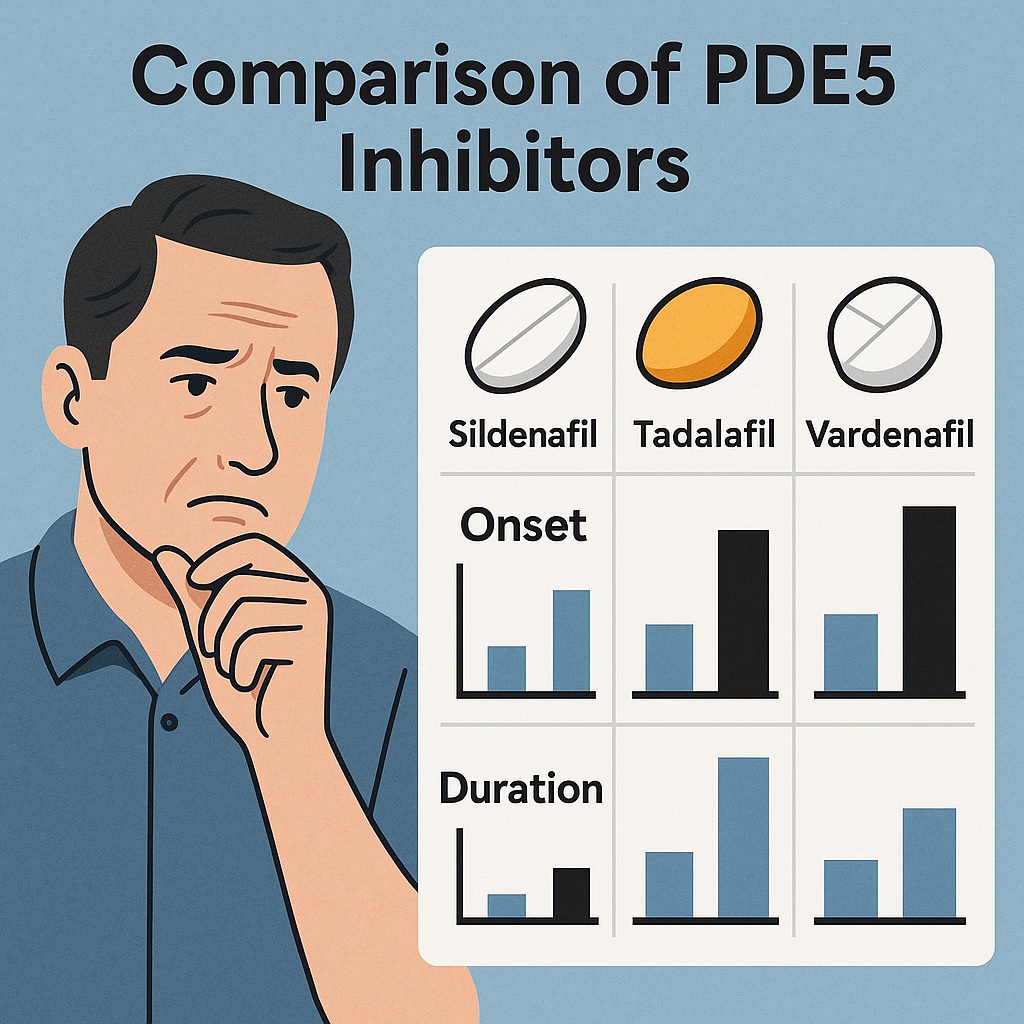
Erectile dysfunction (ED) remains one of the most prevalent and multidimensional conditions in men’s health, affecting vascular integrity, endothelial responsiveness, psychosocial well-being, and overall quality of life. Over the past two decades, tadalafil has emerged as one of the most flexible pharmacologic agents in ED therapy, offering both on-demand dosing for episodic use and once-daily administration for continuous effect.
However, for clinicians confronted with real patients rather than idealized trial participants, one troubling question persists: Which regimen actually performs better in practice? Theoretical arguments exist for both strategies, but until recently, direct comparative evidence has remained scattered and inconsistent.
The meta-analysis from 2025 provides one of the most comprehensive evaluations to date, integrating randomized controlled trials that compared tadalafil 5 mg once-daily with tadalafil 10–20 mg on-demand. The analysis addresses not just efficacy, but safety, tolerability, patient preference, and the subtle—but clinically meaningful—differences in how each regimen influences sexual function and satisfaction.
This article dissects those findings from a clinician-scientist’s perspective, weaving together physiological intuition, statistical outcomes, and practical therapeutic insight. The goal is not simply to summarize data but to refine decision-making for everyday clinical practice.
Understanding the Clinical Logic Behind Two Dosing Strategies
Tadalafil differs from other PDE5 inhibitors primarily due to its long half-life of approximately 17.5 hours. This pharmacokinetic advantage enables two distinct therapeutic philosophies.
The On-Demand Approach: Episodic Optimization
Traditionally, ED therapy has centered on on-demand dosing. Patients take 10–20 mg of tadalafil approximately one hour before sexual activity. The rationale is straightforward:
- maximize PDE5 inhibition during anticipated intercourse;
- avoid unnecessary medication exposure;
- keep treatment tied to sexual activity rather than daily routine.
This regimen appeals to patients who value control, prefer infrequent dosing, or engage in sexual activity sporadically.
Yet this approach requires foresight, planning, and coordination—activities often at odds with human sexuality. Indeed, many patients report that timing constraints, performance anxiety, and the ritualistic nature of pill-taking interfere with spontaneity.
The Once-Daily Strategy: Steady-State Restoration
The alternative is 2.5–5 mg tadalafil daily, which maintains continuous plasma concentrations. The theoretical advantages are compelling:
- improved endothelial function via constant PDE5 inhibition;
- enhanced smooth muscle relaxation and penile oxygenation;
- restoration of spontaneous sexual confidence;
- elimination of timing requirements.
From a pathophysiological standpoint, ED is a chronic condition. Steady-state PDE5 inhibition arguably treats the disease rather than the episode.
The 2025 meta-analysis tests this theory empirically.
Efficacy Outcomes: What the Meta-Analysis Actually Found
A central question addressed by the study is whether once-daily tadalafil improves erectile function more effectively than on-demand regimens. Using standardized IIEF-EF scores and sexual encounter metrics, the pooled analysis revealed a consistent and clinically meaningful pattern.
1. Once-daily tadalafil demonstrated significantly higher IIEF-EF improvements.
Across multiple trials, daily tadalafil produced greater mean increases in erectile function scores than on-demand dosing. The effect was not marginal—it was statistically robust and clinically visible.
This finding suggests that continuous endothelial support translates into more consistent erectile performance, particularly in men with mild to moderate ED.
2. Successful intercourse attempts were more frequent with daily dosing.
Metrics such as SEP2 and SEP3 consistently favored once-daily therapy. Patients reported:
- more reliable erections;
- fewer failed attempts;
- greater sexual confidence.
This reflects not only pharmacology but psychology. When sexual performance does not depend on timing a dose, patients relax—and physiology tends to follow.
3. On-demand therapy still performed well but produced more variability.
Patients using on-demand tadalafil often experienced excellent erections—but inconsistently. Variability is inherent in episodic dosing, driven by food effects, timing errors, and fluctuations in arousal.
Daily dosing smoothed out these peaks and troughs.
Safety and Adverse Events: The Clinical Balancing Act
A persistent concern among clinicians is whether daily tadalafil, by virtue of continuous exposure, increases side effects. The meta-analysis offers reassuring clarity.
1. Overall adverse event rates were similar between groups.
Both regimens produced expected PDE5-inhibitor–related adverse events:
- headache,
- dyspepsia,
- flushing,
- back pain.
However, their frequency did not increase significantly in the once-daily arm despite continuous dosing.
2. Discontinuation rates were slightly lower with once-daily dosing.
This observation deserves attention. Therapy adherence depends not only on drug tolerability but on patient experience. The convenience and spontaneity of daily therapy may improve satisfaction sufficiently to outweigh mild adverse events.
3. Severe adverse events were rare and evenly distributed.
There was no evidence that daily tadalafil increases cardiovascular risk or precipitates serious complications when used appropriately.
From a safety standpoint, once-daily tadalafil is not merely acceptable—it is nearly equivalent to on-demand therapy.
Why Once-Daily Tadalafil Outperforms: A Physiological Explanation
Clinical outcomes must be interpreted through a mechanistic lens. The superiority of once-daily tadalafil likely arises from several reinforcing biological effects.
Continuous endothelial support
Daily PDE5 inhibition:
- boosts nitric oxide bioavailability,
- reduces oxidative stress in penile vasculature,
- improves endothelial responsiveness.
Repeated microdoses act cumulatively, much like antihypertensive therapy improves vascular tone over time.
Enhanced oxygenation of cavernosal smooth muscle
Daily tadalafil improves nocturnal and sub-threshold erections. These physiological events oxygenate cavernosal tissue, preventing fibrotic remodeling.
Reduction in performance pressure
Knowing the drug is already active eliminates timing anxiety. This psychological relief directly improves erectile performance.
Treatment of comorbid conditions
Low-dose tadalafil also alleviates lower urinary tract symptoms (LUTS), improves pelvic blood flow, and reduces prostatic tension.
Many ED patients have overlapping pelvic vascular dysfunction; daily therapy targets the entire system.
Subgroup Insights: Which Patients Benefit Most?
The meta-analysis highlighted several categories of men who respond particularly well to once-daily tadalafil.
1. Men with mild-to-moderate ED
These patients often have partially preserved vascular function that improves with steady endothelial support.
2. Men with comorbid LUTS/BPH
Daily tadalafil is already approved for LUTS. For men with both ED and urinary symptoms, once-daily dosing treats two conditions simultaneously.
3. Men with psychogenic or mixed ED
On-demand therapy can inadvertently increase anxiety. Daily tadalafil removes this psychological burden.
4. Men in stable relationships
The meta-analysis consistently shows that daily therapy improves relational satisfaction more than episodic dosing.
Conversely, who benefits from on-demand therapy?
Men with infrequent sexual activity, cost constraints, or sensitivity to PDE5 inhibitors may prefer the episodic regimen.
This nuance highlights a key theme: daily tadalafil is often superior, but not universally optimal.
Patient Preference: The Behavioral Dimension of Sexual Medicine
Interestingly, patient-reported preference consistently favored daily tadalafil in trials where both regimens were offered without cost differences. Men valued:
- spontaneous sexual activity,
- confidence that an erection would not “fail by mistake,”
- less medicalized sexual encounters.
This aligns with real-world clinical experience: the emotional and relational context of ED therapy often outweighs strictly physiological considerations.
Clinical Application: How Should Clinicians Choose Between Regimens?
The meta-analysis supports a practical, patient-centered approach.
When to prefer once-daily tadalafil:
- when ED coexists with LUTS;
- when sexual activity is frequent or unpredictable;
- when anxiety exacerbates ED;
- when previous on-demand therapy gave inconsistent results;
- when desire for spontaneity is high;
- when endothelial dysfunction is suspected.
When to prefer on-demand therapy:
- when intercourse is infrequent;
- when cost is a limiting factor;
- when patients experience side effects from daily exposure;
- when sexual activity is fully predictable.
Thus, the choice is not binary but tailored.
A Professor’s Reflection on the Evidence
The findings of the 2025 meta-analysis confirm what many clinicians have suspected through years of practice: daily tadalafil is not merely a convenience—it is a more physiologically coherent, psychologically supportive, and clinically stable therapeutic approach.
The on-demand formulation retains an important place, especially for occasional use, but the notion that 20 mg on-demand is “stronger” is misleading. Strength in ED therapy is not measured by milligrams—it is measured by consistency, satisfaction, and restoration of confidence.
Daily tadalafil addresses ED as a chronic vascular disorder, not as a series of disconnected sexual events.
Conclusion
The meta-analysis demonstrates that 5 mg daily tadalafil provides superior improvements in erectile function, higher rates of successful intercourse, better patient satisfaction, and equal safety compared to on-demand dosing.
These findings strongly support the view that ED is best managed through a chronic therapy model, particularly in men with comorbid LUTS, psychological contributors, or inconsistent erectile performance.
On-demand tadalafil remains useful, but for many patients, once-daily therapy offers a more natural, spontaneous, and physiologically restorative path to sexual health.
FAQ
1. Is once-daily tadalafil actually stronger than on-demand tadalafil?
Not stronger in dosage, but stronger in clinical effect. Continuous endothelial support improves erectile function more consistently than episodic dosing.
2. Does daily tadalafil increase side effects because of constant exposure?
No. Adverse event rates are nearly identical between regimens, and discontinuation rates may even be lower with daily dosing.
3. Which patients should definitely consider once-daily tadalafil?
Men with mild or moderate ED, those with LUTS/BPH, those who desire spontaneity, and those who experienced inconsistent results with on-demand use.
