

Penile fracture, despite often being spoken about in hushed tones, remains one of the most dramatic urological emergencies. Defined by rupture of the tunica albuginea during erection, it demands immediate surgical intervention to preserve anatomy, function, and psychological well-being. Yet even when surgical repair is performed promptly and meticulously, many patients experience a complication far more enduring than the acute trauma itself: post-fracture erectile dysfunction (ED).
ED after penile fracture occurs not because surgeons lack skill, but because the injury disrupts a delicately balanced vascular and neural architecture that cannot always restore itself spontaneously. Understanding how to prevent or minimize this dysfunction has therefore become a priority in modern andrological practice.
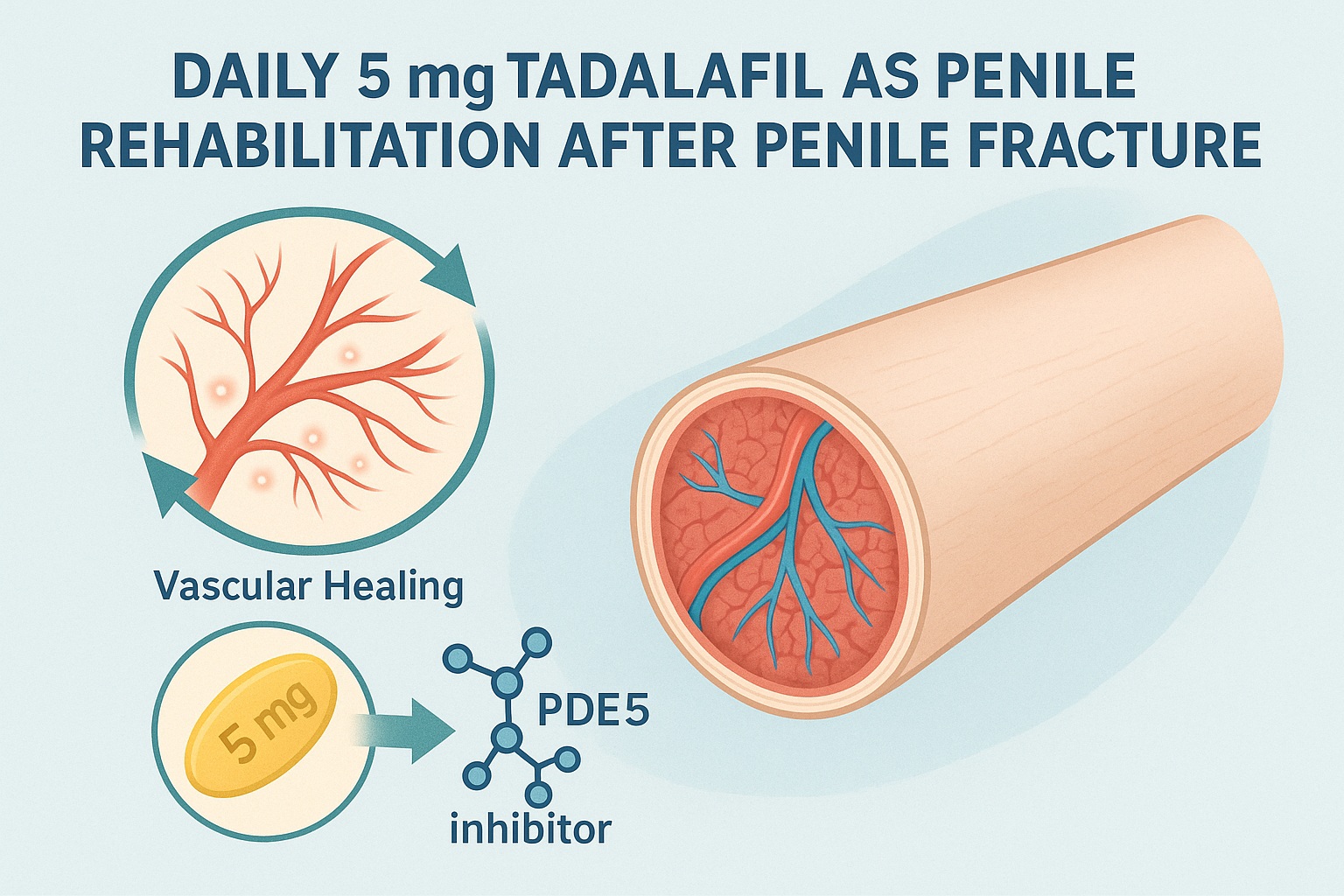
A recent clinical study offers one of the clearest evaluations to date of an intervention that intuitively makes sense but has been insufficiently examined: daily 5 mg tadalafil as a structured penile rehabilitation strategy following surgical repair of penile fracture. As PDE5 inhibitors have shown benefit in post-prostatectomy rehabilitation, clinicians naturally wonder whether similar principles apply to penile fracture injuries, where corporal fibrosis, endothelial disruption, and psychological tension coexist.
In this article, we will dissect the study’s findings in a strictly clinical, evidence-focused manner. The analysis avoids unnecessary theorizing and instead centers on concrete data: incidence of ED after fracture, predictors of dysfunction, timing of tadalafil use, healing outcomes, and what the results imply for real-world patient management.
Clinical Background: Why Post-Fracture Erectile Dysfunction Occurs
Erectile physiology depends on unimpeded arterial inflow, veno-occlusive competence, tunical rigidity, and intact cavernosal endothelium. Penile fracture, by definition, injures one or more of these components. Surgical repair seeks to restore anatomical continuity, yet microstructural and functional healing remains unpredictable.
Several mechanisms explain persistent ED after fracture:
- impaired endothelial nitric oxide production;
- cavernosal fibrosis at the injury site;
- disruption of the veno-occlusive mechanism;
- neurovascular trauma;
- postoperative pain or anxiety inhibiting arousal.
The study confirms that these mechanisms do not affect all patients equally. Some return to normal function, while others struggle with rigidity, curvature, or psychogenic inhibition long after surgery.
This heterogeneity underscores why structured rehabilitation, rather than passive recovery, may be necessary.
Study Design: A Focused Evaluation of Tadalafil for Post-Surgical Rehabilitation
The research explored outcomes in 191 patients diagnosed with penile fracture and treated surgically. After intraoperative confirmation of tunical rupture and standard repair, patients were followed longitudinally to assess postoperative erectile function.
Crucially, patients were divided into two groups:
- Rehabilitation Group: received daily 5 mg tadalafil postoperatively.
- Non-Rehabilitation Group: underwent standard postoperative care without PDE5 inhibitors.
Erectile function was measured using the International Index of Erectile Function (IIEF-5), with ED defined according to validated cutoffs. The goal was not merely to observe differences but to identify predictors of ED and evaluate whether tadalafil alters long-term functional outcomes.
Age, comorbidities, timing of surgery, location and length of tunical tear, and presence of bilateral injury were analyzed as possible risk factors.
This structured approach allows for a clinically meaningful interpretation: not simply whether tadalafil works, but for whom it is most beneficial.
Incidence of Erectile Dysfunction After Penile Fracture
One of the study’s most important findings is the true incidence of ED after fracture, which varies widely in the literature. In this cohort, postoperative ED occurred in a significant proportion of patients, reaffirming that even ideal surgical repair does not guarantee functional restoration.
The incidence was noticeably higher in patients who did not undergo tadalafil-based rehabilitation. Those who received 5 mg tadalafil daily demonstrated a lower rate of ED, a finding that aligns with mechanistic expectations—enhanced endothelial function, improved cavernosal oxygenation, and prevention of fibrosis naturally support better recovery.
These data continue to challenge earlier assumptions that penile fracture, when repaired quickly, carries “excellent prognosis.” While surgical prognosis is indeed favorable, functional prognosis requires more nuanced management.
Age and Tunical Tear Length: Independent Predictors of ED
The study identified two dominant predictors of erectile dysfunction after penile fracture:
1. Advanced Age
Older patients displayed markedly higher risk of postoperative ED. Age already reduces endothelial reserve, cavernosal elasticity, and neural conductivity. Trauma only exacerbates these vulnerabilities.
2. Length of Tunical Tear
The longer the tunical rupture, the greater the risk of ED. Longer tears naturally imply:
- more extensive corporal disruption;
- greater endothelial damage;
- higher risk of fibrosis;
- more pronounced postsurgical remodeling.
Interestingly, the location of the tear (proximal vs. distal) was less predictive than its length, suggesting that injury severity outweighs anatomical nuance.
These predictors provide clinicians with powerful real-world guidance. Patients who are older or present with extensive tunical rupture are ideal candidates for structured rehabilitation.
Why Tadalafil Helps: A Clinically Grounded Mechanistic Explanation
Although the paper does not dwell extensively on molecular pathways, the logic behind tadalafil rehabilitation is straightforward and clinically validated in parallel fields.
Daily tadalafil:
- enhances endothelial nitric oxide signaling,
- promotes cavernosal oxygenation,
- reduces hypoxia-driven fibrotic transformation,
- supports smooth muscle preservation,
- improves spontaneous nocturnal erections,
- and interrupts the cycle of disuse atrophy.
These mechanisms are crucial in the weeks following fracture repair, when healing is active and tissue remodeling determines long-term rigidity.
If we compare penile fracture rehabilitation to postoperative recovery in other organs, the analogy is clear: restoring circulation and preventing fibrosis almost always improves functional outcomes.
Comparative Outcomes: Rehabilitation vs. No Rehabilitation
The study’s results are clinically compelling. Patients who received 5 mg tadalafil daily had:
- significantly lower incidence of ED;
- higher mean IIEF-5 scores;
- better self-reported rigidity and satisfaction;
- fewer complaints of penile curvature or deviation affecting intercourse.
The differences were not marginal—they were clinically meaningful.
Patients in the non-tadalafil group more frequently experienced difficulties with penetration, inconsistent erections, and decreased rigidity, even months after surgery. These issues were far less common in those who underwent structured rehabilitation.
Notably, no serious adverse events were observed with daily tadalafil, supporting its safety in the early postoperative period.
Timing: When Should Rehabilitation Begin?
The study suggests initiating tadalafil early in the postoperative course, once immediate surgical inflammation has subsided and patient comfort allows. Early initiation likely maximizes endothelial support and minimizes fibrotic remodeling.
Delaying rehabilitation until complications develop is far less effective. Once fibrosis and veno-occlusive dysfunction settle in, PDE5 inhibitors cannot reverse structural damage—they can only optimize what remains.
Thus, tadalafil serves best as a preventative, not as a late-stage therapeutic intervention.
Psychosexual Considerations: The Silent Component of ED Recovery
Although the study focused on clinical outcomes, any professor reviewing this evidence must acknowledge psychological factors.
Patients who suffer penile fracture frequently develop:
- fear of reinjury,
- anxiety about sexual activity,
- performance inhibition,
- post-traumatic avoidance.
Tadalafil rehabilitation does more than restore hemodynamics—it reinforces confidence. Knowing a medication is supporting physiological recovery can alleviate anxiety and encourage return to sexual activity before avoidance patterns form.
This subtle interaction between pharmacology and psychology often determines whether recovery is full or partial.
Clinical Implications: Who Should Receive Tadalafil Rehabilitation?
Based on the study’s results, the answer is clear:
- All patients after penile fracture repair may benefit, but
- Older patients and
- Patients with longer tunical tears
have most to gain, as their risk of ED is highest.
This makes rehabilitation an essential component of postoperative care—not discretionary, but standard.
Limitations and Practical Translation
As with all clinical studies, it is important to interpret results within context. The study was not randomized, and tadalafil assignment may reflect patient or surgeon preference. Nonetheless, the magnitude of benefit, combined with strong mechanistic rationale and excellent safety profile, justifies incorporation into routine practice.
In clinical translation, this means:
- offering tadalafil 5 mg daily to all men following penile fracture repair;
- initiating treatment early;
- continuing therapy through the critical remodeling phase (typically 6–12 weeks);
- counseling patients on expectations and follow-up.
This is a simple, low-risk intervention with high payoff.
Conclusion
Erectile dysfunction after penile fracture remains a significant but often underappreciated complication. Surgical repair restores anatomy, but physiology requires active support. The study examined here provides clear evidence that daily 5 mg tadalafil significantly reduces the incidence of post-fracture ED, particularly in older men and those with long tunical tears.
Incorporating PDE5 inhibitor–based rehabilitation into standard postoperative care represents a rational, evidence-supported, and clinically impactful strategy. It is not an optional adjunct—it is a necessary component of modern andrological management.
FAQ
1. Should all patients receive tadalafil after penile fracture repair?
Evidence strongly suggests that early daily tadalafil reduces ED risk. Although all patients may benefit, those who are older or sustained longer tears are especially strong candidates.
2. How long should tadalafil be continued during rehabilitation?
Most functional healing occurs in the first 8–12 weeks. Many clinicians recommend daily tadalafil for at least this period to optimize cavernosal oxygenation and prevent fibrosis.
3. Does tadalafil reverse existing ED after fracture?
Tadalafil is most effective as a preventative measure. Once extensive fibrosis or veno-occlusive dysfunction has developed, pharmacologic therapy has limited ability to reverse structural injury.
