

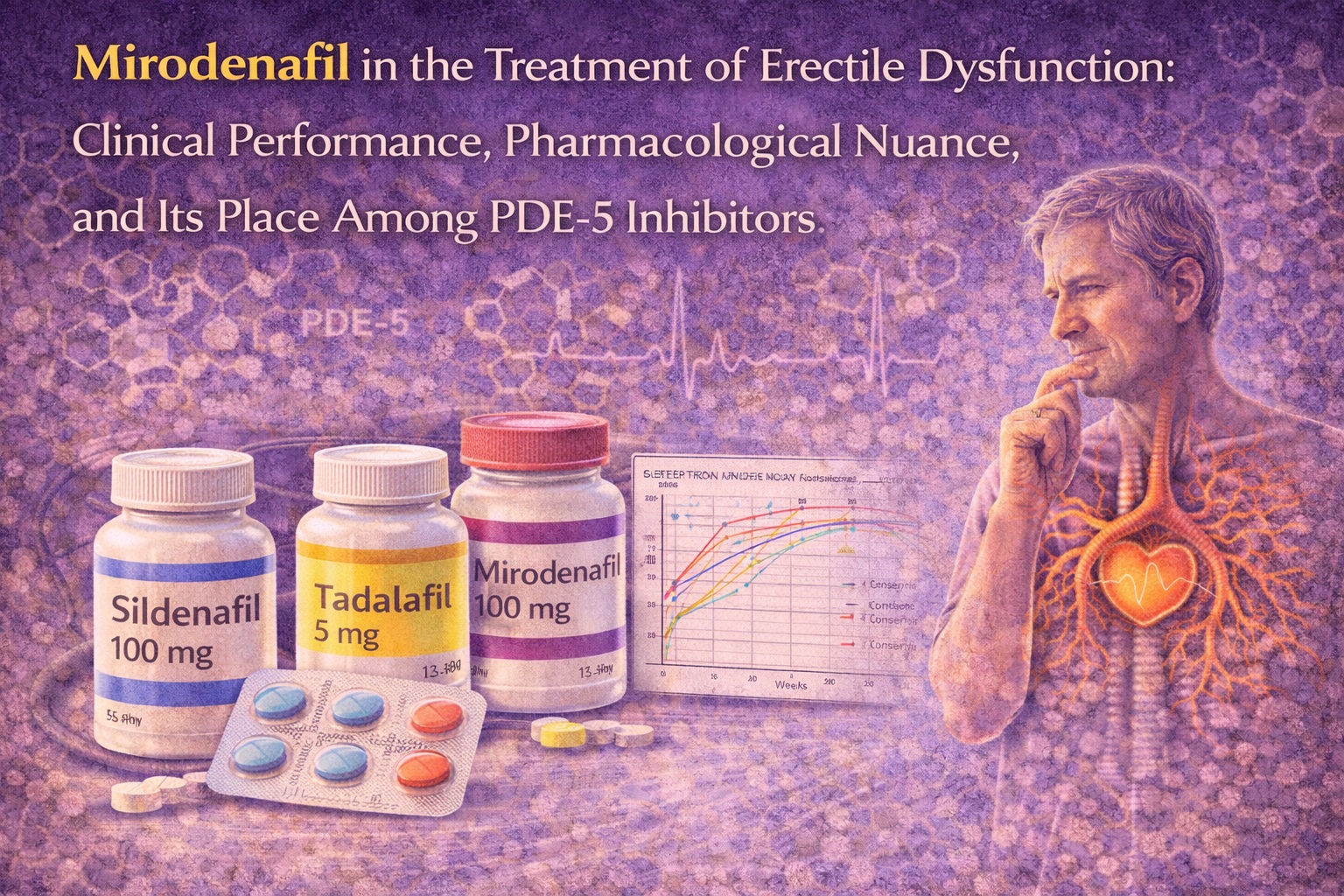
Introduction: Why Another PDE-5 Inhibitor Still Matters
Erectile dysfunction (ED) is one of the most common chronic conditions affecting men worldwide, particularly beyond the fourth decade of life. Despite the availability of several well-established phosphodiesterase type 5 (PDE-5) inhibitors, a substantial proportion of patients remain dissatisfied due to inadequate efficacy, adverse effects, delayed onset, or insufficient duration of action. This reality explains why the development of new agents within an apparently mature drug class continues to be clinically relevant.
Mirodenafil was developed in this context—not as a revolutionary departure from existing pharmacology, but as a refinement. Its introduction was driven by the hypothesis that subtle differences in molecular structure, selectivity, and pharmacokinetics could translate into clinically meaningful advantages for selected patient populations. The systematic evaluation of mirodenafil provides an opportunity to reassess what truly differentiates one PDE-5 inhibitor from another in real-world practice.
Importantly, ED is no longer viewed as an isolated sexual disorder. It is increasingly recognized as a vascular, metabolic, and neurogenic condition with deep connections to cardiovascular disease, diabetes, and endothelial dysfunction. Any drug intended for long-term use in this population must therefore balance efficacy with cardiovascular safety, tolerability, and patient adherence.
Erectile Dysfunction: A Condition of Shared Pathways
The pathophysiology of ED centers on impaired nitric oxide–mediated smooth muscle relaxation within the corpus cavernosum. Sexual stimulation triggers nitric oxide release from endothelial and neuronal sources, activating guanylate cyclase and increasing cyclic guanosine monophosphate (cGMP) levels. The result is smooth muscle relaxation, increased arterial inflow, and venous occlusion.
PDE-5 inhibitors act by preventing the degradation of cGMP, thereby amplifying endogenous nitric oxide signaling. While this mechanism is shared across the drug class, clinical performance varies due to differences in PDE-5 selectivity, tissue distribution, onset of action, and interaction with other phosphodiesterase isoenzymes.
These nuances become clinically relevant in patients with comorbidities, polypharmacy, or sensitivity to adverse effects. The emergence of mirodenafil reflects an attempt to optimize this balance rather than to redefine the underlying mechanism.
Mirodenafil: Pharmacological Characteristics and Rationale
Mirodenafil is a selective PDE-5 inhibitor with structural similarities to sildenafil, yet with distinct pharmacodynamic and pharmacokinetic features. Preclinical studies demonstrated high affinity for PDE-5 with relatively limited activity against other phosphodiesterase isoforms, a property associated with improved tolerability.
Pharmacokinetic analyses indicate that mirodenafil is rapidly absorbed, reaching peak plasma concentrations within approximately one hour. Its elimination half-life is shorter than that of tadalafil but comparable to sildenafil and vardenafil, positioning it as an on-demand rather than long-acting agent.
This profile suggests that mirodenafil is intended for patients who prefer predictable timing, rapid onset, and limited drug exposure rather than extended pharmacological coverage. In clinical terms, it is designed to be precise rather than persistent.
Clinical Evidence: What the Trials Reveal
Randomized controlled trials evaluating mirodenafil consistently demonstrate significant improvement in erectile function compared with placebo. Across studies, improvements in the erectile function domain of the International Index of Erectile Function (IIEF-EF) reach clinically meaningful thresholds, reflecting genuine functional benefit rather than marginal statistical change.
Patient-reported outcomes further support efficacy. Measures such as successful vaginal penetration and maintenance of erection until completion of intercourse improve significantly, indicating that benefits extend beyond questionnaire scores into real-life sexual performance.
Importantly, these effects are observed across a broad spectrum of ED severity, including mild, moderate, and severe cases. This suggests that mirodenafil retains efficacy even in patients with more advanced endothelial dysfunction, although response rates predictably decline with increasing disease severity.
Dose–Response Relationship and Clinical Flexibility
One of the notable features of mirodenafil is its clear dose–response relationship. Lower doses provide measurable benefit with minimal adverse effects, while higher doses produce greater efficacy at the cost of increased—but still manageable—side effects.
This dose-dependent profile allows clinicians to individualize therapy. Patients sensitive to adverse events may benefit from lower starting doses, while those with insufficient response can be titrated upward. Such flexibility is particularly valuable in older patients and those with cardiovascular risk factors.
Unlike agents with very long half-lives, mirodenafil’s pharmacokinetics allow relatively rapid adjustment of dosing strategies without prolonged carryover effects.
Safety and Tolerability: A Central Consideration
Across clinical trials, mirodenafil demonstrates a safety profile consistent with the PDE-5 inhibitor class. The most commonly reported adverse events include headache, facial flushing, nasal congestion, and dyspepsia. These events are generally mild to moderate and transient.
Crucially, serious adverse events are rare. No significant increase in cardiovascular events has been observed in appropriately selected patients, reinforcing the importance of adherence to established contraindications, particularly concomitant nitrate therapy.
Visual disturbances, often associated with off-target inhibition of PDE-6, appear infrequent with mirodenafil, suggesting favorable isoenzyme selectivity. This characteristic may offer an advantage for patients who experienced visual side effects with other PDE-5 inhibitors.
Comparative Perspective: Where Mirodenafil Fits
When placed alongside established PDE-5 inhibitors, mirodenafil does not seek to replace them universally. Instead, it occupies a niche defined by rapid onset, moderate duration, and favorable tolerability.
Compared with sildenafil, mirodenafil offers similar efficacy with potentially reduced visual side effects. Compared with tadalafil, it lacks prolonged duration but avoids extended systemic exposure, which some patients prefer. Compared with vardenafil, it demonstrates comparable onset with a distinct safety profile.
This diversity within the PDE-5 inhibitor class reflects a broader clinical truth: erectile dysfunction treatment is not a one-size-fits-all endeavor. The availability of multiple agents allows therapy to be tailored to patient expectations, lifestyle, and comorbidity profile.
Special Populations: Diabetes, Aging, and Cardiovascular Disease
Evidence suggests that mirodenafil maintains efficacy in patients with diabetes mellitus, a group notoriously difficult to treat due to severe endothelial dysfunction and neuropathy. While absolute response rates are lower than in non-diabetic populations, improvements remain clinically meaningful.
In older men, tolerability is a key concern. The relatively short half-life and predictable pharmacokinetics of mirodenafil reduce the risk of prolonged hypotension or delayed adverse effects, supporting its use in carefully selected elderly patients.
From a cardiovascular standpoint, mirodenafil behaves consistently with class expectations. When prescribed according to guidelines, it does not increase cardiovascular risk and may indirectly improve vascular health through enhanced endothelial function and increased physical activity associated with restored sexual confidence.
Adherence and Patient Satisfaction
Adherence to ED therapy is influenced as much by patient experience as by pharmacological efficacy. Predictable onset, manageable side effects, and reliable performance contribute significantly to long-term satisfaction.
Studies report high patient satisfaction rates with mirodenafil, particularly among those who value rapid onset and short duration. This preference highlights the importance of aligning pharmacological properties with patient lifestyle rather than assuming that longer duration is always superior.
In this sense, mirodenafil reinforces a patient-centered approach to ED management—one that prioritizes individual expectations over abstract pharmacological ideals.
Limitations of the Current Evidence
Despite encouraging results, the existing body of evidence has limitations. Most trials are of relatively short duration, limiting conclusions about long-term safety and sustained efficacy. Comparative head-to-head trials with other PDE-5 inhibitors are also limited.
Additionally, most data originate from specific geographic regions, raising questions about generalizability across diverse populations. Real-world studies and post-marketing surveillance will be essential to fully define mirodenafil’s role in global clinical practice.
Clinical Implications and Practical Use
For clinicians, mirodenafil represents a valuable addition to the therapeutic arsenal rather than a disruptive innovation. It is particularly suitable for patients who did not tolerate other PDE-5 inhibitors, who prefer rapid onset without prolonged exposure, or who experienced specific side effects with alternative agents.
Effective use requires the same principles applied to all ED therapies: thorough cardiovascular evaluation, patient education, and realistic expectation setting. When used appropriately, mirodenafil can deliver reliable and satisfying outcomes.
Conclusion: Refinement Rather Than Reinvention
Mirodenafil illustrates how incremental pharmacological refinement can still produce meaningful clinical value. It does not redefine erectile dysfunction treatment, but it enhances it by offering another well-characterized, effective, and generally well-tolerated option.
In a condition as heterogeneous as ED, such diversity is not redundant—it is essential. Mirodenafil’s place among PDE-5 inhibitors is therefore justified not by novelty, but by nuance.
FAQ
Is mirodenafil as effective as other PDE-5 inhibitors?
Yes. Clinical trials demonstrate comparable efficacy in improving erectile function, with differences primarily in onset, duration, and tolerability.
Does mirodenafil have fewer side effects?
Overall tolerability is good. Certain side effects, particularly visual disturbances, may be less frequent, though individual response varies.
Who is the ideal candidate for mirodenafil?
Patients seeking rapid onset, predictable duration, and an alternative to existing PDE-5 inhibitors—especially those with prior intolerance—may benefit most.
