

Introduction
Erectile dysfunction (ED) has long been one of the most prevalent conditions encountered in urological and sexual medicine clinics. Defined as the persistent inability to achieve or maintain a penile erection sufficient for satisfactory sexual performance, ED affects millions worldwide and carries not only physical but profound psychological and relational consequences.
For over two decades, phosphodiesterase type 5 inhibitors (PDE5i) such as sildenafil, vardenafil, and tadalafil have revolutionized ED therapy. Among them, tadalafil stands out due to its long half-life, lasting up to 36 hours, and its dual approval for both ED and lower urinary tract symptoms. Despite these advantages, a significant subset of patients initially respond to tadalafil but lose effectiveness over time. Dose escalation or switching between PDE5 inhibitors often provides only limited improvement, leading researchers to explore adjunctive therapies.
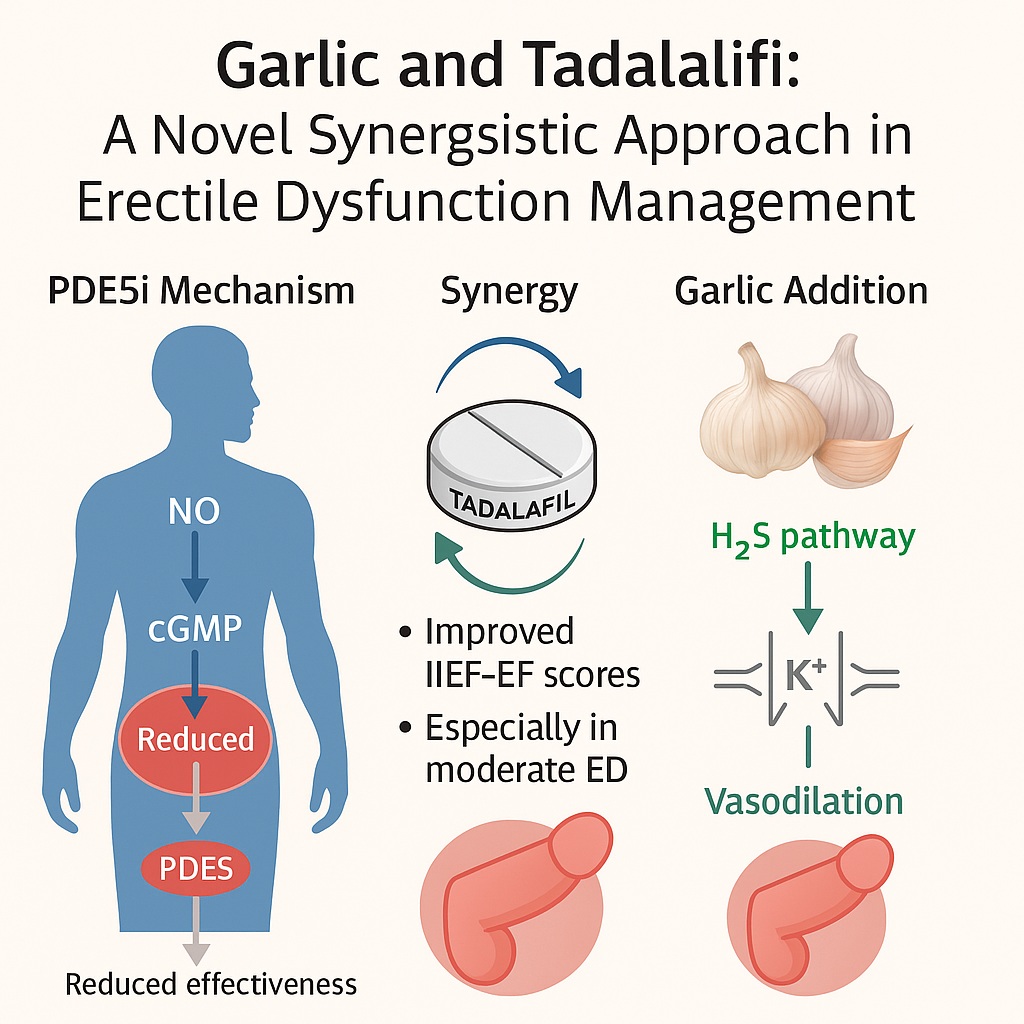
One intriguing pathway involves hydrogen sulfide (H₂S), a gaseous signaling molecule with vasodilatory and pro-erectile properties distinct from nitric oxide. Preclinical studies demonstrated that H₂S donors induce smooth muscle relaxation in the corpus cavernosum through activation of large-conductance Ca²⁺-activated K⁺ channels. Garlic, rich in allicin and other thiosulfinates, is a natural H₂S donor long celebrated in traditional medicine for its cardiovascular benefits. The recent clinical study explored whether coadministration of fresh garlic juice with tadalafil could rescue erectile function in men poorly responsive to tadalafil alone.
Study Design and Methodology
This was a prospective, randomized, placebo-controlled, two-arm pilot trial conducted in India between May and August 2022.
Participants:
- Sexually active heterosexual men with ED confirmed by validated International Index of Erectile Function (IIEF-EF) scores.
- All had normal penile Doppler studies.
- All initially responded to tadalafil for at least three months but later experienced diminished benefit despite dose escalation up to 20 mg.
Exclusion criteria:
Patients with comorbidities, psychiatric disorders, pelvic surgery, radiation, or abnormal penile Doppler were excluded to minimize confounding vascular factors.
Interventions:
- Group A (19 participants): Tadalafil 5 mg daily + freshly prepared garlic juice (5 g of garlic, ~150 ml solution) twice daily for four weeks.
- Group B (16 participants): Tadalafil 5 mg daily + placebo juice twice daily for four weeks.
To maintain blinding, the placebo mimicked garlic juice in color, taste, and consistency, though complete double-blinding was limited by garlic’s distinctive odor. A herbal mouthwash was provided to minimize social discomfort from garlic breath.
Outcome Measures:
- Primary: Improvement in erectile function assessed via IIEF-EF domain after four weeks. Clinically significant improvement was defined as ≥2-point increase for mild ED, ≥5-point increase for moderate ED, and ≥7-point increase for severe ED.
- Secondary: Dropouts due to adverse events.
Results
At study completion, 35 participants were evaluable: 19 in the garlic+tadalafil group and 16 in the tadalafil+placebo group.
- Baseline Characteristics: Both groups were comparable in age and severity of ED. The mean age was ~38 years.
- Primary Outcome:
- Group A improved significantly: mean IIEF-EF increased from 12.3±2.5 to 18.9±2.3 (p ≤ 0.0001).
- Group B showed only marginal change: 11.6±2.4 to 12.9±1.9 (not significant).
- Moderate ED patients in Group A particularly benefited, with 7/14 achieving minimal clinically important difference versus 0/10 in Group B.
- Adverse Events:
- Headache and myalgia were common but mild and similar in both groups.
- Dyspepsia occurred more in the garlic group (3 vs 1), causing one dropout.
- Palpitations were slightly more frequent in the placebo group.
- Importantly, no participants dropped out due to garlic odor, likely due to mouthwash use.
The results strongly suggest that garlic, as an H₂S donor, potentiates the pro-erectile effect of tadalafil through complementary pathways.
Mechanistic Insights
Erectile function is largely mediated by smooth muscle relaxation in the corpus cavernosum. The canonical pathway involves neuronal nitric oxide synthase (nNOS) and endothelial NOS (eNOS), generating NO, which activates soluble guanylate cyclase (sGC) to increase cyclic GMP. PDE5 inhibitors prevent cGMP breakdown, prolonging erection.
However, tachyphylaxis to PDE5i may occur, possibly due to downregulation of NO production or receptor desensitization. Here, H₂S provides a bypass mechanism:
- Garlic-derived thiosulfinates decompose into H₂S in red blood cells.
- H₂S relaxes cavernosal smooth muscle via K⁺ channel activation, independent of NO.
- Studies suggest NO and H₂S are mutually dependent, synergistically enhancing vasodilation and angiogenesis.
Thus, garlic and tadalafil represent a rational combination, engaging two distinct but complementary gasotransmitters.
Discussion
This pilot trial demonstrates a clinically and statistically significant improvement in erectile function with garlic+tadalafil in men poorly responsive to tadalafil alone. Several points are worth emphasizing:
- Clinical Relevance: A subset of men with intact penile vasculature still fail PDE5i therapy. For them, adjunctive strategies are crucial. Garlic provides a safe, natural, and accessible option.
- Safety: Garlic is widely consumed as food and generally safe. Adverse effects were mild and mostly attributable to tadalafil. The main limitation remains the pungent odor, partially mitigated by mouthwash in this study.
- Strengths:
- Rigorous prospective randomized design.
- Careful exclusion of vascular comorbidities to isolate pharmacological effects.
- Objective outcome assessment with IIEF-EF.
- Limitations:
- Small sample size (pilot nature).
- Limited follow-up (4 weeks).
- Single-center trial.
- Difficulties with double-blinding due to garlic’s odor.
Nevertheless, the findings justify larger multicenter studies and exploration of stable H₂S donors with longer shelf-life than fresh garlic juice.
Broader Implications
The trial touches on a wider theme in sexual medicine: the integration of nutraceuticals and phytotherapy into conventional treatment. While herbal remedies abound in folklore, robust clinical validation is rare. This study provides a rare randomized evaluation, bridging traditional knowledge and modern evidence.
Moreover, the synergy between H₂S and NO pathways may extend beyond ED. Both are implicated in cardiovascular health, angiogenesis, and endothelial function. Thus, such combination therapies might one day benefit patients with vascular dysfunction at large, not only those struggling with erections.
Conclusion
The coadministration of garlic juice as a natural H₂S donor with tadalafil significantly improved erectile function in men who responded poorly to tadalafil alone. The effect was most pronounced in those with moderate ED. Garlic appears to act via H₂S-mediated vasodilation, synergizing with tadalafil’s NO-cGMP pathway.
While further studies are needed, this pilot trial offers a promising, safe, and accessible strategy for difficult-to-treat ED. In a field where pharmacological monotony sometimes frustrates both patients and physicians, perhaps the humble garlic clove deserves a seat at the therapeutic table.
FAQ
1. Can garlic really improve erectile dysfunction on its own?
Garlic has vasodilatory properties and may improve endothelial function, but its effects alone are modest. The study shows garlic is most effective as an adjunct to tadalafil, not as monotherapy.
2. Why would tadalafil stop working after initial success?
Some patients develop tachyphylaxis to PDE5 inhibitors, possibly due to reduced nitric oxide availability or receptor desensitization. Adjunct therapies like garlic (H₂S donor) can bypass this limitation.
3. Is garlic safe to use in this way?
Yes. Fresh garlic is widely consumed in diets globally and considered safe. Side effects are mild (dyspepsia, odor). Patients on anticoagulants or with bleeding disorders should consult a physician before high-dose garlic use.
