

Introduction
Benign prostatic hyperplasia (BPH) and erectile dysfunction (ED) often coexist, a fact that has shaped urological practice for decades. BPH leads to lower urinary tract symptoms (LUTS) such as weak urinary stream, nocturia, and incomplete bladder emptying. ED, on the other hand, impairs sexual performance and quality of life. Both conditions are highly prevalent in men over 50 years of age and share overlapping risk factors, including aging, hypertension, diabetes, obesity, and metabolic syndrome.
Traditionally, these two conditions were managed in isolation: α-blockers such as tamsulosin to relax prostatic smooth muscle and improve urinary flow, and phosphodiesterase type 5 inhibitors (PDE5i) such as tadalafil to restore erectile capacity. Yet, clinical practice soon revealed an overlap—not only in epidemiology but in pathophysiology. Both LUTS and ED are linked to pelvic ischemia, endothelial dysfunction, and impaired smooth muscle tone. This realization gave rise to the hypothesis: could a single therapeutic strategy target both urinary and sexual symptoms simultaneously?
Tadalafil, unique among PDE5i, is the only agent approved for both ED and LUTS. Tamsulosin, a uroselective α1-adrenergic antagonist, remains a cornerstone of BPH management. Combining these two drugs promises additive benefit—greater relief of urinary symptoms while preserving or enhancing erectile function. However, concerns remain regarding tolerability, particularly hypotension, dizziness, and treatment discontinuation. The meta-analysis at the center of this discussion systematically evaluated the evidence.
The Pharmacological Logic
Tadalafil: Beyond Erectile Restoration
Tadalafil enhances cyclic GMP signaling by inhibiting PDE5, prolonging smooth muscle relaxation in penile cavernosal tissue. In the lower urinary tract, PDE5 is expressed in bladder, prostate, and vasculature. By relaxing smooth muscle and improving blood flow, tadalafil reduces bladder outlet resistance and alleviates LUTS. Additionally, its long half-life (17.5 hours) ensures steady efficacy and permits once-daily dosing.
Tamsulosin: The Uroselective α-Blocker
Tamsulosin blocks α1A-adrenergic receptors in the prostate and bladder neck, reducing smooth muscle tone and easing urinary flow. Unlike older α-blockers, it is more selective, with lower risk of systemic hypotension. Still, dizziness, ejaculatory dysfunction, and orthostatic events remain common.
Synergy: Complementary Pathways
The rationale for combining tadalafil and tamsulosin is strong:
- Tadalafil targets pelvic vasculature and bladder/prostate tissue via the NO–cGMP pathway.
- Tamsulosin directly antagonizes adrenergic tone in the bladder neck and prostate.
Together, they address both vascular and adrenergic components of LUTS, while tadalafil alone provides the added benefit of erectile recovery.
Methods of the Meta-Analysis
The systematic review searched PubMed, Embase, and Cochrane databases up to 2019 for randomized controlled trials comparing tadalafil+tamsulosin with tadalafil alone in men with LUTS due to BPH and concomitant ED.
Inclusion criteria:
- Adult men with clinically diagnosed BPH and ED.
- Randomized design.
- Outcome reporting for IPSS (International Prostate Symptom Score), IIEF (International Index of Erectile Function), Qmax (maximum urinary flow rate), PVRV (post-void residual volume), and quality of life (QoL).
Primary outcomes: improvement in LUTS (IPSS) and erectile function (IIEF).
Secondary outcomes: Qmax, PVRV, QoL, adverse events, treatment discontinuations.
Key Findings
IPSS (International Prostate Symptom Score)
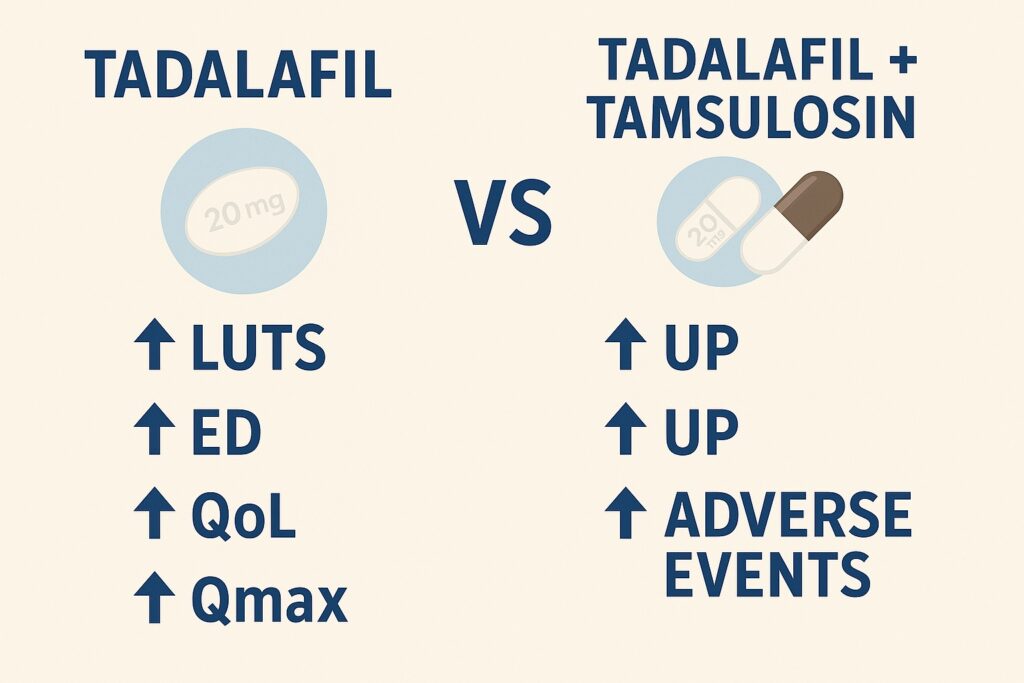
The combination therapy significantly reduced IPSS compared to tadalafil alone, confirming greater relief of LUTS. Patients reported fewer episodes of urgency, nocturia, weak stream, and incomplete emptying. This is the most robust outcome in favor of dual therapy.
Qmax (Maximum Urinary Flow)
Tadalafil+tamsulosin significantly improved Qmax, reflecting enhanced urinary stream. The synergistic smooth muscle relaxation at both vascular and adrenergic levels translates into better flow dynamics.
Quality of Life (QoL)
Patients receiving the combination reported greater improvement in QoL scores. Relief from both urinary bother and sexual dissatisfaction naturally led to higher satisfaction rates.
IIEF (Erectile Function)
Surprisingly, there was no significant difference between combination therapy and tadalafil monotherapy. Both groups improved erectile function compared to baseline, but adding tamsulosin did not further enhance IIEF scores. This suggests that the erectile benefit stems entirely from tadalafil, while tamsulosin contributes exclusively to LUTS improvement.
PVRV (Post-Void Residual Volume)
No significant difference was observed between groups. This aligns with the understanding that neither tadalafil nor tamsulosin strongly influences detrusor contractility.
Adverse Events and Discontinuations
The Achilles’ heel of combination therapy is tolerability. Rates of dizziness, hypotension, and ejaculatory disorders were higher in the tadalafil+tamsulosin group. Correspondingly, discontinuation rates were greater, indicating that while efficacy improves, so does the burden of side effects.
Clinical Implications
This meta-analysis offers several lessons for clinicians.
First, combination therapy is clearly superior for LUTS. For men whose primary concern is urinary symptoms with secondary erectile complaints, the dual regimen is justified.
Second, for men whose primary distress is erectile dysfunction, tadalafil alone suffices. Adding tamsulosin does not enhance erectile outcomes but introduces risk of adverse effects.
Third, patients should be carefully selected. Those at higher risk of hypotension, frailty, or polypharmacy may not tolerate the combination well. Shared decision-making, emphasizing both benefits and risks, is essential.
Practical Scenarios
- The man with severe LUTS and mild ED:
Here, combination therapy is ideal. Relief of urinary symptoms improves QoL, while tadalafil secures erectile function. - The man with severe ED but mild LUTS:
Tadalafil monotherapy is preferable. Adding tamsulosin increases side effects without further benefit for sexual performance. - The man with balanced LUTS and ED:
Either regimen may be chosen, depending on which symptom predominates in patient priorities.
Strengths and Limitations of the Evidence
The meta-analysis is robust, synthesizing multiple RCTs with adequate follow-up. However, limitations exist:
- Sample sizes were modest.
- Trials were mostly short-term (12–24 weeks).
- Long-term safety of the combination remains underexplored.
- Geographic concentration of studies (primarily Asia) may limit generalizability.
Despite these caveats, the findings provide a strong evidence base for clinical practice.
Broader Perspectives: Dual-Targeting Therapy
The study exemplifies a broader trend in medicine: dual-targeting therapy. Many chronic conditions respond better when two complementary pathways are addressed. Hypertension benefits from ACE inhibitors plus diuretics; diabetes from metformin plus SGLT2 inhibitors. BPH and ED, intimately linked by pathophysiology, are no different.
Tadalafil+tamsulosin represents not merely a pharmacological cocktail but a conceptual shift: recognizing that urological and sexual health cannot be siloed. Patients value both equally, and clinicians must offer therapies that reflect this reality.
Conclusion
The combination of tadalafil and tamsulosin offers superior improvement in LUTS, urinary flow, and quality of life compared to tadalafil monotherapy. However, it does not enhance erectile outcomes beyond what tadalafil alone achieves, and it carries a higher burden of adverse events.
Clinical decisions should therefore be individualized: prioritize combination therapy in men with severe LUTS, reserve tadalafil monotherapy for those with predominant ED, and always weigh efficacy against tolerability.
In the nuanced world of men’s health, this meta-analysis reminds us that more is sometimes better—but sometimes simply more.
FAQ
1. Does adding tamsulosin to tadalafil improve erections?
No. Erectile outcomes are driven by tadalafil. Tamsulosin improves urinary symptoms but does not enhance erectile function further.
2. Is the combination safe?
Yes, but with caveats. Side effects like dizziness, hypotension, and ejaculatory disorders are more common. Careful patient selection is necessary.
3. Who benefits most from the combination?
Men with moderate to severe LUTS due to BPH plus coexisting ED gain the most, as combination therapy maximizes urinary and sexual quality of life.
