

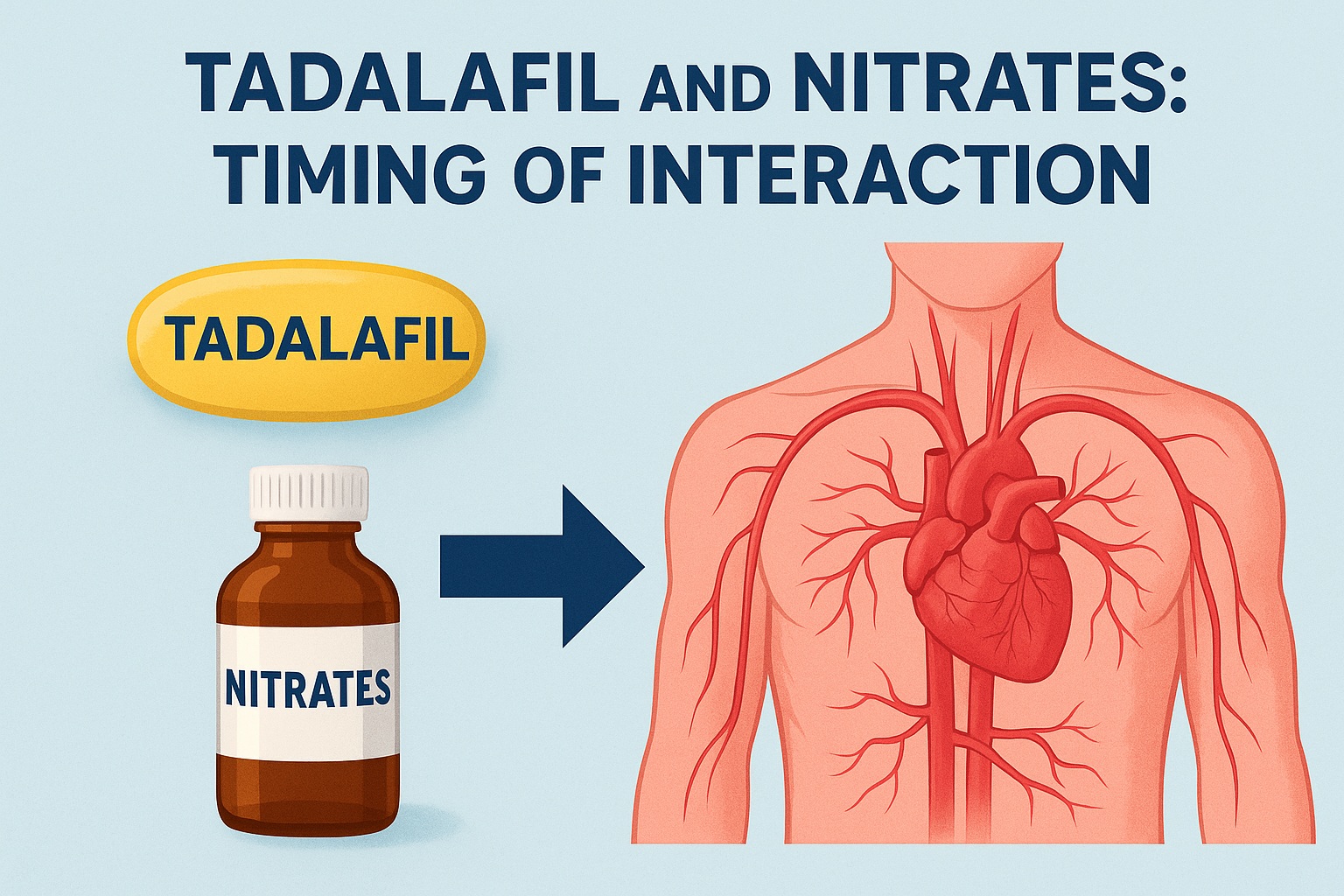
Introduction: When Therapeutic Pathways Collide
Modern cardiology and urology share an unexpected intersection — the cardiovascular consequences of drugs designed to restore sexual function. The rise of phosphodiesterase type 5 (PDE5) inhibitors, such as tadalafil, revolutionized the management of erectile dysfunction (ED), offering not just improved quality of life but also profound physiological effects on vascular tone. Yet with great pharmacologic power comes great hemodynamic responsibility.
In 2003, Kloner et al. addressed a clinical conundrum that continues to resonate today: how long after taking tadalafil is it safe to administer nitrates? This question is not trivial. Patients with coronary artery disease, who are among the largest populations to experience erectile dysfunction, often rely on nitrate therapy for angina relief. The dangerous synergy between nitrates and PDE5 inhibitors — both powerful modulators of nitric oxide and cyclic guanosine monophosphate (cGMP) pathways — can trigger catastrophic hypotension.
The study sought to define the time course of this interaction, offering physicians the evidence needed to balance cardiovascular safety with sexual health. The findings, while technical, carry significant clinical weight: the interaction between tadalafil and nitrates lasts approximately 24 hours, after which hemodynamic stability is restored.
The Biochemical Intersection: Nitric Oxide, cGMP, and Vascular Tone
To appreciate the study’s implications, one must revisit the vascular symphony orchestrated by nitric oxide (NO) and cyclic GMP. Nitric oxide, produced by endothelial nitric oxide synthase, stimulates guanylate cyclase in smooth muscle cells, elevating cGMP levels. This molecular messenger reduces intracellular calcium, leading to smooth muscle relaxation — the physiological basis of both penile erection and coronary vasodilation.
Organic nitrates such as nitroglycerin act by donating nitric oxide, producing rapid cGMP accumulation and vasodilation. In parallel, PDE5 inhibitors like tadalafil prevent cGMP degradation by blocking the PDE5 enzyme. When these two mechanisms converge — an exogenous nitrate donor combined with PDE5 inhibition — cGMP concentrations rise to dangerous levels, producing profound hypotension, syncope, and potentially fatal cardiovascular collapse.
Previous data on sildenafil (Viagra) had prompted the ACC/AHA to recommend withholding nitrates for 24 hours after sildenafil use. However, tadalafil’s longer half-life of 17.5 hours raised legitimate concerns: could the dangerous hemodynamic synergy persist longer than a day?
Study Design: Dissecting the Timeline of Interaction
The researchers conducted a randomized, double-blind, placebo-controlled, two-period crossover trial across multiple centers. A total of 166 healthy male volunteers aged 40–83 years participated, including subsets with diabetes mellitus, hypertension, and smoking history — comorbidities that reflect real-world cardiovascular risk.
Participants received either:
- Tadalafil 20 mg daily for seven consecutive days, or
- Placebo, with crossover after a 10–21 day washout.
Following the last tadalafil or placebo dose, each subject received sublingual nitroglycerin (0.4 mg) at specific intervals — 2, 4, 8, 24, 48, 72, and 96 hours — simulating various clinical scenarios where a patient might present with chest pain after PDE5 inhibitor use. The primary measurement endpoint was clinically significant hypotension, defined as a standing systolic blood pressure (SBP) below 85 mmHg.
Secondary endpoints included:
- Standing and supine diastolic BP ≤45 mmHg,
- Decrease in systolic BP ≥30 mmHg,
- Decrease in diastolic BP ≥20 mmHg,
- Mean maximal change in blood pressure post-nitrate exposure, and
- Adverse event frequency, particularly dizziness, headache, and myalgia.
Blood pressure and heart rate were monitored continuously using automated devices (DINAMAP PRO), and responses were analyzed using repeated-measures logistic regression and linear mixed-effects modeling.
Results: The 24-Hour Danger Window
The results revealed a clear temporal relationship between tadalafil use and nitrate-induced hypotension.
- At 4, 8, and 24 hours, subjects who received tadalafil experienced significantly greater reductions in both systolic and diastolic blood pressure compared to placebo.
- At 48, 72, and 96 hours, however, this hemodynamic difference disappeared — indicating that the interaction ceased after 24 hours.
Specifically, the proportion of subjects with standing systolic BP below 85 mmHg after nitroglycerin was markedly higher within the first day of tadalafil administration (p < 0.05) but indistinguishable from placebo beyond that point. Similar patterns emerged for all hypotensive thresholds and mean maximal BP decreases.
Interestingly, compensatory heart rate responses remained stable and comparable between tadalafil and placebo arms, indicating that autonomic compensation mechanisms were not significantly altered by PDE5 inhibition.
In essence, the study demonstrated that the critical interaction window between tadalafil and nitrates lasts up to 24 hours — a period during which concurrent use should be absolutely contraindicated.
Safety Profile and Adverse Events
Tadalafil’s safety record in this trial was reassuring. Out of 166 participants, 150 completed the study, and no serious adverse events occurred in the tadalafil group. The most frequent complaints were myalgia, back pain, headache, and flushing, all mild and transient.
- Myalgia and back pain, in particular, were more common during the initial days of dosing, peaking around days two and three before subsiding.
- Dizziness rates were similar between tadalafil and placebo groups and were largely attributed to nitroglycerin-induced vasodilation rather than tadalafil itself.
- One serious event — a case of sinus arrest — occurred in a placebo-treated subject following nitroglycerin and resolved spontaneously.
These findings reaffirm tadalafil’s excellent tolerability, even in older populations and those with comorbidities, provided it is not combined with nitrates.
Mechanistic Insights: Why the Danger Persists for 24 Hours
The persistence of the nitrate–tadalafil interaction can be explained by pharmacokinetics and pharmacodynamics. Tadalafil’s half-life (approximately 17.5 hours) ensures that plasma concentrations remain pharmacologically active for more than 36 hours. When nitrates are introduced within this window, additive vasodilatory effects occur through simultaneous cGMP accumulation.
- Nitrates donate nitric oxide, stimulating guanylate cyclase to increase cGMP.
- Tadalafil inhibits PDE5, preventing cGMP degradation.
- The result: a multiplicative increase in cGMP, leading to extensive vasodilation and potentially dangerous drops in systemic arterial pressure.
Even after a full day, enough tadalafil remains in circulation to amplify the hemodynamic effects of nitrates. Only after two full half-lives — approximately 36–40 hours — do drug levels decline below clinically significant thresholds, though the study confirmed hemodynamic normalization by 48 hours.
This mechanistic understanding emphasizes that it’s not just the presence of the drug but its interaction kinetics with vascular smooth muscle signaling that dictate safety timing.
Comparative Perspective: How Tadalafil Differs from Other PDE5 Inhibitors
The prolonged duration of tadalafil’s nitrate interaction distinguishes it from other PDE5 inhibitors such as sildenafil and vardenafil, which have shorter half-lives (~4–5 hours).
Clinical guidelines thus recommend:
- Withholding nitrates for at least 24 hours after sildenafil or vardenafil, and
- At least 48 hours after tadalafil, as an extra safety margin.
This distinction has real-world clinical consequences. Patients on chronic nitrate therapy — including those with angina, prior myocardial infarction, or congestive heart failure — must avoid tadalafil entirely. Conversely, tadalafil’s extended duration can be advantageous for ED management, providing up to 36 hours of efficacy per dose, earning it the nickname “the weekend pill.” However, this convenience comes at a cost of delayed nitrate compatibility.
Clinical Implications: Managing the Overlap Between ED and Heart Disease
The intersection of erectile dysfunction and cardiovascular disease is not coincidental. Both share common pathophysiological roots — endothelial dysfunction, oxidative stress, and impaired nitric oxide signaling. As a result, a significant subset of cardiac patients may seek PDE5 inhibitors for ED, creating potential for dangerous drug interactions if not carefully managed.
Clinicians must:
- Obtain a thorough sexual and medication history before prescribing PDE5 inhibitors.
- Advise patients that tadalafil should not be used concurrently with nitrates, and nitrates must be withheld for at least 48 hours after the last tadalafil dose.
- In cases of angina or chest pain following tadalafil ingestion, use non-nitrate anti-anginal therapies such as:
- Beta-blockers,
- Calcium channel blockers,
- Morphine,
- Oxygen, and
- Aspirin.
For acute myocardial infarction within this window, standard reperfusion strategies (aspirin, heparin, thrombolytics, PCI) remain appropriate — with one exception: no nitrates.
This simple yet critical knowledge can prevent catastrophic hemodynamic collapse in vulnerable patients.
Risk Communication: Educating Patients and Providers
Despite the well-documented contraindication, clinical surveys suggest that a fraction of physicians and patients remain unaware of the tadalafil–nitrate hazard. Education is therefore paramount.
Patients must be counseled that:
- Tadalafil’s effects last up to 36 hours, even if the subjective erectile benefit wanes earlier.
- Taking nitrates during this period may cause severe, life-threatening hypotension.
- Emergency responders should always be informed of recent PDE5 inhibitor use before administering cardiac medications.
For healthcare professionals, awareness must extend beyond cardiology to encompass primary care, emergency medicine, and urology, ensuring unified, cross-specialty adherence to safety protocols.
Statistical Rigor and Study Validity
From a methodological perspective, Kloner et al.’s study remains a benchmark in cardiovascular pharmacodynamics. The crossover design minimized inter-individual variability, while repeated-measures modeling accounted for intra-subject correlations across time points. The 150-subject completion rate ensured sufficient power for hemodynamic endpoints, though not for rare adverse outcomes.
No adjustments were made for multiple comparisons — a reasonable choice given the exploratory nature of the time-course hypothesis. Importantly, the consistency of findings across primary and secondary endpoints reinforces their robustness.
While the population consisted primarily of healthy men, inclusion of diabetic and elderly subgroups allowed limited extrapolation to clinical populations. Future research in patients with coronary artery disease or chronic nitrate therapy could further refine real-world safety recommendations.
A Broader Lesson: Precision in Pharmacologic Combinations
This study exemplifies why precision in pharmacologic timing can mean the difference between therapy and toxicity. Both tadalafil and nitrates are life-improving agents in their respective domains — one restoring sexual function and confidence, the other relieving ischemic chest pain. Yet their combination transforms synergy into danger, illustrating the delicate equilibrium of vascular pharmacology.
The findings also highlight a broader truth: drug half-life is not a trivial pharmacokinetic statistic but a clinical determinant of safe practice. The longer persistence of tadalafil’s effects must always be factored into cardiovascular decision-making.
Future Directions: Toward Safer Integrative Care
While the prohibition against co-administration remains absolute, future developments may explore safer temporal or molecular frameworks. Potential research avenues include:
- Investigating PDE5 inhibitors with shorter half-lives but similar efficacy.
- Exploring NO-independent vasodilators that can be safely used post-PDE5 inhibitor.
- Developing risk prediction tools integrating pharmacogenomics and renal function to refine individualized washout periods.
Moreover, the study underscores the need for collaboration between cardiologists and urologists — disciplines that must coordinate, not compete, in managing overlapping patient needs.
Conclusion: A Precise 24-Hour Window of Caution
Kloner and colleagues provided the cardiology community with a clear, evidence-based answer:
the hemodynamic interaction between tadalafil and nitrates persists for approximately 24 hours and dissipates by 48 hours.
Within this period, concurrent administration can cause profound hypotension and is strictly contraindicated. Beyond 48 hours, nitrate use appears hemodynamically safe but still warrants caution and monitoring.
This finding reshaped clinical practice guidelines and remains foundational two decades later. It exemplifies the importance of pharmacologic vigilance in balancing efficacy, safety, and patient lifestyle considerations.
In essence, tadalafil’s prolonged half-life — the very feature that enhances sexual spontaneity — demands clinical patience when cardiovascular emergencies arise. As medicine advances, the principle endures: timing matters as much as the molecule itself.
FAQ
1. Why can’t tadalafil and nitrates be used together?
Both drugs amplify nitric oxide–mediated vasodilation through the cGMP pathway. Combined use leads to excessive vascular relaxation and dangerously low blood pressure. The effect is pharmacodynamic, not allergic or idiosyncratic.
2. How long after taking tadalafil can nitrates be safely given?
Clinical evidence shows that the interaction lasts 24 hours, with complete resolution by 48 hours. Therefore, nitrates should be withheld for at least 48 hours after the last tadalafil dose to ensure patient safety.
3. What should be done if a patient who recently took tadalafil develops chest pain?
Avoid nitrates entirely. Instead, manage angina with non-nitrate anti-anginals such as beta-blockers, calcium channel blockers, or morphine, and provide oxygen and aspirin. Nitrates may be considered only after 48 hours, under close hemodynamic supervision.
