

Introduction: When Endocrinology Meets Urology
Medicine loves a good paradox, and few are as intriguing as the relationship between erectile dysfunction (ED) and type 2 diabetes mellitus (T2D). What was once considered a purely vascular or psychological issue has, over the past two decades, emerged as a complex interplay between metabolic derangements, endothelial dysfunction, and microvascular pathology. Men with diabetes are more than three times as likely to experience ED as their non-diabetic counterparts, a statistic that underscores the silent vascular damage diabetes inflicts long before overt cardiovascular events occur.
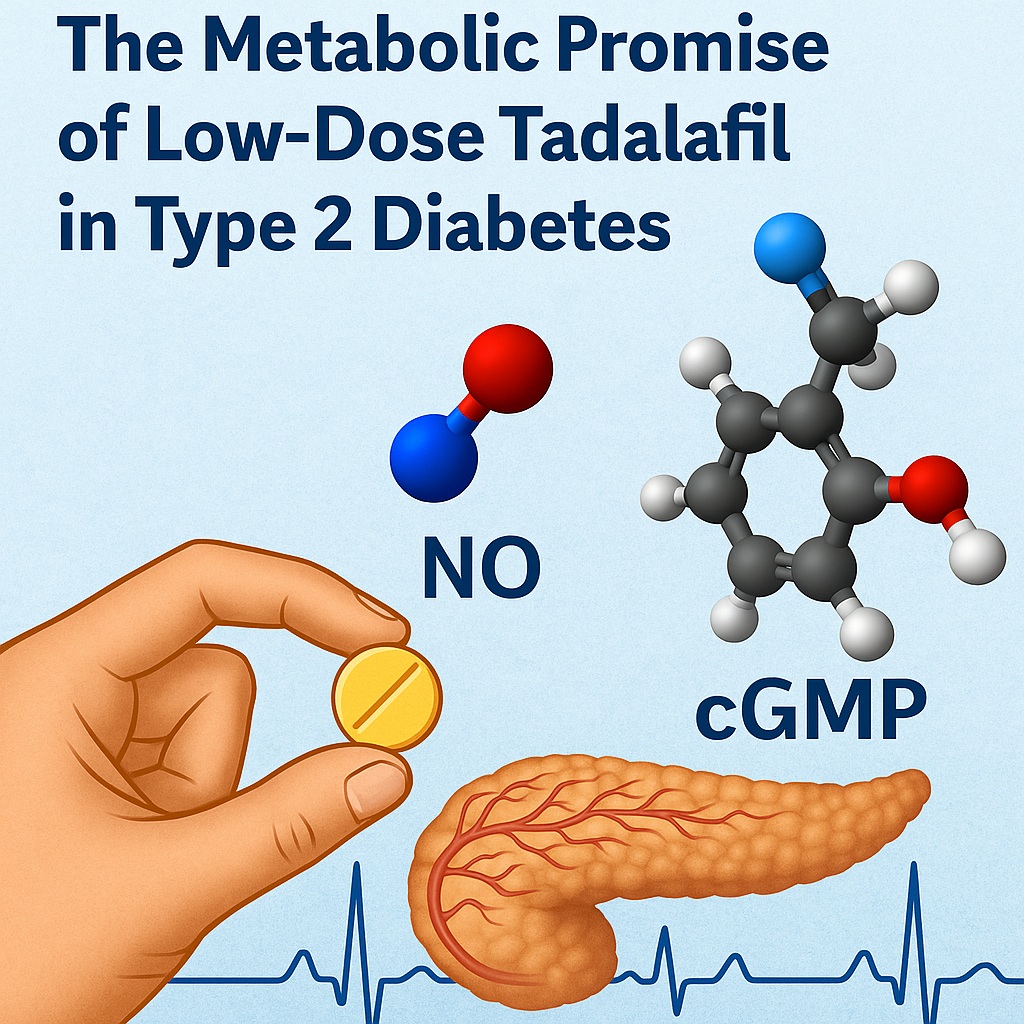
While the clinical conversation around diabetes usually centers on glucose, insulin, and HbA1c, the real drama often unfolds at the endothelial level — where nitric oxide (NO) and cyclic guanosine monophosphate (cGMP) act as molecular diplomats ensuring smooth vascular dialogue. In both ED and T2D, these messengers fall disturbingly silent. Enter phosphodiesterase type 5 inhibitors (PDE5i), best known for restoring sexual function but now being reconsidered as subtle metabolic modulators.
A 2022 pilot study by Lee et al., published in Diabetology & Metabolic Syndrome, dared to ask a bold question: could a low, daily dose of tadalafil — the same agent used for erectile health — quietly improve glycemic control in diabetic men? The results were modest, but the implications were revolutionary. This is the story of how a “lifestyle” drug might just be whispering solutions to one of endocrinology’s most persistent challenges.
The Vascular Symphony: Connecting Nitric Oxide, Insulin, and Glucose
Before delving into clinical results, it’s worth understanding the biochemical duet that inspired this investigation. Nitric oxide is more than a vasodilator; it’s a key regulator of insulin-mediated glucose uptake. Through activation of the NO/cGMP pathway, insulin promotes microvascular recruitment and enhances glucose transport into skeletal muscle cells — a process vital for maintaining euglycemia.
In diabetes, chronic hyperglycemia and oxidative stress reduce NO availability, triggering endothelial dysfunction and blunting insulin action. This vicious loop links poor vascular health with deteriorating metabolic control. PDE5 inhibitors, by preventing cGMP degradation, prolong NO signaling and theoretically restore part of this lost sensitivity. In animal models, chronic PDE5 inhibition improved insulin sensitivity and reduced inflammatory cytokines. However, human data remained scarce and inconsistent — until studies like this one began connecting the clinical dots.
Thus, tadalafil’s mechanism may transcend its famed role in the corpus cavernosum. By preserving NO bioavailability systemically, it could enhance muscle perfusion, glucose delivery, and insulin efficiency — all while addressing one of the most frustrating complications of diabetes: erectile dysfunction itself.
Study Design: A Metabolic Experiment in Microcosm
The Korean research team designed a six-month, randomized, double-blind, placebo-controlled pilot trial, with all the hallmarks of clinical precision. Men aged 35 to 75 years, diagnosed with both type 2 diabetes and erectile dysfunction for over a year, were recruited. None had used PDE5 inhibitors in the preceding three months, and all had HbA1c levels below 9%, ensuring moderate glycemic control at baseline.
Participants were randomized in a 2:1 ratio to receive either tadalafil 5 mg once daily or placebo. Importantly, their usual antidiabetic medications — mostly metformin, sulfonylureas, and DPP-4 inhibitors — remained unchanged throughout the study, ensuring that any observed metabolic shifts could be reasonably attributed to tadalafil itself.
The primary endpoint was change in glycated hemoglobin (HbA1c) after six months. Secondary endpoints included fasting plasma glucose (FPG), insulin levels, lipid profiles, liver enzymes, and erectile function, measured via the International Index of Erectile Function-5 (IIEF-5). To capture physiological nuance, insulin resistance was estimated using the HOMA-IR index.
Such a study design, though modest in size (68 completers out of 81 randomized), offered something rare in pharmacometabolic research: an integrative look at how a traditionally urological agent might influence systemic metabolism in a real-world diabetic cohort.
Findings: Small Numbers, Significant Meaning
After six months, the data revealed a subtle but statistically meaningful improvement in glycemic control among the tadalafil group compared with placebo.
- Change in HbA1c: −0.14% in the tadalafil group versus +0.20% in the placebo group (P = 0.03).
- Change in fasting plasma glucose: −6.4 mg/dL versus +5.35 mg/dL (P = 0.046).
Though these differences appear numerically modest, in metabolic research — particularly within a well-controlled diabetic cohort — they are biologically significant. The results suggest an incremental yet consistent improvement in glucose homeostasis attributable to tadalafil’s endothelial and microvascular effects.
Meanwhile, erectile function showed robust improvement. The IIEF-5 score rose by an average of 6.56 points in the tadalafil arm, compared to just 2.22 points in placebo (P = 0.003). This dual benefit — sexual and metabolic — reinforces the notion that these domains are not separate, but intimately linked through shared vascular and neuroendocrine pathways.
Interestingly, alanine transaminase (ALT) levels, often a surrogate marker of hepatic inflammation and insulin resistance, decreased significantly in the tadalafil group (−1.49 IU/L vs. +6.17 IU/L; P = 0.008). This finding hints at broader metabolic modulation, potentially involving hepatic insulin sensitivity and lipid oxidation, though the mechanisms remain speculative.
Safety and Tolerability: A Gentle Pharmacologic Profile
The tolerability profile was exemplary. Only four mild adverse events occurred — two each in the tadalafil and placebo groups — none severe enough to cause discontinuation. Reported events included mild myalgia, transient visual changes, and in one case, age-related cataract progression, all consistent with tadalafil’s known safety spectrum.
Adherence exceeded 80%, underscoring the feasibility of chronic low-dose PDE5 inhibitor therapy. Given tadalafil’s long half-life (~17.5 hours) and once-daily dosing convenience, its pharmacokinetics align naturally with chronic disease management — a quality not shared by shorter-acting agents like sildenafil or vardenafil.
For clinicians, this reinforces the concept that low-dose continuous PDE5 inhibition is not only safe but also potentially beneficial for long-term vascular conditioning.
Biological Rationale: Why Might Tadalafil Improve Glucose Control?
Understanding the molecular interplay provides a satisfying mechanistic narrative. PDE5 inhibition enhances NO-dependent vasodilation, which increases skeletal muscle perfusion, thereby improving glucose uptake and insulin delivery. Additionally, NO modulates AMP-activated protein kinase (AMPK) activation — a metabolic regulator central to insulin sensitivity.
Experimental data further suggest that chronic tadalafil exposure:
- Reduces oxidative stress and inflammatory cytokines (e.g., TNF-α, IL-6).
- Improves β-cell function in the pancreas, independent of weight loss.
- Enhances microvascular recruitment, facilitating nutrient exchange.
- Potentially influences hepatic metabolism, lowering transaminase levels.
This constellation of effects resembles that of exercise or metformin — both of which improve vascular NO signaling and mitochondrial efficiency. Thus, the observed HbA1c reduction, though numerically modest, may reflect a broader systemic recalibration toward metabolic balance.
Comparing Evidence: How Does This Fit the Bigger Picture?
The findings from Lee et al. do not stand alone. Previous small studies hinted at similar metabolic benefits:
- Jansson et al. (2010) demonstrated improved forearm glucose uptake after tadalafil in diabetic women.
- Hill et al. (2009) reported enhanced β-cell function in metabolic syndrome.
- Varma et al. (2012) found reduced inflammation and hyperglycemia in diabetic mice treated with tadalafil.
Yet, meta-analyses prior to 2020 concluded that PDE5 inhibitors as a class offered inconsistent effects on glycemic control — likely due to heterogeneity in dosing regimens, populations, and study durations. The Lee et al. study stands out by employing continuous low-dose administration, which maintains stable plasma concentrations conducive to endothelial remodeling.
Chronic rather than intermittent exposure appears to be the key. Much like antihypertensive therapy, the benefits of PDE5 inhibition may accrue cumulatively, subtly recalibrating vascular responsiveness over weeks and months rather than in acute bursts of activity.
Clinical Implications: The Convergence of Cardiometabolic Care
What makes this research clinically intriguing is its potential to bridge disciplines. Urologists traditionally focus on symptom relief; endocrinologists chase metabolic metrics. Tadalafil, it seems, sits comfortably at the intersection.
For men with T2D, daily low-dose tadalafil could serve as:
- Dual-purpose therapy, addressing both sexual and metabolic dysfunctions.
- A vascular conditioner, improving endothelial tone and insulin delivery.
- A metabolic adjunct, possibly complementing first-line agents like metformin or DPP-4 inhibitors.
Of course, tadalafil is not a substitute for dietary management or exercise, but its role as an adjunctive agent deserves further exploration. For patients struggling with both glucose control and ED — a combination more common than most clinicians acknowledge — it represents a psychologically and physiologically integrated solution.
Limitations and Next Steps: Small Study, Big Questions
No clinical study is immune to caveats, and this one is no exception. The trial’s pilot nature and small sample size (n=68) limit generalizability. The magnitude of HbA1c reduction, though statistically significant, remains modest — perhaps insufficient alone to alter long-term diabetic outcomes.
Other limitations include:
- Lack of biomarker analysis for endothelial or inflammatory markers.
- No objective insulin clamp measurements, which would more precisely quantify insulin sensitivity.
- Absence of data on dietary habits or physical activity, both critical confounders in metabolic studies.
Nonetheless, as a proof of concept, the trial establishes feasibility and invites larger, mechanistically focused investigations. Future studies could explore tadalafil’s effects on hepatic glucose output, microvascular perfusion imaging, or β-cell secretory dynamics, ideally over 12–24 months and in diverse populations.
Reframing the Role of PDE5 Inhibitors: From Bedroom to Biomarkers
It’s tempting to view PDE5 inhibitors purely as facilitators of sexual function, but their systemic vascular actions are impossible to ignore. By restoring endothelial flexibility and promoting sustained NO signaling, agents like tadalafil may quietly address the root causes of multiple diabetic complications — neuropathy, nephropathy, and even retinopathy, all of which share a vascular etiology.
Moreover, their anti-inflammatory and hepatoprotective effects — observed through reductions in ALT and cytokine levels — suggest a broader “metabolic tuning” role. As medicine moves toward multi-target therapies that integrate cardiovascular, renal, and metabolic axes, tadalafil’s long half-life, safety record, and pleiotropic mechanisms make it a compelling candidate for repurposing.
Ironically, a drug developed to treat the most visible symptom of vascular dysfunction may end up helping to mend its invisible origins.
Conclusion: The Subtle Power of Daily Tadalafil
The study by Lee and colleagues may not rewrite diabetes guidelines overnight, but it does something arguably more valuable: it challenges boundaries. It invites clinicians to think of vascular health, sexual health, and metabolic health not as separate silos but as overlapping systems guided by the same molecular language — nitric oxide and cGMP.
By demonstrating that low-dose tadalafil can modestly improve glycemic control while simultaneously enhancing erectile function, the researchers illuminated a potential therapeutic synergy. The results are a whisper rather than a shout, but in medicine, whispers often precede revolutions.
In a world where polypharmacy is the rule and adherence the exception, a single daily tablet that benefits both metabolism and mood holds undeniable appeal. The next logical step is large-scale, long-term trials — not to prove tadalafil’s worth as an antidiabetic agent per se, but to understand how endothelial repair, not just insulin manipulation, can shape the future of diabetes management.
FAQ
1. Can tadalafil be used as a diabetes medication?
Not officially. Tadalafil remains approved for erectile dysfunction and benign prostatic hyperplasia. However, emerging evidence suggests that daily low-dose therapy may slightly improve glycemic control by enhancing vascular and endothelial function. It’s an intriguing adjunct, not a replacement for standard diabetic care.
2. Is it safe for diabetic patients to take tadalafil daily?
Yes, when prescribed appropriately. Studies, including the 2022 trial by Lee et al., found no serious adverse effects even with continuous six-month use. Nonetheless, patients using nitrates or with unstable cardiovascular conditions should avoid PDE5 inhibitors due to potential hypotensive interactions.
3. How does tadalafil improve glucose metabolism?
By inhibiting PDE5, tadalafil prolongs the action of nitric oxide and cGMP, leading to better vascular perfusion and insulin sensitivity. This enhanced microcirculation improves glucose uptake in muscles and may support β-cell function and hepatic metabolism.
