

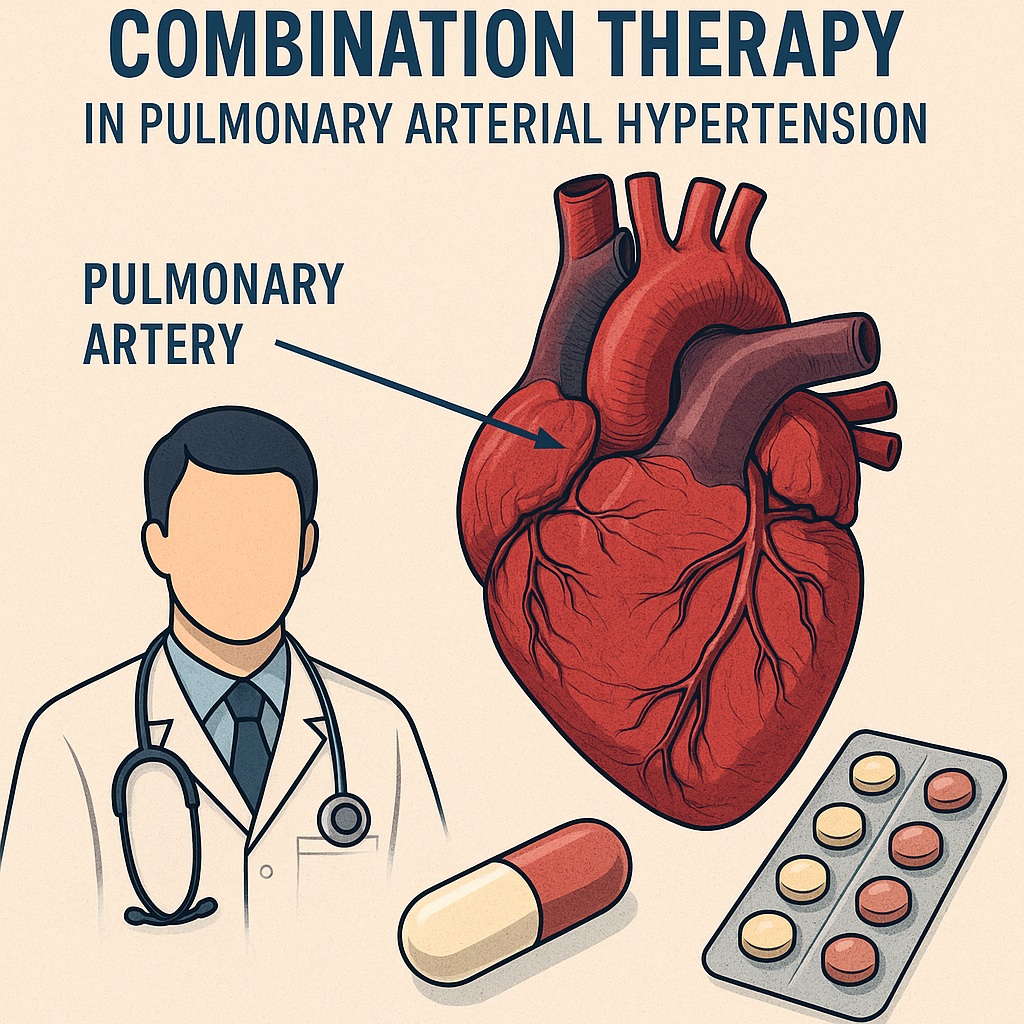
Pulmonary arterial hypertension (PAH) has undergone a remarkable therapeutic evolution over the past three decades. A disease once defined by a grim natural history and a near-total absence of pharmacologic options has transformed into a domain where sophisticated, multimodal treatment strategies are now the standard of care. Standing at the crossroads of this transformation is the compelling question of how best to optimize combination therapy—specifically, whether single-tablet fixed-dose combinations (FDCs) may offer practical and clinical advantages for certain patients.
The editorial and trial data summarized in the referenced article introduce a timely discussion about the emerging role of macitentan/tadalafil FDC therapy in PAH management. While the concept of combination therapy is not new, the refinement of its delivery, tolerability, and long-term applicability calls for renewed examination. This article synthesizes the essence of those insights into a narrative that is clinically rigorous, intellectually engaging, and grounded in evidence, while also reflecting on the necessary nuance required to manage PAH in an increasingly heterogeneous patient population.
From Monotherapy to Pathway-Oriented Combination Treatment: How Did We Get Here?
The story of combination therapy in PAH begins with prostacyclin analogues in the 1990s, which revolutionized management by improving exercise capacity, hemodynamic parameters, and ultimately survival. At the time, these agents provided the first glimmer of hope in a landscape otherwise devoid of meaningful interventions. As more pharmacologic pathways became defined—endothelin receptor antagonism, PDE5 inhibition, and soluble guanylate cyclase stimulation—the rationale for targeting multiple mechanisms simultaneously gained traction. Yet the initial results from early combination studies were inconsistent, creating uncertainty among clinicians about the appropriate therapeutic sequence.
This ambiguity changed dramatically with the publication of large-scale trials such as SERAPHIN and AMBITION, which demonstrated clear superiority of initial or early dual therapy over monotherapy. These findings reshaped treatment algorithms, encouraging clinicians to embrace combination strategies as a default rather than a rescue approach. Parallel “real-world” evidence confirmed improvements in symptoms, hemodynamics, and right ventricular function when combining endothelin receptor antagonists (ERAs) with PDE5 inhibitors (PDE5i).
Despite this progress, an unexpected challenge emerged: PAH populations encountered in contemporary clinical practice differ significantly from those included in landmark trials. Registry data reveal that today’s typical PAH patient is older, more likely to have multiple cardiopulmonary comorbidities, and more heterogeneous in phenotype. This shift complicates the direct application of trial findings and underscores the need for individualized treatment strategies. Against this backdrop, evaluating single-tablet dual therapy takes on renewed importance—not as a universal solution, but as a potential refinement for carefully selected patients.
Why a Single-Tablet Combination? The Clinical Logic Behind Simplifying Therapy
The concept of a single-tablet regimen is grounded in a practical but essential issue: adherence. In chronic diseases requiring lifelong therapy, even small barriers to consistent medication use can have disproportionate clinical consequences. Although both macitentan and tadalafil are once-daily medications, their combination in standard practice still requires ingestion of three tablets daily. For motivated patients, this may seem trivial; for others, even this minor complexity contributes to missed doses and imperfect adherence.
The article cites evidence that approximately 10% of patients on macitentan and 5% on tadalafil exhibit low adherence, defined as more than two missed daily doses per month. Self-reported adherence failure is even higher, approaching 12%. Interestingly, the literature presents contradictory findings regarding whether increasing the number of medications directly worsens adherence. However, one consistent conclusion emerges: increased dosing frequency—not pill burden per se—is the strongest contributor to poor adherence.
This insight justifies the exploration of FDCs. Reducing the number of tablets to one may not dramatically alter pharmacodynamics, but it has the potential to simplify daily routines, reduce decision fatigue, and provide a psychological sense of treatment coherence. Whether these benefits translate into measurable clinical improvements remains to be fully established, but the logic behind the strategy is compelling, particularly in younger or treatment-naïve patients.
The A DUE Trial: What the New Evidence Tells Us About Macitentan/Tadalafil FDC Therapy
The A DUE trial, highlighted in the article, represents an important step toward understanding the safety and efficacy of single-tablet ERA–PDE5i therapy. Designed to compare a fixed-dose macitentan/tadalafil combination against each monotherapy, the trial included both treatment-naïve patients and those already on either class of drug. This allowed investigators to evaluate the combination as both initial therapy and sequential add-on.
Recruitment of 187 PAH patients was notable for its alignment with classic clinical trial demographics: mean age around 50 years and nearly 80% female participants. This sharply contrasts with real-life PAH populations, where older age and comorbidities prevail. Yet the trial’s design enabled clear assessment of pharmacologic effects without confounding comorbidity-driven variability.
The primary endpoint—change in pulmonary vascular resistance (PVR) at 16 weeks—demonstrated substantial benefit with the FDC. Compared with macitentan alone, the FDC achieved a 29% greater reduction in PVR; compared with tadalafil, a 28% greater reduction. These reductions echo findings from prior dual combination studies, reinforcing the biological plausibility of strengthened hemodynamic effects when two complementary pathways are addressed simultaneously.
A secondary analysis examining treatment-naïve and previously treated cohorts offered additional insight. While the trial was not powered for formal subgroup comparisons, each group showed consistent benefit from the combination. The smallest relative improvement occurred among PDE5i-pretreated patients—a reminder that incremental gains diminish when one pathway is already maximally engaged. Still, even in this group, the add-on effect of macitentan contributed meaningful hemodynamic benefit.
Interpreting the Lack of Improvement in Functional Endpoints: Absence of Evidence or Evidence of Absence?
While the PVR results were unequivocally positive, the FDC did not demonstrate superiority in key functional endpoints at 16 weeks, including 6-minute walk distance (6MWD), WHO functional class, or symptom burden. At first glance, this seems to dampen enthusiasm for the combination strategy. However, interpretation requires caution.
First, the study was not powered to detect changes in these outcomes, all of which typically require larger sample sizes and longer follow-up periods. Moreover, functional measures often lag behind hemodynamic improvements, and short-term studies frequently underestimate eventual benefit. These are familiar limitations in PAH research; many landmark trials required extended follow-up before functional superiority emerged.
Second, functional endpoints are influenced by numerous factors unrelated to pulmonary vascular resistance: musculoskeletal conditioning, comorbid disease, medication tolerance, and even weather conditions. By contrast, PVR is a direct mechanistic reflection of therapy targeting pulmonary vascular remodeling and vasoconstriction. Thus, strong PVR reduction may forecast eventual functional gain, even if not yet seen at 16 weeks.
Finally, the lack of comparison between FDC therapy and conventional two-tablet macitentan+tadalafil therapy means that conclusions about superiority, equivalence, or interchangeability remain speculative. The hemodynamic effect appears robust, but whether this translates into clinically meaningful advantages over standard pill combinations remains uncertain.
Safety, Tolerability, and Why FDCs Are Not a “Free Lunch”
The safety profile of macitentan/tadalafil FDC therapy closely mirrored that of the individual components. The most common adverse events included headache, edema, anemia, and hypotension—expected pharmacologic consequences of systemic vasodilation and endothelin receptor antagonism. Approximately 8.4% of FDC patients discontinued therapy due to side effects, compared with 4.5% of patients on tadalafil monotherapy.
This difference raises an important clinical implication: combining medications amplifies both desired and undesired effects. Although the safety profile overall is acceptable and consistent with guideline expectations, clinicians must remain attentive when initiating combination therapy, especially in patients at risk for anemia, volume overload, or blood pressure lability.
A deeper challenge emerges when translating trial findings to real-world settings. As the article emphasizes, the typical PAH patient today is older and has multiple comorbidities. Guidelines recommend caution—and in many cases, avoidance—of upfront combination therapy in such populations. Single-tablet combinations may simplify dosing, but they also limit the clinician’s flexibility to titrate or discontinue one agent independently. Thus, the FDC is not universally appropriate; it is a streamlined tool for a specific subset of patients, not a blanket solution.
Who Might Benefit Most From Single-Tablet Therapy? A Personalized Perspective
The article makes clear that FDC therapy has conceptual and practical strengths but must be deployed selectively. The ideal candidate for macitentan/tadalafil FDC therapy likely falls into one of the following groups:
- Younger, treatment-naïve patients without cardiopulmonary comorbidities, who meet guideline criteria for early dual therapy.
- Patients already stable on macitentan and tadalafil seeking simplification to enhance convenience or long-term adherence.
- Individuals with lifestyle or psychosocial barriers that make multi-tablet regimens more challenging.
Conversely, older patients, those with complex comorbidities, or those requiring tailored titration of individual drug components may derive little advantage—and potentially increased risk—from transitioning to a rigid FDC format.
Thus, the FDC represents a refinement, not a paradigm shift. Its benefits lie in simplification, reinforcement of adherence, and consolidation of established dual therapy into a single administrative step. The innovation is practical rather than pharmacologic—but in chronic disease management, practical innovation should not be underestimated.
The Broader Therapeutic Landscape: How FDCs Fit Into the Future of PAH Management
With the advent of sotatercept, a novel agent targeting the TGF-β/BMP pathway, the therapeutic universe of PAH is poised to expand into a fourth validated pathway. In this context, oral combination therapy—whether dual, triple, or eventually quadruple—will likely remain the cornerstone of chronic management. Fixed-dose tablets may simplify early combination therapy, but they are unlikely to replace the nuanced sequencing and escalation strategies required for advanced disease.
Emerging registries, phenotypic clustering analyses, and risk-stratified algorithms are moving PAH care toward increasingly personalized models. Single-tablet therapy functions within this paradigm as a modular tool: useful for some, unnecessary for others, and inappropriate for many. It exemplifies how patient experience—not merely hemodynamic data—shapes contemporary treatment innovation.
Conclusion
Single-tablet macitentan/tadalafil therapy represents a promising and patient-friendly evolution in PAH management. The A DUE trial demonstrates robust hemodynamic benefits comparable to established combination therapy, with a safety profile consistent with expected pharmacology. Yet, the absence of functional superiority, the lack of direct comparison with conventional combination therapy, and the limited generalizability to older or comorbid populations all call for thoughtful application rather than uncritical enthusiasm.
For selected patients—particularly treatment-naïve individuals without comorbidities or those seeking simpler dosing—FDC therapy may offer meaningful benefit. For others, standard titratable combination therapy remains preferable. In the end, the future of PAH management will rely not on a single pill but on the clinician’s ability to select the right therapy for the right patient at the right time.
FAQ
1. Does single-tablet macitentan/tadalafil therapy improve outcomes more than taking the same drugs separately?
At present, there is no direct evidence comparing FDC therapy with conventional two-tablet combination regimens. The hemodynamic effect appears similar, but superiority has not been demonstrated.
2. Is FDC therapy appropriate for older PAH patients or those with multiple comorbidities?
Generally no. Current guidelines caution against routine upfront combination therapy in comorbid populations. Individual titration and close monitoring are usually preferable.
3. Will fixed-dose combinations improve medication adherence?
Possibly, but not definitively. Although simplifying pill burden may help some patients, studies show that dosing frequency—not tablet count—is the strongest predictor of adherence. FDCs offer convenience but are not guaranteed to enhance adherence.
