

Introduction
Benign prostatic hyperplasia (BPH) remains one of the most prevalent urological conditions affecting aging men. It is estimated that nearly 50% of men over the age of 60 and up to 80% of those over 80 experience lower urinary tract symptoms (LUTS) attributable to prostate enlargement. While the disorder itself is benign, its impact on quality of life is far from trivial. Men with BPH frequently present with urinary urgency, weak stream, incomplete emptying, and nocturia, symptoms that disrupt sleep, restrict daily activity, and erode confidence.
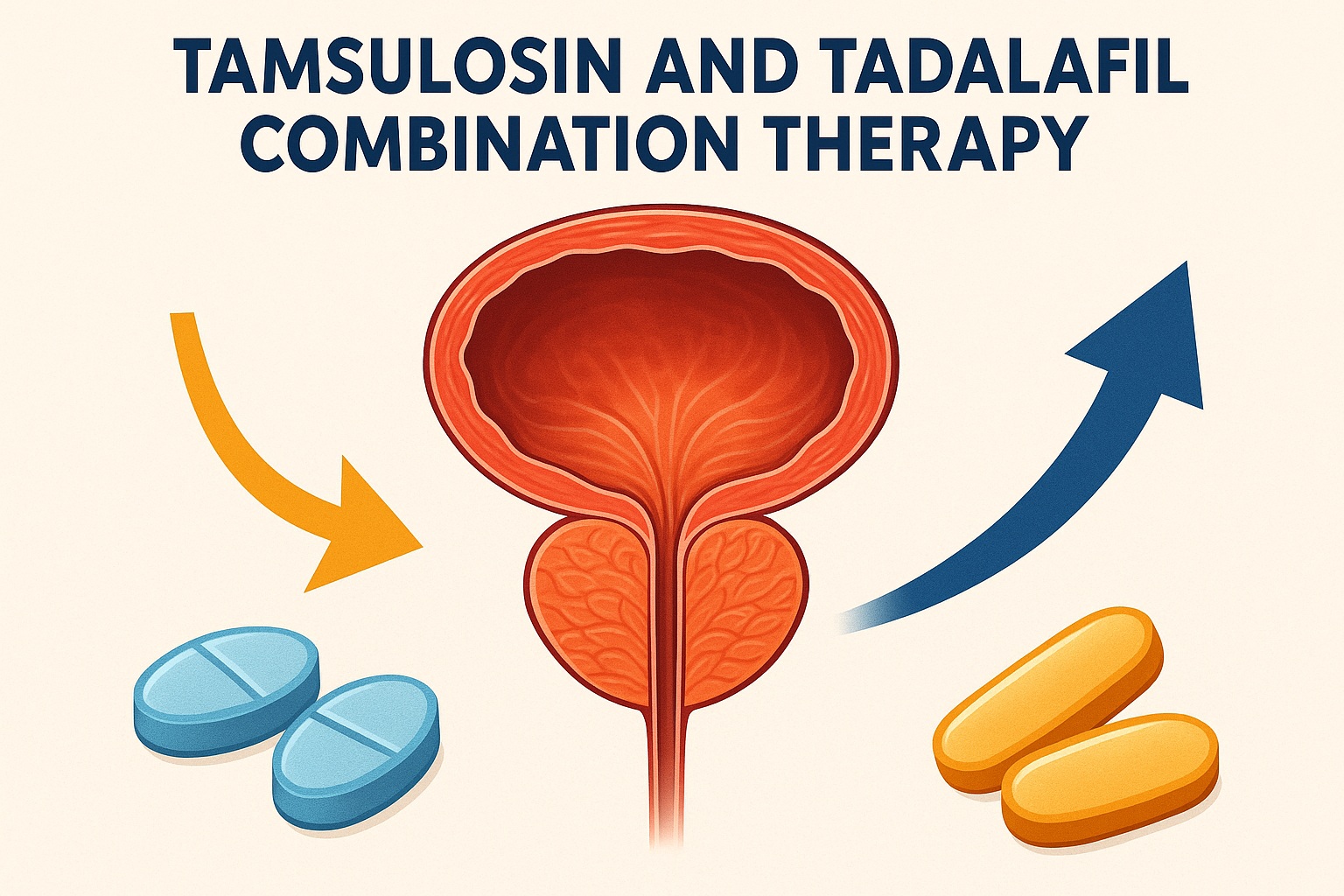
Standard pharmacological treatment typically relies on α1-adrenergic receptor antagonists, with tamsulosin as the prototypical drug in this class. By relaxing smooth muscle in the bladder neck and prostate, tamsulosin alleviates obstruction and reduces voiding symptoms. While effective, it often fails to address concurrent sexual dysfunction—an equally distressing complaint that accompanies LUTS in a significant proportion of patients.
In parallel, tadalafil, a phosphodiesterase type 5 (PDE5) inhibitor better known for treating erectile dysfunction (ED), has demonstrated benefits in relieving LUTS through mechanisms involving smooth muscle relaxation, improved endothelial function, and reduced afferent signaling from the bladder. The pharmacologic rationale for combining tamsulosin and tadalafil is therefore compelling: one drug targets urinary obstruction, the other enhances both erectile and urinary function.
Recent years have witnessed a surge in clinical trials examining this dual regimen. A comprehensive meta-analysis synthesizing evidence from 11 randomized controlled trials (RCTs), including 940 participants, provides the most rigorous evaluation to date. This article explores the findings of that analysis, the mechanisms underpinning the results, and the clinical implications for daily practice.
Pathophysiology of LUTS and ED: Shared Pathways
Understanding why tamsulosin and tadalafil might complement one another requires revisiting the pathophysiological overlap between LUTS and ED. Far from being independent entities, these conditions frequently co-occur and reinforce each other.
Firstly, autonomic dysregulation plays a central role. Increased adrenergic tone contributes to bladder neck and prostatic urethra constriction, while impaired nitric oxide–cGMP signaling limits penile vasodilation. Thus, one pathway drives obstruction, while the other undermines erection.
Secondly, endothelial dysfunction is a common denominator. Reduced nitric oxide bioavailability affects both the prostate and penile vasculature. It results in poor perfusion, impaired relaxation, and heightened irritative symptoms in the bladder.
Thirdly, chronic pelvic ischemia contributes to both conditions. Atherosclerotic changes limit blood supply to the bladder and prostate, exacerbating LUTS, while simultaneously diminishing cavernosal tissue oxygenation, worsening ED.
Lastly, psychological and lifestyle factors—including sedentary habits, obesity, and depression—tend to exacerbate both urinary and sexual symptoms, creating a vicious cycle.
Thus, it becomes evident that LUTS and ED are intertwined through vascular, neurologic, and hormonal pathways. Combining drugs that address these mechanisms makes pathophysiological sense.
Study Design and Methodological Rigor
The meta-analysis synthesized data from 11 RCTs published between 2013 and 2020. Collectively, these trials enrolled 940 male participants aged 45–80 years, all diagnosed with BPH and experiencing moderate to severe LUTS, with or without concomitant ED.
Intervention arms included:
- Tamsulosin monotherapy (0.4 mg daily).
- Tamsulosin 0.4 mg + tadalafil 5 mg daily.
Duration of follow-up: ranged from 8 to 12 weeks across studies.
Outcomes measured:
- International Prostate Symptom Score (IPSS): total and subscores (storage vs voiding).
- International Index of Erectile Function (IIEF): focusing on erectile domain.
- Quality of life (QoL) index.
- Maximum urinary flow rate (Qmax).
- Postvoid residual volume (PVR).
- Adverse events (AEs).
Risk of bias was assessed using Cochrane criteria, with most trials scoring high for randomization and blinding, though reporting bias was noted in smaller studies. Statistical analysis employed random-effects models due to heterogeneity, with mean difference (MD) for continuous variables and odds ratios (OR) for dichotomous outcomes.
Results: Efficacy Outcomes
Symptom Relief (IPSS)
The cornerstone of BPH evaluation, IPSS, demonstrated notable improvement in the combination therapy group.
- Pooled analysis: Combination reduced IPSS total scores by an additional 2.78 points compared to tamsulosin alone (95% CI −3.72 to −1.84, p < 0.001).
- Clinical relevance: While a 3-point change may seem modest, it is widely accepted as the threshold for meaningful patient-perceived improvement.
Subscore analysis indicated that both storage (frequency, urgency, nocturia) and voiding symptoms (weak stream, straining, intermittency) improved, though storage symptoms responded more robustly—likely reflecting tadalafil’s effect on bladder afferent signaling.
Erectile Function (IIEF)
As expected, the greatest divergence emerged in sexual outcomes.
- Mean IIEF improvement: Combination therapy improved erectile scores by +2.98 points over tamsulosin alone (95% CI 2.49 to 3.48, p < 0.001).
- Patients reported enhanced rigidity, longer maintenance, and greater confidence.
Notably, improvement was evident even in men without baseline ED, suggesting that tadalafil’s role extends beyond correcting dysfunction to optimizing sexual health.
Quality of Life (QoL)
Improvement in QoL scores paralleled symptom relief.
- Mean difference: −0.65 points in favor of combination therapy (95% CI −0.94 to −0.36, p < 0.001).
- Patients described greater satisfaction with daily activities, sleep, and sexual spontaneity.
Given the subjective but profound nature of QoL, this outcome may be the most compelling for patients.
Objective Measures (Qmax and PVR)
- Qmax: Combination therapy increased flow rates by +1.04 mL/s compared with tamsulosin alone. While statistically significant, clinicians may argue the real-world impact is limited unless accompanied by symptom relief.
- PVR: Residual urine volumes declined by −9.34 mL, reducing the risk of infection, bladder dysfunction, and further symptom aggravation.
Together, these objective measures reinforce the symptomatic improvements observed.
Results: Safety and Tolerability
No therapeutic gain comes without cost. The meta-analysis revealed a higher incidence of adverse events in the combination group.
- Overall risk: OR 1.59 (95% CI 1.27 to 2.00, p < 0.001).
- Most common events: headache, dyspepsia, back pain, and flushing.
- Withdrawals due to AEs: slightly more frequent in the combination group, though absolute rates remained under 10%.
Interestingly, the incidence of serious cardiovascular events was negligible, consistent with tadalafil’s established safety profile when prescribed judiciously. However, clinicians must remain cautious in patients taking nitrates or with unstable cardiac disease.
The trade-off is clear: combination therapy delivers greater symptomatic and functional benefits but at the cost of more frequent, albeit usually mild, side effects.
Clinical Interpretation
The results crystallize into several clinically relevant insights:
- Combination therapy is superior for symptom relief. Patients gain a measurable and meaningful reduction in LUTS compared with tamsulosin alone.
- Sexual function is restored. This is particularly important for men whose quality of life is eroded not just by urinary frequency but also by diminished sexual confidence.
- Quality of life improves globally. Patients perceive benefits in daily functioning, sleep quality, and relational satisfaction.
- Objective measures follow suit. Although improvements in Qmax and PVR are modest, they corroborate the symptomatic gains.
- Side effects are the balancing act. Headaches and dyspepsia are the price paid for improved erections and urinary comfort—a trade many patients find acceptable.
In practice, patient counseling should emphasize these trade-offs, allowing shared decision-making that aligns with individual priorities.
Limitations of Evidence
While the meta-analysis is rigorous, certain limitations deserve mention:
- Short follow-up: Most studies lasted only 8–12 weeks, leaving long-term efficacy and safety unaddressed.
- Heterogeneity: Variations in trial design, baseline severity, and concomitant conditions introduce variability.
- Absence of cost-effectiveness data: Combination therapy is more expensive than monotherapy, and economic evaluations are lacking.
- Limited generalizability: Most participants were relatively healthy aside from BPH; findings may differ in frail elderly populations with multiple comorbidities.
These limitations highlight the need for longer, real-world studies that track outcomes over years rather than months.
Practical Guidance for Clinicians
When should combination therapy be considered? Based on current evidence, the following principles may be useful:
- Men with moderate to severe LUTS who also report ED are prime candidates.
- Younger men, still sexually active, may particularly benefit from the dual action.
- Patients must be counseled regarding higher risk of side effects and monitored accordingly.
- Combination therapy is not ideal for those with low sexual activity, high sensitivity to headaches, or financial constraints.
Ultimately, the decision should rest on shared discussion, balancing efficacy with tolerability and personal priorities.
Conclusion
The meta-analysis of 11 RCTs encompassing 940 men provides robust evidence that tamsulosin plus tadalafil is more effective than tamsulosin monotherapy for treating LUTS associated with BPH. The dual regimen significantly reduces IPSS scores, improves erectile function, enhances quality of life, and modestly improves objective measures such as Qmax and PVR.
The price of this superiority is a higher incidence of mild side effects, which must be balanced against the clinical gains. For many men, particularly those who value both urinary and sexual health, the trade-off will be more than acceptable.
In the evolving landscape of BPH management, this combination represents not just another therapeutic option but a thoughtful integration of urinary and sexual medicine. It addresses the patient as a whole—urinary stream, erections, sleep, and satisfaction—rather than isolating one organ system from another.
FAQ
1. Is combination therapy with tamsulosin and tadalafil safe?
Yes, when prescribed appropriately. Most side effects are mild (headache, flushing, dyspepsia). Serious adverse events are rare but contraindications, such as concurrent nitrate use, must be respected.
2. Does combination therapy work better than tamsulosin alone?
Yes. Evidence shows superior reduction in urinary symptoms, better erectile function, and improved quality of life compared with tamsulosin monotherapy.
3. Who benefits most from the combination?
Men with moderate to severe LUTS who also suffer from erectile dysfunction are the best candidates. For men without ED or with low sexual activity, the benefits may be less compelling compared to monotherapy.
