

Introduction
Benign prostatic hyperplasia (BPH) remains one of the most prevalent urological disorders among aging men, with a prevalence exceeding 50% in men over the age of 60. The condition is not merely a benign enlargement of the prostate; it represents a progressive interplay between hormonal regulation, stromal and epithelial proliferation, and functional disturbances of the lower urinary tract. While life expectancy continues to increase globally, the burden of BPH-related lower urinary tract symptoms (LUTS) and the accompanying decline in sexual health are becoming ever more prominent in clinical practice.
Conventional pharmacotherapy relies heavily on two classes of drugs: α1-adrenergic blockers, which relax smooth muscle in the bladder neck and prostate, and 5α-reductase inhibitors (5-ARIs), such as dutasteride, which reduce dihydrotestosterone-driven prostatic growth. Dutasteride, in particular, has shown remarkable efficacy in reducing prostate volume and preventing acute urinary retention. Yet the drug is a double-edged sword: while it improves obstruction, it often worsens libido, ejaculatory function, and overall sexual satisfaction. For many patients, this trade-off undermines adherence and diminishes quality of life.
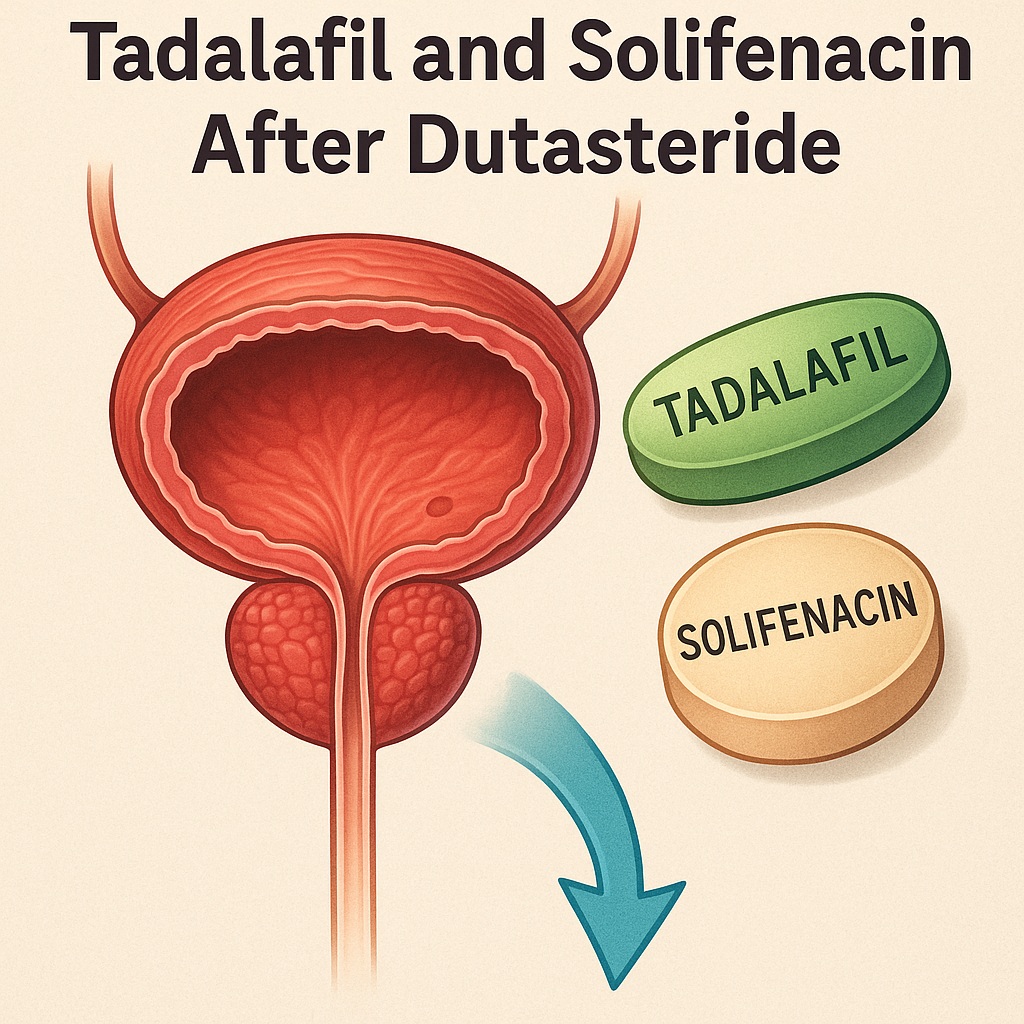
Enter tadalafil and solifenacin—an unlikely but scientifically sound combination. Tadalafil, a phosphodiesterase type 5 inhibitor (PDE5-I), is well known for restoring erectile function and has also been shown to improve LUTS by enhancing oxygenation and reducing afferent signaling in the bladder. Solifenacin, a selective M3 muscarinic receptor antagonist, is a cornerstone in the management of overactive bladder (OAB), directly addressing detrusor overactivity and urgency symptoms. The hypothesis is straightforward: when combined, these drugs may offset the drawbacks of dutasteride therapy, simultaneously restoring sexual health and resolving storage symptoms.
The study under discussion tested this hypothesis in 326 men, offering compelling evidence that combination therapy represents a rational and effective step forward in the post-dutasteride treatment landscape.
Pathophysiological Background
The connection between BPH, LUTS, and sexual dysfunction is far from coincidental. These conditions share overlapping pathways that reinforce one another.
Firstly, hormonal shifts dominate the pathogenesis of BPH. Increased activity of 5α-reductase promotes the accumulation of dihydrotestosterone, leading to prostatic hyperplasia. Dutasteride interrupts this process, but by lowering circulating and local androgen levels, it inadvertently dampens sexual drive and performance.
Secondly, autonomic nervous system dysregulation plays a critical role in both urinary and sexual function. Overactivation of muscarinic receptors in the bladder contributes to urgency and frequency, while impaired nitric oxide–cyclic GMP signaling limits erectile capacity.
Thirdly, vascular dysfunction adds another layer. Endothelial impairment reduces blood flow to pelvic organs, weakening both detrusor compliance and penile rigidity. PDE5 inhibition, therefore, holds dual potential—enhancing penile perfusion while improving bladder microcirculation.
Finally, psychological impact cannot be overlooked. Men coping with LUTS often suffer from disrupted sleep due to nocturia, social embarrassment from incontinence, and frustration from sexual decline. This psychosocial stress perpetuates a cycle of reduced quality of life and treatment dissatisfaction.
Thus, any therapy that seeks to improve only one dimension—either urinary or sexual—will likely fall short. An integrated approach is not merely ideal but necessary.
Study Design and Methods
The trial was conducted in Russia across two clinical sites and included 326 men aged over 50 years. All participants had undergone a 3–6 month course of dutasteride monotherapy and continued to report LUTS and sexual dysfunction. Entry criteria required mild obstructive symptoms (IPSS 8–19), evidence of detrusor overactivity (OABq-AT >8), and confirmed sexual dysfunction according to the International Index of Erectile Function (IIEF) and Men’s Sexual Health Questionnaire–Ejaculatory Dysfunction (MSHQ-EjD).
Participants were randomized into three groups:
- Group A (n=107): tadalafil 5 mg daily as monotherapy.
- Group B (n=107): tadalafil 5 mg daily + solifenacin 10 mg daily.
- Group C (n=112): tadalafil 5 mg daily + solifenacin 20 mg daily.
The study duration was 12 weeks. Evaluations included prostate ultrasound, uroflowmetry, PSA testing, voiding diaries, and serial administration of IIEF, MSHQ-EjD, IPSS, and OABq-AT questionnaires. Statistical rigor was maintained through ANOVA and nonparametric correlation analyses, with significance set at p<0.05.
Attrition was low, with only 9.5% discontinuing—most due to lack of effect or mild side effects such as dry mouth and vertigo. This highlights both the tolerability and practicality of the regimens.
Key Findings: Sexual Function
Results from the MSHQ-EjD and IIEF were consistent and clinically meaningful.
- Tadalafil monotherapy improved ejaculatory function, orgasmic function, and satisfaction scores significantly. However, libido and overall satisfaction remained largely unchanged, and erectile domain scores showed no significant gain—likely because baseline erectile function was already within normal range for many participants.
- Combination therapy with solifenacin produced dramatic improvements across the board. Orgasmic function, intercourse satisfaction, libido, and overall sexual satisfaction increased significantly in both Groups B and C. Patients reported not just improved performance but also renewed confidence and spontaneity in sexual activity.
Interestingly, doubling the dose of solifenacin did not yield proportionally greater sexual benefits. This suggests that standard-dose solifenacin may be sufficient when combined with tadalafil, avoiding the additional risk of side effects.
Key Findings: Lower Urinary Tract Symptoms
The contrast between monotherapy and combination therapy was even more striking for LUTS.
- In Group A (tadalafil alone), obstructive symptoms (weak stream, straining) showed slight improvement, but urgency, nocturia, and daytime frequency remained largely unchanged.
- In Groups B and C (tadalafil + solifenacin), storage symptoms plummeted. Urgency scores decreased from 2.9 to 1.1 in Group B and from 2.5 to 0.8 in Group C. Nocturia dropped by more than 60%, with many patients reporting uninterrupted sleep for the first time in years.
- Voiding diaries confirmed fewer urgency episodes and lower nocturnal frequency, while uroflowmetry revealed significantly reduced postvoid residual volume and improved average flow rates in the combination groups.
Again, doubling solifenacin did not confer additional advantages beyond the standard dose, suggesting a ceiling effect for detrusor inhibition.
Clinical Implications
The implications of this study extend well beyond academic curiosity. They provide a pragmatic roadmap for clinicians managing men with BPH who remain symptomatic after dutasteride.
- Sexual function can be salvaged. Dutasteride’s negative impact on libido and satisfaction is not irreversible. PDE5 inhibition restores erectile physiology, while the synergistic effect with solifenacin improves the broader spectrum of sexual health.
- Storage symptoms deserve equal attention. Many men prioritize relief from nocturia and urgency over stronger urine flow. Solifenacin, when paired with tadalafil, delivers meaningful improvements in these domains.
- More is not always better. The lack of superiority of 20 mg solifenacin over 10 mg emphasizes the importance of dose optimization. Higher doses may invite unnecessary side effects without commensurate benefit.
- Patient adherence improves with symptom relief. By addressing both urinary and sexual complaints, combination therapy enhances overall satisfaction, reducing the likelihood of treatment discontinuation—a common issue in BPH management.
Limitations and Future Directions
The study, while robust, was not without limitations. Its duration was limited to three months, leaving unanswered questions about long-term sustainability of benefits and adherence. Cognitive side effects of prolonged high-dose solifenacin, especially in elderly men, remain a concern. Furthermore, the absence of a group treated with solifenacin monotherapy prevents definitive conclusions about its independent role in restoring function post-dutasteride.
Future research should explore:
- Long-term efficacy and safety of combination therapy beyond 12 weeks.
- Comparative effectiveness of solifenacin versus other antimuscarinics or β3-agonists.
- Partner-reported outcomes, which would provide a more holistic view of treatment impact.
- Cost-effectiveness analyses, given the chronic nature of BPH therapy.
Conclusion
This study offers a reassuring message for both clinicians and patients: life after dutasteride does not have to mean diminished sexual satisfaction or unrelenting nocturia. Tadalafil monotherapy restores aspects of sexual function, but its combination with solifenacin achieves far more—relieving urgency, reducing nocturia, improving ejaculatory and orgasmic functions, and restoring overall quality of life.
For practicing urologists, the lesson is clear: consider combination therapy early in patients who remain symptomatic after 5-ARI treatment. For patients, the message is hopeful: relief from both urinary and sexual dysfunction is achievable, and sometimes, two drugs are indeed better than one.
FAQ
1. Why not continue with dutasteride alone?
While dutasteride reduces prostate size and obstruction, it often worsens sexual function and fails to fully resolve storage symptoms such as urgency and nocturia. Combination therapy addresses these residual problems.
2. Does higher solifenacin dosing work better?
Not significantly. Both 10 mg and 20 mg doses improved symptoms when combined with tadalafil, but the higher dose added side effects without major additional benefit.
3. Can tadalafil alone solve both urinary and sexual issues?
Tadalafil improves sexual satisfaction and some voiding parameters, but it does not adequately treat storage symptoms like nocturia. For complete relief, adding solifenacin is more effective.
