

Introduction
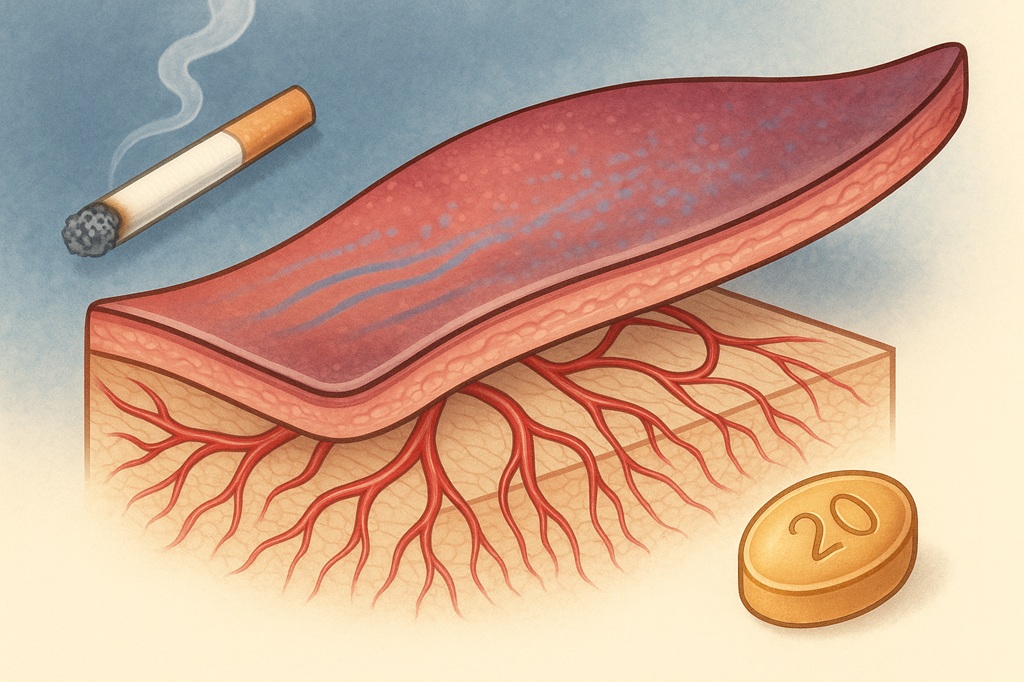
The survival of cutaneous flaps and grafts remains one of the most critical determinants of success in reconstructive dermatologic and plastic surgery. Despite advances in surgical technique, ischemia-induced flap necrosis continues to challenge even the most skilled surgeons. Among the well-documented risk factors for flap compromise, smoking stands out as both common and highly detrimental. Nicotine-induced vasoconstriction, carbon monoxide–mediated hypoxia, and impaired platelet function create a microenvironment that is inherently hostile to tissue survival. Surgeons who have labored over delicate nasal or facial flaps know the frustration of watching distal tissue edges turn dusky and necrotic within days of an otherwise flawless operation.
Traditionally, prevention of flap ischemia has relied on meticulous technique, tension-free closure, and judicious postoperative monitoring. Adjunctive pharmacotherapy, however, has remained limited. In recent years, phosphodiesterase-5 (PDE5) inhibitors—best known for their role in treating erectile dysfunction and pulmonary hypertension—have emerged as unexpected allies in this field. Their vasodilatory effects, mediated by sustained cyclic guanosine monophosphate (cGMP) signaling, translate into improved peripheral circulation and reduced platelet aggregation. Tadalafil, in particular, with its prolonged half-life and sustained hemodynamic effects, appears well-suited for maintaining blood flow in compromised flaps.
The case series under discussion explores this off-label application: using tadalafil to salvage cutaneous flaps at risk of ischemia in smokers. Two illustrative cases demonstrate how a medication originally developed for entirely different indications may hold promise as a practical intervention in reconstructive surgery. Beyond the anecdotal, this report also builds on a growing body of experimental and clinical evidence suggesting PDE5 inhibitors could represent a new pharmacologic frontier in flap survival.
Pathophysiology of Flap Ischemia and the Burden of Smoking
Flap survival depends fundamentally on adequate perfusion. After transfer, the vascular supply must adapt to altered anatomy, often relying initially on tenuous connections before neovascularization consolidates. Several insults can compromise this fragile balance:
- Arterial insufficiency, which limits inflow
- Venous congestion, which impairs outflow
- Excessive tension, causing mechanical obstruction
- External pressure, compressing delicate vasculature
Among these, smoking exerts a particularly pernicious influence. Nicotine is a potent vasoconstrictor, narrowing peripheral arteries and reducing oxygen delivery. Carbon monoxide binds hemoglobin with greater affinity than oxygen, producing tissue hypoxia. Smoking also disrupts normal platelet and endothelial function, increasing the risk of thrombosis in microvessels. The result is a hostile milieu where even meticulously constructed flaps are predisposed to ischemic failure.
For patients unwilling or unable to abstain from tobacco, surgeons are left with limited strategies. Here, pharmacologic modulation of microcirculation becomes an attractive proposition. If vasoconstriction and hypoxia are the culprits, could vasodilators such as PDE5 inhibitors tip the balance back toward tissue survival? The logic is compelling, and early clinical experiences suggest it may indeed be more than theoretical.
Mechanism of Action of Tadalafil in the Context of Flap Survival
Tadalafil belongs to the PDE5 inhibitor class, which also includes sildenafil, vardenafil, and udenafil. These drugs block the breakdown of cGMP in vascular smooth muscle cells. Elevated cGMP levels promote relaxation of smooth muscle, leading to vasodilation and enhanced blood flow. Additionally, PDE5 inhibition reduces platelet aggregation, a feature particularly relevant in the context of flap microcirculation where microthrombi can prove devastating.
Compared with its counterparts, tadalafil is notable for its pharmacokinetics. With a half-life of approximately 17.5 hours, it provides sustained vasodilatory effects for up to 36 hours, far outlasting sildenafil’s 4-hour profile. This extended duration makes tadalafil particularly attractive in postoperative settings, where continuous perfusion support is desired. The drug’s oral bioavailability and tolerability further enhance its practicality.
While originally approved for erectile dysfunction and later pulmonary arterial hypertension, tadalafil’s hemodynamic properties logically extend to conditions of compromised peripheral perfusion. Laboratory studies in animal models have demonstrated improved flap survival with PDE5 inhibitors, and small clinical experiences have begun to confirm similar benefits in humans. The present case series adds to this evolving narrative, focusing on smokers undergoing complex nasal reconstruction.
Clinical Case Illustrations
Case 1: Salvaging a Melolabial Interpolation Flap
An 83-year-old woman with a history of daily tobacco use and prior lymphoma underwent excision of basal cell carcinoma on the left nasal ala. Reconstruction was achieved with a cartilage graft and melolabial interpolation flap. On postoperative day (POD) 3, the distal pedicle showed ominous signs: pallor, ischemia, and early necrosis. Rather than resigning the tissue to inevitable loss, the surgical team initiated tadalafil at 5 mg daily. Within three days, perfusion visibly improved, with better coloration and viability. Tadalafil was reintroduced during flap takedown, and by POD 90, the patient demonstrated complete flap survival with excellent cosmetic and functional outcomes. Notably, no adverse effects from the medication were reported.
Case 2: Restoring Viability in a Paramedian Forehead Flap
A 63-year-old woman, also a chronic smoker, underwent complex nasal reconstruction involving a paramedian forehead flap, cartilage graft, and melolabial interpolation flap after excision of nodular basal cell carcinoma. On POD 3, the distal paramedian flap appeared dusky and pale—an early warning of impending ischemia. Tadalafil 5 mg daily was initiated for three days. By POD 7, coloration improved significantly, indicating restored perfusion. At flap takedown on POD 30, tissue survival was complete, with both cosmetic and functional success. Again, the patient tolerated tadalafil without adverse events.
These two clinical vignettes illustrate a consistent pattern: in high-risk smokers with early ischemic changes, tadalafil administration appeared to reverse flap compromise and secure long-term survival. While anecdotal, the reproducibility across distinct cases adds weight to the hypothesis that PDE5 inhibition can meaningfully augment postoperative outcomes.
Broader Evidence Base and Experimental Foundations
The use of PDE5 inhibitors in reconstructive surgery is not entirely novel. Preclinical studies in animal models have long suggested their potential. In rats, both systemic and local sildenafil administration improved random skin flap survival. Tadalafil, with its longer duration, demonstrated superior outcomes in axial-pattern flaps. Comparative work has also shown vardenafil to be effective, though tadalafil frequently outperformed its peers in terms of perfusion support.
Human data remain limited but promising. In 2014, Pfaff and colleagues reported improved outcomes in smokers undergoing facial reconstruction when sildenafil was administered postoperatively. This aligns with the mechanistic rationale that PDE5 inhibitors can counteract nicotine-induced vasoconstriction. The current case series extends this line of inquiry, suggesting that tadalafil, given its pharmacological advantages, may be even better suited for such applications.
Nevertheless, clinical adoption has been slow, largely due to the off-label nature of this use and concerns about potential side effects. More robust prospective trials will be necessary to establish efficacy, optimal dosing regimens, and safety profiles before PDE5 inhibitors can be incorporated into formal postoperative protocols.
Safety Considerations and Potential Risks
No pharmacologic intervention is without risks, and tadalafil is no exception. Common side effects include headache, dyspepsia, myalgia, rhinitis, and flushing. These are typically mild and self-limited. More concerning are contraindications: patients with significant hypotension, severe heart failure, or those on nitrates or multiple antihypertensives may be at risk of dangerous interactions. In the postoperative setting, an additional theoretical concern is bleeding. By promoting vasodilation, tadalafil could potentially exacerbate postoperative hematoma formation, a complication that can itself compromise flap survival.
In the presented cases, no adverse effects were observed, which is reassuring. However, caution must guide broader application. Careful patient selection and vigilant monitoring are essential. For otherwise healthy patients with high ischemic risk—such as smokers undergoing nasal reconstruction—tadalafil may provide a favorable risk-benefit balance. In frailer patients with cardiovascular comorbidities, prudence dictates restraint until more evidence accumulates.
Practical Implications for Clinical Practice
The translation of experimental insights into practical tools is the essence of medical progress. What do these cases suggest for surgeons at the bedside? Several practical implications emerge:
- Early Intervention Matters: Both cases highlight that tadalafil was introduced at the first signs of ischemia. Prompt initiation may maximize the chance of reversing tissue compromise before necrosis becomes irreversible.
- Smokers May Benefit Most: Given nicotine’s vasoconstrictive effects, smokers represent a subgroup where pharmacologic vasodilation could meaningfully offset risk. For these patients, tadalafil may serve as a valuable adjunct, especially when smoking cessation proves elusive.
- Adjunct, Not Substitute: No medication can replace surgical fundamentals. Flaps must still be designed with respect for vascular anatomy, executed with precision, and monitored closely. Tadalafil may serve as a safety net, not a license for technical laxity.
- Short-Course Use Appears Sufficient: In both cases, only brief courses of tadalafil—3 days at initiation and sometimes repeated at takedown—were sufficient. This suggests that prolonged therapy may not be necessary, reducing cumulative risk.
Together, these insights sketch the contours of a potential new practice pattern: selective, short-term use of tadalafil in high-risk patients with early ischemic signs, particularly smokers undergoing nasal or facial reconstruction.
Limitations and the Path Forward
While compelling, the evidence remains preliminary. Case series inherently lack control groups, making it impossible to rule out spontaneous recovery or other confounders. The number of patients is small, and selection bias may influence outcomes. Furthermore, the absence of long-term safety monitoring limits conclusions about delayed complications.
Future research should aim to address these gaps. Randomized controlled trials comparing tadalafil with placebo in high-risk flap patients would provide definitive evidence. Studies could also explore optimal dosing (daily low-dose versus higher short-term regimens), timing (preoperative prophylaxis versus postoperative rescue), and comparative efficacy among different PDE5 inhibitors. Additional pharmacodynamic studies might clarify the relative importance of vasodilation versus anti-platelet effects in promoting flap survival.
Despite limitations, the cases described represent important proof-of-concept demonstrations. They show that even in real-world, high-risk smokers, tadalafil can be safely deployed to rescue compromised flaps. This should encourage further investigation, both in dermatologic surgery and in broader reconstructive contexts.
Conclusion
The viability of cutaneous flaps remains a cornerstone of reconstructive success, yet smoking continues to undermine outcomes through ischemia and necrosis. PDE5 inhibitors, particularly tadalafil, offer a pharmacologic avenue to counteract these insults. By promoting vasodilation and reducing platelet aggregation, tadalafil supports microvascular perfusion in compromised flaps. The cases presented demonstrate successful salvage of ischemic nasal flaps in smokers, yielding excellent functional and cosmetic outcomes without adverse effects.
While evidence remains preliminary, the logical pharmacologic rationale, consistency with preclinical data, and reproducible clinical benefits all point toward tadalafil as a promising adjunct in flap surgery. Surgeons should remain cautious, balancing potential benefits against risks, but also remain open to innovation. With further study, tadalafil and its class may one day occupy a routine place in the reconstructive surgeon’s pharmacologic toolbox, transforming flap rescue from a matter of chance to one of predictable intervention.
FAQ
1. Can tadalafil really improve flap survival in smokers?
Yes, early case reports and experimental studies suggest that tadalafil enhances perfusion and reduces ischemia in compromised flaps, particularly in smokers where nicotine-induced vasoconstriction is a key problem. While not yet standard practice, it shows promising potential as an adjunct therapy.
2. Is tadalafil safe to use after surgery?
In healthy patients without cardiovascular contraindications, short courses of tadalafil appear well tolerated, with only mild side effects reported. However, caution is required in patients with heart disease, hypotension, or those taking nitrates, as interactions can be dangerous.
3. Should tadalafil be used prophylactically in all flap surgeries?
At present, no. Evidence is too limited to support routine prophylactic use. It may be most useful in high-risk patients—particularly smokers or those showing early ischemic changes. Larger controlled studies are needed before prophylactic protocols can be recommended.
