

Introduction
Cognitive decline is one of the most feared consequences of aging, not only for patients but also for clinicians who face the limits of therapeutic options. Among the various contributors to dementia, cerebral small vessel disease (SVD) stands out as both common and devastating. It accounts for a significant fraction of vascular cognitive impairment (VCI) and is frequently observed alongside Alzheimer’s pathology, accelerating the road to dementia.
Despite the growing recognition of SVD as a driver of cognitive decline, therapeutic options remain sparse. Traditional risk factor management—blood pressure control, lipid regulation, and antiplatelet therapy—offers modest benefit. In this context, drug repurposing provides a tantalizing shortcut: taking medications developed for other indications and testing their potential in cerebrovascular and cognitive disorders.
One class of drugs, phosphodiesterase-5 inhibitors (PDE5i), has attracted attention for such repurposing. Originally celebrated for treating erectile dysfunction and pulmonary hypertension, these drugs—including sildenafil, vardenafil, and tadalafil—exert their effects by enhancing nitric oxide (NO)–cyclic guanosine monophosphate (cGMP) signaling. This pathway is critical not only for vascular relaxation but also for synaptic plasticity and cognitive processes.
The PASTIS trial (Perfusion by Arterial Spin Labelling Following Single Dose Tadalafil in Small Vessel Disease) set out to explore whether a single dose of tadalafil could increase cerebral blood flow and, as a secondary outcome, improve cognitive performance in older adults with SVD. The results were sobering but instructive: no significant cognitive benefits were observed after a single administration, though subtle trends emerged. This article will explore the trial design, findings, and implications for future research on PDE5 inhibitors as candidates in cognitive medicine.
The Rationale: Why Tadalafil in Small Vessel Disease?
The choice of tadalafil was neither whimsical nor accidental. Among PDE5 inhibitors, tadalafil offers several pharmacological advantages. Its long half-life (~16 hours) ensures sustained systemic exposure, potentially relevant for cerebrovascular modulation. Preclinical studies in rodents and non-human primates have shown that tadalafil can penetrate the blood-brain barrier, raising hopes that it might influence neural processes directly.
Moreover, the rationale was reinforced by preclinical observations:
- In rodents, acute sildenafil improved executive function in tasks impaired by nitric oxide synthase inhibition.
- In animal models of Alzheimer’s disease, chronic PDE5 inhibition enhanced synaptic protein expression and cognitive outcomes.
- Observational human data even suggested that PDE5i exposure might correlate with a reduced risk of dementia.
If nitric oxide–cGMP signaling is pivotal for both vascular health and synaptic function, then enhancing this pathway pharmacologically might theoretically counteract SVD-related cognitive impairment. Tadalafil’s safety record in other populations further bolstered the case for a clinical trial.
Study Design: A Double-Blind Experiment in Older Adults
The PASTIS trial was a randomized, double-blind, placebo-controlled, cross-over study. Each participant received both a 20 mg tadalafil dose and a placebo on separate occasions, at least seven days apart, in randomized order. This design allowed each patient to serve as their own control, minimizing variability due to individual baseline differences.
Participants
- 65 individuals were recruited, and 55 completed the protocol.
- Mean age was 66.8 years, spanning 52–87 years.
- All had symptomatic cerebral SVD, evidenced by prior stroke or transient ischemic attack, white matter hyperintensities, or lacunes on MRI.
- None had diagnosed dementia, but many had Montreal Cognitive Assessment (MoCA) scores below the threshold of 26, indicating mild cognitive impairment.
Cognitive Assessments
The neuropsychological test battery was designed to capture domains particularly relevant to SVD:
- Attention and processing speed (CANTAB reaction time, Speed of Information Processing test).
- Working memory (Digit Span Forward and Backward).
- Executive function and verbal fluency (Semantic fluency).
Tests were administered before and after dosing, with four parallel versions used to minimize practice effects.
Statistical Analysis
Treatment effects were analyzed using linear mixed models, comparing changes after tadalafil with changes after placebo. No correction for multiple comparisons was applied, given the exploratory nature of secondary outcomes.
Results: The Cognitive Impact of a Single Tadalafil Dose
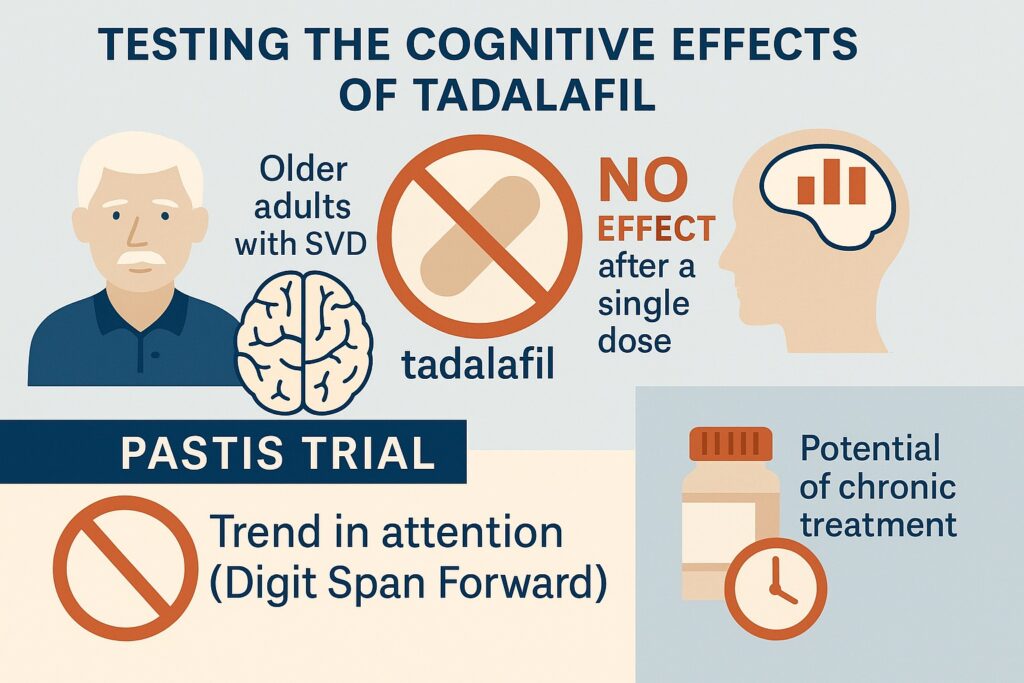
The headline result was clear: no statistically significant cognitive improvements were detected following tadalafil compared with placebo. Across measures of reaction time, information processing, working memory, and fluency, treatment effects were neutral.
Yet, one finding stood out—a trend toward improvement in Digit Span Forward (treatment effect 0.37, p = 0.0521). While not conventionally significant, this subtle signal hints that tadalafil might transiently enhance attentional capacity. Curiously, no such effect was observed in Digit Span Backward, which demands higher executive control.
No carry-over effects were identified, and no serious adverse events were attributed to tadalafil. Minor side effects were consistent with the known safety profile of PDE5 inhibitors.
The interpretation, therefore, must balance caution with curiosity: while the study was negative overall, the glimmer of effect in simple attention invites further exploration.
Why No Significant Effect? The Role of Trial Design and Biology
The absence of significant results may reflect several interacting factors.
First, the dosing paradigm: a single administration of tadalafil is unlikely to remodel cerebrovascular function or synaptic plasticity in a measurable way. Most preclinical studies demonstrating cognitive benefits relied on chronic exposure over weeks. Cognitive decline in SVD is gradual, and any pharmacological rescue would plausibly require sustained treatment.
Second, the test sensitivity: while reaction times and fluency tests are established measures, they may not capture subtle, short-term neurophysiological changes. Emerging digital cognitive platforms or advanced neuroimaging biomarkers might be more sensitive endpoints in future trials.
Third, disease stage and heterogeneity: participants had symptomatic SVD but no overt dementia. This heterogeneity complicates detection of small drug effects, as cognitive reserve and vascular pathology vary widely between individuals.
Finally, sample size and power: with 55 completers, the trial was powered for cerebral blood flow outcomes, not for detecting modest cognitive changes. A larger cohort might have clarified whether the Digit Span Forward trend represents noise or a genuine pharmacological effect.
Tadalafil Beyond the PASTIS Trial: Evidence from Other Studies
While PASTIS itself was neutral, the broader literature on PDE5 inhibitors and cognition provides a patchwork of optimism.
- Animal studies: Chronic treatment with sildenafil, vardenafil, or tadalafil improved memory performance and altered synaptic protein expression. These effects were linked to enhanced hippocampal plasticity and reduced neuroinflammation.
- Human studies: Small pilot trials reported cognitive improvements with PDE5i in patients with erectile dysfunction or benign prostatic hyperplasia, often in attention and processing speed. However, other randomized studies in stroke survivors or healthy volunteers found no acute cognitive benefit.
- Epidemiological data: Large real-world datasets suggest that PDE5i use correlates with reduced dementia incidence. While correlation does not equal causation, such signals provide rationale for more rigorous prospective testing.
The emerging theme is that chronic administration rather than single dosing is more likely to yield measurable cognitive effects, perhaps by promoting synaptic resilience or mitigating vascular injury.
Implications for Future Research
The PASTIS trial underscores both the promise and the challenges of testing PDE5 inhibitors in cognitive disorders. Key lessons for future studies include:
- Longer treatment duration is essential to detect clinically relevant effects.
- Larger, more diverse cohorts will improve statistical power and generalizability.
- Integration of imaging biomarkers (such as perfusion MRI, white matter integrity, and functional connectivity) may capture drug effects invisible to neuropsychological tests alone.
- Combinatorial strategies—for example, PDE5 inhibitors alongside established vascular risk management—may maximize therapeutic impact.
The potential payoff is considerable. If PDE5 inhibitors can preserve cognitive function by improving microvascular health and synaptic signaling, they could join the therapeutic arsenal against vascular dementia, one of the most pressing unmet needs in neurology.
Conclusion
The PASTIS trial found no significant cognitive benefits from a single 20 mg dose of tadalafil in older adults with cerebral small vessel disease. While the results were neutral, the study provides crucial guidance: cognitive enhancement is unlikely to emerge from one-off dosing, but subtle signals—such as the trend in attentional tasks—encourage further exploration under conditions of sustained treatment.
Tadalafil and its pharmacological cousins may yet have a role in the prevention or slowing of vascular cognitive impairment. For now, the message is cautious but not discouraging: sometimes science advances not by dramatic breakthroughs but by carefully ruling out what does not work, setting the stage for better-designed studies to come.
FAQ
1. Does tadalafil improve memory or thinking in older adults with small vessel disease?
Not after a single dose. The PASTIS trial found no significant cognitive improvements, though there was a hint of enhanced simple attention. Chronic treatment may still hold potential, but further studies are needed.
2. Why test an erectile dysfunction drug for dementia risk?
Because tadalafil enhances nitric oxide–cGMP signaling, which supports both vascular function and synaptic plasticity. Since small vessel disease damages brain microcirculation, PDE5 inhibitors are attractive candidates for repurposing in cognitive disorders.
3. What are the next steps in research?
Future studies should test longer-term tadalafil treatment in larger populations, with sensitive imaging and cognitive endpoints. The goal would be to determine whether chronic PDE5 inhibition can slow or prevent vascular cognitive impairment.
